
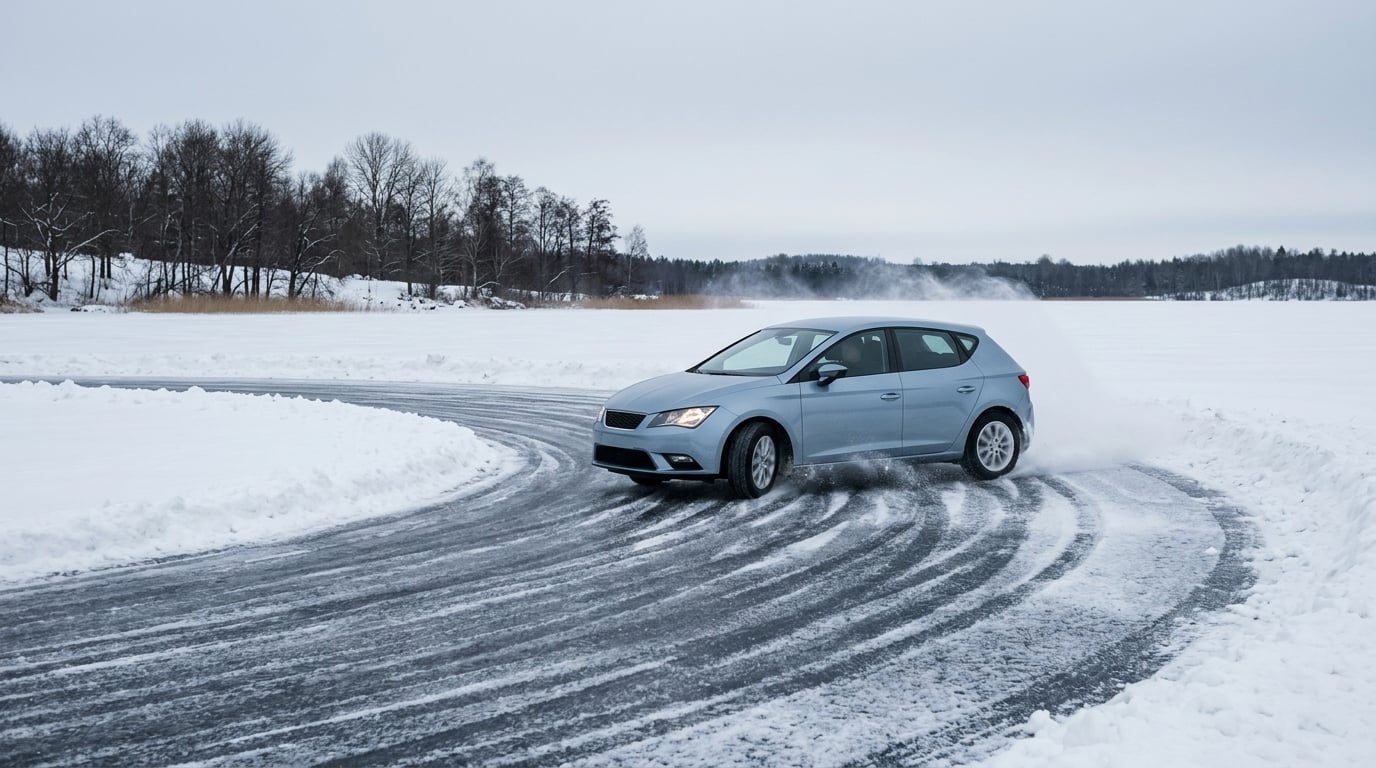
Ice racing is motorsport held on frozen lakes and prepared ice tracks, where cars run on winter or studded tires and slide sideways through nearly every corner. The whole discipline is about low-grip car control. Most beginners start in a normal road car with snow tires, spend a season learning to hold a slide, and never need to modify anything beyond the tires and safety gear.
Everything below is aimed at someone who has never done it. If you take one idea from this guide, make it this one: ice racing is a skill sport, and the fastest way to learn it safely is an instructor-led session on an inspected surface, not a weekend experiment on a frozen pond.
Table of Contents
- The Short Version
- What Is Ice Racing?
- How Ice Racing Differs from Normal Driving
- How to Prepare Safely for Your First Event
- What Equipment Does a Beginner Need?
- Which Car Is Best for Learning on Ice?
- What Basic Technique Should Beginners Learn?
- How Should a Beginner Practice Without Taking Unnecessary Risks?
- How Are Beginner Ice-Racing Events Run?
- What Common Mistakes Should New Drivers Avoid?
- Frequently Asked Questions
- Can a beginner use a rear-wheel-drive car for ice racing?
- Should I use winter tires or studded tires for my first ice-racing event?
- Is all-wheel drive better for learning to ice race?
- How cold does it need to be for safe ice-racing practice?
- What happens during a beginner’s first timed ice-racing run?
- How do I know when I am driving on unsafe ice?
- Start With One Safe, Instructor-Led Session
The Short Version
- Ice racing happens on frozen lakes or purpose-built ice tracks, usually between December and March in the northern hemisphere.
- You need winter tires, a certified helmet, a proper harness, and a car that is mechanically sound and easy to drive slowly.
- Speed comes from carrying momentum through a slide, not from braking hard. Smoothness beats aggression every single lap.
- Club entry is volunteer-run, low-stakes, and far friendlier than a sanctioning body would have you believe. The usual prizes are a trophy and a grin.
- Nobody starts fast. Race directors expect first-timers, and the format is usually a time trial or a short novice group rather than a full-contact race.
What Is Ice Racing?
Ice racing is a form of motorsport run on a frozen surface, most often a plowed oval or course cut into a frozen lake. Because the contact between tire and ice is so thin, the car is sliding nearly all the time. Drivers steer the slide rather than trying to avoid it, and the sport rewards patience far more than bravery.
It is a real sport, and an organized one. There are governing bodies, national championships, and professional events like the Trophée Andros in France, which draws top drivers from all over Europe. But the beginner does not enter there. Beginner ice racing happens at club level with volunteer-run events, and the whole thing is deliberately low-key.
Three formats cover almost everything a beginner will encounter:
- Time trials. You get a set number of laps against the clock, alone or in small groups. This is the most common first-event format and the least pressure. You are scored on time, nothing else.
- Novice or gymkhana courses. A coned course of gates, slaloms, and braking zones. It looks less like racing and more like a driving test, which is exactly why a lot of clubs run it as the entry-level event.
- Wheel-to-wheel racing. Actual side-by-side competition over multiple heats, usually on an oval. Novice heats are slower, wider, and have rules about passing and contact, but this is the step up once you are quick and consistent.
Two more things separate ice racing from everything else. First, the track has to be certified: a club will drill, measure, and refuse to open the ice if it is not thick enough. Second, ice racing is a winter-season commitment, not a one-off. Clubs alternate ice weekends with road rally or autox weekends, so you sign up for a few months of Saturdays, not a single afternoon.
It is also not the same as driving carefully on a snowy road, and it is nothing like ice fishing. On a public road you are managing a hazard. In a race you are managing a line, and the difference in how you treat the wheel is enormous.
How Ice Racing Differs from Normal Driving
The single biggest adjustment is that the tires do not tell you what the front end is doing. On pavement, a small steering input produces a predictable response. On ice, the same input might grip, wash, or do nothing at all depending on the surface under that specific patch of rubber.
Here is what actually changes:
- Traction loss happens without warning. You can be gripped, then not gripped, across a few feet of ice. Watch the surface, not the speedometer.
- Braking distances balloon. A firm brake on smooth ice can take you several times the distance a normal road would need, and steering while braking makes it worse. Plan your entry to the corner, not the corner itself.
- Weight transfer dominates. Braking loads the front tires and unloads the rear, which is how you get a slide started, deliberately or not.
- Steering response lags. Because the front tires can only push against so much grip, the car will often continue on its old path for a moment after you turn the wheel. You have to lead the corner with your eyes and correct later.
- Visibility changes fast. A polished patch, a strip of hardpack slush, or a snowbank kicked up by the car ahead all look different from the racing line one lap earlier.
This is why ordinary road-racing technique does not transfer. Trail braking, aggressive trail-throttle transitions, and abrupt inputs that work on a track with 100 percent grip will put a beginner into a snowbank on the first lap. Everything on ice is subtractive: less steering, less brake, less throttle, more often.
How to Prepare Safely for Your First Event
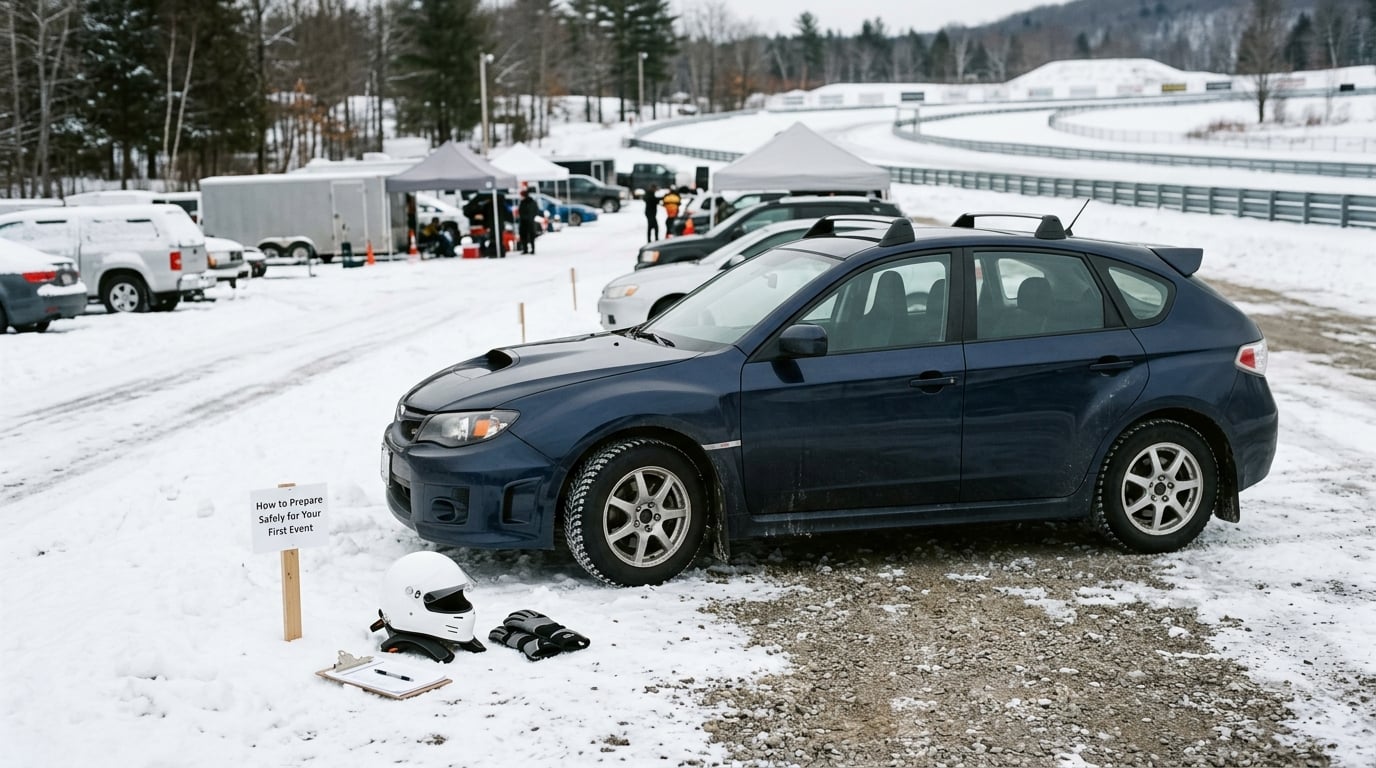
Most first-event disasters are logistics, not driving. A car without a helmet, a driver who shows up after the ice has been closed for the day, a thin-jacketed person standing on a frozen lake for four hours: all avoidable.
Run through this list the week before:
- Confirm the event is actually happening. Warm winters mean clubs cancel or move dates at short notice. Check the club’s site and any group chat in the days before you drive out, not the night before.
- Verify your class and car eligibility. Novice classes usually want a sound street car, a current inspection, and sometimes a membership and a safety inspection. Read the rules before you buy anything.
- Get the ice report and conditions. Organized events tell you thickness and surface state. If you are practicing on your own, you need an inspected surface, not a hopeful one.
- Sort your equipment early. A certified helmet, eye protection, gloves, and a fire-resistant base layer are not optional. See the next section.
- Rehearse the car before the day. Know where your pedal adjusters are, and take a slow lap in the parking lot so the clutch bite and brake feel are not a surprise.
- Plan the cold and the day. Layer up, bring a thermos and something to eat, park where you can leave without blocking the return lane, and arrange a ride home if you will be drinking anything at the track.
- Plan recovery. If there is any chance you go off and damage something, know how a club handles a tow and whether your insurance covers track days. Ask before you sign up.
Acclimatize to the cold before the season starts. Handling a car on ice in hard gloves at 15 below is a coordination problem before it is a driving one. Do your first sessions in warmer conditions and thicker gloves, then work down to race gear.
What Equipment Does a Beginner Need?
Beginner safety equipment splits cleanly into two groups. Required gear protects you in a real failure: a car off the track, a roll, a fire. Optional gear makes ice racing more comfortable or more effective, and you can add it over a season rather than in one purchase.
| Item | Required? | What to look for | What it does for you |
|---|---|---|---|
| Certified helmet | Yes | Current motorsport certification, correct size, no old impact damage | The only thing standing between a roll and a serious head injury |
| Eye protection | Yes | Full-face visor or a separate goggle layer | Ice chips, snow, and cold wind at speed |
| Harness | Class dependent | Proper five- or six-point harness, current date stamp | Holds you in the seat when the car is sliding hard |
| Insulated gloves | Yes | Thin enough to feel the wheel, warm enough for a long session | Cold hands lose fine steering feel within minutes |
| Fire-resistant clothing | Recommended | Underlayer and outer layer suited to a four-hour cold session | Buys time if the car catches fire |
| Winter boots | Recommended | Insulated, waterproof, not bulky | Warm feet mean calm hands and better clutch control |
| Roll cage | Class dependent | Built to the class ruleset, professionally welded | Required for wheel-to-wheel classes, not for a novice time trial |
| Balaclava and spare layers | Optional but smart | A dry change of base layer in the car | A damp base layer ends your session early |
Two details catch newcomers out. First, a helmet is not a winter hat: it fits differently, sits lower, and takes a few laps to feel normal. Second, if your club has a rule about fire extinguishers, brakes, or a cut-off switch, treat it as part of the equipment list, not a formality. A track car that cannot be stopped from the pit lane is not track-ready.
Which Car Is Best for Learning on Ice?
For learning, the best ice racing car is the boring one you already own. Predictable handling, low repair risk, and a car you have driven for years beat horsepower every time, because on ice you are fighting the surface, not chasing a lap time.
| Car type | Why it works for beginners | Watch out for |
|---|---|---|
| Compact hatchback | Light, cheap to fix, easy to control at low speed | Loud cabin and very little insulation in a modified car |
| All-wheel-drive compact | Easy to bring to a halt, forgiving, good for a first season | Teaches you less about throttle control; heavier nose |
| Rear-wheel-drive sedan | Direct, communicative, the classic ice training platform | Oversteer arrives without much warning; live with it deliberately |
| Pickup | Tough, roomy, and easy to inspect before a run | Weight and a high seating position change the balance |
| Dedicated track car | Correct safety gear, correct tires, no compromises | You have committed money before you have learned anything |
Rear-wheel drive is the traditional answer and the one most driving schools use, because you feel what the rear axle is doing every time you lift off. All-wheel drive is easier to drive slowly and more forgiving of small mistakes, which makes it a reasonable first car. Neither choice matters as much as the tires and your patience.
What does matter is mechanical condition. Ice loading is hard on wheel bearings, CV joints, driveline dampers, and suspension bushings, and a car with a clunk or a wind up will make the track inconsistent. Check tire age and pressures before every session: an old tire with hardened rubber is the most common cause of a car that will not hold a line, and cold weather needs higher pressure than warm weather, not lower.
What Basic Technique Should Beginners Learn?
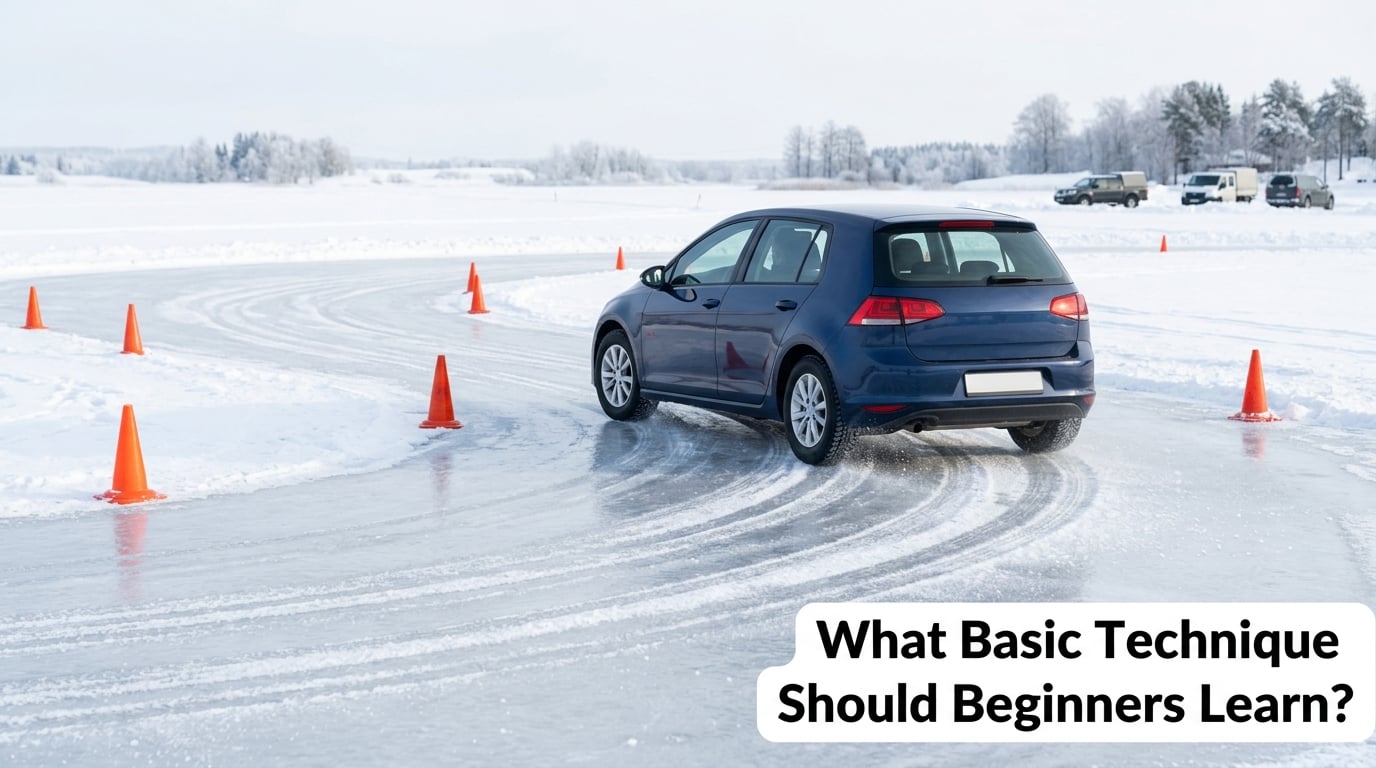
Basic technique is mostly restraint. Beginners who improve fastest are the ones who learn one repeatable sequence and do it for a whole season before trying anything clever.
- Steer smoothly and early. Feed the wheel in rather than cranking it. Small inputs keep the front tires working, and big ones wash everything out.
- Brake before the corner, not in it. Get the speed off early, then bring the throttle in as the nose rotates.
- Balance the slide with the throttle. The throttle is a steering input on ice. Too much and the rear steps out, too little and the car straightens into the snowbank.
- Use weight transfer. Braking loads the front, throttle unloads it, and lifting mid-corner rotates the car. That is the whole trick.
- Look through the corner. Aim at the exit, not at the apex. Your hands follow your eyes.
What Does the Basic Racing Technique Look Like?
Break a lap or a course into five repeatable moves and practice them in order until they are boring. That predictability is the goal, not boredom for its own sake.
- Settle the car. Come to a straight, check nothing, and get the steering straight before committing to anything.
- Select a line. Look two or three features ahead. On ice, the line is chosen for grip, not for the shortest path, so aim for the textured or rougher strip rather than the polished patch.
- Initiate the turn. Brake in a straight line, turn the wheel smoothly, and let the weight move rearward to bring the car around.
- Manage the throttle through the exit. Add throttle as the car comes back, and trim it if the rear starts to step wide. This is where oversteer is held rather than fought.
- Reset. As the car straightens, unwind the wheel, glance at the next feature, and start again.
Work up gradually. Spend one session on a straight line doing nothing but smooth starts and stops, then a coned slalom, then a single timed lap, and only then a full run. Beginners regularly reach for a level of speed that their hands are not ready for, and the fix is a slower month, not a braver one.
How Should a Beginner Practice Without Taking Unnecessary Risks?
Safe practice is controlled practice, and control comes from the surface, the speed, and having someone watching who can stop you.
- Use an inspected surface. A club track that has been plowed, measured, and opened is a controlled environment. A neighborhood pond is not, however solid it looks from the bank.
- Take an instructor-led session first. A school session in Lapland-style driving or a club beginners’ clinic teaches the slide in a setting with recovery capability. It is the cheapest insurance in the sport.
- Build the course with cones. Cones let you set gates, clipping points, and braking zones on a flat surface so you can repeat a pattern instead of chasing a corner.
- Graduate the speed. Every time a run feels easy, add a small amount. If it feels like you are managing a crisis, slow down and repeat the last clean run.
- Have a spotter. Someone standing at a safe position with a flag or radio is the cheapest safety system there is.
- Never practice near public roads. Icy public roads are where people die, and no lap time is worth it.
One honest warning: experienced drivers with rally and drift backgrounds still put cars into the first snowbank. This is normal, it is not a sign you are bad at it, and it is the reason the sport is run on closed tracks with banks and recovery crews.
How Are Beginner Ice-Racing Events Run?
A first race day has a fairly fixed shape, and knowing it in advance removes most of the anxiety. Events run from a drivers’ meeting through to results, usually within a few hours.
- Registration and tech. You sign in, hand over your entry details, and possibly present your car for a quick inspection. Have your membership and any required license to hand.
- Drivers’ meeting. A short briefing covering flags, passing rules, penalties, the weather hold procedure, and the plan if the ice closes. Attend it. The green flag is not permission to ignore safety instructions.
- Novice group and orientation. A lead instructor takes first-timers out for a few laps to learn the flags and the course, usually at a deliberately slow pace.
- Practice or time trial. This is where you get your car used to the surface. On an oval, the first few laps are for feel, not for time.
- Timed or scored runs. Either a set number of laps against the clock, or grouped heats. Expect to be told your run order and to wait more than you expect between outings.
- Results and awards. Classes are usually separated by experience, so a slow first run is not a wasted weekend.
Know the formats in advance. Many first-timers arrive expecting a short sprint and find the local event is a multi-hour oval enduro, which is a completely different commitment. The entry page and the club will tell you. Ask what the run length is before you pay, and ask what happens if the ice closes mid-event, because warm afternoons on a plowed lake do happen.
Volunteer-run clubs exist in most northern regions. Search for local ice racing or auto sport clubs, then look for public frozen lake, oval, or winter racing events. The Adirondack Motor Enthusiast Club, the Sports Car Club of Vermont, and the Lakes Region Ice Racing Club are named examples of the kind of organization that runs novice events, and most of them publish a simple rules page and a calendar.
What Common Mistakes Should New Drivers Avoid?
- Abrupt braking mid-corner. It unloads and reloads the axle in a fraction of a second and takes the car straight off line. Brake in a straight line instead.
- Excessive steering. The classic beginner spin. A smaller input earlier would have done the same thing without the rotation.
- Late throttle. Waiting for the corner to finish before adding power leaves the rear with no help through the hardest part of the turn.
- Overdriving beyond your visibility. If you cannot see the exit past the snowbank or the haze, you are going faster than you can see.
- Ignoring the surface change. A polished strip where everyone has been running, or hardpack slush dragged onto the line, will undo everything you have set up.
- Running unsuitable tires. All-seasons and worn winter rubber are the leading cause of a car that will not hold an angle. Age and pressure matter more than the tread pattern on the label.
- Treating a green flag as a licence to be quick. The flag means the track is clear. It does not mean ignore the briefing, the spotters, or the limits.
Most of these come from the same root cause: trying to do too much in the first five minutes of a session. Speed comes from carrying momentum, and momentum comes from smoothness.
Frequently Asked Questions
Can a beginner use a rear-wheel-drive car for ice racing?
Yes, and it is the traditional choice for a reason. Rear-wheel drive makes the rear axle’s grip limit obvious every time you lift off, which is exactly the feedback you want while learning. The trade-off is that oversteer arrives quickly, so expect to correct the car more often in your first sessions than a beginner with all-wheel drive would.
Should I use winter tires or studded tires for my first ice-racing event?
Fresh winter tires are the right starting point. A modern snow tire uses a soft, low-temperature compound and a blocky tread that bites into textured ice far better than an all-season, and it is far less of a jump than studded rubber. Move to studded tires once you are quick and consistent and want more bite on smooth ice. A worn winter tire is worse than a new one regardless of label.
Is all-wheel drive better for learning to ice race?
It is easier, not better. All-wheel drive pulls the car out of a slide more readily, which makes early sessions calmer and shortens the learning curve. It also teaches you less about throttle control, so many drivers deliberately learn on rear-wheel drive or spend a season in each. If you already own an all-wheel-drive car, do not buy another one to learn.
How cold does it need to be for safe ice-racing practice?
Cold is the wrong variable to judge by. What matters is that the ice is inspected, measured, and opened by someone responsible, and that a plowed track is being maintained through the session. Racing generally needs a solid foot of clear ice, with snow cleared from the racing line. Warm afternoons thin the surface faster, which is why organized clubs measure and sometimes close the track mid-day.
What happens during a beginner’s first timed ice-racing run?
You join a novice group, usually get a short orientation lap with an instructor, and then take a set number of laps against the clock. Nothing depends on you being quick: classes are grouped by experience, and the first session is about finishing cleanly. You will spend more time waiting between runs than you expect, and you will be asked to follow flags and passing rules exactly.
How do I know when I am driving on unsafe ice?
Look for a shore, and stay well away from it. Also avoid cracks, pressure ridges, open water, and anything showing through, such as reeds, rocks, or a fishing hole. If you did not measure the ice yourself with a clear, tested route, you cannot confirm it is safe, and a frozen pond is not a track. If you are not sure, do not drive on it, and never practice alone on uncertain ice.
Start With One Safe, Instructor-Led Session
Pick a novice event run by a club on an inspected track, buy a certified helmet and good gloves, put fresh winter tires on the car you already drive, and turn up for the orientation. Learn one repeatable sequence of line, brake, turn, throttle, and reset, and get through a whole session without anything surprising you.
That is a good first outing. Everything else, from studded tires to wheel-to-wheel heats, is a second-season decision you will make with better information than you have today. In 2026, the sport is still mostly volunteer-run and still waiting for people who want to learn it properly.