
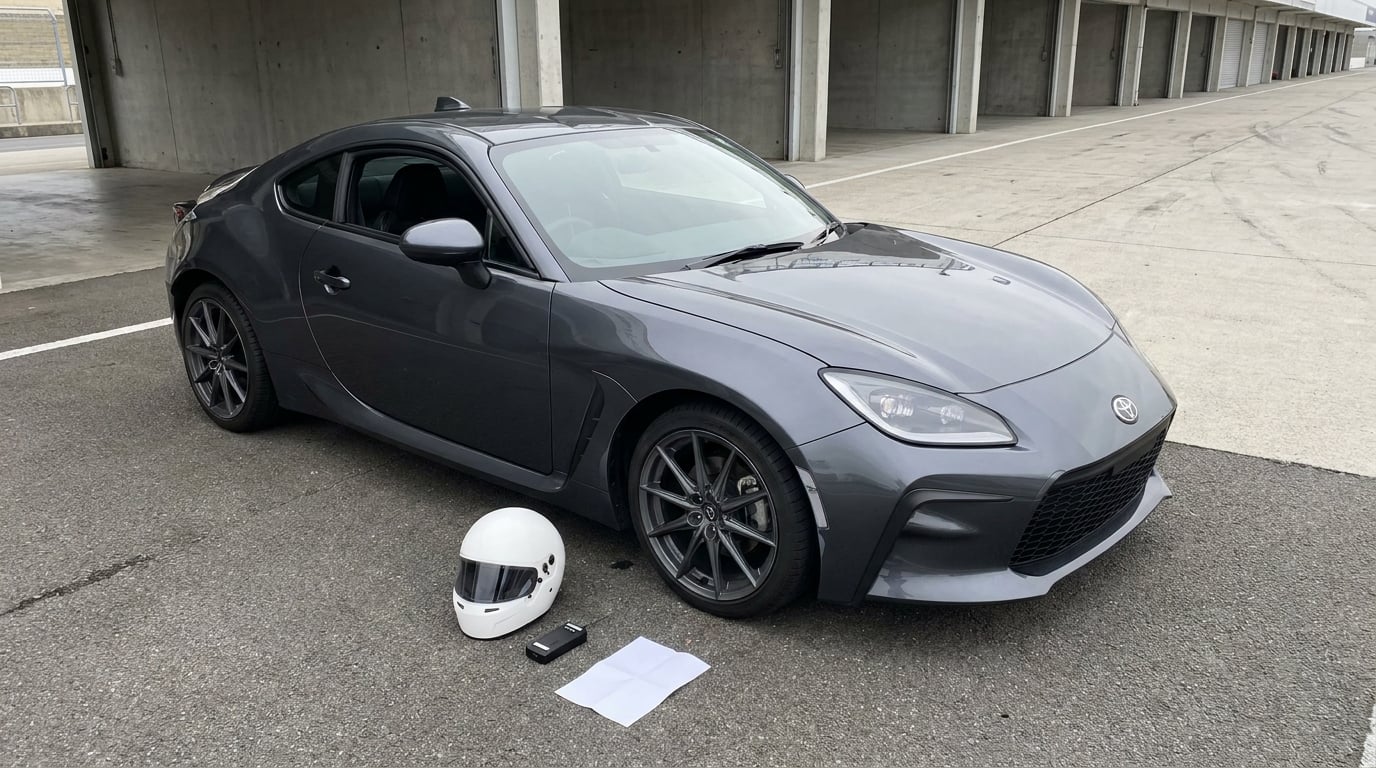
Track day insurance is a short-term policy, normally bought for one named event, that covers damage to your own car while you drive it on a closed circuit at an HPDE, time trial or similar track day. Your everyday auto policy almost always excludes that driving, so without separate track coverage you are personally carrying the entire repair bill.
That is the idea in two sentences. The rest is detail, and the detail matters more than most first-timers expect: what the policy pays for, what it refuses, what a deductible actually costs on your particular car, and the perfectly reasonable case for buying none of it. The figures below reflect what carriers published in 2026.
One more caution before we start. This is a general explainer, not a coverage determination for your car and your policy. Terms vary by carrier, by state and by event, and nobody at a track can tell you what your insurer will do. What a good explainer can do is show you exactly where to look.
Table of Contents
- What Track Day Insurance Is—and What It Usually Does Not Cover
- How Track Day Insurance Works
- What You Need Before Driving on Track
- How Much Does Track Day Insurance Cost?
- What Affects Track Day Insurance Coverage and Price
- How to Check Your Coverage Before an Event
- Frequently Asked Questions
- Does ordinary car insurance cover a track day?
- Does the track organizer’s insurance cover my car?
- Can I use track-day insurance for a high-performance or modified car?
- What is the difference between a damage waiver and insurance?
- Will my personal policy pay after a track accident?
- What should I do if my car is damaged at a track day?
- What to Do First
What Track Day Insurance Is—and What It Usually Does Not Cover
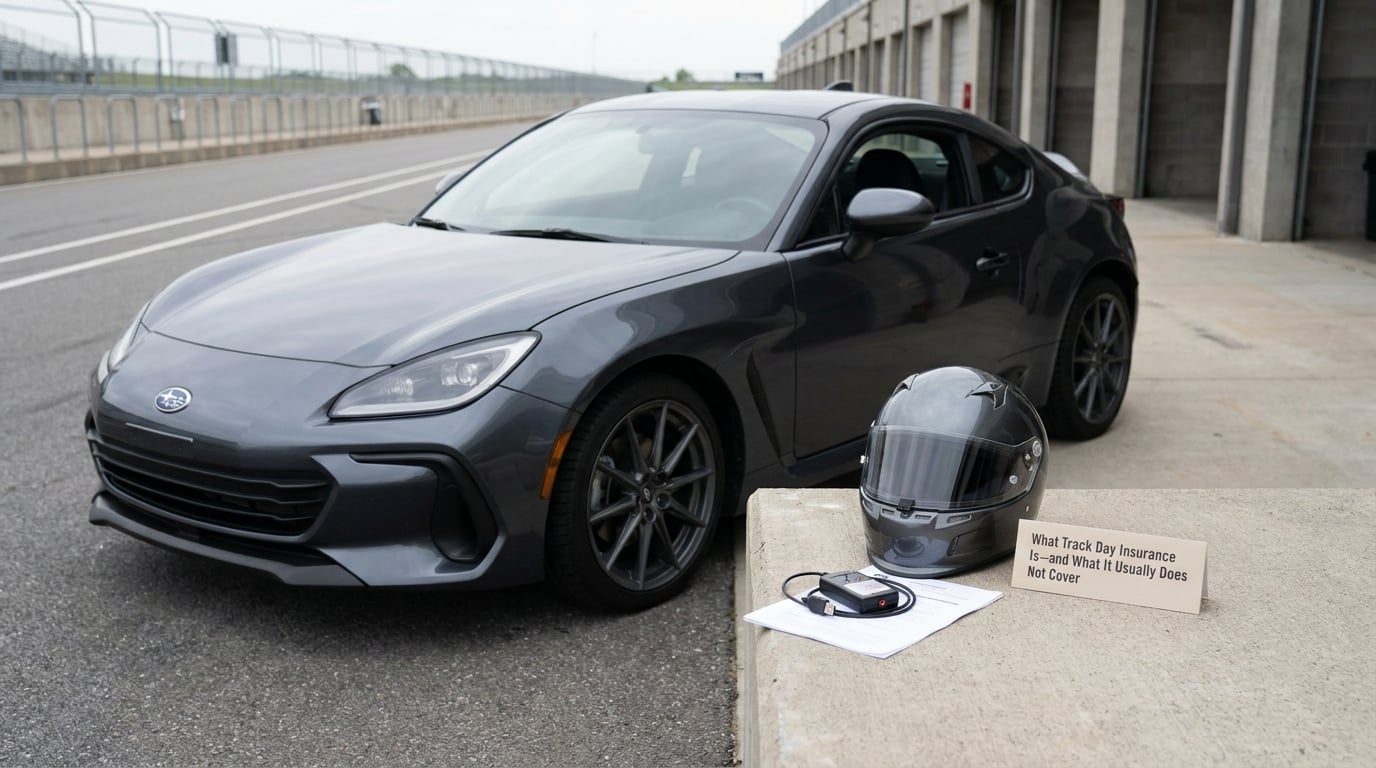
Track day insurance picks up where your street coverage stops, from the moment you roll onto the track grounds until you are back on public streets. Before that gate you were an ordinary driver with an ordinary policy. After it you were a participant in a motorsport event, which insurers treat as a different risk entirely.
The reason traces back to language that sits in most personal auto policies today. Standard exclusions take coverage away while the car is used in a race, a competition, a trial, a speed test, or any other contest of speed, and many carriers also exclude driving on a closed circuit or during any organized on-track event. Read your own declarations page exclusions and the language is usually plain enough once you know what to look for.
It also helps to name the terms you will see repeated. HPDE means High Performance Driver Education, the coached instruction level most first-timers book. A time trial is a session where you drive alone against the clock. Wheel-to-wheel racing means cars alongside each other with race starts. The paddock is the garage and staging area behind the pits, where a surprising share of track damage actually happens.
What a track day policy usually covers
- On-track contact damage to your own car during the insured event
- Off-track excursions onto the runoff, grass or dirt at the facility
- Damage in the paddock, pit lane and staging areas
- Declared modifications listed on the policy, such as wheels, tires, suspension or a roll cage
- Coverage while an approved driving instructor is behind the wheel
- Some policies extend to a listed secondary driver at no added cost
What it usually does not cover
- Mechanical failure, blown engines, gearbox damage or anything broken by the car’s own parts
- Normal wear and tear, including worn brakes, tires, pads and fluids
- Wheel-to-wheel racing and any event a provider classifies as competition rather than education
- Damage above the declared or capped value of the vehicle
- Towing, transport and rental costs, unless the policy specifically includes them
- Third-party liability to other drivers, which most event policies do not carry at all
| Coverage category | Standard auto policy | Track day policy |
|---|---|---|
| Daily driving | Covered, subject to terms | Not applicable |
| HPDE or coached lapping | Excluded on a closed circuit | Covered, per policy terms |
| Time trial | Excluded | Covered on many single-event policies |
| Wheel-to-wheel racing | Excluded | Excluded on most event policies |
| Paddock or pit area damage | Excluded | Usually covered |
| Off-track excursion on site | Excluded | Usually covered |
| Mechanical breakdown | Not covered | Not covered |
| Wear items: brakes, tires, fluids | Not covered | Not covered |
| Undeclared modifications | Claim dispute risk | Claim denial risk |
The mechanical exclusion is the one that surprises people most. A track policy insures your car against the collision you caused, not against the engine you cooked overheating on lap nine. That is a repair bill you own, insurance or not, so the prep work matters more than the policy does.
How Track Day Insurance Works
There are two structures, and the difference between them explains most of the confusion in forum threads about whether the track covers you.
Option 1: the organizer’s event coverage
The track or event company buys a blanket motorsport policy for the day and collects a waiver and a fee from each driver. You are not usually a named insured. The organizer carries primary coverage and the event policy pays above your agreed share, which is commonly the entry fee or a fixed deductible stated in the event packet. Ask for that number in writing, because it is the number you will be judged against if you damage the car.
Option 2: your own single-event coverage
You buy a policy yourself, online, naming the event, the date and the vehicle. You become the named insured for that weekend, and the carrier pays the repair less the deductible you chose, up to a declared or capped value. This is the structure most people mean when they search for track day insurance, and it stacks on top of what the organizer provides rather than replacing it.
Where the clock starts and stops
Coverage is tied to the event and the grounds, not to the session. The useful mental model is a timeline: it begins when you enter the facility for the event, usually running through the paddock, the pit lane, the on-track sessions, any course or classroom time, and the run-off areas inside the facility. It ends when you leave the grounds for the last time that day, and it does not follow you home on public roads. Some policies extend to a defined radius from the track, which matters if the venue has a nearby skidpad or autocross course attached.
What evidence you should get
Before you drive, you should be able to pull up a document on your phone that names you or the car, the event, the date, and the carrier. Save the policy schedule, the certificate of insurance and the event confirmation offline. A screenshot that does not work in a parking lot with no signal is not evidence you have.
What You Need Before Driving on Track
Track day insurance is one item on a list that begins a lot earlier. Most cancellations at the paddock gate come from paperwork and preparation, not from the car being wrong.
- Driver documents. A valid licence that matches the name on the waiver, government ID, and any club or membership credentials the event requires.
- Signing authority. If the car is not in your name, bring registration or title, and a written owner authorisation to drive it on track.
- Insurance decisions made. Coverage bought, or a clear conscious decision to self-insure, before you leave home. Not at the gate.
- Waiver completed in advance. Most events do the paperwork online days ahead, and it can be closed to new drivers at the gate.
- Technical inspection passed. Tread depth, brake condition, no fluid leaks, secure battery, functional lights, and whatever the event’s noise rule requires.
- Safety gear. A certified helmet is the one item most events will not let you pass the gate without. Depending on the group, expect gloves, a long-sleeve fire-resistant layer and a fire extinguisher.
- Timing equipment. A transponder or loaner unit from the track, plus a mount for it.
- A car that is actually ready. Brake feel, tire condition and fluid levels are the deciding factors, not horsepower.
On hybrids and EVs, one extra bit of preparation matters: the pedal feel changes dramatically between street and track modes, and regenerative braking behaves differently under load than it does in traffic. Our regenerative braking explained for beginners guide covers why it feels odd after a few fast laps.
If the car is due for service, do it before the event, not the week after. The high-mileage oil explained breakdown is worth a read if you are weighing whether a higher-viscosity oil is worth the change for a car that has been lapping hard for years.
How Much Does Track Day Insurance Cost?
Track day insurance is priced as a percentage of the car’s total insured value, not as a flat fee. Most single-event policies land around 1 to 2 percent of the car’s total insured value, which in practice puts a typical car somewhere between 190 and 600 dollars for one day. A well-kept older car at the low end, a new or heavily modified car at the top.
The deductible is the number that actually decides the question. Policies commonly carry a deductible of 5 to 10 percent of the car’s value, or a flat minimum of 2,500 dollars whichever is higher. A forum thread on a driver education community discussed that same 5 to 10 percent range, and the number matches what the carrier pages publish, so treat it as the working assumption.
That percentage looks abstract until you put your own car in it.
| Car value | 5 percent deductible | 10 percent deductible | Plus a 1.5 percent premium |
|---|---|---|---|
| 10,000 dollars | 2,500 dollars (flat minimum applies) | 2,500 dollars (flat minimum applies) | 150 dollars |
| 30,000 dollars | 1,500 dollars, or the 2,500 floor | 3,000 dollars | 450 dollars |
| 60,000 dollars | 3,000 dollars | 6,000 dollars | 900 dollars |
| 100,000 dollars | 5,000 dollars | 10,000 dollars | 1,500 dollars |
| 250,000 dollars | 12,500 dollars | 25,000 dollars | 3,750 dollars |
Read that middle row again. On a 60,000 dollar car, a 10 percent deductible is 6,000 dollars in your own hands before the carrier pays a cent. A driver on a track community thread itemised roughly 6,000 dollars of total exposure between premium and deductible, and that is the arithmetic that makes this decision for most people.
Three things push the number up fast. Multi-day and multi-driver events: one thread cited 1,400 dollars for a two-day event, and every additional driver is priced as another risk. Value caps: one driver reported a provider covering only up to 500,000 dollars of value with a 10 percent deductible, which is a ceiling rather than a promise. And modifications, especially cage work and stripped interiors, which get declared or refused.
These are typical US ranges, they vary by region and by carrier, and they change over time. Treat them as a framework for weighing your own numbers, not as a quote.
What Affects Track Day Insurance Coverage and Price
The event tier, first of all
HPDE levels 1 through 4 sit comfortably inside most single-event policies. A competitive time trial is covered on many of them, though some providers offer it as a separate product. Wheel-to-wheel racing is normally excluded outright from event-day products and needs a genuine motorsport program with much higher premiums, which is why most club racers are covered through a long-term affinity arrangement rather than a one-day policy.
Autocross and skidpad days are treated separately again. Because the speeds and consequences are lower, some event policies include an attached autocross course and some will not. Ask specifically rather than assuming.
The car and how you declared it
Total insured value is the base of the calculation, so a valuation method matters: agreed value against an actual cash value basis can change the ceiling considerably. Modifications must be listed. Wheels, tires, suspension, brake upgrades, a cage, a stripped cabin, a different engine management system, all of it. Undeclared modifications are one of the most common reasons a claim gets denied, and the fine print is rarely ambiguous about it. An approved instructor behind the wheel is usually a covered scenario, but only an approved one, and the organizer has to vouch for them.
Deductible choice and driver history
You choose between a smaller deductible and a larger one, and a larger deductible lowers the premium. Some providers will also look at your driving record, your age and licence type, your prior claims history, and how many events you buy in a year. Your state matters too, since rate filings and form language differ.
Motorcycles: a separate and harder problem
Motorcycle track days are not a cheaper version of the car version. Several major providers exclude them from track day products entirely, which is why the question keeps coming up unanswered. A bike on track is a different risk profile, a smaller and more fragile machine, and a different rider population. Expect to work with a carrier who writes motorcycle motorsport specifically, expect to declare your gear and your mods, and expect the coverage to cost more as a share of value than the car equivalent.
How to Check Your Coverage Before an Event
Do this work in a specific order, and you will have a defensible answer instead of a guess.
- Read the event packet and the sample waiver first. The packet usually names the carrier, the deductible and the coverage structure. If it does not, that is itself an answer.
- Send the organizer four questions in writing. Who is the named insured, the vehicle or the driver? What is the participant deductible, in dollars? Does coverage extend to the paddock and pit lane? Do they require proof of your own coverage before you drive? A track that will not answer by email is telling you something.
- Request the document from the provider, not the broker. A certificate of insurance naming you or the car, the event and the date. Save it to your phone and to a folder you can reach without signal.
- Read your own exclusion language, then call your insurer and ask. Give them the specific question: does my policy exclude this event at this facility on this date? Get the answer in writing. Enthusiasts report that insurers will decline to quote at all for track use, or will insert a racing exclusion into an otherwise normal policy, and knowing which you are dealing with takes ten minutes.
- Sort out financed and leased cars. The lender almost always requires proof of physical damage coverage naming the vehicle, and the lender usually has to be listed as loss payee. If you skip the policy, your lender may still require you to show coverage, so ask them what they want before you decide anything.
- Note the deadline. These policies are bought days ahead, not the morning of. A quote needs the VIN, the event date and the facility, and a value cap means the insurer may want photos before binding.
If you have no coverage and something happens
People buy insurance after a crash and ask what now, so let us be blunt: a policy cannot be bought retroactively. What you can do is protect the evidence. Stop, check yourself and everyone else first, tell track staff immediately and take the medical route if it is needed. Photograph the car, the other car, the track surface and the debris field before anything moves. Ask for the incident report and write down the time, the session and the names of everyone involved. Do not drive the car and do not make a statement about fault beyond the facts. Then call your insurance company, call your lender, and get the car to a shop that has seen track repairs before touching anything.
Frequently Asked Questions
Does ordinary car insurance cover a track day?
Almost never. Standard personal auto policies exclude the car while it is used in a race, competition, trial, speed test or any contest of speed, and most also exclude closed-circuit driving and organized on-track events. Some carriers will confirm in writing or even add a motorsport endorsement for an annual policy, but the default answer is no. Assume you are uninsured on track until a carrier or a written policy says otherwise.
Does the track organizer’s insurance cover my car?
Usually, but as secondary coverage. The organizer buys a blanket event policy and you agree to a deductible or participant share, commonly the entry fee, which the carrier pays above. The organizer is normally not the named insured, and the packet rather than the marketing page is what tells you the actual number. Ask the organizer in writing for the carrier, the deductible and the coverage structure before you drive.
Can I use track-day insurance for a high-performance or modified car?
Usually yes, but only if you declare the modifications on the policy. Wheels, tires, suspension, brake upgrades, a roll cage, a stripped interior and engine management changes all need to be listed, and undeclared work is a common reason a claim is denied. Some modifications push the car out of standard track day products entirely and into a motorsport program. Declare everything and expect the premium to rise with the value.
What is the difference between a damage waiver and insurance?
A damage waiver is an agreement, not insurance. You sign it, you often pay a fee or a larger entry charge, and it releases you or the track from responsibility for damage. Insurance is a contract with a licensed carrier that pays covered claims above your deductible, subject to policy terms. A waiver can leave you with the whole bill; insurance puts part of it with a carrier. Read both documents, because they are often presented together and confused.
Will my personal policy pay after a track accident?
Do not plan on it. The closed-circuit and contest-of-speed exclusions apply during the drive, and a claim submitted afterward is exactly when they get examined. If the accident happens while loading the car in the paddock, or while driving the car to and from the event on public roads, your normal policy may still respond, which is why the timeline of the incident matters. Get your insurer’s position in writing before the event, not after.
What should I do if my car is damaged at a track day?
Tell track staff and the medical staff first, then secure the scene and photograph the car, the other car, the surface and any debris before anything moves. Ask for the incident report and note the session, the time and the names of everyone involved. Do not drive the car. Contact the carrier or the organizer right away, and keep every receipt for towing, storage and teardown, because those costs are often disputed.
What to Do First
Before you load the car, do five things in this order. Get the organizer’s current coverage details in writing, including the carrier and the participant deductible. Confirm that your car and your licence qualify for the event and that any modifications are declared. Read your own policy’s exclusion language and ask your insurer the specific question, then save the answer. If you are buying a policy, do it now with the VIN, the event and the facility, and download the certificate to your phone. If you are not buying one, make that a deliberate choice with the deductible number in front of you rather than a shrug.
Most people who self-insure come back the next month anyway. Plenty of them do not. The difference is that the ones who thought it through knew the number they were accepting.