
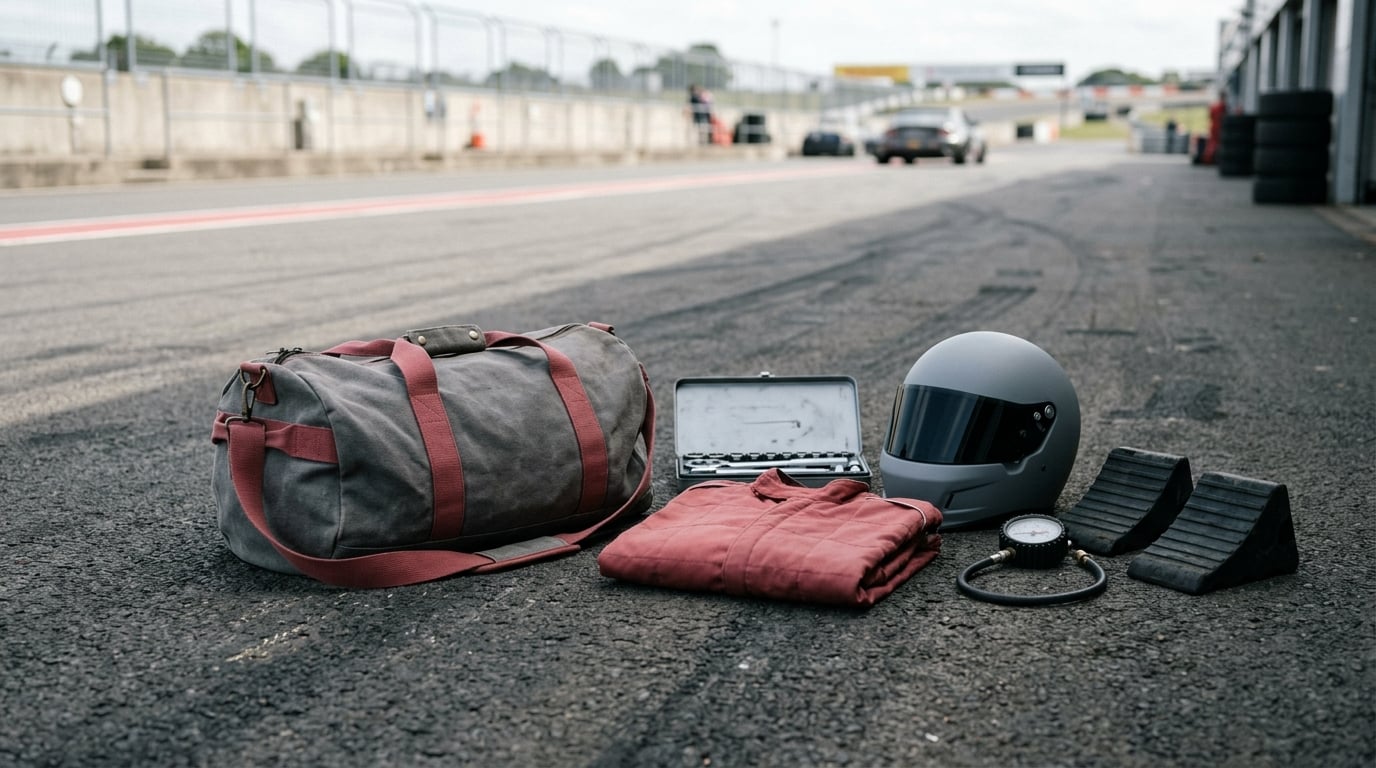
A track day is a supervised session on a closed circuit where street-legal cars get coached through high-performance driving, and what to bring to your first track day falls into four buckets: safety gear, a small tool kit, documents, and paddock comfort. Most organizers publish a gear list, and most of it assumes you already know what a run group is. This guide spells out the twelve things that actually matter on the day, plus the few you can safely leave at home.
Here is the rule that catches out most beginners: nothing loose stays in the cabin. A phone, a sunglass case, or a garage-door remote left on the passenger seat becomes a projectile the first time the car is loaded up in a braking zone. Empty the interior before tech inspection, then decide what goes back in — usually nothing more than a water bottle in a secured holder.
The second thing worth saying up front is that twenty minutes on track is harder on a car than a month of commuting. Brakes build heat they were never designed to hold, tire pressures climb, fluids get cooked, and every fastener you left slightly loose gets a vote. What you pack and how you prep the car decide whether the day is a good one.
Everything below is written for 2026 event schedules, and every track is different. Treat it as a starting list, then check your organizer’s own requirements, because they set the rules and they change.
Table of Contents
- What to Bring to Your First Track Day at a Glance
- 1. A DOT- or ECE-Rated Helmet
- 2. Eye Protection or a Helmet Visor
- 3. Fire-Resistant Gloves
- 4. Driving Shoes With Flat, Grippy Soles
- 5. Track-Suitable Clothing and Rain Gear
- 6. A Supportive Seat Belt Harness
- 7. Basic Track Tools and Spare Hardware
- 8. Tire Pressure Gauge and Tire-Safety Supplies
- 9. Brake and Fluid Inspection Supplies
- 10. Registration, Insurance, and Emergency Information
- 11. Water, Snacks, and Sun Protection
- 12. A Packed Duffel and Organized Car Checklist
- Frequently Asked Questions
- Conclusion: Pack the Essentials and Ask the Track
What to Bring to Your First Track Day at a Glance
Twelve items, sorted by who supplies them. If a row says “you bring it,” leaving it home is the single most common reason a beginner gets turned away at the gate.
| Item | Why it matters | Who supplies it |
|---|---|---|
| Approved full-face helmet | Required at most tracks, and dated certification is checked | You bring it |
| Visor or impact-rated eye protection | Debris and insects at speed; a scratched visor scatters light | You bring it |
| Driver gloves | Protect hands during wheel and cabin contact, add grip | You bring it |
| Thin-soled driving shoes | Thin soles give you feedback through the brake and throttle | You bring it |
| Track-suitable clothing plus a rain layer | Heat, sun, and sudden weather; some tracks require a cert | You bring it |
| Properly installed harness | Far better lap-belt support in a high-G corner | You bring it, or the car |
| Socket set, torque gauge, chocks | Fastener checks and a safe way to stage the car | You bring it |
| Tire pressure gauge and plug kit | Pressure changes between every session, not once a morning | You bring it |
| Brake and fluid inspection gear | Know your car is safe before it is loaded into a run group | You bring it |
| Registration, insurance, waiver, contacts | Gate check, waiver, and someone to call if it all goes wrong | You bring it |
| Water, snacks, sunscreen | Heat, energy, and sun add up across a full day | You bring it |
| One packed duffel and a car checklist | Keeps gear together and stops the last-minute scramble | You bring it |
1. A DOT- or ECE-Rated Helmet
A helmet is non-negotiable, and the certification is stamped inside the shell. Look for a DOT FMVSS 218 label on the back of the helmet, or an ECE 22.06 mark near the chin strap. Many tracks also accept Snell SA or an FIA standard, and a few insist on one of those specifically.
Check two dates. The manufacturing date tells you the shell is not ancient, and the certification date tells you whether the standard has since been superseded. A helmet that passed years ago can still be legal, but organizers vary, so read the rule before you buy.
Fit matters more than the badge. The helmet should sit level with no gap above your eyebrows, the cheek pads should press firmly against your jaw, and there should be no pressure points after twenty minutes. Bring a thin balaclava or liner for the first session — you will sweat in it, and cotton under a helmet turns into a hot damp layer by lap four.
2. Eye Protection or a Helmet Visor
Your visor is your eye protection, so treat it as safety equipment rather than a comfort item. Scratches scatter light exactly when you need contrast to read a corner, and an old visor can yellow.
Carry a clear visor for daytime and a second tinted visor if you are comfortable driving in one. Many tracks allow tear-offs, those thin sticky sheets that peel off and take the debris with them; pack a stack if the rulebook permits and stick to a clear one during instructor laps.
Impact-rated goggles are a sensible backup, particularly if your helmet came with a removable visor and you lose it. They also sit more comfortably over prescription glasses than trying to fit a shield over frames.
3. Fire-Resistant Gloves
Gloves protect your hands during the unglamorous parts of a track day: cranking the jack, steadying the car, pulling a wheel, or grabbing the steering wheel after a spin when the rim is hot.
Look for full-grain leather with grip padding across the palm and fingers, and a gauntlet that covers the wrist. Fingerless versions are permitted at some tracks and keep airflow in hot weather, but they offer less protection for a scrub against a hard surface.
Try them on with your driving gloves and check the fingertips. If you can feel the seam through the material, the fit is close enough. Loose gloves bunch at the knuckle and get in the way of a quick catch on the wheel.
4. Driving Shoes With Flat, Grippy Soles
The reason for thin soles is feedback. A soft street shoe with a chunky midsole absorbs the movement of the brake pedal, so you cannot feel the pedal start to release or the throttle stop feeding in. Thin-soled shoes let you brake earlier and more precisely.
Avoid heavy trainers and anything with aggressive tread; deep lugs can catch the carpeting in the pedals of a car with manual transmission. If you wear boots, look for a flexible, low-profile sole.
Wear thin socks. A thick athletic sock doubles the effective sole thickness and undoes the whole point. Bring a spare pair in your bag, because a sweaty foot in a hot shoe ends the session early.
5. Track-Suitable Clothing and Rain Gear
You will be in the paddock in the sun and in a car getting hot, then standing in a cold queue for fuel if the session schedule runs late. Pack for all three.
Base layer close to the skin, breathable layer over it, and something windproof on top. Natural fibers are the usual recommendation near the skin because many certification schemes treat man-made materials carefully for heat transfer, and some tracks require clothing carrying an FIA or SFI label outright. Read the rulebook before you buy anything.
Add a lightweight rain shell in your duffel rather than wearing it in the car. A sudden storm during a session will not stop for you, and wet tires on a cold track are the least fun part of the day.
6. A Supportive Seat Belt Harness
A stock three-point belt is designed to be comfortable over a long drive, not to hold you in place through repeated high-G corners. A racing harness spreads load properly and keeps you positioned, which makes the car easier to drive.
The difference comes down to lap and shoulder support. A lap belt restrains your hips; adding shoulder straps holds your torso back, and a five- or six-point system adds anti-submarine straps across your lap so you do not slide forward under braking. More points means more restraint and more comfort, not more difficulty.
The installation is the part that matters. A harness needs to mount to reinforced factory or aftermarket anchor points, sit correctly on your body, and be torqued to specification. Do not improvise with straps bolted through seat foam, and do not cut a factory belt to make a retrofit look tidy. Airbag-equipped cars need the system removed or replaced by someone qualified before a lap belt goes in. If you are unsure, have a qualified fabricator fit it.
7. Basic Track Tools and Spare Hardware
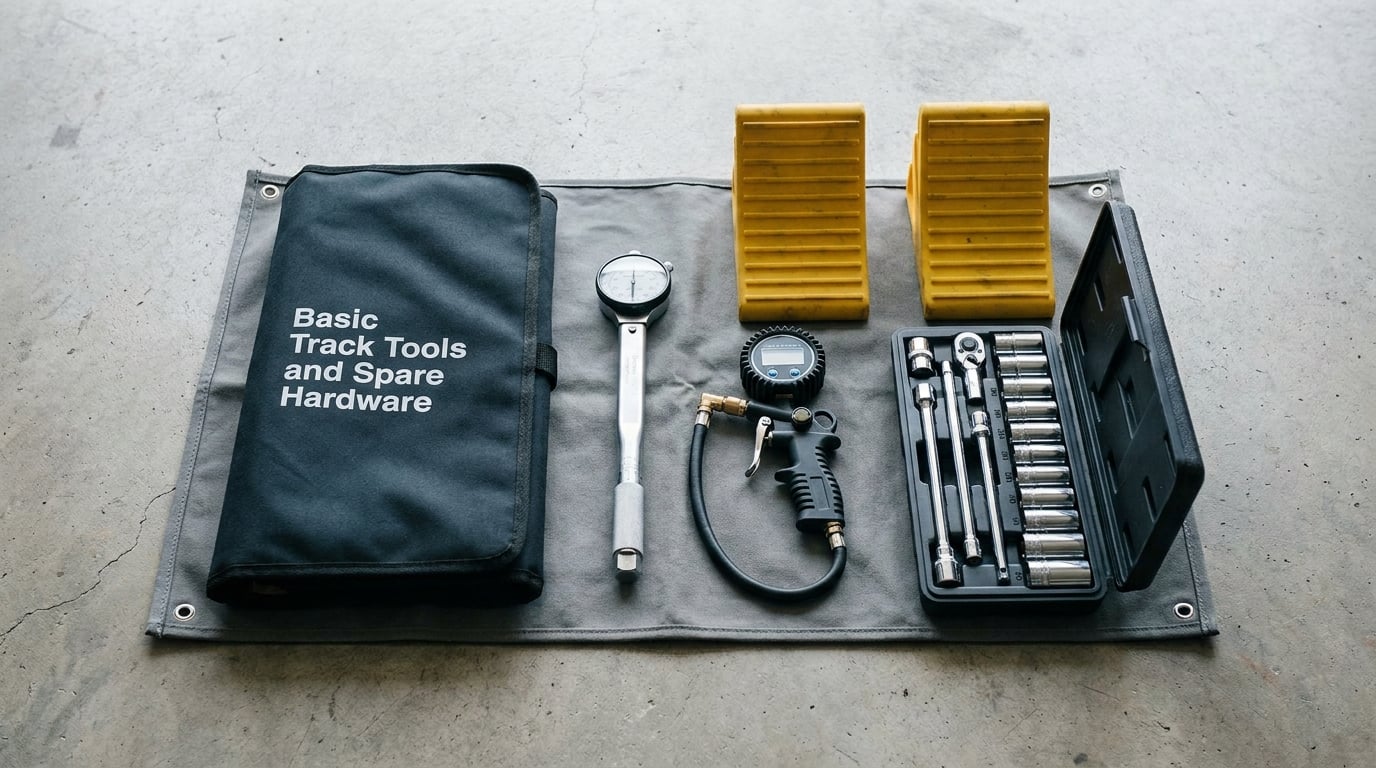
A track day tool kit is small. It is not a mechanic’s cart. Most tracks provide roadside assistance, a recovery vehicle, and often basic hand tools at the paddock, so the job of your kit is quick checks and safe staging rather than repairs. If you are still deciding what a sensible starter set looks like, our guide to what tools you need for basic car maintenance is a solid starting point for the garage half of the list.
Bring a socket set or small metric ratchet for checking lug nut tightness, a torque gauge or torque wrench for anything you adjust, and wheel chocks or jacking pucks so the car is secure when you get out. A tire pressure gauge appears in its own section below, and it deserves the space. If you have never used a torque wrench, what a torque angle gauge is used for explains the spec sheet in about two minutes.
Then the small consumables that veteran attendees mention more than anything else: duct tape, electrical tape, zip ties, a utility knife, a flashlight with spare batteries, a multi-tool, a shop rag or paper towels, and a spare key. Add the fluid type your car takes for brake fluid and engine oil, sealed in a small bottle.
Know the rule about repairs before you need it. On many tracks you cannot touch the car during a session, and work done on track can end your day. If something is loose, the answer is usually to report it and let the organizers handle it.
8. Tire Pressure Gauge and Tire-Safety Supplies
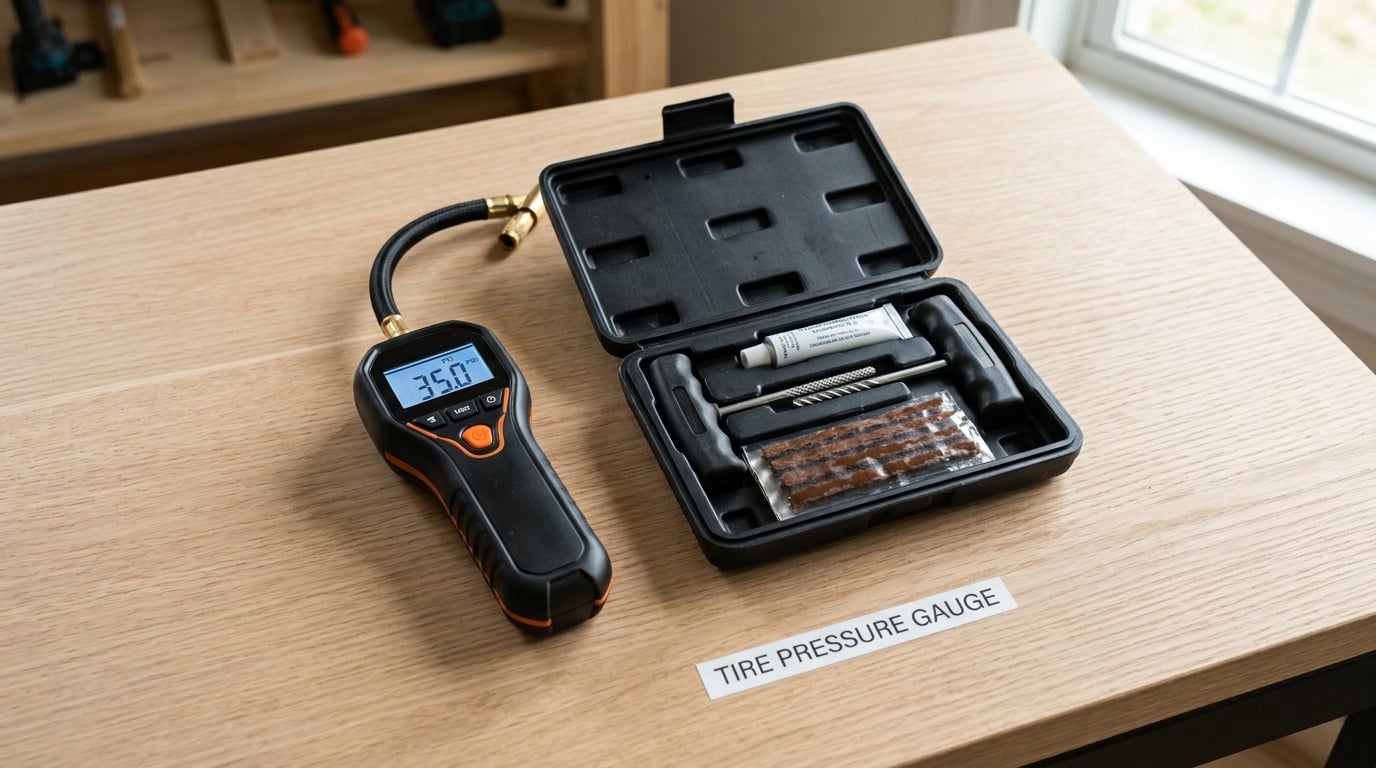
Tire pressure is the easiest thing to get wrong and the easiest to fix. Bring a quality gauge — a cheap pencil gauge on a tubeless tire reads the wrong number often enough to matter — and check the tires cold before every session, not once in the morning.
Pressure climbs as the tires heat up, sometimes by several psi, and bleeding hot tires down to the cold spec leaves you dangerously low once they cool. Use the placard on the driver’s door jamb as your cold reference, and treat the sidewall maximum as a ceiling rather than a target.
Look at the tires yourself. Most tracks want at least a few 32nds of an inch of tread, and plenty of tires on the road today are below that. Check the sidewalls for cuts, bulges, or bulged beads, and look for uneven wear across the tread that suggests an alignment or pressure problem rather than normal track wear. We covered that pattern in more detail on what tire feathering is and what causes it.
A string-style plug repair kit fits in a glove box and can save a session, but only if your track allows track-side or paddock repairs. Many do not, and some require you to report a tire issue and sit out. Check before you pack it.
9. Brake and Fluid Inspection Supplies
Brakes are the reason track days wear out tires, and they are the system most worth inspecting before you load the car. Check pad thickness against the minimum on your caliper or in the service manual, and look at the rotor surface for deep scoring or a lip at the edge.
Fluid matters as much as pads. Fluid absorbs moisture over time and boils at a lower temperature once it does, which is how brake fade starts on a long run of hot laps. Fluid labeled DOT 4 or DOT 5.1 is a normal modern choice, and manufacturers generally call for a change around every two years regardless of mileage. Note the date on the reservoir or your records.
Other warning signs: a pedal that feels spongy or travels too far, a fluid level that keeps dropping, any visible weeping around a caliper or hose, and a car that pulls to one side under braking. If you find one of those, the answer is not a spare part in your duffel. Have a qualified mechanic look at it, and take the car out of the running if the condition is unclear.
10. Registration, Insurance, and Emergency Information
Most tracks want proof of registration and current insurance, a valid driver’s license, and a signed waiver. Many now handle the waiver online ahead of time, so complete it before you leave home rather than standing in line.
Confirm whether your insurance covers track use. Policies vary widely and many exclude it, so check with your provider directly rather than assuming. Bring the card and the digital paperwork in case the gate asks for it.
Put the track’s address, gate hours, and the organizer’s phone number in your phone and on paper. If you break down and the car has to go home on a flatbed, someone needs to know where you are.
Carry two emergency contacts who can make decisions if you cannot, plus any medical information and medications that matter. Keep a short list of allergies or conditions on a card in your wallet. It takes five minutes to write and it goes with you.
11. Water, Snacks, and Sun Protection
Track days are long and standing around in the paddock is dehydrating, even when the air feels cool. Bring more water than you think: a reusable bottle or two and a refill point at the track is plenty for most people.
Add an electrolyte drink or powder for long summer days. You are losing salt as well as water, and a plain water session can leave you flat by the last group even when the car feels great.
Eat something easy between sessions. Complex food sits heavily, and a car that bounces over curbs on a full stomach is no fun. Fruit, sandwiches, and a few salty snacks cover most of it.
Sun protection does real work here. Use sunscreen, wear a hat and sunglasses around the paddock, and keep a change of clothes in the car so you are not wearing a sweat-soaked base layer for the drive home. A small towel earns its space too.
12. A Packed Duffel and Organized Car Checklist
The reason people forget things is that everything lives somewhere different. One duffel solves it. Use a single bag with a helmet pocket and a separate waterproof pouch for documents, and label the compartments so you are not unpacking the whole thing at the gate.
Divide it the way this article divides it: safety gear, tools and supplies, documents, and comfort items. Keep the documents pouch sealed so a leaking water bottle does not turn your insurance card into pulp.
Before you leave the house, walk this list once. Helmet, gloves, shoes and clothing. Gauges and tools. Fluids and plug kit. Water, snacks, sunscreen. Waiver signed, registration and insurance to hand, emergency contacts written down. Tow strap or tow hook fitted and the car’s key accounted for. Cabin empty of everything loose.
Then check the car one final time in the paddock: cold tire pressures set to the door-jamb spec, brakes and fluid looked over, nothing loose in the trunk, nothing loose in the cabin. Once you are through tech inspection, stop fiddling and go and learn the circuit.
Frequently Asked Questions
What should I bring to my first track day?
Bring a certified helmet with a clear visor, driver gloves, thin-soled shoes, and clothing the track allows. In the car, pack a tire pressure gauge, a small socket set and torque gauge, wheel chocks, tape, zip ties, and the fluid type your car takes. Carry water, snacks, sunscreen, your registration, insurance, signed waiver, and two emergency contacts. Empty the cabin of every loose item before tech inspection.
Do I need my own tools at a first track day?
No mechanic’s cart is needed. Most tracks provide roadside recovery, and many have hand tools and basic equipment in the paddock. A small kit for yourself means a socket set, a torque gauge, a tire pressure gauge, chocks, tape, zip ties, a utility knife, a flashlight, and a spare key. Check the organizer’s rules first, because several tracks do not allow repairs on track at all.
Can I wear normal clothes and shoes on track?
You can drive in everyday clothing at many tracks, but it is not ideal. Some organizers require clothing that carries a recognized certification, so read the rulebook before you buy. Shoes matter more than most people expect: a thin, flat sole gives you feedback through the pedals, while a chunky sneaker absorbs it. Wear thin socks, and pack a breathable base layer plus a rain shell in your bag.
What safety equipment does the track provide?
It varies a lot, so ask the organizer directly. Some events rent helmets and suits, and high-performance driving schools usually supply the car, the helmet, and often the suit. Most public track days provide nothing beyond fire extinguishers, recovery services, and sometimes a basic tool area. A few supply a spare transponder or timing transponder for a fee. Assume you bring everything else.
What should I bring in my car for emergencies?
Pack a spare key, a flashlight with spare batteries, a multi-tool, duct tape, electrical tape, zip ties, paper towels, a small bottle of the correct brake fluid and engine oil, and a string-style tire plug kit if the track permits track-side repairs. Add a tow strap or confirm the factory tow hook is fitted and reachable. If you break down during a session, report it rather than working on the car yourself.
How do I know whether my car is ready for the track?
Look at brakes, tires, and fluids. Confirm pad thickness is above minimum, rotor surfaces have no deep scoring, fluid is within two years of a change and not low, and nothing is leaking. Tires need several 32nds of an inch of tread and clean sidewalls. Cold pressures set to the door-jamb spec, a cabin emptied of loose items, and a completed waiver will get you through tech inspection.
Conclusion: Pack the Essentials and Ask the Track
Do one thing before you pack anything: read the gear list published by the track you booked, because organizers set their own rules and they change. Then pack the twelve items above, keep the safety gear in one duffel, and inspect the car the night before rather than the morning of.
Ask the organizer or your instructor about anything unclear when you arrive. A question at the gate costs you nothing, and it is a far better outcome than being sent home for a missing glove or a waiver you never signed.