
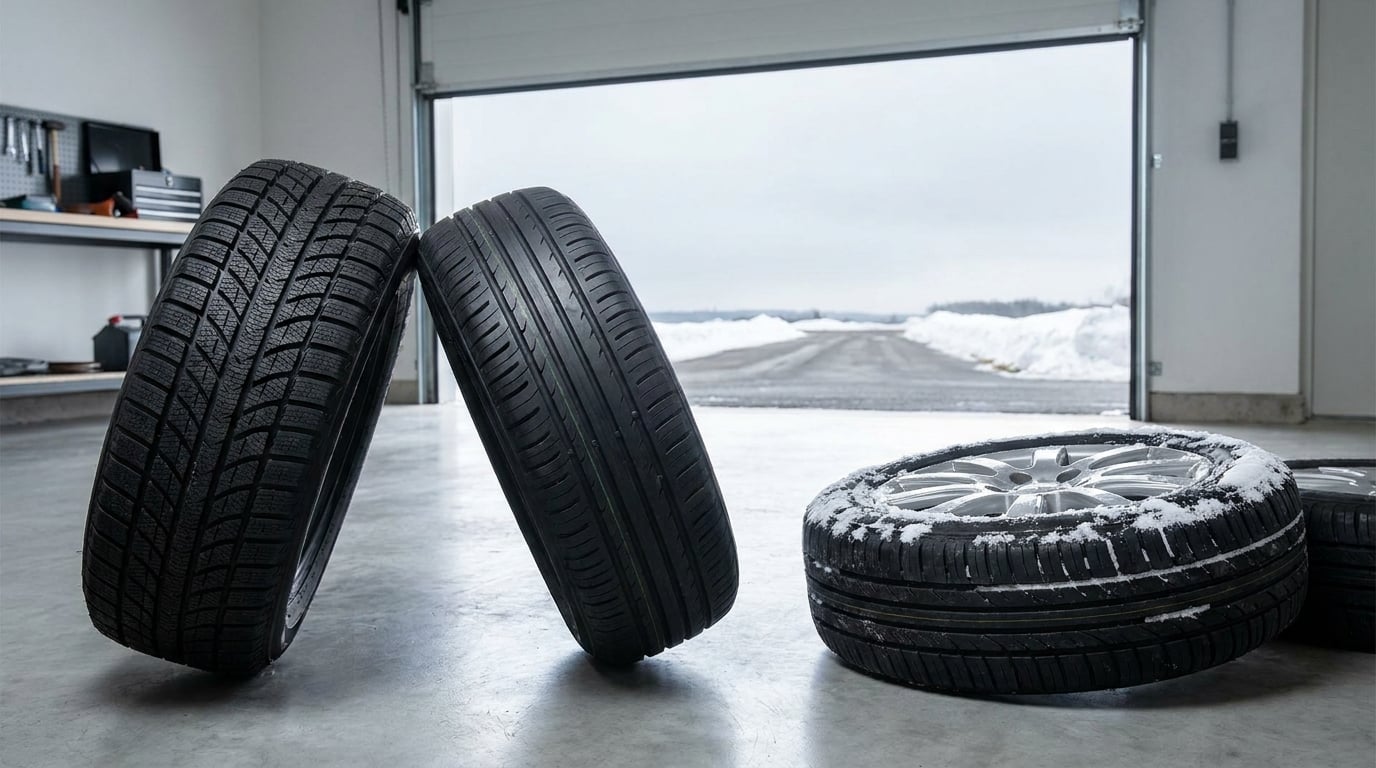
Snow tires use a softer rubber compound that stays flexible in cold weather, while all season tires use a harder compound built to last on warm pavement. Once temperatures fall below about 45°F (7°C), that all season rubber stiffens and loses grip on snow, ice and even cold dry roads, and dedicated snow tires pull ahead.
That single difference decides most of the argument. Everything else, tread pattern, price, storage, lifespan, comes back to it.
The confusing part is the labeling. Snow tires, winter tires, all season tires and all weather tires all get sold in winter, and only some of them are actually certified for it. I have pulled a lot of owner threads on this topic, and the same frustration comes up every time: people paid for “winter” tires that only had an M+S marking and felt let down the first real storm.
So here is the honest breakdown, with a side-by-side table, the stopping distance numbers, and a decision rule by climate.
Table of Contents
- Snow Tires vs All Season Tires at a Glance
- How Snow Tires and All Season Tires Work
- Traction in Snow, Ice, and Wet Weather
- Temperature and the Importance of Winter Rubber
- Costs, Lifespan, and Seasonal Swapping
- Are Snow Tires Better for Every Kind of Winter Weather?
- Which Should You Choose?
- How to Compare the Labels Before You Buy
- Frequently Asked Questions
- Bottom Line
Snow Tires vs All Season Tires at a Glance
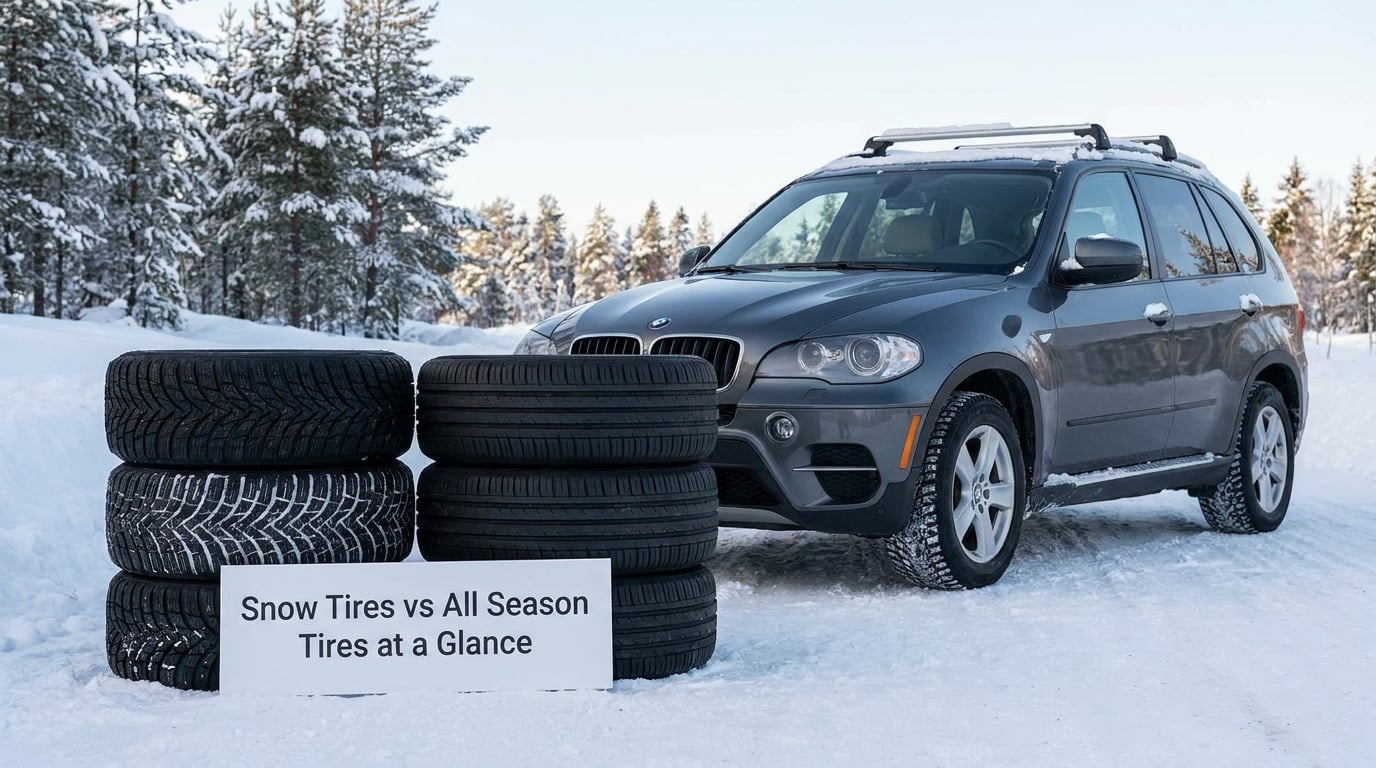
This table covers what actually changes between the two tire types. Read the temperature row first, because everything else follows from it.
| Attribute | Snow Tires (Winter Tires) | All Season Tires |
|---|---|---|
| Rubber compound | Soft, high silica and oil blend that stays pliant in cold | Harder compound tuned for warm pavement and tread life |
| Ideal conditions | Sustained temps below 45°F, snow, slush, ice, freezing rain | Temperatures generally above 45°F, rain, dry and mild winter roads |
| Snow and ice traction | Strong, from dense sipes and biting edges | Weak below the threshold, rubber stiffens and lets go |
| Wet performance | Very good, drains through siped blocks | Very good, usually the better tire on warm wet roads |
| Dry handling | Vague and floaty, especially at highway speeds | Sharper, quieter, more confident |
| Temperature behavior | Weak above roughly 50°F, wears fast and heats up | Holds up warm, loses grip as air temperature drops |
| Tread design | Blocky pattern, many sipes, deep grooves, wide tread | Shallower grooves, fewer sipes, continuous center rib |
| Winter certification | 3PMSF snowflake required to be called a winter tire | Optional, many M+S models are not certified for winter |
| Tread life | Shorter, often worn out with tread still usable in summer | Longer, routinely last three or more seasons |
| Storage | Needs a second set, extra wheels or a swap shop | Stays on the car year round |
| Best fit | Snowbelt regions, rural unplowed roads, sustained sub 45°F winters | Mild winters, highway commuting, low seasonal mileage |
One thing the table cannot show: the gap between these two on packed snow is not a small percentage. It is the difference between a tire that bites and a tire that skates.
How Snow Tires and All Season Tires Work
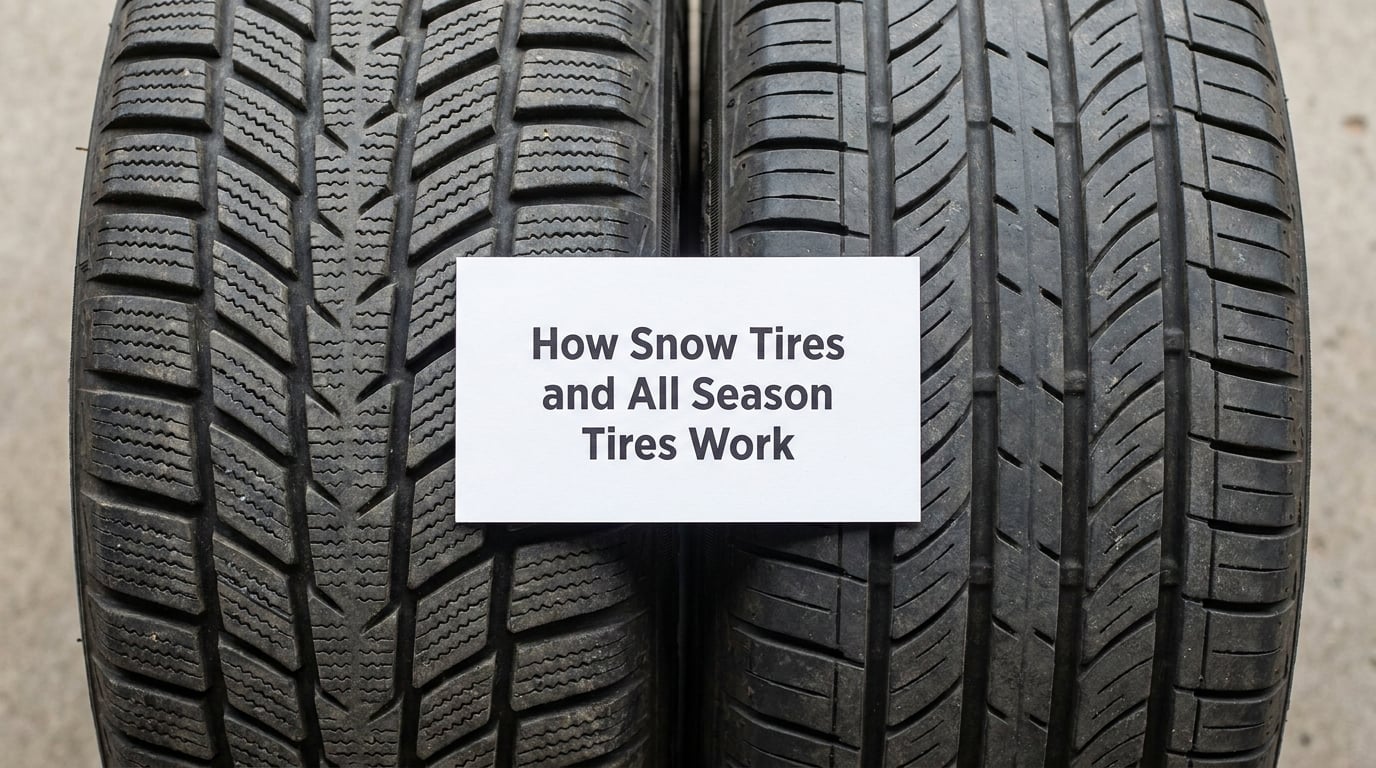
Both tires do the same job with different chemistry. The difference starts in what the rubber is made of.
Winter tire compounds are loaded with silica and processed at a lower temperature so the compound stays soft in cold air. All season compounds are stiffer so they can resist heat build-up and abrasion on warm pavement. Warm pavement rewards hardness. Cold pavement punishes it, because a stiff tread block cannot conform to snow crystals or press into a thin ice film.
Then there is the tread. Winter tires use a blocky pattern with a high siping count, small zigzags cut across the blocks. Owners on tire forums keep correcting the same misconception here: it is the sipes, not the chunky blocks, that create winter grip. Each siping flexes as the tire rolls, giving the edge a biting hook into snow and ice. Our guide to tire siping covers how they work in more depth.
All season tires trade sipes away for a continuous center rib, shoulder blocks and shallow grooves. That rib is why they feel planted and quiet at 70 mph on a dry interstate, and why they are the wrong shape for a snowbank.
Construction matters too. Winter tires often carry a plumper casing and higher tread depth to hold onto slush and resist puncture from ice chunks and road debris thrown up by plows.
Traction in Snow, Ice, and Wet Weather
Braking is where the gap shows up most clearly, which is why most hard data comes from straight-line stopping tests.
The Ontario Ministry of Transportation ran winter tire testing at minus 20°C on 3 to 5 cm of compacted snow and ice over asphalt, braking from 50 km/h. Winter tires needed 38.3 meters on a minivan where all season tires needed 51.1 meters, roughly 33 percent more road. Across the other vehicle classes tested, all season tires took between 20 and 33 percent longer to stop.
On packed snow and slush, the siped winter tread clears slush out from under the contact patch instead of rolling over it. Owners report the same thing in plain language: slushy city streets are exactly where the difference stops being theoretical.
On black ice, winter tires help and nobody pretends otherwise they abolish the risk. A siped edge gives you more bite and more steering feel, so you can make small corrections instead of committing to a spin. Ice under a bridge at minus 10°C will still find you.
In heavy rain at moderate temperatures, the ranking flips. All season tires on warm wet pavement usually outperform winter tires, because the winter tread pattern and soft compound are designed for cold, not standing water at 60°F.
Here is the part most drivers skip: no tire removes the risk of a slippery road. Every winter crash has a driver in it who was going too fast for the conditions, and the best traction in the world cannot brake for you.
Temperature and the Importance of Winter Rubber
The 45°F threshold is not a marketing number. It sits near the glass transition range where a tread compound stops behaving like a flexible elastomer and starts behaving like something closer to rigid plastic.
Below that point an all season tire still looks fine, feels fine steering on a dry road, and shows legal tread depth. It just grips far less. Owners describe the odd sensation of a car that steers normally in cold dry weather and then refuses to stop the moment packed snow appears.
The 3PMSF snowflake is the certification that separates real winter capability from the word snow on the sidewall. It means the tire passed standardized tests for peak traction on snow, and severe snow grip, on top of wet traction and durability. The M+S marking, mud and snow, is far older and much weaker. M+S only says the tread pattern qualifies for mud and light snow. Plenty of M+S tires have never been tested against snow and ice at all.
So the rule of thumb: if average daily temperatures sit below 45°F for a stretch of the winter, you want a 3PMSF rated tire. That can be a dedicated snow tire or a severe snowflake rated all weather tire. Both meet the same bar.
Owner consensus lines up with that. Across tire forums, the recurring advice is simple: below the 7°C mark, winter rated rubber is the safe call no matter what drivetrain you have.
Costs, Lifespan, and Seasonal Swapping
The reason most people stay on all season tires is not ignorance. It is math, and it is legitimate.
Owning a second winter set means buying a second set of tires plus a second set of wheels, because mixing wheel styles on one car is painful. Add mounting and balancing twice a year and somewhere to store four tires and four wheels through the warm months. For a lot of households, that storage space is the real blocker, not the money.
Winter tires also wear fast on warm pavement. Run them a week too long in spring and you will watch tread disappear. Frequently replaced before they ever see warm weather, they still have usable life left, which frustrates owners who see three years of service out of four dollars of tread.
Then there is the low mileage problem. If you drive maybe 2,000 miles a winter, two or three winters of real snow use can chew through a set. The tires wear out from age and storage cycles before they wear out from miles. That is a genuine reason to pick a severe snowflake rated all weather tire instead, and it comes up constantly in owner threads.
Expect a small fuel economy penalty too. Winter tire compounds and tread patterns drag more at highway speed, and the effect on fuel economy is usually modest but measurable over a full winter of commuting.
One myth to kill while we are here: all wheel drive does not create traction. AWD helps you move, brake and steer, but it puts the same tire on the road. Drivers on snow are far safer with winter rubber and two driven wheels than all season rubber and four.
Are Snow Tires Better for Every Kind of Winter Weather?
No. A snow tire with 75 percent of its tread left will still out-brake a brand new all season tire on snow and ice, and it will still lose to that new all season tire on dry warm pavement.
This is where the label confusion does the most damage. Snow tires and all season tires carrying the 3PMSF rating are both winter rated, but they are built for different jobs.
A dedicated snow tire is soft, deep and quiet-minded. Below 45°F that is exactly what you want. Above roughly 50°F it heats up, wears quickly and gives vague steering feel. Owners with rear wheel drive cars consistently report the biggest improvement in slush and packed snow.
An all weather tire with the 3PMSF rating splits the difference. It holds up better on warm dry roads, lasts longer, and still carries the winter certification. It is the middle option most snowbelt drivers underuse, and forum regulars describe it as not your best option for deep winter, but far better than a three season tire.
Cold but dry is the case people get wrong. On a clear, cold, salted suburban road with no snow on the ground, both tire types work, and an all season tire can feel better. Sustained cold plus actual snow or ice is where the choice actually matters.
Which Should You Choose?
Match the setup to your winter, not to a brand. Here is how the decision breaks down.
| Your situation | Best choice | Why |
|---|---|---|
| Snowbelt region, average winter temps well below 45°F | 3PMSF snow tires | Biggest traction gain where hazards are routine |
| Rural or unplowed roads, steep driveways, hilly commute | 3PMSF snow tires | Clearing slush matters more than dry handling |
| Mild winters, occasional frost, snow that melts in a day | Severe snowflake rated all season or all weather | Covers the cold snaps without a second set |
| Low seasonal mileage, maybe 2,000 miles a winter | Severe snowflake rated all weather tire | Will not age out before it wears out |
| Year-round commuter, high mileage, moderate winters | Severe snowflake rated all weather tire | One set, good in summer and snow |
| Southern climate, essentially no snow | Standard all season tires | Nothing to gain and tread life to lose |
| BMW or other sport sedan on all season tires in the snowbelt | 3PMSF snow tires, second wheel set | Rear or all wheel drive performance cars depend on grip more than most |
BMW owners come up constantly, and the pattern is consistent. Once a rear wheel drive or xDrive car gets winter rubber on it, drivers describe the car as transformed in the snow. Plan on separate wheels so the swap takes minutes and nobody is doing it in a parking lot at minus 5°F.
Switch timing is easy. Put winter tires on when average daily temperatures drop below 45°F for about a week, usually late fall. Take them off once average highs climb back above 45°F, usually in spring. That rule protects winter tread from heat wear and keeps your all season tires from sitting in cold conditions where they belong.
How to Compare the Labels Before You Buy
Turn the tire over and read the sidewall. Everything you need to compare two tires is printed there.
Start with the size, which looks like 225/50R17. The first number is section width in millimeters, the second is aspect ratio, R means radial, and the last is rim diameter in inches. Your door jamb placard lists the factory and acceptable cold pressure sizes. Match the placard, not what is on the tire currently installed, because a mismatched tire can break the speedometer and change the effective sidewall height.
Next is the speed rating, a letter such as V or W, which is the maximum sustained speed the tire is certified for. W-rated tires are common on performance sedans and are fine on snow tires if the manufacturer allows it, but a lower-rated tire caps your speedometer electronically.
Then the wear grade number, a multiple of 3 that measures tread wear resistance. A 220 grade on your summer set and a 160 on your winter set is normal and not a defect. Winter tires are graded lower precisely because their soft compound gives up sooner on pavement.
Traction grades follow, lettered A, B and C for wet grip with A as the best. Then the two markings that matter most in winter. 3PMSF is the snowflake, the real winter certification. M+S is mud and snow, a much weaker claim about tread shape only. The Ice Grip symbol, a bare snowflake inside a mountain peak, is a third separate rating you may see on European and some specialty tires.
Check the tire age too. The final four digits of the DOT code are the week and year of manufacture, and tire shops treat anything more than about six years old as old stock even if it still shows full tread.
One more cold weather habit worth building: air pressure falls roughly 1 psi for every 10°F the temperature drops, which is why tire pressure warning lights start chiming on the first cold morning of the season. Recheck pressures cold, monthly through winter, and never bleed air off a warm tire. Our winter tire PSI guide covers the numbers, and storing tires over the summer matters if you are running two sets.
Frequently Asked Questions
Are snow tires required in the US?
Almost nowhere. A handful of states and mountain passes have seasonal traction requirements, and some mountain chains or approved traction devices are mandated during storms, but no state requires winter tires on private vehicles year round. Canada is different: several provinces including Quebec and New Brunswick require winter tires on passenger vehicles for part of the year. Check your own state rules before planning a mountain trip.
Do all-season tires work in snow?
They work, but not well below about 45°F. Ontario Ministry of Transportation testing at minus 20°C found all season tires needed 20 to 33 percent more stopping distance than winter tires on packed snow and ice. All season tires are fine for a light dusting that melts quickly and for cold dry pavement. They are the wrong choice for sustained cold with snow, slush or freezing rain.
How much colder is too cold for all-season tires?
The widely used line is 45°F, or 7°C. That is roughly where an all season compound stiffens enough to lose meaningful contact patch grip on cold surfaces, dry or snowy. If your average daily temperature sits below that for a week or more, you want 3PMSF rated rubber, either a dedicated snow tire or a severe snowflake rated all weather tire.
Can I use winter tires in warm weather?
You can, but it is a bad trade. Winter tire compounds soften and heat up above roughly 50°F, tread wears several times faster than on all season tires, and wet braking distance gets worse on warm rainy pavement. Winter traction also disappears above about 70°F. Swap back once average highs climb past 45°F rather than running winter tires through the spring.
Is a severe snowflake-rated all-season tire as good as a snow tire?
Not quite in deep winter, and often better overall. A 3PMSF rated all weather tire handles snow, ice and freezing rain far better than a standard all season while lasting longer and staying quieter on warm dry roads. Dedicated snow tires with more tread and sipes still stop shorter on packed snow. For most drivers, the all weather tire is the easier and cheaper compromise.
Bottom Line
Use certified winter tires, marked 3PMSF, when cold temperatures and real winter hazards are routine in your driving. They are the only setup that meaningfully shortens stopping distance on packed snow.
Use a severe snowflake rated all season or all weather tire when that is enough for your roads, especially if you drive few winter miles and would rather own one set. And stay on standard all season tires in mild climates where snow and ice are occasional.
Whichever you pick, read the sidewall before you buy, match the size to your door placard, and check pressures cold once a month through the winter. Updated for 2026.