
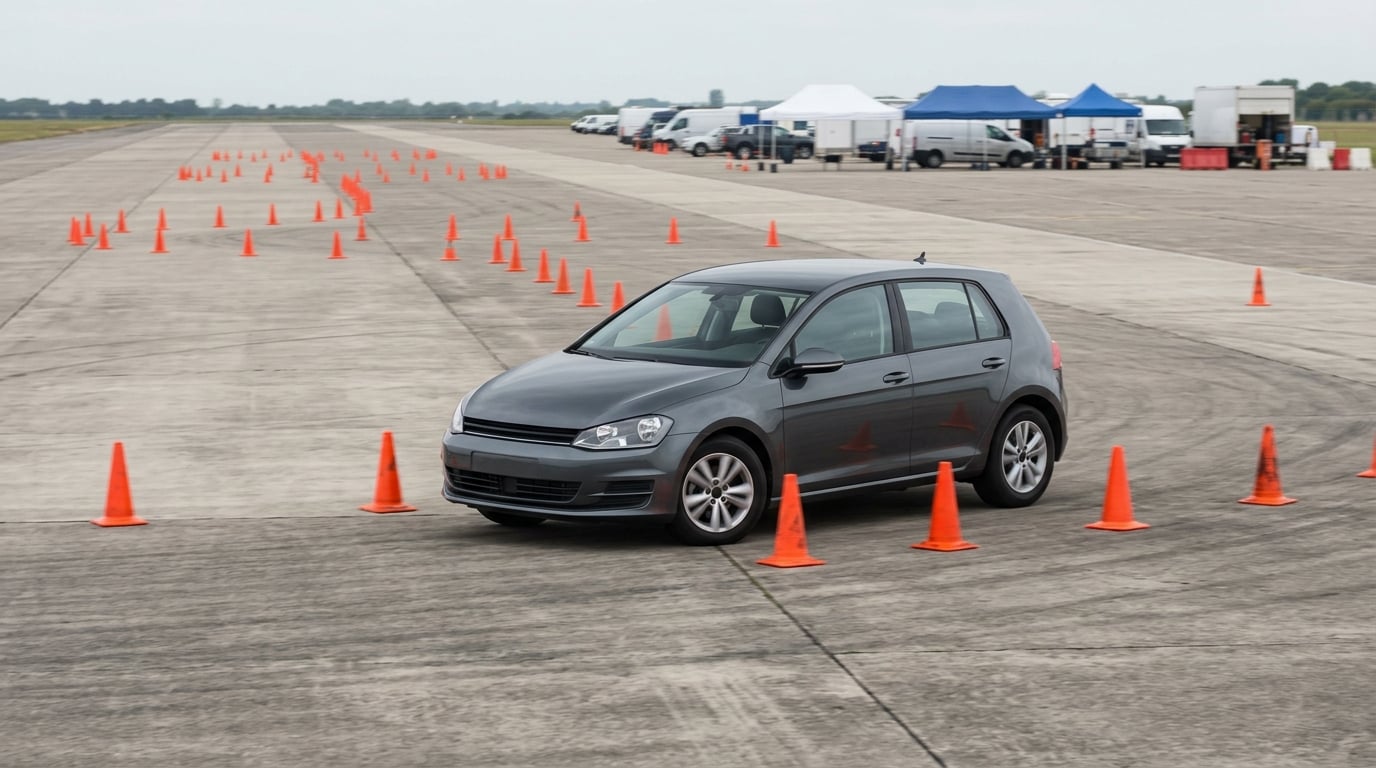
Autocross is a timed motorsport where drivers run a short, twisty course marked by cones, one car at a time, on a closed airfield or parking lot. What to expect at your first autocross event is mostly logistics: register online, park in the paddock, get your car teched, walk the course, and post a single timed run that usually lasts about a minute. No race cars, no roll cages, no experience required.
The hardest part of a first event is not driving. It is not knowing what is about to happen. So here is the whole day in order, what to bring, what to buy (which is almost nothing), and what your first sixty seconds on course will actually feel like.
Table of Contents
- What Is Autocross and How Does It Work?
- What Happens at Your First Autocross Event?
- How Are Autocross Classes Assigned?
- What Equipment Should You Bring?
- What Happens During a Typical Run?
- How Do You Drive Your First Autocross Course?
- What Is a Typical Beginner Autocross Course Like?
- How Is Autocross Scored?
- Should You Prepare Your Car or Tires First?
- What Should You Do During the Course Walk?
- What Common Mistakes Should Beginners Avoid?
- How Can You Improve Between Events?
- Frequently Asked Questions
- Conclusion
What Is Autocross and How Does It Work?
Autocross is a motorsport in which cars are driven one at a time around a tight, very twisty course marked by cones, also called pylons. Each run is timed to one one-thousandth of a second, and the cones define the boundaries, the gates you must pass through, and the corners you must not cut.
Under SCCA rules this is called Solo, and the two common formats are Solo I and Solo II. Solo I is a test and tuning format where you get feedback and unlimited runs. Solo II is the competition format most beginner events use: three runs, your best one counts, and the rest count for class standings only.
Two ideas carry the whole sport. The first is that you drive one car alone, so there is no traffic, no other driver to avoid, and nowhere to be except the cones. The second is that autocross is not about reaching the top speed your car can do. Average speeds on a beginner course are often in the mid-30s to 40 mph, yet it feels far faster from inside the car because you are constantly braking, turning, and accelerating back at it.
What Happens at Your First Autocross Event?

Times vary by region, so treat the clock below as a shape rather than a schedule. A typical SCCA region event runs something close to this.
- Register online in advance. Nearly every event lists on MotorsportReg or on the region website. Pay the entry fee, sign the waiver, and note the official start time. Arriving after the first run group has gone out is the most common first-timer mistake.
- Arrive when the gates open and park in the paddock. The paddock is the open area where competitors park, work on cars, and hang out. Regulars on the r/Autocross advice threads tell newcomers the same thing repeatedly: park in the paddock, not out in the spectator grass. That is where people will talk to you.
- Check in and get in a run group. At the registration table you hand over your waiver, get your run group or heat assignment, and learn whether you are in a novice group that goes out first or in a combined group.
- Get through tech inspection. A tech inspector walks around the car and checks the basics. Organizers report the same two failures over and over: an unsecured battery, and a positive battery terminal that is not covered.
- Put on your class number and your helmet. Solo rules require a class number, typically painted in a contrasting color and at least 8 inches tall, on both sides of the car. Painter’s tape and a marker are the traditional method and they work fine.
- Do the course walk. Most events run a guided walk for novices. This is the single most useful twenty minutes of the day, and skipping it is why people get lost.
- Attend the driver’s meeting. The organizer covers rules, flags, penalties, weather calls, and any course changes. It is short and it is where the official answers to your questions live.
- Run your group. Cars are released to the start line one at a time in rotation. You get several runs spread across the session with waits in between, which is when you watch other cars and start learning the layout properly.
- Collect results and go to the awards. Times are posted, trophies or gift cards are handed out for class wins, and everyone hangs around. The paddock socializing is regularly described in the forum threads as the best part of the day, not the runs.
How Are Autocross Classes Assigned?
Classes group cars by vehicle type and by modification level, not by how fast you are. Under SCCA Solo Cars rules a stock road car with street tires might run in one class, while the same car with a limited-slip differential and better tires moves up a class or two. Spend enough on a car and it can jump several steps, which is exactly why the sport discourages beginners from spending anything.
What classes do not do is rank you by experience. A slow beginner and a fast beginner in the same car are in the same class, competing against each other. That is good news, because the person setting the pace in your class is usually someone with more seat time than you, not a better car.
Do not guess your class. The SCCA publishes a class lookup by vehicle, and the event’s tech and registration staff assign you on the day. If you are unsure, ask the organizer at check-in, and ask what class your car runs in with no modifications at all. Regional clubs that are not SCCA affiliates run their own class structures, so the organizer’s answer beats anything you read online, including this.
What Equipment Should You Bring?
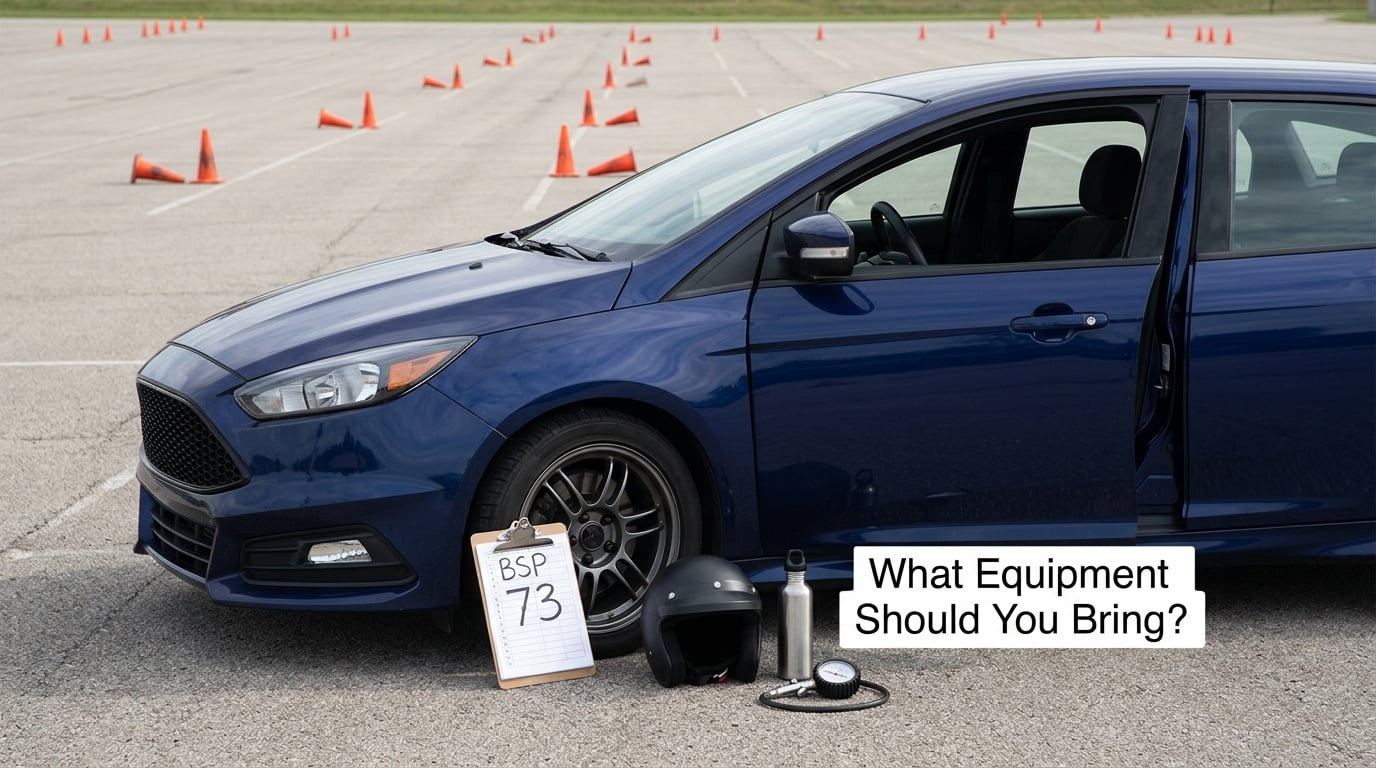
Most events do not require you to own a helmet, and that removes the usual first barrier. Solo rules ask for a helmet certified to SNELL, FIA, or SFI standards. A DOT-certified automotive helmet is not accepted for competition use. Many regions keep a handful of loaner helmets at the tech table, and organizers will tell you before the event whether one is reserved for you.
Bring this and you are covered:
- A certified helmet if you own one, current, undamaged, and in date. Check the certification sticker, not the brand.
- Water and something to eat. You will be outside for hours and you will be walking the course more than you expect.
- A tire-pressure gauge. A pocket model is fine. Checking pressures warm, before the session, is a good habit and forum regulars are firm that they should not sit above the number on the door jamb.
- Painter’s tape and a marker for a class number, if the event asks you to supply your own.
- Closed-toe, flat-soled shoes. Sneakers are the norm. Thin soles give you no feedback and sandals are not allowed.
- A basic tool kit if you want to check anything on the car yourself. Our guide to the basic tools every car owner should keep covers the sensible minimum.
- Sun protection and a spare layer. There is usually very little shade in a paddock and it can be hotter than you expect.
What not to bring: money for parts, a trailer of spare wheels, or a plan to make changes. The first event is for learning the format, not for setting up a car.
What Happens During a Typical Run?
A run is roughly a minute long and it starts when the person at the start line waves you forward. A course worker releases cars, watches for a stalled vehicle or an incident, and closes the course if something needs attention. You come back down a return lane, called the X-course, and go to the staging area until your next rotation.
| Phase | What is happening | Where your attention goes |
|---|---|---|
| Staging | You wait in a car line, usually pointed at the first cone | Nothing. Do not rev, do not launch early |
| Launch | The starter waves you out and you roll forward on a countdown | First gear only, then breathe |
| Early section | Usually a first corner or box right after the line | Look two corners past the one you are in |
| Technical middle | Slaloms, transitions, hairpins, and sweeps in some order | Fixed steering, no hands crossed, no trail braking yet |
| Back straight | The only place you are near full throttle | Straighten the wheel before you press it |
| Finish and cool-down | Cross the finish, take the cool-down lane, return to staging | Do not skip the cool-down lane |
You will be slower than you want to be on the first run, and that is the normal result. A newcomer on a first event is often many seconds off the pace of a regular in the same car, and the repeated advice in every beginner thread is to ignore the time entirely and just finish the course.
How Do You Drive Your First Autocross Course?
Look ahead. This is the whole technique in one sentence. Your car goes where the front wheels point, so your eyes need to be two corners past the one you are driving. Beginners who stare at the cone in front of them arrive at every corner already out of position.
Turn the wheel smoothly and only as much as needed. The temptation on the first run is to saw at the wheel through a slalom, and that scrubs speed and unsettles the car. Small, continuous inputs work better than big ones.
Drive the same line every run. Consistency is worth more than bravery in your first hour. A tidy lap you can repeat is how you find the tenths later, and a fast first run followed by five scrappy ones leaves you with nothing to show.
Respect the cone limits. A cone is a marker, not a wall, and if you touch one you pick up a penalty that costs far more time than the corner would have. Give yourself a small margin on the outside of every cone and let the car breathe.
Leave yourself an exit. Before you enter a corner, know where you would go if it went wrong. In a cone course that usually means arriving a touch slower than your ego suggests. Slowing down is measurably faster, and it wears your tires less, which is the most repeated tip in the forum advice on this sport.
What Is a Typical Beginner Autocross Course Like?
Courses are laid out to use whatever space is available, so no two are the same. But a handful of features show up at almost every event, and each one tests a different thing.
Slalom
Evenly spaced cones you weave through without braking. It tests smooth hands and patience, and it punishes anyone who tries to power through it. A slalom at the end of a straight is where beginners most often spin the car.
Transition
A tighter corner right after a faster one, sometimes with only a single cone of separation. It tests whether you can change direction without lifting and stamping on the brakes, which is the real skill here.
Hairpin
A near-180 degree turn, usually taken at low speed. This is where novices learn to rotate the car with steering and throttle rather than with the brake pedal. It is forgiving and it is a good confidence builder.
Sweep
A long, constant-radius corner. Sweeps are the place where drivers are tempted to carry too much speed early, run wide, and lose the whole corner. Being smooth through a sweep is usually faster than being brave.
Box
A tight rectangle of cones you must enter and exit without clipping anything, often right after the start. It is the feature that catches out first-timers, because it comes before you have settled into the car.
Back straight
Every course has one, and it is where you finally get to use some of the engine. It is also a trap, because arriving at it sideways from the last corner throws the car off line for the whole run.
How Is Autocross Scored?
Your score is your best clean run, timed to the thousandth, and every cone you disturb adds to that time. In a run, cones you touch or knock over are set aside as penalty cones, and a gate you miss entirely is a DNF, which usually means the run does not count.
| What you did | What it usually costs | How to recover |
|---|---|---|
| Knocked one cone | Two seconds added to your time under standard Solo rules | Nothing. It is a normal first-event outcome |
| Knocked three or more cones | Four seconds added, plus the cone cost | Look further ahead next run |
| Missed a gate completely | DNF for that run | Follow the arrows, and walk the course before your group |
| Spun and stopped | DNF, and the car waits for the course worker | Stay put, hazards on, hands off the wheel |
| Clean run | Nothing added | Now go again and beat it |
This is why the fastest possible time is not the winning strategy. A brave lap that collects four cones is often several seconds slower than a tidy lap, and the standard penalties are only part of the story: the mistake itself almost always cost you more time than the penalty charges.
After the session, times are sorted within each class, not across the whole event. A class win in a slow car is a class win. Awards are usually modest, sometimes nothing more than a trophy or a small gift card, and nobody has ever asked a beginner what they drove.
Should You Prepare Your Car or Tires First?
Buy nothing before your first event. This is the advice regulars give on the forums more insistently than any other, and it is the advice that will save you the most money. Tires, a limited-slip differential, and a set of brake pads are all improvements, and all of them can wait until you know you like the sport.
What you should do is put the car through a sensible baseline check so it is safe and so it passes tech.
| Task | Why it matters | When to do it |
|---|---|---|
| Clear the cabin and trunk of everything, including floor mats | Loose items become projectiles in a hard stop, and a mat under a pedal is a real hazard | The night before |
| Secure the battery and cover the positive terminal | The two most common tech failures organizers see | The week before |
| Check tire age, tread depth, and pressure cold | Old rubber is the biggest mechanical risk you carry to an event | Before you leave, then again warm at the event |
| Check brakes, lug nut torque, and visible leaks | Tech inspects look for exactly this and will send you home for it | One to two weeks before |
| Confirm the car is not a rollover risk | Tall vehicles are not eligible, and a rough guide is if it is taller than it is wide | Before you register |
| Check that controls work freely | Throttle return, steering, and brakes are all inspected | Event morning |
On tire pressure, expect conflicting advice, because there is a real debate. Some people run the door-jamb number, which is a cold highway number and is roughly right for street use. The long-standing autocross practice is to run noticeably higher cold pressures, often in the upper 30s, because a hard lateral push on a lower-pressure street tire is what rolls it onto its sidewall. Over-inflating past the door rating reduces grip, so the practical answer is to stay at or just under it cold and check that the warm reading is not climbing above it during a session.
If your pressures have crept up over the day, uneven wear across the tread is a related symptom worth understanding. Our explainer on tire feathering covers what causes that pattern and how to address it.
On the question of whether autocross is hard on the car: brakes and tires take the beating, and if you drive within your grip you will go through more of both than you expect. The engine sees far less stress than people fear, because there is almost no sustained high-load cornering and very little time at full throttle. Nobody’s oil-starved. Check levels before and after your first event and you will have your own answer.
What Should You Do During the Course Walk?
Walk the course at walking pace and use a repeatable order, so you do not miss the same corner twice. Start at the start line, since beginner groups start every novice and other participants will follow you out.
From there, work through the course in this order: find the finish line and the finish gate, identify every major corner by type, note where cones sit close together, spot the hazards, and then commit to one workable first-line plan.
On corner types, drivers use shorthand like “hairpin,” “sweep,” and “transition.” If you do not know a term, describe the shape instead. It is more useful to note “tight left, then wide right” than to guess at a name. Advice threads on the dfkitcar.com forum make the same point: getting lost, missing a gate, or asking someone which way to go is so common on a first run that regulars do not even remark on it.
Finish the walk with two things written down or remembered. One is the single place on the course you are most likely to get confused. The other is where you will be slowest. Both are worth focusing on in your first two runs and ignoring afterwards.
What Common Mistakes Should Beginners Avoid?
Going too fast on the first run. Everyone does it. The result is usually a cone, a missed gate, or a stop in a place the course worker has to sort out, and it feels worse than driving at seventy percent would have.
Sawing at the wheel. Sharp, back-and-forth inputs through slaloms are the single most obvious habit a novice brings to the sport. Fixing it is mostly a patience problem, not a strength problem.
Looking at the cone in front of the car. You will be late to every corner and you will arrive at each one already correcting.
Braking late and hard, then trying to steer. Cars on street tires will not hold that, and the correction will take you into cones.
Chasing a time before you can read the course. The drivers who post a fast first run usually post nothing after it. Finish your first two runs cleanly and the rest of the day gets interesting.
Buying parts. Suspension, tires, brake upgrades, and limited-slip differentials all come up in conversation at every event, and every one of them is a decision to make after a few weekends, not before the first one.
Leaving the course before you are released. Stay in your car, keep your hands on the wheel, turn on your hazards, and wait for direction after a spin or a stall. Course workers control the course for a reason.
How Can You Improve Between Events?
Improvement in autocross is mostly familiarity. Most of a beginner’s first-event time is lost not to driving skill but to not knowing where the course turns, which corner is the hairpin, and how much room there is after the box.
So the first step is repetition of the course, not of speed. Run the same event layout again, or a different one at the same site, and watch how much of the course you can describe from memory after one lap. A lot of drivers say their second event feels like a completely different sport from the first, and it is almost entirely because they stopped being surprised.
Second, use the data the event gives you. If results are posted, look at where your times changed between runs. The run where you lost two seconds is a corner, not a feeling, and it is specific enough to work on.
Third, ask for coaching. Novice groups usually have an instructor available, and ride-alongs or in-car instruction are the normal way people learn. Regulars genuinely want new people in the sport; threads on forum.miata.net from decades ago still carry the same advice, which is that beginners get offered unsolicited coaching constantly as long as they are approachable about it.
One limit worth stating plainly: do not practise this on public roads. Every technique described here, at speeds the public will not tolerate, with consequences that a cone course does not have. The whole appeal of autocross is that the consequences are two seconds and a cone.
Frequently Asked Questions
Do I need competition experience to enter an autocross event?
No. Most events include a novice run group, and SCCA Solo rules do not require prior experience, a license, or a road racing history. You need a street-legal car that passes tech, a signed waiver, a certified helmet if your event requires you to supply one, and an entry fee. Plenty of people have run their first event in a hand-me-down sedan with zero modification. If you are nervous, tell an organizer or a paddock regular before your first run and you will usually get a walk-through and a few tips for free.
What kind of car can I use for my first autocross event?
Almost any street-legal car that is safe and mechanically sound, as long as it is not a rollover risk. A rough eligibility guide organizers use is simple: if the vehicle is taller than it is wide, it probably cannot run. Most sedans, hatchbacks, coupes, crossovers, and wagons are fine. Modifications are not required and buying them before your first event is discouraged. Ask the organizer to classify your car, and do not guess at the class yourself.
How much does it cost to enter an autocross event?
Per-event entry fees at most SCCA region events fall in the low tens of dollars, with optional extras such as a season membership, extra runs, or a tech service. Tires are usually your only real expense, and a set will outlast many events. Novice and club-level events are considerably cheaper than track days, which is the main reason people start here. Fees vary by region and change over time, so check the current listing for your event rather than trusting a number you read online.
Can I run in the rain or cold weather?
It depends on the event, and the decision belongs to the organizer. SCCA Solo rules allow events in the wet, and plenty of clubs run rain or cold-weather dates, though some events are cancelled or shortened when conditions turn. Cold is usually more of a tire and pressure issue than a safety one: check your pressures warm and know what your tires need as temperatures drop. Our guide to what PSI car tires need in winter covers the seasonal part of that.
Why did I receive penalty cones during my run?
You touched or knocked over a marked cone. Penalty cones are set aside during the run and added to your time, usually two seconds each under standard Solo rules, with a larger penalty for hitting three or more. Missing a gate completely is a DNF instead. It is not a judgement about your driving and it is not unusual on a first run. The fix is simply to give the cones a little more room and to look further ahead through the corner.
How should I handle nerves before my first run?
Do the course walk properly, then drive at seventy percent for your first run on purpose. Nerves usually come from not knowing the layout, and the layout is knowable in one careful walk. Nobody in the paddock is watching your time, and the regulars will tell you that a clean first run matters more than a fast one. Expect to be far slower than the leaders, because everyone was on their first event once. If you stall or spin, stay in the car with your hazards on and wait for the course worker.
Conclusion
Your first event comes down to five things. Register early, ask the organizer to classify your car, empty it of every loose item and get through tech, walk the course before your group goes out, and drive your first run looking two corners ahead at seventy percent pace.
Buy nothing, modify nothing, and ignore your time. Everything else, the class list, the tire debate, the pressure numbers, and the upgrades people will offer to explain, matters from your second event onward. The best first event to have is the one where you ignore the clock entirely and spend the rest of the day in the paddock talking to people who have all been where you are.