
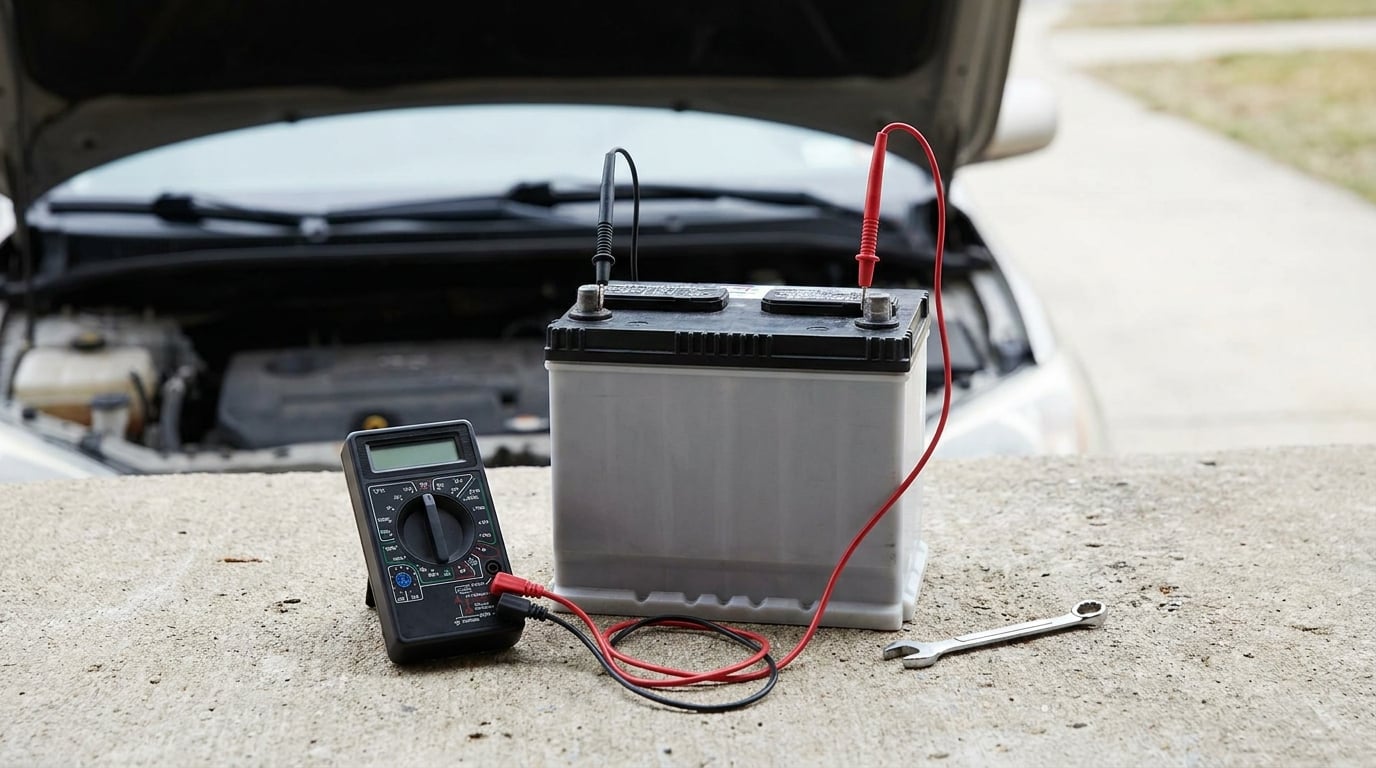
A car battery test takes about five minutes and tells you in that time whether your battery holds a charge, whether it can deliver power under load, and whether the alternator is putting out enough voltage to keep it topped up. A digital multimeter set to DC volts is the only tool you really need, and if you have never touched a multimeter before you can still do this in your driveway with the engine off and a pair of gloves.
That matters because the symptoms are useless on their own. A slow crank, dim headlights or a battery light on the dash tell you something is wrong but not what, and swapping a healthy battery because the car would not start one morning is a common and expensive way to leave the actual problem untouched.
Table of Contents
- What You Need
- Step-by-Step: How to Test a Car Battery at Home
- Step 1: Inspect the Battery and Connections
- Step 2: Measure the Battery Voltage With a Multimeter
- Step 3: Test the Battery During Cranking
- Step 4: Check the Charging System With the Engine Running
- Step 5: Interpret the Results and Decide What to Do Next
- How temperature changes the numbers
- Flooded, AGM and lithium batteries do not share the same chart
- When the battery tests fine but dies overnight
- Common Mistakes
- Frequently Asked Questions
- What is a good voltage for a car battery when it is fully charged?
- Can I test my car battery with a multimeter while the engine is running?
- What does 12.2 volts mean for a car battery?
- Does a multimeter test whether a car battery is actually bad?
- How much voltage should the battery show while the engine is cranking?
- Do I need to disconnect the car battery before testing it?
- Conclusion
What You Need
Most of the list is cheap and a few items you probably already own.
- Digital multimeter with a DC voltage range. Any accurate meter in the 20V DC range works for a 12V system, and auto-ranging models remove the guesswork about which dial position to pick.
- Safety glasses and nitrile gloves. Lead-acid batteries vent explosive hydrogen gas when charging or frozen, and the acid inside will burn skin.
- Terminal cleaning kit or a wire brush and a solution of baking soda and water, plus a rag.
- A helper for the cranking test, or probe clips if you are working alone.
- Owner’s manual, mostly for the battery location and for any warnings specific to your vehicle.
- Optional: a load tester or conductance tester if you want a definitive pass or fail on battery health rather than a state of charge reading.
Before you start, note the battery date code stamped on the top of the case. Batteries are dated with a week and year letter code, and anything past four to five years old deserves suspicion no matter what the voltmeter says.
One more preparation step that people skip and then regret: let the car sit for at least an hour, and ideally overnight, after driving or charging. A battery right off the road holds a surface charge that can read half a volt higher than the real figure. If you cannot wait, turning the headlights on for a minute burns most of it off.
Step-by-Step: How to Test a Car Battery at Home
Step 1: Inspect the Battery and Connections
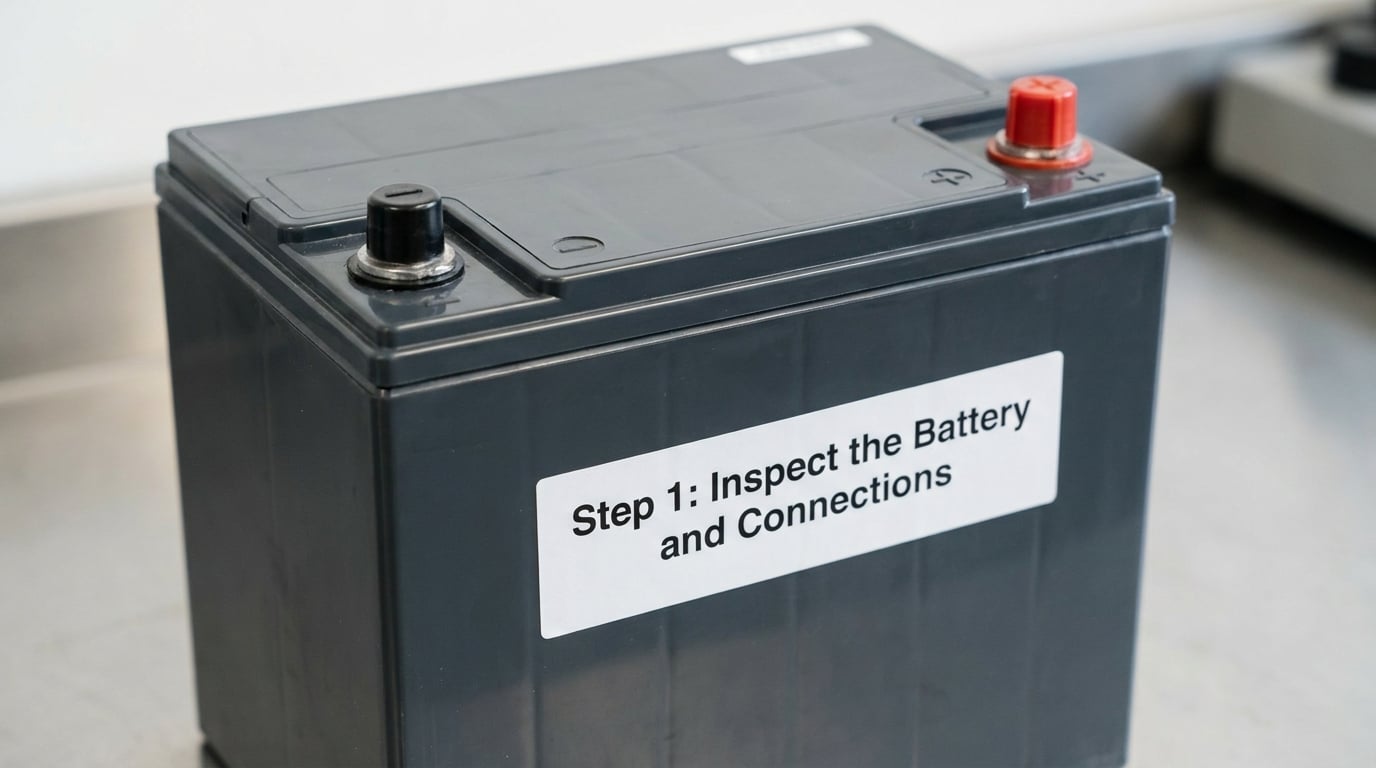
Corroded terminals are the single most common reason a good battery tests bad, so look before you measure. Pop the hood, find the battery (under the hood on most cars, in the trunk or under the rear seat on many European models including plenty of BMWs) and look at the cables where they clamp onto the posts.
White or greenish powder on a terminal means corrosion. Squeeze the clamp and check that the cable is tight; a loose clamp looks fine and measures terrible. Also look at the case itself for cracks, bulging sides or a hiss of acid. A swollen or leaking battery is finished, and you should stop testing it and take it to a shop.
Clean what you find. Scrub the corrosion off with a stiff brush and the baking soda solution, rinse with plain water, dry, and refit the cables. Do this before taking any reading, otherwise you are measuring the connection rather than the battery.
Step 2: Measure the Battery Voltage With a Multimeter
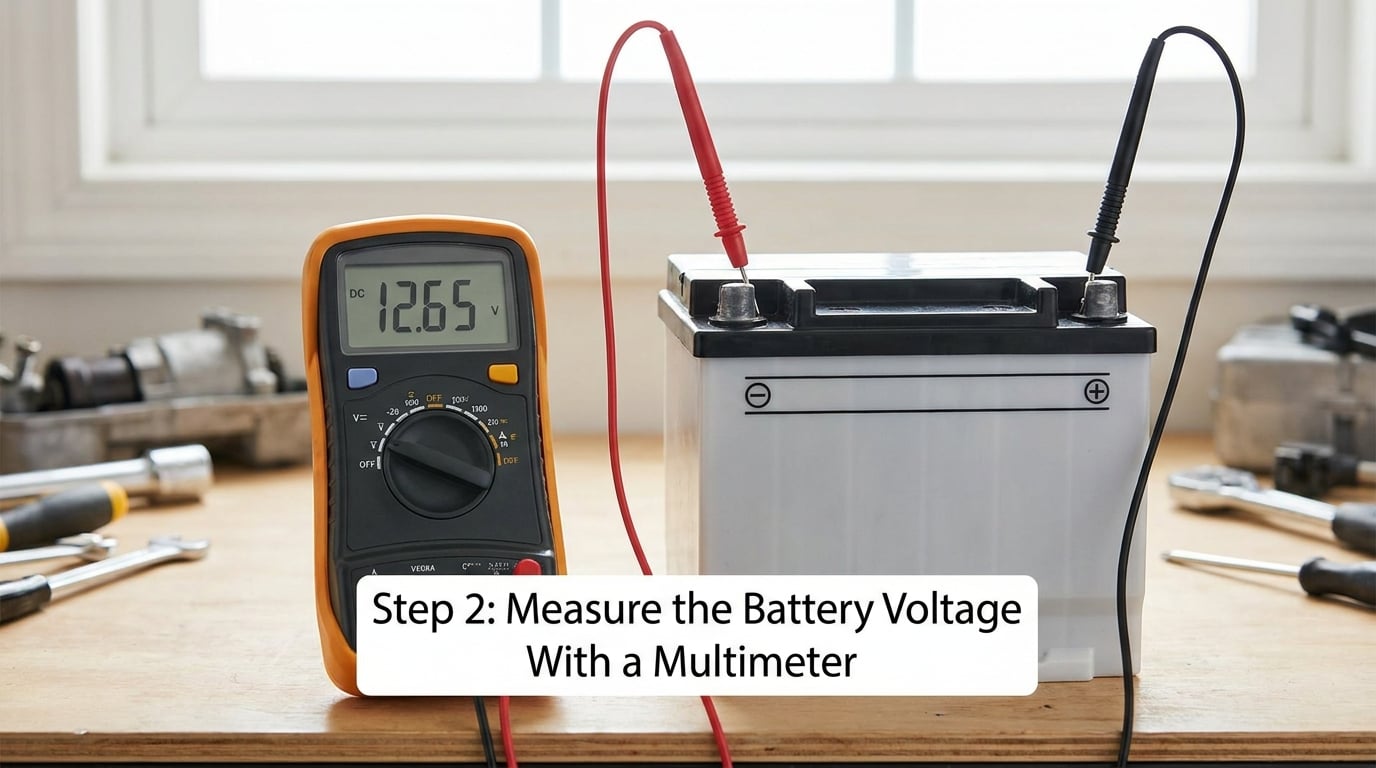
Set the meter to DC voltage in the 20V range. On a manual dial, look for the straight line symbol next to the 20V position, not the wavy one, which is AC. Plug the black probe into COM and the red probe into the V socket, and confirm the meter reads roughly 0.00 before you go near the car.
Touch the black probe to the negative terminal and the red probe to the positive terminal. The reading should appear almost instantly and stay steady.
| Resting voltage | State of charge | What it means |
|---|---|---|
| 12.70V or higher | Fully charged | Healthy, no action needed |
| 12.60V | About 100% | Good condition |
| 12.50V | About 90% | Normal for a car that sits a lot |
| 12.40V | About 80% | Still fine, top it up with a charger |
| 12.30V | About 75% | Acceptable, watch it |
| 12.20V | About 50% | Discharged. Charge it fully, then retest |
| 12.10V or lower | Below 50% | Deeply discharged or sulfated |
| 12.00V or lower | Near empty | Failing or dead, plan a replacement |
This is a state of charge table, not a health table. A battery can sit at 12.6V and still be too weak to start the car, which is exactly what the next step catches.
Step 3: Test the Battery During Cranking
Keep the probes clamped on the same terminals and have your helper turn the key to crank. Watch the meter while the starter turns over, not after the engine catches.
During cranking the voltage should dip but stay above about 9.6V on a healthy battery, and the engine should start within a second or two. A reading that collapses to 10.5V or lower while the engine cranks is the classic sign of a weak battery, and it is the answer to the question people ask most often on mechanic forums: yes, 10.5V during cranking means the battery is on its way out even if the resting reading looked perfect.
Listen as well as measure. A heavy, grinding or slow whir means the battery cannot deliver current. A fast clicking sound that stops immediately means the battery is so discharged the starter never engages. If the engine cranks at normal speed but the voltage dips to 11V, the battery is fine and the starter is drawing too much, or the alternator is not charging and the battery arrived at the test already low.
If you are alone, clamp the probes on with alligator clips and start the engine yourself. The reading settles a beat after cranking begins, so put the meter where you can see it.
Step 4: Check the Charging System With the Engine Running
Start the engine and let it idle. Without touching the probes, the reading should climb from the cranking value to somewhere between 13.5V and 14.8V on a car with a conventional alternator.
Anything consistently under 13.2V means the alternator is not charging properly, and no amount of battery replacement will fix that. A reading that climbs past about 15V is overcharging and will cook the battery fluid, which usually points at a bad voltage regulator. Some vehicles show a higher running voltage, and cars with intelligent charging systems can vary, so check the manual for your specific spec.
With the engine off but the key turned to accessory or on, a healthy car sits between 12.5V and 12.8V, and headlights and blower motor barely change it. A reading that climbs to 13.5V with the engine off means a relay or diode is back-feeding the circuit, which is a different fault entirely.
Step 5: Interpret the Results and Decide What to Do Next
Put the three numbers together, because no single reading tells the whole story. Good resting voltage and good cranking voltage but low running voltage points to the alternator. Good cranking but a reading that decays over a few days means the battery cannot hold a charge. Bad cranking with good resting and good charging points squarely at a battery that has lost capacity.
Below about 12.2V at rest, put the battery on a charger overnight and test again the next morning before spending money. A battery that holds 12.6V after a full charge, cranks at good speed and holds above 13.5V running is fine. A battery that fails the cranking test with good charging is done.
How temperature changes the numbers
Battery chemistry slows down in the cold, so the same battery reads lower in January than in July. The table above assumes roughly 70F. A battery sitting around 12.4V is normal in a cold climate and marginal in a warm one, and a warm morning after a cold night often adds back a few tenths of a volt. Judge cold readings by how the car cranks, not by the table alone.
Flooded, AGM and lithium batteries do not share the same chart
AGM batteries, which most modern start-stop vehicles use, sit slightly higher on open circuit, so 12.8V is a normal resting reading rather than something to worry about. They fail differently too, with sudden capacity loss instead of a slow decline, which is why an AGM can show 12.6V and still refuse to crank.
Lithium iron phosphate car batteries use a different scale entirely. A 12V LiFePO4 pack at rest is fully charged above 13.4V and sits near 13.2V empty, so the traditional 12.2V reading that means half charge on a lead battery means almost nothing on a lithium pack. Check what is actually under your hood before you apply any of these thresholds, and if a vehicle is idle for weeks at a time, a battery tender is cheap insurance against a deep discharge.
When the battery tests fine but dies overnight
A healthy battery that goes flat in a night has a parasitic draw, a small constant drain that should be under roughly 50 milliamps with everything switched off. Test it by switching the meter to DC current, breaking the negative cable, then reconnecting it through the meter. The reading will spike for a few seconds, then settle. If it stays high, pull fuses one at a time until the number drops, and the last fuse removed before it drops is the circuit responsible.
Common culprits on older vehicles are aftermarket alarms, stereo installs, a stuck glove box light or a trunk latch that never quite finishes. On a BMW or other German car, a comfort-access module that never fully sleeps will pull roughly 100 milliamps and flatten a healthy battery in a week, so that is worth checking before you blame the battery.
Most auto parts stores will run this test and a load test on the counter at no charge, and a carbon-pile load tester gives a far more honest verdict than a multimeter alone on a battery that has been sitting discharged. If you would rather not buy a meter, that is the cheapest way to get a professional answer.
Common Mistakes
Testing on the wrong setting. A meter left on AC voltage gives a small, useless fluctuating number that looks like a dead battery. Confirm the straight-line DC symbol and check the meter reads 0.00 on the probes before touching the car.
Reversed probes. Touching red to negative shows the reading as a negative number, which alarms people who assume it means deep discharge. Swap the probes around and confirm the polarity before you jump to conclusions.
Measuring right after driving. Surface charge inflates the reading by several tenths of a volt. Wait an hour, or burn it off with the headlights on for a minute, and a dying battery suddenly looks like a healthy one.
Treating voltage as capacity. 12.6V means the battery is full, not that it is strong. A battery that has been sat flat for weeks can be full on the surface and have half its internal plates sulfated, and only the cranking test or a load test exposes that.
Leaving corrosion in place. A resistive connection drops voltage and mimics a bad battery. Clean the posts and tighten the clamps before you accept any reading.
Reading the crank dip too late. The number you want is the lowest point while the starter is turning. Look at the meter when you hear the starter, not at the settled value after the engine catches, and remember the dip should stay above roughly 9.6V.
Skipping the manual. Some vehicles hide the battery under a seat or in a luggage well, and a few charging systems do not behave like the standard 13.5V to 14.8V range. The manual settles both arguments in ten seconds.
Ignoring slow symptoms that are not electrical. A rough idle, overheating or a slipping transmission can all feel like a starting problem. If the crank test is clean, look elsewhere, and testing the cooling system and the brakes is often more productive than swapping parts at random.
For a broader look at the other fluids and systems that cause trouble, how to test brake fluid with a moisture tester covers a check most owners put off for years.
Checks you can make without any tool at all: turn on the headlights with the engine off and watch them in a dark garage. Bright, even beams mean a decent state of charge. Restart the engine and the lights should get brighter, which means the alternator is doing its job. Listen for a steady starter whir rather than a slow grind, and glance at the dashboard battery or voltage gauge with the key on. These are rough screens, not measurements, but they catch a dead battery in about thirty seconds.
Frequently Asked Questions
What is a good voltage for a car battery when it is fully charged?
A healthy 12V lead-acid battery at rest reads 12.6V or higher after the car has sat for an hour, measured across both terminals with a multimeter set to DC volts. AGM batteries typically sit a little higher, around 12.8V, which is normal for that type. If you measured straight after driving, the reading is inflated by surface charge and needs repeating once the car has cooled and rested.
Can I test my car battery with a multimeter while the engine is running?
Yes, and that reading tells you about the alternator rather than the battery. With the engine idling, a healthy conventional charging system puts out between 13.5V and 14.8V at the terminals. Below about 13.2V means the alternator is not charging enough, and above roughly 15V means it is overcharging and will damage the battery over time.
What does 12.2 volts mean for a car battery?
It means the battery is at roughly half charge, not that it is dead. Put it on a charger overnight and test again the next morning. If it then holds 12.6V or better, cranking normally and reads above 13.5V with the engine running, the battery is fine. If it drops back to around 12.2V within a few days of not driving, it has lost its capacity and needs replacing.
Does a multimeter test whether a car battery is actually bad?
A multimeter measures state of charge accurately but says less about health. A battery can read 12.6V and still be too weak to crank, so pair the resting reading with a cranking test, where the voltage should stay above about 9.6V. For a true pass or fail verdict, use a load tester or conductance tester, or let an auto parts store run one on the counter at no charge.
How much voltage should the battery show while the engine is cranking?
On a healthy 12V battery the reading should dip to between 9.6V and 10.5V at the lowest point while the starter turns, and the engine should start within a second or two. A dip to 10.5V or below, a slow grinding crank or a fast click that stops immediately all point to a battery that cannot deliver current and needs replacing.
Do I need to disconnect the car battery before testing it?
No, not for any of the tests in this guide. You can measure resting voltage, cranking voltage and charging voltage with the battery still connected, which is safer because you avoid arcing at the posts. The only test that requires disconnection is the parasitic draw check, where you break the negative cable and reconnect it through the meter on the DC current setting.
Conclusion
Start with the simple part: shut the car off, let it sit an hour, look at the terminals for corrosion or swelling, and measure resting voltage across both posts with a multimeter on DC. Anything at or above 12.6V means the battery is charged, and anything near 12.2V or below means it needs a charge before you judge it.
Then crank the engine with the probes still attached. Voltage that stays above 9.6V while turning over points away from the battery and toward the starter or the alternator. Low cranking voltage with good charging output means replace the battery. Good cranking voltage with a running reading under 13.2V means take the alternator to a shop, and a battery that reads well but will not hold a charge for a week has a parasitic drain worth tracking down.
Worth knowing too: slow starting is not always the battery, and a cooling system pressure test may be the better use of an afternoon on a car that has been struggling in hot weather.