
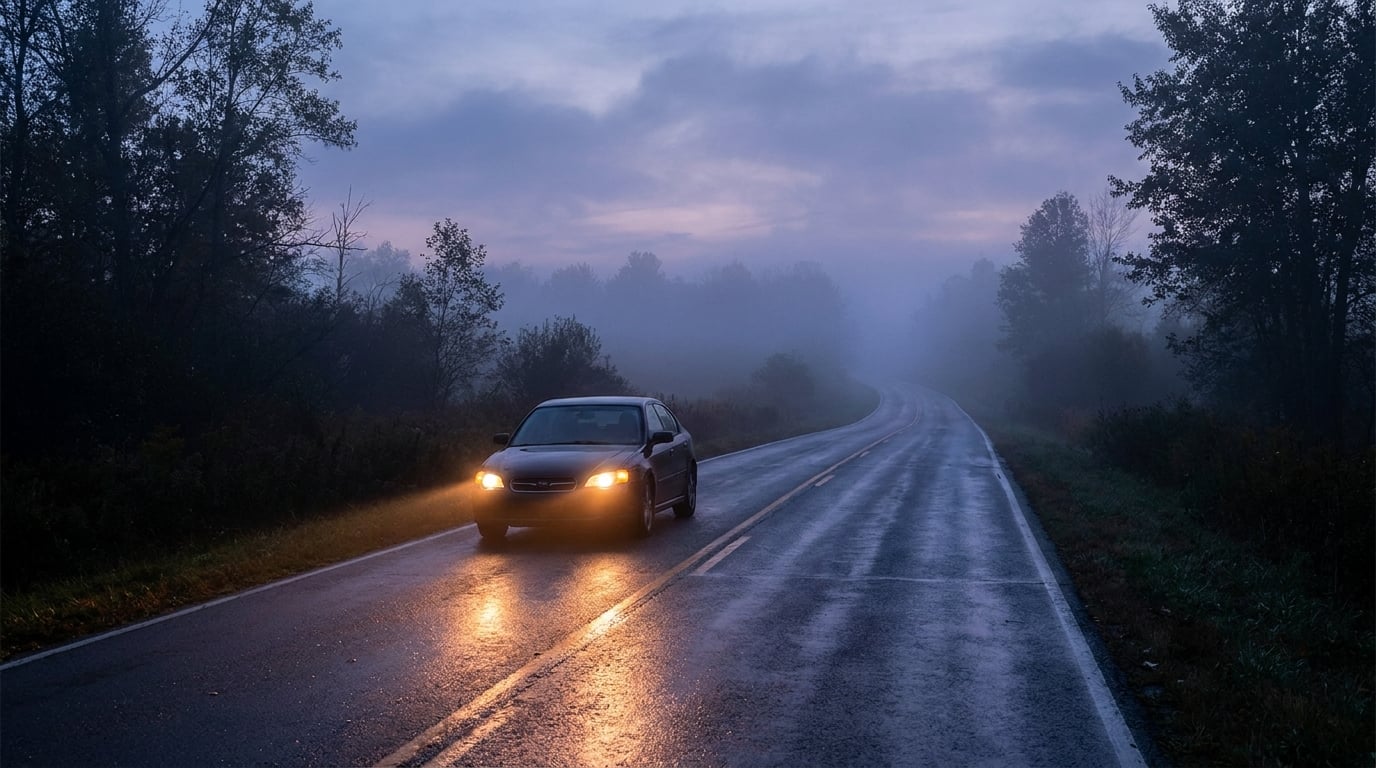
Fog is not a problem you solve by driving more carefully. It is a visibility limit, and once you can no longer see far enough to stop inside the distance your car travels, the only safe move is to slow down or stop. Learning how to drive in fog safely comes down to five habits: drop your speed, run low-beam headlights and fog lights, never touch the high beams, double your following distance, and use the right edge of the road as your guide line.
That answer is deliberately dull, and that is the point. Almost every fog crash comes down to a driver who kept a normal speed and a normal gap while their usable visibility dropped to nothing.
Here is the full routine, from the five-minute check before you leave the driveway to the exact moment you decide the trip is not worth driving at all.
Table of Contents
What You Need
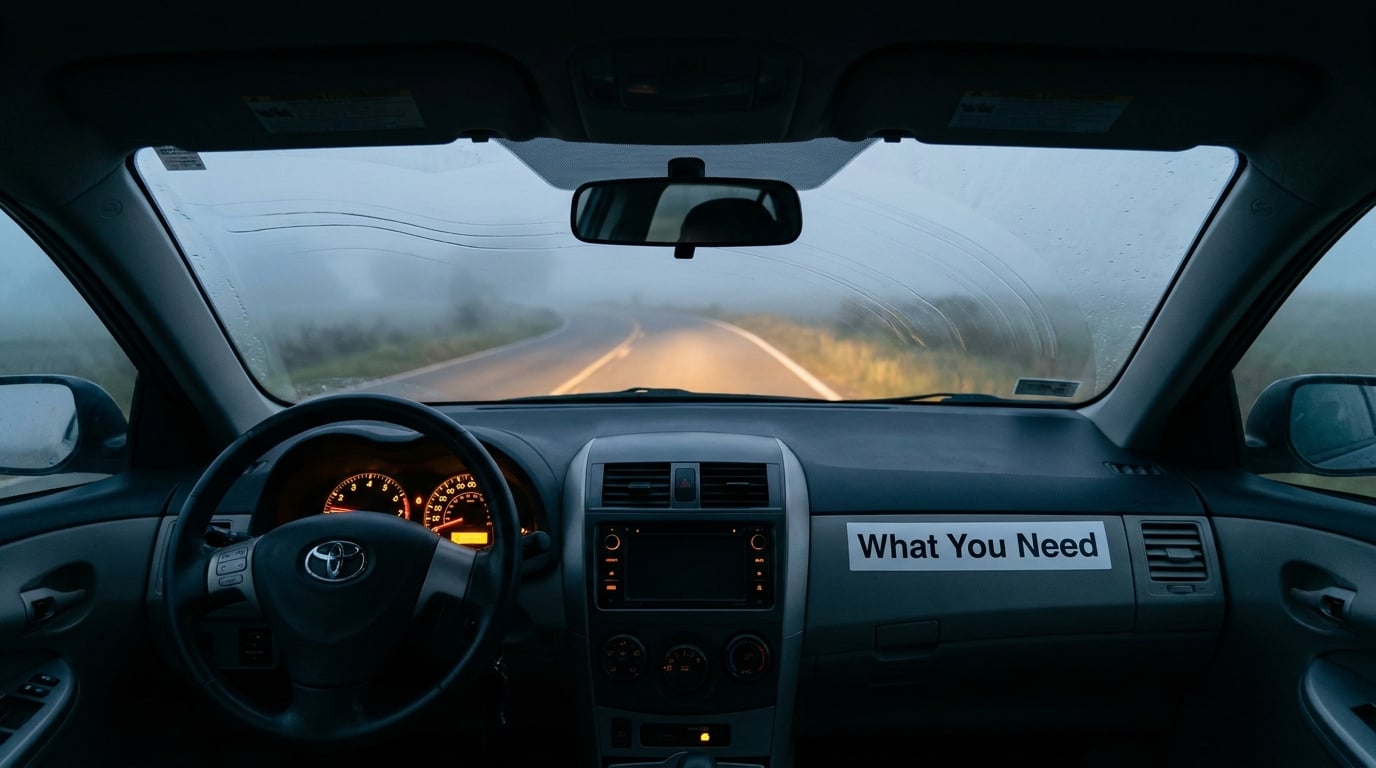
Fog driving needs almost no equipment. It needs a car that is ready, a driver who is willing to lose time, and one honest decision about whether visibility is good enough to leave.
Before you start the engine, walk around the car and check five things. Wiper blades that are torn or smeared are the first thing to replace. Washer fluid needs to be topped up, and you need to actually spray the windshield to confirm the nozzles are not clogged.
The defroster and rear defogger should both work, because interior condensation on the outside of the glass is what blinds you first in humid fog. Check that all bulbs work, including the fog lights, and that the tail lamps light up.
Tire tread and pressure matter more than usual. Fog roads are damp, and a tire that would still be acceptable on dry pavement loses grip sooner than you expect. If the car has been parked for weeks, do the same brake check you would before any long drive.
Then decide about the trip itself. Check the National Weather Service forecast and any visibility advisories before you leave, not after. If the trip can wait an hour, waiting is the best preparation there is.
It helps to know your car’s own equipment before you need it. Which fog lights are fitted, whether they cut out when you select high beams, and where the switch for the defroster sits. Reading your owner’s manual for that takes ten minutes on the driveway and removes a fumbling problem later.
Step-by-Step: How to Drive in Fog Safely
Step 1: Check Visibility and Road Conditions
Judge the fog before you merge into traffic, and judge it again from the driver’s seat once you are moving. The question is simple: can you see far enough to stop in the distance you are travelling at?
Light haze is not a problem. Dense fog that hides the base of trees, hills, or the tops of oncoming trucks is. Freezing fog is worse than either, because it leaves a slick surface behind it and the ice is often invisible until the car is already on it.
Check the pavement the moment you enter it. Wet asphalt with a sheen, or patches of white that turn to dark as you pass, mean ice. If you cannot see 100 yards ahead, the National Weather Service guidance is simple: do not drive.
Step 2: Prepare the Car Before Driving
Clear the glass completely before you pull away, because trying to fix visibility at 40 mph with one hand on the wheel is how rear-end shunts happen.
Run the windshield washers, set the defroster to its warmest setting, and use the air conditioning on high with the heat off if condensation is forming on the inside. Fresh air drying beats warm air on an already-warm windshield. The rear defogger clears the back glass, and it does not clear your mirror, so wipe that by hand.
Walk around and check the lights, and confirm the mirrors are clean and aimed. Fog plus a dirty mirror equals a blind spot with scenery in it.
If the car has been sitting, treat the brakes the way you would before a long trip. If you are not sure how they feel, our guide on how to maintain brakes on a car you rarely drive walks through the checks that take ten minutes.
Step 3: Use Lighting Without Creating Glare
Turn on your low-beam headlights every time you drive in fog, including in the middle of the day. Add your fog lights if the car has them fitted. Never use high beams.
The reason is backscatter. Fog is a suspension of tiny water droplets, and high beams throw a long, flat beam of light straight into it. That light hits the droplets and scatters back at you as glare, so the road ahead turns into a bright white wall. You see less, not more, and the taillights of the car in front disappear into that wall.
Low beams are aimed down and cut off before the beam reaches fog depth, so they light the road surface without lighting the air in front of you. That is why white and yellow low beams and amber-ish fog lamps work and high beams do not.
Daytime running lights are not a substitute. They are usually too dim to light the road and they often leave the rear lamps dark, so the car behind you sees almost nothing.
Here is how each light behaves once fog closes in:
- Low-beam headlights: on in daytime fog and on at night, switched off only once the car is fully parked.
- Fog lights: on whenever the car has them fitted, in any fog, off once parked.
- High beams: never, in any fog condition.
- Daytime running lights: on as a supplement, never as the only lighting, because they are too dim for the road and often leave the rear lamps dark.
- Hazard flashers: only while the car is fully off the road, with the headlights switched off.
One common complaint from drivers on modern cars is that the fog lights switch off the moment you select high beams. That is the correct behaviour, built into the car to stop you creating backscatter, and it is worth knowing before you go looking for a faulty switch.
If your car has no fog lights, low beams and a slow, edge-anchored speed are the whole strategy. Do not compensate with high beams.
Step 4: Reduce Speed and Leave More Space
Slow down before the fog gets thick, not after. Fog arrives in banks, and by the time the air looks grey to a pedestrian it has already cut your sight line to nothing.
Watch the speedometer, not your sense of speed. Fog strips away every cue you normally use: the roadside rushes past, the horizon is missing, and drivers routinely report drifting above the limit without noticing. Set a speed and hold it.
Double your following distance, and then some. The normal rule is about two seconds; in fog, five seconds minimum. A truck needs more, and freezing fog needs more still, because stopping distance grows as grip falls.
- Dry road: about two seconds, the baseline everyone learns.
- Wet or fogged road: five seconds or more, because braking takes longer and hazards appear later.
- Freezing fog or ice: eight seconds or more, because grip can drop abruptly with no warning at all.
Count the gap out loud, in car lengths, if seconds feel abstract. Steering, braking, and any lane change should be smooth and gradual. Sudden inputs are what put you into a barrier you did not see.
Turn off cruise control. It will happily hold a speed your eyes have not yet justified.
Step 5: Drive Smoothly Through Hidden Hazards
Use the right edge line, the shoulder, and roadside reflectors as your guide. Never steer by the center line, because a drifting vehicle or a stopped car in the opposite lane will pull you straight toward it.
On multi-lane roads, stay out of the outermost lane if you can, and resist the instinct to hug the far right. On a single-lane road, the right edge is the only reference you have. That is the whole argument, and it changes with the road.
Watch for what fog hides rather than what it shows: vehicles stopped in a lane with no hazards on, a disabled car on the shoulder, pedestrians, and animals. Fog does not slow a deer down, and it does not make a lost driver less disoriented.
Roll the window down a few inches. Listening for an engine or a siren behind you is often your earliest warning, and it is a habit drivers in coastal and valley fog pick up quickly.
Adaptive cruise control and forward collision warning deserve caution here. Radar-based systems are tuned for clear conditions, and in dense fog they can either hold a speed you want to reduce or warn late. Use them, but stay ready to override.
Do not pass and do not change lanes unless it is genuinely necessary. If the vehicle ahead is going too fast for the conditions, back off and let it go. The gap is safer than the argument.
Step 6: Know When to Pull Over or Stop
Stop driving when you reach the point where you cannot see far enough to stop. That is a judgement call, not a number, and the honest version of the answer is: if you are hesitating about whether it is safe, it is not.
If you do pull over, do it in this order. Signal early. Ease off the road and stop as far to the right as you can, or off the roadway entirely if there is a place to do it. Turn on your hazard flashers once you are stopped. Then turn your headlights off, so the vehicle behind you does not mistake you for a car still in a travel lane.
That is the one place hazard lights belong while a fog drive is in progress. In many states, running flashers while moving is against the vehicle code, and the flashers also mask your turn signal, so the car behind cannot read your intentions.
What if the road has no shoulder, a concrete barrier, or a median wall? This is the situation drivers complain about most, and the standard “just pull over” advice is no help. Options: the nearest turnout, an exit ramp, or a wide paved apron. In the worst case, stop in the rightmost lane with hazards on, which is unpleasant and risky but safer than continuing blind. Do not stop on a bridge or in a live lane with no alternative.
For anyone who cannot postpone the trip, which is most gig and long-haul drivers, the fallback is a speed you could survive stopping from at the visibility you have. If you can see about 200 feet, that is roughly 30 mph on dry pavement and lower on anything wet.
Common Mistakes
Using high beams because the fog is dark. The road gets brighter and your usable visibility gets worse, because the beam is coming back off the droplets at you. Back to low beams.
Leaving headlights off in daytime fog. Cars with no lights at all are the single most common complaint in driver discussions about fog, and a daytime headlight is the cheapest safety improvement available. Every jurisdiction now allows low beams on while parked too.
Keeping your normal speed. Fog feels deceptively slow, so drivers unconsciously accelerate. Glance at the speedometer more often than you think you need to.
Following two seconds behind. Two seconds is a dry-weather number built on a dry-weather stopping distance. In fog, double it.
Running the four-way flashers while moving. It is the most debated tip in this whole topic, because some driving guidance recommends it. The legal position is that many states restrict flashers to a stopped or parked vehicle, and the mask on your turn signal costs you communication exactly when you need it.
Leaving the windshield half-cleaned. A defogger on low, or a misty strip across the driver side you plan to clear later, is the reason drivers brake too late.
Steering by the center line. A stopped vehicle in the opposite lane will pull you across the road at the worst possible moment.
Treating cruise control as a safety system. It holds a speed. Fog changes that speed continuously, and the system does not know it.
Forgetting freezing fog. When fog forms as ice crystals on the road, the surface looks like ordinary damp pavement. On bridges and shaded curves, expect the road to be slick before the air even looks thick.
Insisting on finishing the trip. The most common regret in every fog story is about time, not technique. Fog usually lifts, and a delayed arrival is always cheaper than a collision.
Frequently Asked Questions
Should I use high beams in fog?
No. High beams point a long, flat beam straight into suspended water droplets, and that light scatters back toward you as glare. The road ahead looks brighter but you actually see less of it, and taillights ahead disappear into the murk. Use low-beam headlights, plus fog lights if your car has them fitted, and leave the high-beam switch alone.
What speed should I drive in fog?
Lower than you think, and lower than feels necessary. Pick a speed you could actually stop from at the visibility you have: roughly 30 mph if you can see 200 feet, and less on wet or icy pavement. Fog strips away the cues you normally use to judge speed, so watch the speedometer instead of the roadside, and remember fog is densest on a straight where there is no curve to warn you.
When driving in fog, what should you not do?
Do not use high beams, do not stay at your normal speed, do not hold a two-second gap, and do not steer by the center line. Do not change lanes or pass, do not stop in a live travel lane, and do not use cruise control. If you cannot see roughly 100 yards, do not drive at all. Pull fully off the road, switch on hazard flashers, and turn your headlights off once you are parked.
What color light is best for visibility in fog?
White or yellow low-beam light, plus amber fog lamps if your car has them. The key is the beam cutoff, not the color: low beams are aimed down and stop short of fog depth, so they light the road instead of lighting the air in front of you. A brighter, whiter high beam is worse in fog, not better, because backscatter blinds you.
How do I drive in fog with no fog lights?
Low-beam headlights on, every trip, day or night, and accept a slower speed. Fog lights are a genuine aid but not a magic fix, because a beam has to reach the fog before it scatters back, and most cars are set up so the low beams are the right tool. Without fog lights, lean harder on the right edge line and roadside reflectors, and widen your gap to a full five seconds or more.
What if I am caught in fog with almost no visibility?
Stay in your lane, keep low beams on, and hold a speed you could stop from. Do not brake hard or swerve unless a person or an animal is directly ahead of you. If you can reach a turnout or an exit, use it; otherwise reduce speed, roll the window down to listen, and accept that following the vehicle in front may be safer than trying to see the road yourself. Never stop in a live lane unless you have no choice.
Start with the three seconds before you pull out. Check the forecast, clear the windshield, confirm the lights work, and decide honestly whether the trip can wait.
Then the whole drive reduces to four things: low beams on, high beams off, speed set to what you can see, and a gap you can afford to give up. If those four hold, driving in fog safely is a matter of habit rather than luck.
If visibility is genuinely bad enough that you are asking the question, it is bad enough to pull over. Fog lifts. Arriving late costs you an hour; a rear-end collision on a road you cannot see costs considerably more.