
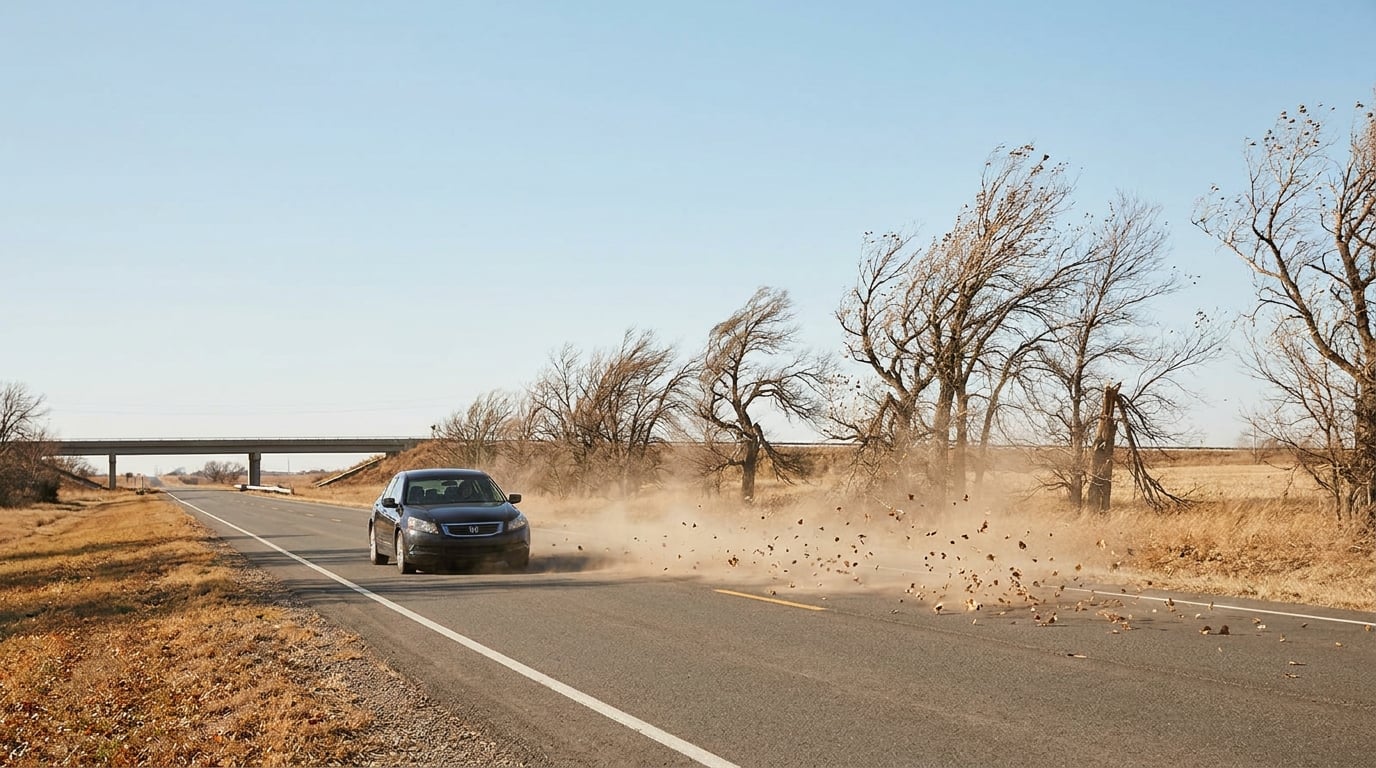
To drive in high winds safely, slow down well below the posted limit, keep both hands firmly on the wheel, double or triple your following distance, avoid exposed roads and bridges, and pull completely off the roadway the moment a gust pushes you out of your lane. Almost every wind-related crash traces back to one correction made too fast and too late.
That answer is not complicated, but it is useless without the technique behind it. Wind pushes on the flat side of your vehicle, your tires push back through traction, and once the wind wins that tug of war the steering only works if you are slow enough for the front tires to still bite. Speed is the variable you control, and it is the one that decides whether a gust is a wobble or a wreck.
Everything below works in an ordinary sedan and scales up to a pickup, camper, or trailer. Reading it takes ten minutes. Applying step 2 takes about four.
Table of Contents
- What You Need
- Step-by-Step: How to Drive in High Winds Safely
- Step 1: Check Forecasts, Warnings, and Road Conditions
- Step 2: Inspect Tires and Secure Vehicle-Side Items
- Step 3: Reduce Speed Before You Encounter a Gust
- Step 4: Hold the Wheel Firmly With Both Hands
- Step 5: Use a Lower Gear and Avoid Sudden Inputs
- Step 6: Drive Around Exposed Areas and Watch for Sudden Crosswinds
- Step 7: Adjust for Rain, Standing Water, and Limited Visibility
- Step 8: Park Safely and Never Leave Roadway Debris
- Common Mistakes
- Frequently Asked Questions
- Conclusion
What You Need
Almost no equipment is required. What you need is information, a vehicle in decent mechanical shape, and an extra half hour in your schedule.
Weather and road information. The National Weather Service forecast gives you sustained wind and gust speed separately, and the gust number is the one that matters. You also want active wind advisory, wind watch, or wind warning text for your counties, plus state Department of Transportation or patrol road closure and closure reports. Save those pages in your phone before you leave, because you may not have signal in a canyon or on open highway.
A vehicle that is ready to roll. Tires with usable tread and correct pressure, wipers that clear water instead of smearing it, washer fluid, working lights, and a fuel tank at least half full. A car sitting for months often has a weak battery, damp brakes, and tired belts, and none of those show up until you are halfway across a bridge in a gale. Our guide to high mileage oil explained covers the oil change question if the car has a lot of miles on the clock and no recent service.
A clear windshield and side windows. Wind turns dust, salt, and insects into a matte film. Stop at a gas station and clean the glass properly before you merge. Visibility is your early-warning system, and a smeared windshield removes it.
Time and a backup plan. If a wind warning is active, add 30 to 40 percent to your trip time or postpone entirely. Know one inland alternate route that avoids open plains, causeways, and long exposed bridges.
A small emergency kit. Water, a flashlight, a first-aid kit, a phone charger, a scraper for ice, and a reflective vest. Wind events usually mean downed lines, blocked roads, and long waits at intersections.
One last thing: pull the correct pressure figures for your exact vehicle and load from the door jamb placard, not from the sidewall or a forum post. High-profile vehicles and loaded ones need different numbers, and the placard is the only source that is right for your car.
Step-by-Step: How to Drive in High Winds Safely
Step 1: Check Forecasts, Warnings, and Road Conditions
Check the forecast and, if a wind warning covers your area, postpone. Sustained wind of 30 to 40 mph with gusts to 55 is uncomfortable for a sedan and genuinely dangerous for a tall vehicle or trailer. Above 50 mph sustained with gusts to 70, the honest answer for most people is that you do not need to be on the road.
Look at four things before you turn the key: sustained wind speed, peak gust speed, the direction the wind is coming from, and whether a wind advisory, watch, or warning is active for your route. Direction matters more than drivers expect. A 40 mph wind straight down the road is a nuisance; 30 mph across the road is a lane-keeping problem.
Then check road conditions. Wind warnings usually come bundled with rain, and some states close bridges, causeways, or overpasses outright at a certain gust threshold. If a closure is posted for your route, reroute before you leave rather than improvising from the shoulder of a fast road. Check again once you are parked, because conditions shift through the day.
Step 2: Inspect Tires and Secure Vehicle-Side Items
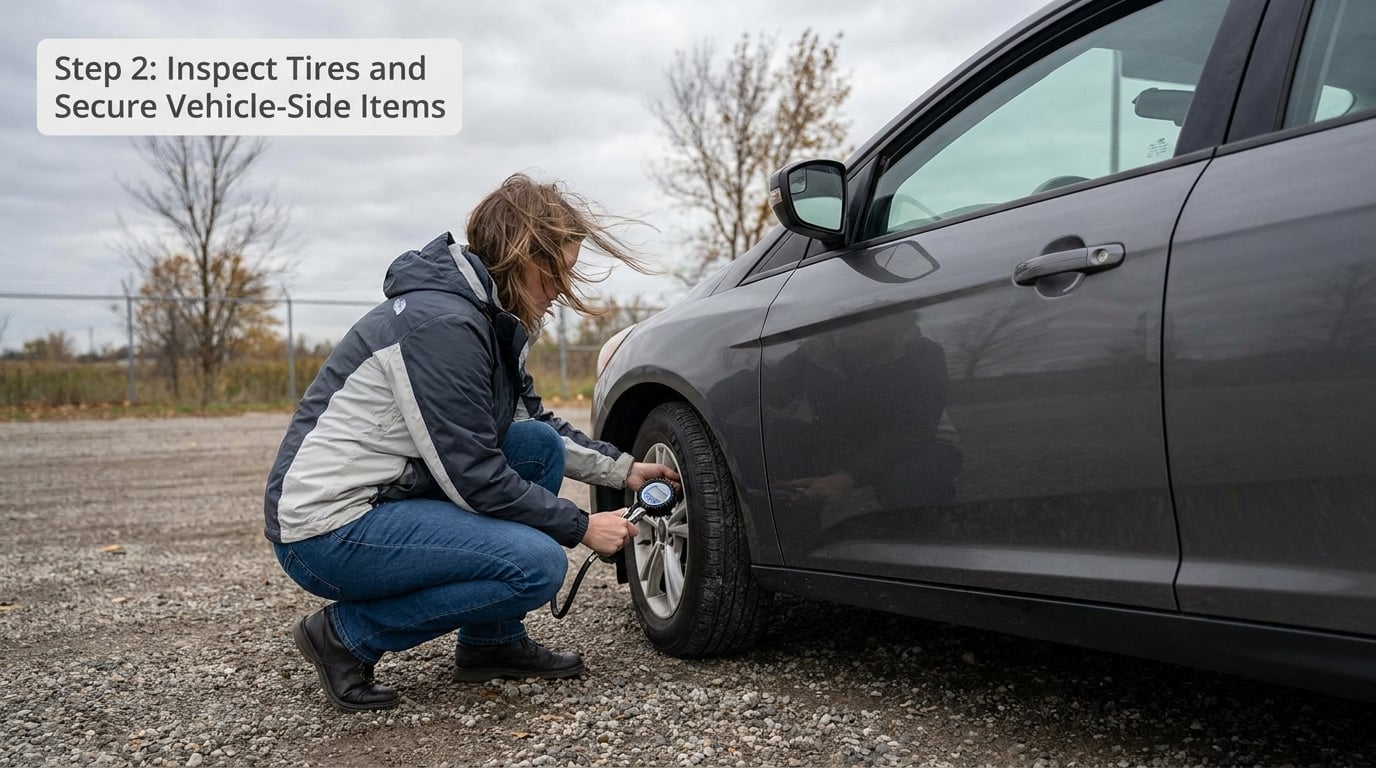
Underinflated tires lose grip first, and grip is the entire defense against a crosswind. Cold tire pressure drops about one psi for every 10 degrees Fahrenheit of temperature drop, so a car that was fine yesterday morning can be soft today. Check all four plus the spare, look for tread wear across the shoulder rather than just the center, and confirm the wheel nuts are tight.
Next, walk around the vehicle and deal with anything the wind can catch. Roof rack crossbars, ladder racks, plastic trim, a partially open hood, unsecured cargo, and a trailer hitch cover all become projectiles at highway speed. Push down and latch the hood fully, and check the gas cap. On a pickup or a camper, secure awnings, screens, and loose covers before you pull away.
Clear the yard too. Bins, planters, patio furniture, and sports gear travel surprisingly far in a straight wind, and the driver who gets hit by your garbage bin never forgives you. The same wind will carry debris onto the road later, which is exactly what step 8 is about.
Step 3: Reduce Speed Before You Encounter a Gust
Cut your speed by at least 30 percent below the posted limit, and slower when the vehicle is visibly moving sideways. The reasoning is simple. Aerodynamic force rises steeply with speed, and steering response time is the number of seconds between a gust hitting and your front tire actually doing something about it. Every mile per hour you remove makes that window wider.
Rough working numbers, based on what experienced drivers report rather than an official standard:
- Sedan or coupe: comfortable to about 40 mph in gusts; above that, expect to hold a line and correct continuously.
- Tall SUV or pickup: treat gusts of 30 to 35 mph as a caution zone and drop to highway minimum for the pass.
- Camper, motorhome, or box truck: 25 to 30 mph, single file, no overtaking, exposed routes avoided entirely.
- Anything towing a trailer: 30 mph or less in any crosswind, with far more distance than feels necessary.
Slow down before the bridge, not on it. A gust arrives without warning, and a driver who is still doing 60 when the first shove arrives has no time to react. RV drivers often leave earlier or later specifically to avoid the peak wind window, because sustained wind is often lower in the early morning. If the timing is flexible, use that.
Step 4: Hold the Wheel Firmly With Both Hands
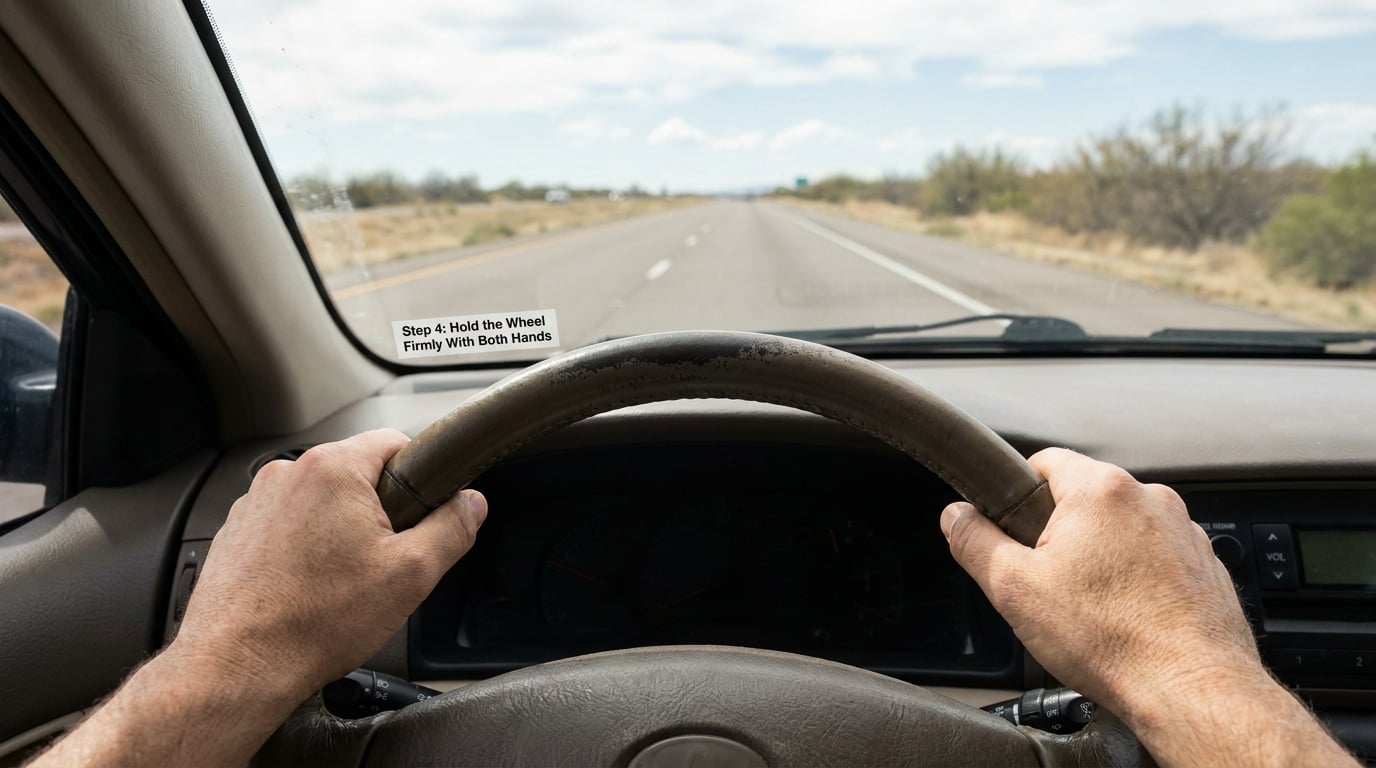
Take the wheel at 9 and 3, thumbs hooked, forearms relaxed rather than locked. Firm means firm, not rigid. A white-knuckle grip tenses your arms, slows your reaction, and makes small fast corrections instead of smooth ones.
What you are avoiding is overcorrection. A gust pushes the vehicle, the driver yanks the wheel, and the tires either break loose or the car swings the other way. Both outcomes are worse than the original push. The alternative is a series of small, slow inputs: nudge, hold, wait, nudge again. Think of steering as adding to the front tire’s grip rather than fighting it.
Also keep your eyes up and far ahead. You cannot see the gust coming, but you can see the windbreak ahead, the exit to a sheltered road, or the truck about to cross your path. A driver looking at the wheel during a shove has already lost the two seconds that mattered.
Step 5: Use a Lower Gear and Avoid Sudden Inputs
Downshift one gear on descents and before exposed stretches. Engine braking keeps the vehicle stable and takes pressure off the brakes, which matters more than usual because a firm, abrupt stop in a crosswind is how cars end up rotated. Accelerate gently, change lanes one at a time with long smooth arcs, and let it run.
Double or triple your following distance. In wind, you need room to see a vehicle get pushed toward you, a debris field, or a stopped truck, and room to stop without a sudden jolt. On a six-lane interstate in a gust, staying about six seconds behind the vehicle ahead is sensible rather than obsessive.
Turn off cruise control before the wind picks up. Cruise control holds a speed and, on many cars, makes small steering adjustments for you, which is the opposite of what you want. On a descent with a loaded cargo area, the same rule applies. While you are thinking about brakes, our piece on how to maintain brakes on a car you rarely drive covers why a week-old sitting car needs a pedal check before a storm trip.
Step 6: Drive Around Exposed Areas and Watch for Sudden Crosswinds
Wind is not evenly distributed. It accelerates across bridges and overpasses, funnels through highway junctions and deep road cuts, and pours unimpeded across open plains, causeways, lakefront causeways, and exposed ridge lines. Buildings on one side of a street can either block the wind or create a violent eddy around the corner.
The tell is visible ahead. A row of trees, a change in road surface, a stand of buildings, a guardrail leading to an open span, a summit where the road crests with nothing beyond it. When you see one coming, drop speed early enough that you are settled before you reach it.
When a gust does arrive, keep the vehicle pointed where you want it to go. Feel the push, ease off the accelerator a little, apply smooth steering input in the direction you want the car to travel, and let the tires bring it back rather than trying to drag it back. Do not brake hard and do not add abrupt throttle while the car is still sliding. If the wind is winning consistently, get out of the wind entirely. Pulling over and stopping is a decision, not a failure.
Step 7: Adjust for Rain, Standing Water, and Limited Visibility
Wind almost never arrives alone. Wind-driven rain turns a windshield into a grinder, so wipers on intermittent at maximum speed clear more than a slow sweep. Watch fluid levels, because a wiper running dry in a storm is how a car ends up stopped in a lane.
Add more distance again, and slow further. Standing water on a road with strong crosswind is genuinely dangerous, because the tire loses both its grip and its ability to resist a side push. Avoid puddles, painted road markings, and the seam between wet and dry pavement where you can.
At night in wind and rain, visibility collapses to the width of your headlights. Slow to where you can stop inside what you can see, keep lights on so other drivers can see the shape of your vehicle, and leave extra space for a stopped vehicle ahead. Some states require headlights when wipers are in use, so check before you leave.
Step 8: Park Safely and Never Leave Roadway Debris
When you arrive, park the vehicle stable. On a slope with a crosswind, leave the transmission in park, set the parking brake, and turn the wheels so the car cannot roll. Do not park where a gust can roll it or where the driver cannot rejoin traffic safely.
Choose a sheltered but legal spot. Parking against a building, inside a garage, or under a carport keeps the wind off the vehicle, but parking under a highway overpass or bridge to escape a tornado is one of the most dangerous things a driver can do. A parking deck or a low sturdy building is the safe choice, because the gap under a bridge channels and accelerates wind.
Do not collect debris from the road. It may be load from an overturned vehicle, and roadside debris in a wind event often comes with downed power lines. Stay well back, note the location, and report it to your state patrol, highway patrol, or transportation department. If you see a line on the ground, treat it as live, keep everyone in the car, and drive away.
Common Mistakes
Nearly every wind-related incident traces back to one of a handful of habits. Here is what to stop doing, and what to do instead.
Driving at the posted limit because traffic allows it. The limit is a maximum for perfect conditions. Cut speed by at least 30 percent, and cut it more when the vehicle moves.
Grabbing the wheel and yanking it. A hard correction breaks traction or swings the car the other way. Use small, slow inputs and let the tires work.
Following a truck too closely. A high-sided vehicle ahead can be pushed into your lane, and a gust can hit you from nothing. Double or triple your distance and stay out of its wind shadow.
Leaving cruise control on. Turn it off before the highway. It holds a speed and steers without you, which is the wrong behavior in a crosswind.
Fighting a slide with the brakes. Ease off the throttle and steer smoothly. Slamming the brakes removes the front tire’s ability to resist the wind.
Continuing because you already started the trip. A high wind warning is a real signal. If conditions deteriorate past what you planned for, stop at a gas station, a parking structure, or away from the road, and wait it out.
Sheltering under a bridge or overpass. This is the one that gets people badly hurt. The open sides of a bridge act like a funnel, so wind speed increases under it rather than dropping. A sturdy low building or a designated shelter is the answer.
Gripping the wheel like a vice. Tension slows your reaction and produces jerky inputs. Firm and relaxed, not locked.
If you only change one thing, make it the speed. A driver at 30 mph with a firm two-handed grip and six seconds of following distance has time, options, and grip. A driver at 65 mph with all three missing has none of them.
Frequently Asked Questions
Is it safe to drive in high winds?
It depends on the vehicle and the gust speed, not just the average wind speed. A sedan is generally manageable in gusts up to about 40 mph if you slow down, but tall vehicles and anything towing a trailer need to stay far below that. In an active wind warning, the safest choice for most people is to postpone until the gusts drop. Check the National Weather Service gust number for your route before you decide.
How fast should I drive when winds are strong?
Cut your speed by at least 30 percent below the posted limit, and slow further whenever the vehicle is moving sideways. Many drivers who regularly travel in wind say 30 to 35 mph is where a car stops feeling pushed around. The important part is doing this before you reach an exposed stretch, not after the first shove, because a gust arrives with very little warning.
What should I do if a strong gust pushes my car sideways?
Keep the car pointed where you want it to go. Ease off the accelerator, apply smooth and small steering input in the direction you want to travel, and let the front tires bring it back. Do not slam the brakes or add sudden throttle while the vehicle is still sliding. If the wind keeps winning, pull completely off the road and stop somewhere sheltered and legal.
Are SUVs and trucks safer in high winds than cars?
No. A tall body has more exposed side area for the wind to push, and a higher center of gravity means less margin before a tire lifts. Trucks and tall SUVs are usually heavier, so they are less easily pushed around, but when they do lose control the consequences are larger. Low, wide vehicles generally handle crosswind better. Any vehicle is safest when driven slowly with both hands on the wheel.
Should I use cruise control during high-wind conditions?
No. Cruise control maintains a set speed and makes small steering adjustments for you, and holding a steady speed in a gust is exactly what you do not want. Turn it off before the highway and manage the throttle yourself, with smooth and gentle inputs. It is also worth turning off any lane-keeping or steering-assist feature if the vehicle will not stay predictably straight without you.
When should I cancel my trip because of high winds?
Cancel or postpone when a wind warning covers your area, when roads or bridges on your route are closed, when your vehicle is tall, lightly loaded, or towing, or when gusts are forecast above about 50 mph. If you are driving a sedan, gusts near 40 mph are uncomfortable but manageable with reduced speed. The forecast matters more than the current conditions outside your window.
Conclusion
If the wind is already pushing your vehicle, do these four things in order: lift off the gas, steer smoothly toward where you want to go, check the mirrors and your speed, and get completely off the road if you cannot hold the line.
If you have not left yet, check the warning, check the gust number, check your tires, and build in a third more travel time. If the answer is that your route crosses exposed ground in a high wind warning, that is the moment to stay home.