
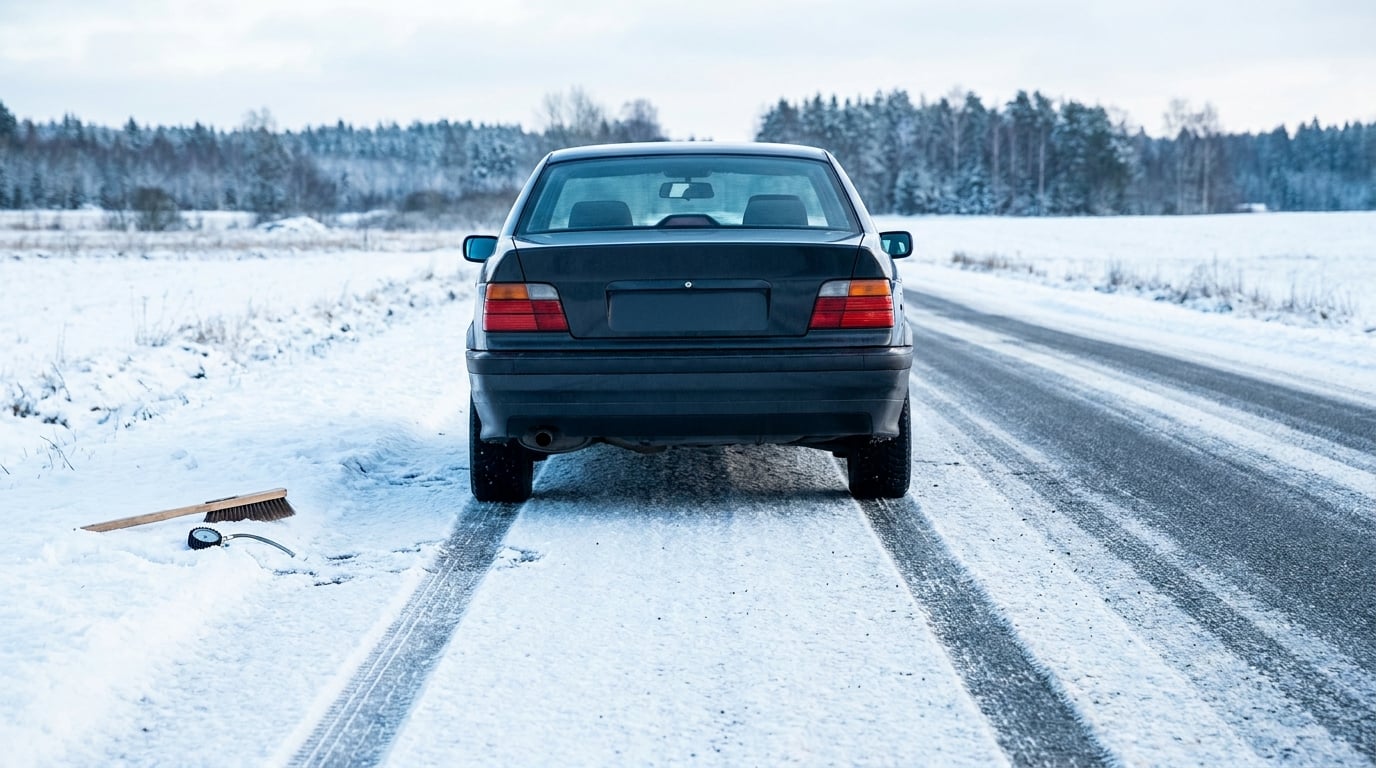
Snow driving techniques for rear-wheel drive cars come down to one thing: keep the rear tires rolling instead of spinning. Because all the driven weight sits on the rear axle, an abrupt throttle input breaks traction there first, and the car rotates. Smooth throttle, progressive braking, gentle steering and one gear lower than instinct suggests will keep the same car predictable on a white road.
Last reviewed: October 2026. This guide is written for rear-wheel-drive owners, not driving instructors in a race car, and the examples lean toward everyday performance saloons, estates and sports cars on a rear axle.
Two things get a rear-wheel-drive car into trouble in the snow: sudden throttle after the weight has moved rearward, and lifting off mid-corner. Both are fixable with technique, which is the whole point of the rest of this page.
Table of Contents
- What Makes Rear-Wheel-Drive Cars Slip in Snow?
- How to Prepare Your Rear-Wheel-Drive Car for Snow
- The Best Snow Driving Techniques for Rear-Wheel-Drive Cars
- How to Control a Rear-End Slide
- How Do Traction Control, Stability Control, and Winter Mode Help?
- How to Drive Uphill, Downhill, and in a Straight Line
- How to Recover When the Car Cannot Move
- How to Avoid Common Snow Driving Mistakes
- Frequently Asked Questions
- What to Do First This Winter
What Makes Rear-Wheel-Drive Cars Slip in Snow?
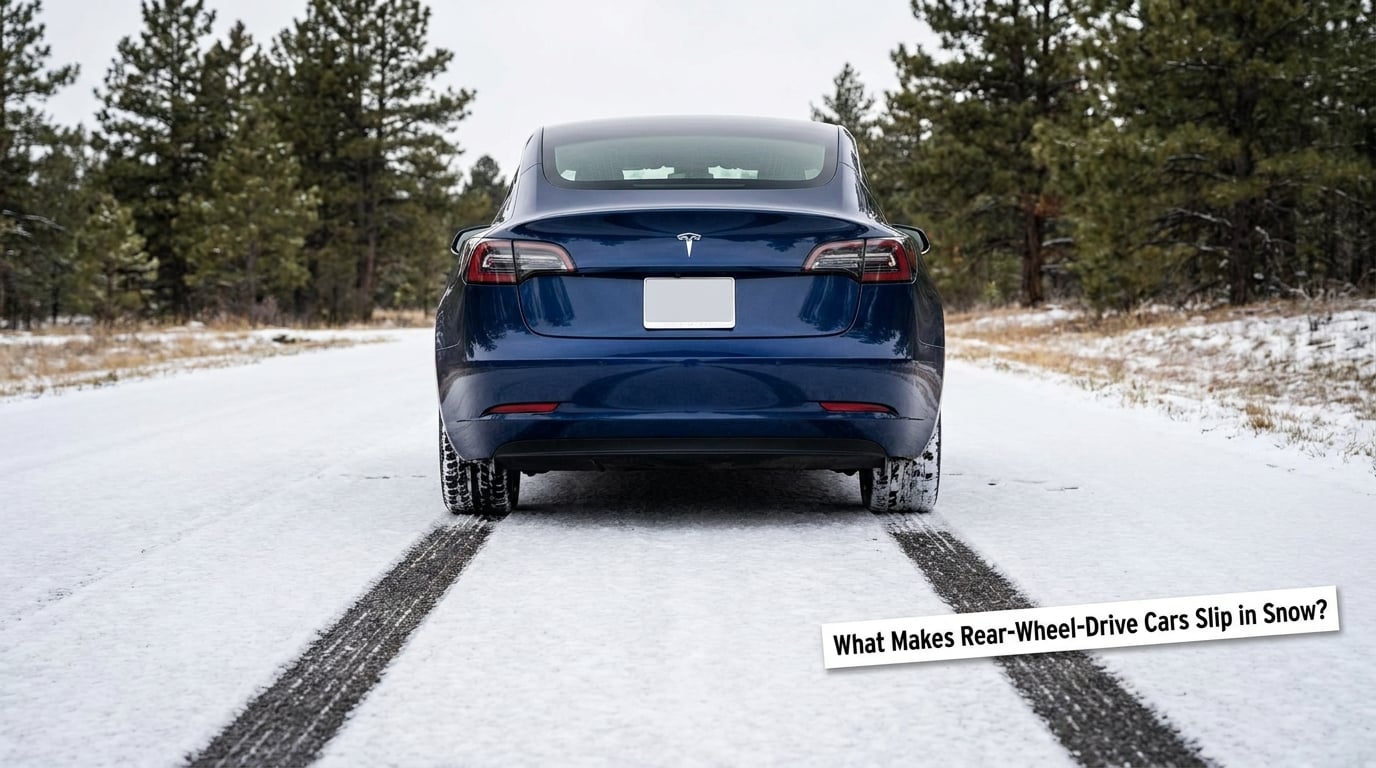
A rear-wheel-drive car slips because its weight moves. Under acceleration the load transfers onto the rear axle, and on snow the rear tires break away before the fronts, pushing the nose outward and rotating the car into oversteer. That is the mechanical reason every snow-driving mistake in a rear-drive car is a throttle or steering mistake first.
Front-wheel drive has the opposite problem. Its driven wheels carry less of the car’s weight, so when the fronts wash out the car understeers, plows wide and keeps going. Long-time drivers on r/BMW and r/cars make the argument often enough to be worth repeating here: a rear-wheel-drive car that steps out is giving you a progressive, catchable signal, while a front-wheel-drive car that washes out is simply gone.
That is a mechanical claim, not a comfort blanket. Driven hard, a rear-drive car will swap ends and spin just as readily as a front-driver understeers into a barrier. The difference is that the failure arrives in stages you can feel and correct.
Why the rear axle goes first
Two forces decide which end of a car lets go: how much weight is sitting on the tires, and how much grip those tires have left. On snow, grip is scarce everywhere, so the axle carrying more load crosses the threshold first. In a rear-wheel-drive car under power, that axle is the rear.
The familiar rules people repeat on forums are all versions of this one idea. Turn into a skid in a rear-drive car and out of a skid in a front-driver, as a driver on r/Eugene put it, and lift off the accelerator in both cases. But the cleaner statement is simpler: a slide is a tire exceeding the grip available, and every smooth input buys the tires time to find it again.
How to Prepare Your Rear-Wheel-Drive Car for Snow
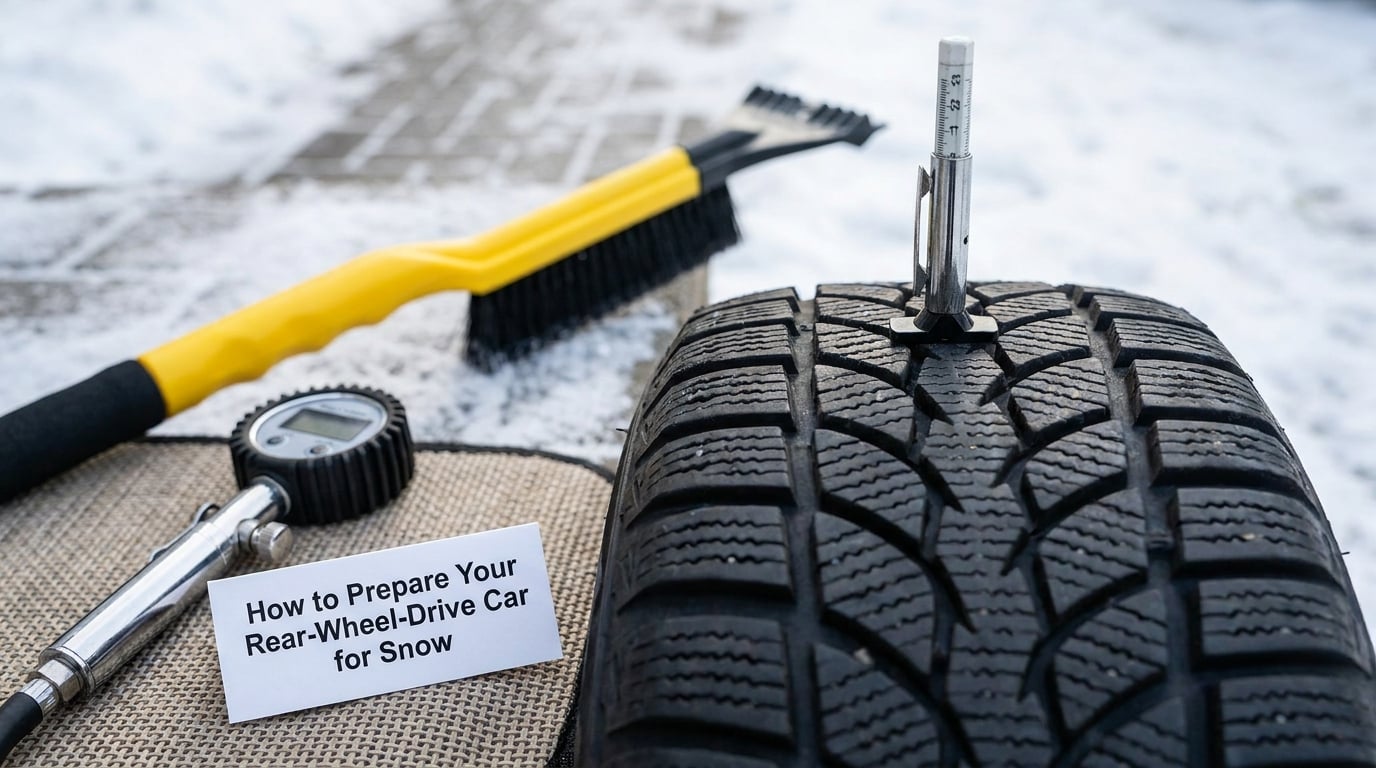
No technique compensates for the wrong rubber. Preparation is where a rear-wheel-drive car is either made good in snow or left to spin its rear tires every time it sets off. Your owner’s manual and your tire manufacturer’s specifications always take priority over anything written here.
Tires carry the whole job
Winter tires are the single biggest change you can make, and forum consensus in r/cars is blunt about it: decent snow tires, then everything else matters much less. The rubber compound stays soft in cold temperatures, which is the only reason a winter tire grips snow when an all-season goes stiff and skates over it.
Check tread depth before the first snowfall of 2026. Around 1.6 mm is the legal floor in much of Europe, and 3 mm is the sensible winter minimum in practice, because packed snow and slush wear a block down far faster than rain does. If you are choosing between tread patterns rather than swapping rubber, our guide to all-terrain versus highway tires for daily driving covers which patterns suit which surface.
Cutting grooves in an old tire, known as siping, gives it more bite in packed snow. It is a cheap and genuinely useful step for a car that spends the winter on ungritted lanes; what tire siping is and whether it helps covers how to do it properly.
Pressures, fuel, battery and brakes
Cold pressure drops roughly 1 psi (0.07 bar) for every 10 degrees Fahrenheit or 6 degrees Celsius of temperature fall, and a soft tire works harder for less grip. Inflate to the figure on the driver’s door jamb, not the number molded into the sidewall, and never let air out of the tires on the assumption it improves contact with snow. It does not.
Keep the tank above half on a long rural run, since a cold engine and a cold fuel supply make a roadside recovery that much harder. Batteries fail in winter because cold reduces capacity, so check yours and the alternator charge before the first freeze.
Brakes on a car that spends weeks in a garage suffer from standstill corrosion, which shows up as a pedal that feels firm but weak. Our walkthrough on how to maintain brakes on a car you rarely drive is worth an afternoon before the season starts.
Visibility and the kit in the boot
Clear every window, mirror and camera lens before you move, not just the windscreen. Run the defroster on high with the fan at medium to clear the demister faster, and treat a frozen wiper blade as a reason to stop and clear it rather than a reason to swerve.
Carry a shovel, traction mats or a coil of rope, a scraper, de-icer spray, a torch, a charged phone cable, a blanket, water and a high-visibility vest. The rope is the one people leave behind and then want: tie it to a wheel, pull from a low angle, and you gain the few centimeters a buried car needs.
A five-minute pre-drive check
Before you set off, look at all four tires and confirm none is soft, visibly damaged or still carrying a smear of road salt mud. Clear the exhaust pipe and the grille of snow and ice, run the lights so everyone can see you coming, and confirm the boot is not so full of gear that it has gone light over the rear axle.
The Best Snow Driving Techniques for Rear-Wheel-Drive Cars
The method is simple to describe and hard to master: everything you do with your right foot should be a slow, deliberate movement, and everything you do with the wheel should be small. A rear-wheel-drive car in snow is not slow because of the engine. It is slow because traction is the scarce resource, and traction responds to smoothness.
Pulling away from a stop
Feather the clutch to bite, select second gear on a manual, give the engine just enough gas to feel the car lean forward, then increase the throttle smoothly until the car moves. If the rear tires spin, you have asked too much, and the fix is to lift slightly, let the wheels regain grip and try again, not to stab harder.
On an automatic, put it in drive, choose a low gear if the car offers one, and hold the brake while you feather the throttle until the car pulls away without wheelspin. The rolling creep of most automatics makes hill starts easy; it also means the car will creep downhill in exactly the situation you do not want it to.
Three things quietly destroy traction
Water under snow, packed snow or ice, and worn or underinflated tires. That list covers most of what drivers call bad roads, and it is why clearing a road to black tarmac before a cold snap produces better conditions than driving a fresh fall of snow.
Cornering, braking and following distance
Enter a bend slow enough that you could stop within the distance you can see. Turn the wheel a few degrees at a time, keep the car balanced, and let the engine’s drag do the slowing rather than the brake pedal. If the rear starts to go, adding throttle and unwinding the wheel in the same moment is the correct response, which is the subject of the next section.
On braking, a car with ABS wants a firm, steady pedal and no pumping. It releases and re-applies pressure far faster than your foot can, and pumping resets that work. Without ABS, threshold braking, in which you squeeze to the point the pedal starts to slip and then ease a fraction, is the only technique that works on ice.
Follow at least five seconds behind the car in front, ten when it is snowing hard or the road is untreated. Braking distance on packed snow can be five to ten times the distance you would use on dry tarmac, and the vehicle ahead of you is almost always braking earlier than you are.
How to Control a Rear-End Slide
To correct oversteer in a rear-wheel-drive car, ease off the accelerator, do not stamp on the brakes, and steer the wheel toward the direction you want the car to travel. Small inputs, held steadily, bring the rear tires back into line with the road and let the front tires do their job again.
- Lift. Take your foot off the accelerator immediately. A closed throttle is what tells the rear tires to stop spinning and regrip.
- Keep the brake pedal quiet. Stand on the brakes and you add forward weight transfer, which lightens the rear tires further. A touch of brake to settle speed is fine; a stab is not.
- Steer to where you want to go. If the rear has stepped out to one side, feed the wheel in that direction, in small increments. This is the opposite lock, or countersteer, and it is simply the wheel pointing down the road the car is already travelling.
- Do not overcorrect. Sawing the wheel back and forth is what spins the car. Let the front tires pull it straight and use the wheel as a small, steady adjustment.
- Reapply power smoothly. Once the car is tracking straight, ease the throttle back in. Too much again and you are back at step one.
If the slide keeps building, the car is not pointing where you want it, or traffic is close, stop correcting and slow to a halt with both hands on the wheel. Getting stopped safely off the carriageway is always available; a spin at speed in a traffic lane usually is not. Drivers on r/Eugene put the same rule in fewer words: lift off the gas, steer into it, and do not panic.
How Do Traction Control, Stability Control, and Winter Mode Help?
Electronic aids help a rear-wheel-drive car in snow by cutting engine torque when the driven wheels spin, and by braking individual wheels to correct yaw when the car rotates. They are genuine assistance, not a licence to carry on faster, and they will not save a car that is already past the point of grip.
What each system actually does
Traction control watches for wheelspin at the driven axle and cuts torque to stop it. On snow it usually means slightly more wheelspin than you wanted, in exchange for the car going somewhere rather than standing still and sliding. Stability control goes further: it compares steering angle, yaw and individual wheel speeds, then brakes a specific wheel or corners the car with one brake to keep the nose pointed along the road.
A limited-slip differential, usually on the rear axle in a performance rear-drive car, sends torque to the spinning wheel differently from an open differential and keeps the car moving in a tight, slippery corner. Winter or snow mode is a separate thing again: it changes throttle mapping, shift strategy and sometimes differential locking so the car is gentler off the line.
When to leave them on
Leave them on for ordinary driving. The common complaint from rear-drive owners is that traction control cuts power mid-manoeuvre and leaves the car stranded, which is a fair criticism and a real symptom of a system working exactly as designed. The answer is to modulate your own foot so the system has less to do, not to switch it off at the junction.
Turning systems off is occasionally justified in a specific situation, such as a self-inflicted bog in deep snow where the car needs the wheelspin to dig itself out, and a driver who knows exactly what they are doing. It is not justified for a public road, in traffic, because you have decided the electronics are holding you back. Drivers on r/cars rank correct tires and driving habit above electronic aids in overall snow capability, and that ranking is about right.
Snow and winter modes, by contrast, are worth using whenever your car has them. If you also tow or drive a four-wheel-drive vehicle, the 4H and 4L question belongs to that vehicle, not to a rear-wheel-drive car, which has no low range to select.
How to Drive Uphill, Downhill, and in a Straight Line
Going up, keep the momentum you already have. A steady speed on a slope needs less traction to continue than a standing start does, so approach a hill already rolling, hold a constant throttle position, and avoid changing gear on the gradient.
Climbing a snowy hill
On a manual, pick a low gear before you need it and keep the clutch just enough engaged that the engine does not stall. A stall halfway up means a rollback, so balance the clutch more carefully than you would on the flat and be ready with the handbrake. On an automatic, hold the brake, select drive or low range, and add throttle gently rather than pushing the pedal straight down.
Descending without cooking the brakes
Select a low gear and let engine braking do the work. Drivers on r/Seattle are consistent on this point: drop into a low gear, do not ride the brakes downhill, and let the engine pull. Continuous braking on a slope overheats the friction material and takes away the very braking you need at the bottom.
Use the brake only to slow to a speed the engine can hold. Keep the wheel straight, because any steering input on a steep, slippery descent is a demand for grip you do not have, and do not reach for the parking brake as a substitute for a gear. The handbrake is for stopping on a slope while stationary and for the low-speed handbrake turn; it is not a descent tool.
Holding a straight line
Counter-steering, small wheel movements, constant speed and looking further ahead than feels necessary will keep a rear-wheel-drive car tracking. Cruise control has no place in snow, because it holds a speed and a throttle position your tires may not be able to support.
How to Recover When the Car Cannot Move
If a rear-wheel-drive car is stuck in snow, stop, assess the surroundings, clear the tires of snow and ice, and take another run at it at a steady speed. Spinning the wheels dig a hole faster than they climb out of it, so the method is about keeping the snow packed and moving forward in one attempt.
- Stop and assess. Check traffic, cyclists and pedestrians, and get out of the vehicle on the side away from danger before clearing anything.
- Clear the tires. Dig packed snow out from in front of and around each wheel, and out from under the front and rear bumper. A shovel and a traction mat between the tire and the snow make a large difference.
- Choose a low gear and straighten up. Aim for the wheel that is spinning or sitting deepest, get the car straight if you can, and clear a path forward before adding power.
- Apply smooth throttle. In first gear, feather the throttle to the point the car moves, then hold a steady, modest input. On an automatic, creep forward in drive and use just enough throttle to keep the car moving.
- Repeat, or get help. Give it three honest attempts. If the car will not move, or you are on a busy road, a verge or a bank, stop digging and call roadside assistance. Get back in the car and wait somewhere safe and warm.
Rope or traction mats are worth carrying for exactly this. Where more than one vehicle is nearby, a second car with the same technique can be more effective than anything you can do alone, and remember that a stuck car still needs a recovery plan for the drive home.
How to Avoid Common Snow Driving Mistakes
Almost every rear-wheel-drive snow spin traces back to one of a handful of habits, and each has a simple correction. Learn to spot them in yourself rather than waiting for the car to show you.
Stabbing the throttle out of a junction or a parking space. The load is fully on the rear axle and the tires are on fresh snow, which is the worst possible combination. Feed the throttle in gradually instead, and accept a slower launch.
Lifting off mid-corner. Lifting off a rear-wheel-drive car mid-corner on a slippery road is lift-off oversteer, and it is the most-reported spin in owner threads. Carry a little more entry speed, keep a light steady throttle on through the bend, or brake before the turn in rather than during it.
Following too closely. If you are relying on the vehicle ahead to show you where the road is, you have no margin when it stops suddenly. Five seconds becomes ten in real conditions, and more on a bridge or shaded bend where black ice collects.
Assuming stability control or winter mode makes the car safe at the same speed. These systems manage wheel slip within the limits the tires can support. They do not add grip, and they cannot change the stopping distance of a car on black ice.
Driving over frozen puddles, shaded bends and bridges without changing. Black ice is transparent and offers no warning. Where the road surface changes, or where you lose the sound of your tires on tarmac, ease off the throttle and straighten up rather than holding a line at speed.
Frequently Asked Questions
How do I make a rear-wheel drive car good in snow?
Start with winter tires and at least 3 mm of tread, inflated to the pressure on your door jamb. Then drive it gently: second gear to pull away, one gear lower downhill, no cruise control, and no sudden throttle. A limited-slip differential and stability control help, but tires and smooth inputs do most of the work. Nothing else substitutes for those two.
Do any rear-wheel drive cars handle well in snow?
Yes, with the right tires and technique. A rear-wheel-drive car that steps out is easier to catch than a front-wheel-drive car that plows straight on, because the failure is progressive and gives you a signal you can act on. Drivers on r/BMW and r/cars make the same point. Fast, open, powerful models demand more respect, not less.
Does rear-wheel drive cause understeer or oversteer?
Rear-wheel drive causes oversteer under power. The rear axle carries the driven load, so it breaks traction first, and the nose swings wide as the car rotates. Under braking the weight moves forward and the front tires can wash out, producing understeer, which is why you brake before a slippery bend rather than in it. Both are cured by smoothness.
How do I correct oversteer in a rear-wheel drive car?
Lift off the accelerator, keep off the brakes, and steer into the slide in small increments until the wheel points where the car is already travelling. Hold it steady rather than sawing it back. Once the car is tracking straight, ease the throttle back in. If the slide keeps building, stop correcting and slow to a halt somewhere safe.
Should I turn off traction control in the snow?
Normally no. Traction control cuts torque when the driven wheels spin, which is useful protection rather than a restriction, and the complaint that it leaves you stranded mid-manoeuvre is a sign to feather the throttle rather than disable the system. It is occasionally useful when deliberately digging a bogged car out, but not on a public road in traffic.
What gear should I use going downhill in snow?
Pick a low gear before the slope and let engine braking hold the speed, pressing the brake only to slow down to what the engine can hold. On an automatic, use a lower gear or low range if the car provides one. Riding the brake on a long descent overheats it and leaves you with very little braking left at the bottom of the hill.
What to Do First This Winter
Fit winter tires, check the tread and the pressures on the door jamb, and put an emergency kit in the boot before the first snowfall rather than during it. From there, the driving itself is one habit: everything your right foot does should be slow, and everything your hands do should be small.
If a rear-wheel-drive car feels nervous in snow, it is usually asking for a lower gear, more following distance and less throttle than feels necessary. Give it those three things and the same car is usually fine.