
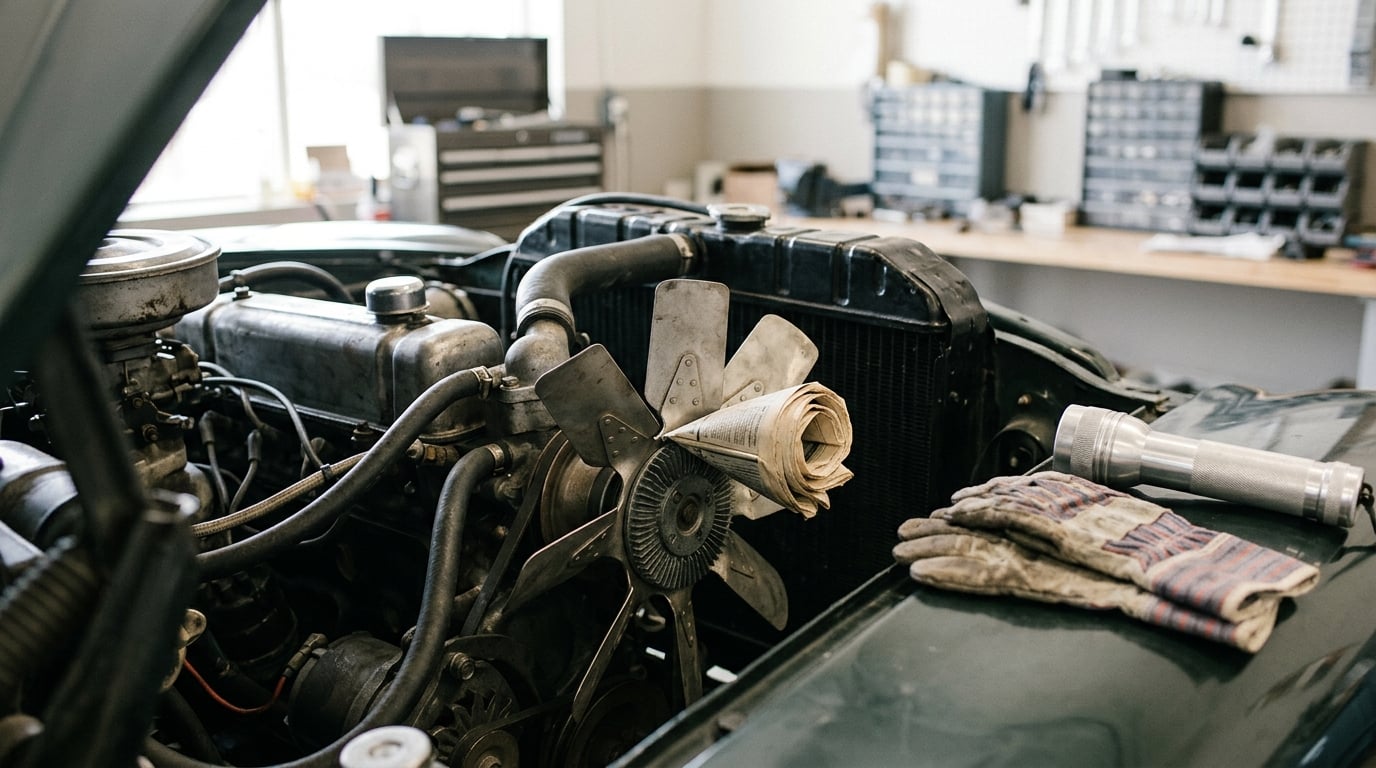
A BMW cooling fan clutch test takes about five minutes and tells you in one go whether the viscous clutch on your mechanical radiator fan is still locking the blades to the water pump pulley when the engine is hot. The newspaper test is the one everybody asks about, and it is the one most often done wrong. Below is the full sequence, ordered so you rule out the cheap causes before you blame the clutch.
The catch is that most BMWs of a certain age do not use one cooling fan setup. Some run a single mechanical clutch fan off the crank, some run an electric fan plus an auxiliary fan in the e-box, and the newest cars run everything under module control. Testing a clutch when the car has no clutch just wastes your afternoon.
Table of Contents
- What You Need
- Step-by-Step: How to Perform a BMW Cooling Fan Clutch Test
- Common Mistakes
- Frequently Asked Questions
- How can I test if my radiator fan clutch is working properly?
- How much resistance should a fan clutch have when I spin it by hand?
- Will the air conditioning still work if the fan clutch is bad?
- How do I test a cooling fan with a multimeter?
- What are the symptoms of a failed fan clutch on an E46?
- What tool do I need to remove a clutch fan from my BMW?
- Conclusion
What You Need
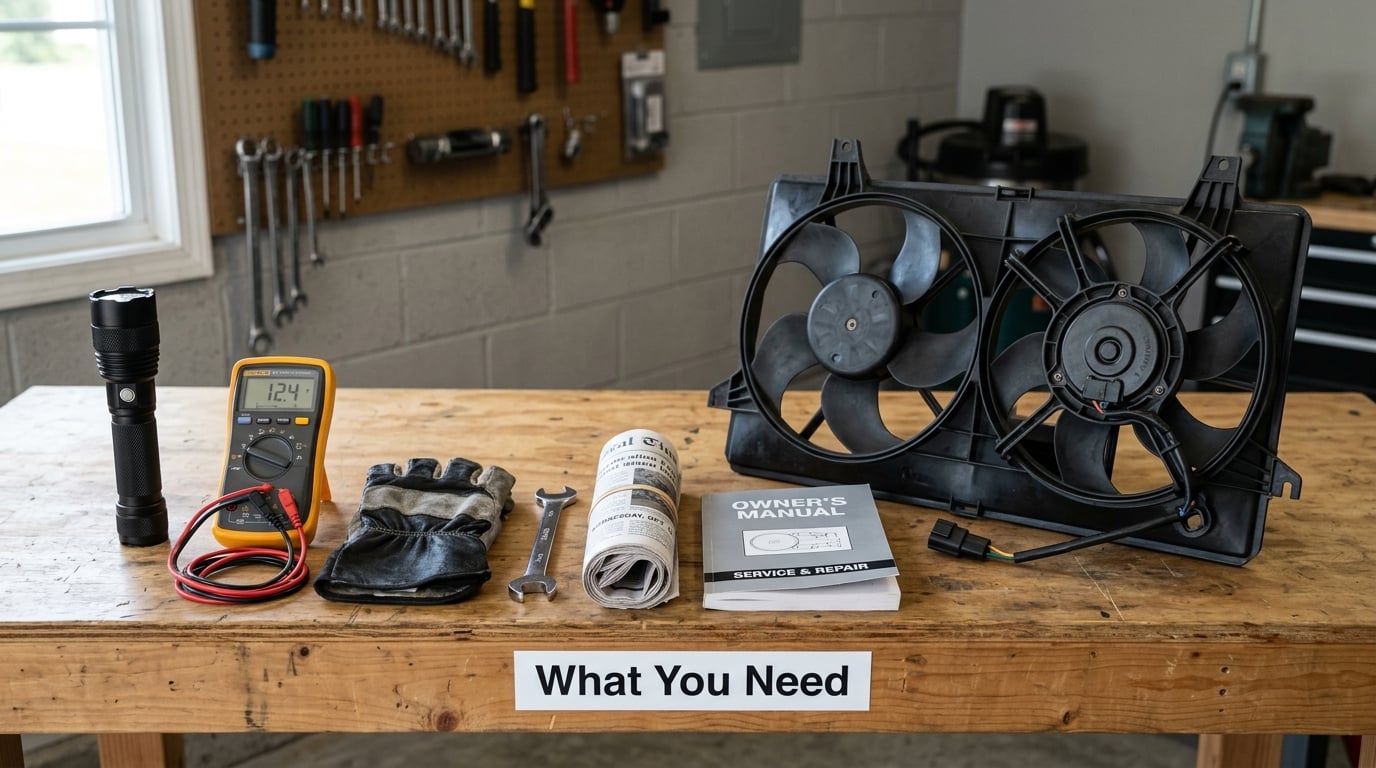
Start by identifying what your car actually has. Look at the fan behind the radiator: a large multi-blade fan bolted to a large-diameter pulley is a mechanical clutch fan. Two smaller plastic fans mounted in a shroud near the radiator are electric and auxiliary fans. The E36, E39, Z3 and most 7-series cars use a mechanical clutch fan. Many E46 cars run both, and the E60 moved almost entirely to electric fans under DME control.
For the tools, you really need very little:
- A rolled-up newspaper, or any stiff sheet rolled into a tube.
- Work gloves, plus a flashlight if your radiator is tucked behind anything.
- A multimeter, only if your car runs an electric or auxiliary fan.
- A scan tool or a laptop with ISTA if you want the module to command the fan on demand.
- A fan clutch wrench, an X63 or X64 size depending on chassis, but only if the test says replace it.
Precautions first. Work on a cold engine for anything that involves your hands, never reach through the grille while the engine is running, and expect the clutch housing to be hot enough to burn you once the engine has been at temperature for half an hour. Keep the paper roll away from the fan shroud edge, because that is where a cracked blade ends up.
You also want your vehicle’s service information open, ideally the current 2026 BMW documentation for your chassis code, so you can compare the fan behaviour against the specification instead of against a decade-old thread on a forum.
Step-by-Step: How to Perform a BMW Cooling Fan Clutch Test
Step 1: Check the Fan and Its Operating Conditions
Confirm the fan type, then look at the blades before you look at the clutch. A shattered or cracked blade throws the whole assembly out of balance and will shake the engine at idle, and that symptom gets blamed on the clutch constantly. Owners on the E46 boards have traced engine shake to a broken blade rather than a bad clutch, so look first.
Check the coolant level while the engine is cold, and look for a leak, since a low system can mimic everything else. Feel the upper radiator hose with the engine at idle; if the gauge is rising and the hose stays cool, the thermostat is stuck or the system is full of air, not the fan at fault. If air is the suspect, how to burp air out of a cooling system comes before any clutch test.
Step 2: Observe Fan Operation with the Engine Cold
On a cold start, a healthy mechanical clutch fan should run for a short burst and then switch off, because a cold silicone clutch slips and lets the fan freewheel. Owners on the E39 boards describe it as the fan running briefly then going quiet. A clutch that runs loudly and continuously from cold is stuck engaged, which is a different failure from a clutch that never locks up.
Note the noise while you are there. Silence from a clutch fan at idle is normal. A rising roar that kicks in as the gauge climbs is the fan locking up, and that is the good news, not the bad news.
Step 3: Test the Viscous Fan Clutch by Feel
With the engine off and cold, try to spin the fan with one finger against the blade tip. On a healthy clutch it should spin freely, with maybe a faint drag through the silicone. If it spins like a bicycle wheel on a downhill and you can keep it going for several rotations, the fluid has leaked out and the clutch will never engage. That free-spinning result is the single most commonly reported confirmation of a failed clutch among E46 and E36 owners.
The hot test is the definitive one. Get the engine fully hot and hold it there for at least thirty minutes, then park in neutral or park, and try to hold the fan with the rolled paper at the blade tip. A good hot clutch grips hard and stops the fan with light pressure. Here is how to run it properly:
- Warm the engine to full operating temperature and keep it there for half an hour, or drive it on the highway for a few minutes first.
- Park, leave the engine idling, and set the heater to maximum to dump heat into the radiator.
- Feed the rolled paper between the radiator and the fan at the top of the shroud, close to the hub, not at the outer blade tips.
- Increase the paper pressure gradually until the fan stops.
- Withdraw the paper. If the fan stays stopped, the clutch is holding.
Test close to the hub on purpose. At the outer tips the paper shreds no matter how good the clutch is, which is where most contradictory results come from. If the paper shreds everywhere, at the hub and at the tips, the clutch is slipping badly.
Step 4: Test an Electric Fan Clutch or Motor
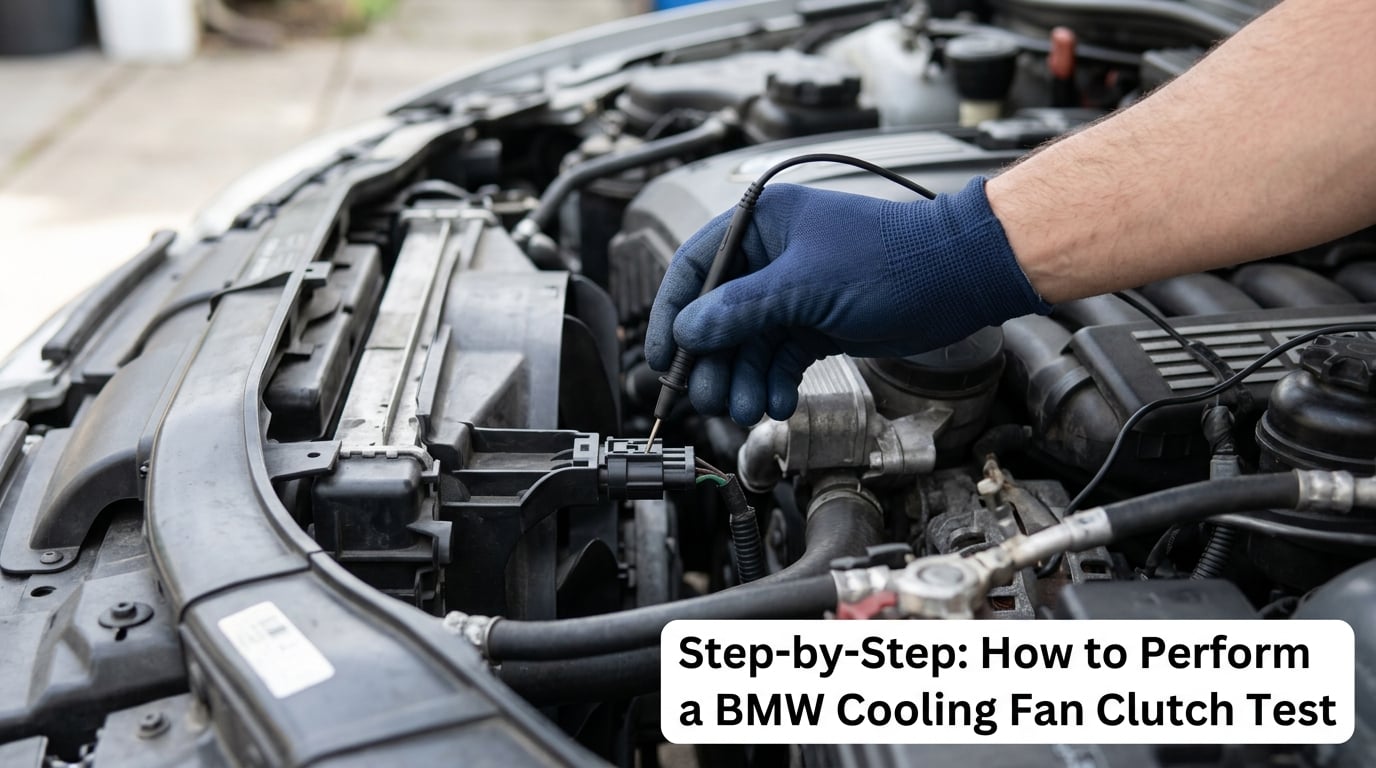
No clutch means no newspaper test, so the electrical checks take over. With the ignition off, check for battery voltage at the fan connector and then confirm the ground is solid. No voltage with the module asking for the fan means a wiring, relay or fuse problem upstream, and the motor is innocent.
To make the fan spin on demand, scan the car and command it through the fan test in ISTA or ISTA+. On a working system the fan runs on command, and you have proven the motor, the wiring and the module in one shot. If the car has no scan access, back-probe the connector while someone else works the climate controls, since switching the A/C on is what usually calls the fan in.
On cars with both, the mechanical fan and the electric fan should take over together at hot idle. If the electric fan runs fine and the mechanical one never locks up, you have a clutch problem, not an electrical one.
Step 5: Compare the Result With the BMW Service Specification
Here is how to read what you found. Each line is a result you can actually observe, not a feeling.
| What you observed | What it means | Next move |
|---|---|---|
| Paper stops the fan near the hub, fan stays stopped after you pull the paper | Clutch holds at temperature | Clutch is good, look elsewhere for the overheating |
| Paper shreds at the blade tips but holds near the hub | Clutch is working | Normal result, test closer to the hub next time |
| Paper shreds at all points, engine fully hot | Clutch slips and never locks | Replace the clutch, and check for a leak in the housing |
| Fan spins freely with one finger when cold | Silicone fluid has leaked out | Clutch is finished, replacement is the only fix |
| Fan is locked and roaring from a cold start | Clutch is stuck engaged | Replace the clutch, expect extra fuel burn and noise |
| Fan never runs or never locks under any condition | Blades, hub or drive damaged | Inspect blades and hub before ordering a clutch |
| Electric fan has no voltage when commanded | Wiring, relay or fuse fault | Trace the circuit, not the motor |
Model notes matter here, because the same test means different things across chassis. The E36 and Z3 are pure mechanical, so the clutch is the whole story. The E39 540i is mechanical and the newspaper test is reliable once hot. The E46 runs a mechanical fan on many variants plus a DME-controlled electric fan, so a cooling complaint can come from either side. The E60 and the later X5 and 7-series are electric, and the clutch is not part of the car at all.
One more caution before you condemn a brand-new part. Forum threads on the E46 boards and the M5 board describe new aftermarket clutches that shredded paper at every temperature straight out of the box. If that happens, repeat the test at the hub rather than the tips, re-run it on a second heat cycle, and confirm the fan is seated fully on the pilot bearing. A clutch that is not pushed all the way onto its pilot bearing will never hold, and that is a fitting problem, not a parts problem.
Common Mistakes
Testing a hot fan with a bare hand is the mistake that gets people hurt. The clutch housing sits right behind the radiator and gets hot enough to burn, and a seized clutch can throw a blade through the radiator core or up into the hood. Gloves, paper, and an engine that is cold for anything involving your fingers.
Assuming every BMW uses a clutch is the second big one. An owner with an E60 or a modern X5 will read an article about newspaper tests and conclude their cooling problem is a bad clutch that does not exist. Check the chassis first.
Mistaking a relay, fuse or temperature sensor fault for a dead clutch wastes the most money. If the fan never runs at all, test for voltage at the connector before you turn a single wrench. A module that never commands the fan will leave a perfectly good clutch looking broken.
Replacing parts without checking airflow is the fourth. A plugged radiator, a dirty A/C condenser or a radiator packed with debris can drop airflow enough to overheat the car with a brand-new fan. What a radiator cap does matters too, and a cap that will not hold pressure can spoil a system you just spent a day rebuilding. When you suspect a leak rather than a fan, how to pressure test a cooling system is the right next step.
Finally, do not judge the clutch on a partly warm engine. The silicone has to be at full operating temperature before the clutch is meant to grip, and a test at twenty minutes in tells you almost nothing. Give it the full thirty.
Frequently Asked Questions
How can I test if my radiator fan clutch is working properly?
The newspaper test is the standard check. Get the engine fully hot and hold it there for at least thirty minutes, then try to stop the fan with a rolled-up newspaper at the blade tip close to the hub. A healthy clutch grips hard and holds the fan stopped after you withdraw the paper. A clutch that spins freely with one finger when the engine is cold has already leaked its silicone fluid and will never engage.
How much resistance should a fan clutch have when I spin it by hand?
Very little when the engine is cold. A healthy viscous clutch should turn easily with one finger, with at most a faint drag through the silicone fluid. If the fan spins like a free wheel and you can keep it turning for several rotations, the fluid is gone and the clutch has failed. That free-spinning result is the most common confirmation owners report on E36 and E46 forums.
Will the air conditioning still work if the fan clutch is bad?
Barely, and only above idle speed. A failed clutch fan means no airflow through the A/C condenser while the engine is stopped or crawling, so the system cannot shed heat at a stoplight and you may end up with weak cooling in traffic. On a highway the motion air is enough to keep the condenser fed, which is why the problem often only shows up in city driving.
How do I test a cooling fan with a multimeter?
Set the meter to DC volts and probe the fan connector with the engine idling and the A/C switched on. A working electric or auxiliary fan should show battery voltage at the connector, and a good ground completes the circuit. No voltage with the fan being commanded means the fault is upstream in a fuse, relay, wiring or module, not in the motor. On a clutch car, this test does not apply.
What are the symptoms of a failed fan clutch on an E46?
The classic symptom is a temperature gauge that climbs at idle or in slow traffic while the car is fine at highway speed. Others report a fan that spins freely by hand, a fan that roars constantly from a cold start because it is stuck engaged, and engine shake caused by a broken blade rather than a bad clutch. Remember that many E46 cars also run a DME-controlled electric fan, so check both sides.
What tool do I need to remove a clutch fan from my BMW?
You need the correct size fan clutch wrench, which is X63 on many E36, E39 and E46 applications and X64 on others, plus a water pump holder tool so the plastic pulley does not crack while you counter-hold it. On an E46, the fan and clutch usually come off together as a unit. Take your time at the plastic tabs around the shroud, they break far more easily than the clutch does.
Conclusion
Start where most people should: engine off and cold, one finger on the blade. A fan that free-spins has already answered the question, and the newspaper test on a fully hot engine confirms it. If the clutch holds, the clutch is not your problem, and you move on to coolant level, the thermostat, trapped air and radiator airflow.
Before ordering a clutch, check the fan is seated fully on its pilot bearing, confirm the radiator and condenser are not blocked, and pull the service information for your chassis. On an E60 or a newer X5 there is no clutch to test at all, so the same symptoms come from relays, sensors or module control instead.