
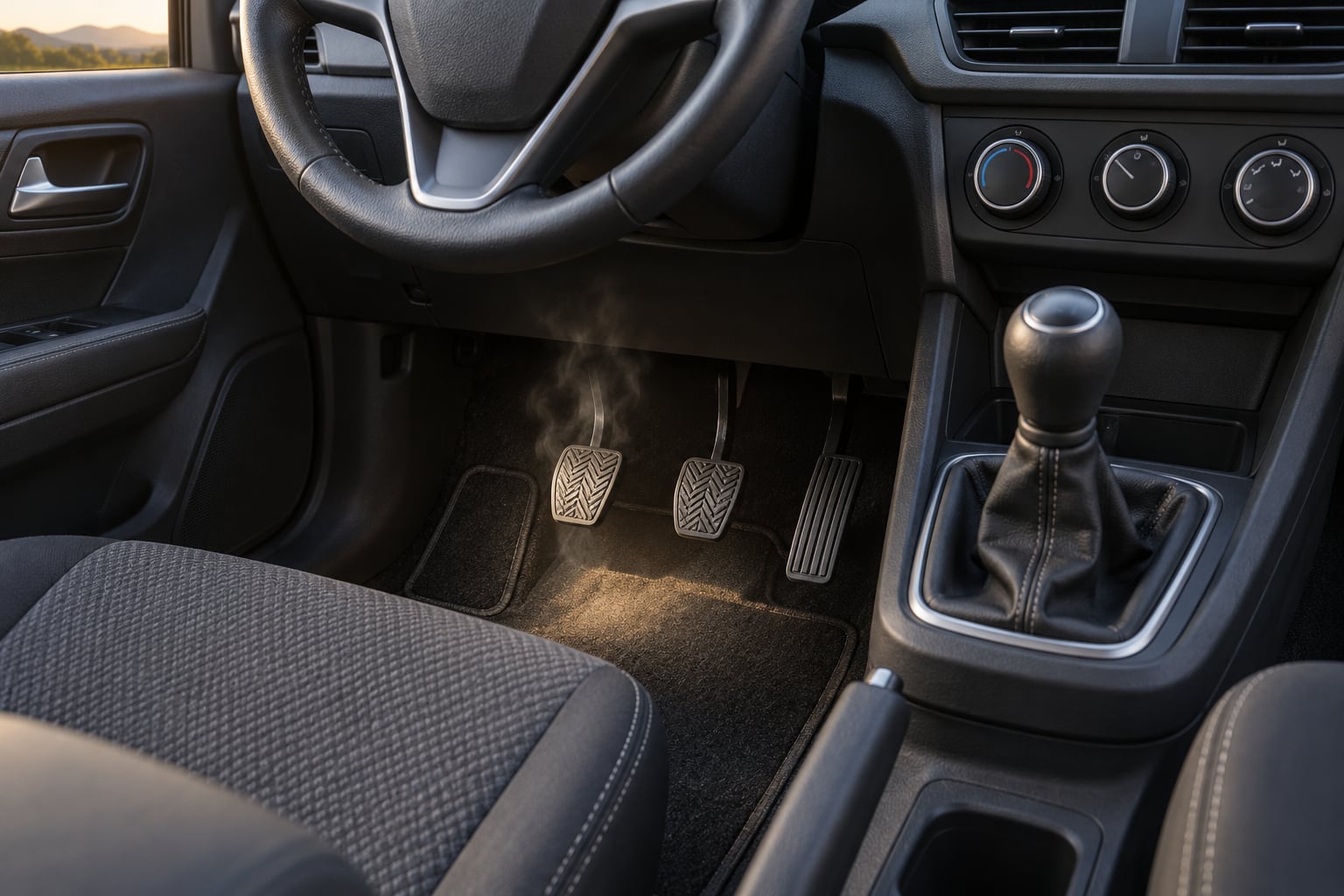
If your engine revs up but the car stops accelerating, if the pedal goes soft or the bite point keeps climbing, you are probably looking at the most common signs your clutch is going bad. Most of the time the failure starts small, shows up as a change in pedal feel or a noise on a hill, and gets dramatically worse if you keep driving it hard. A clutch is a wear item like a brake pad: it is built to be replaced, and the goal here is to catch it early rather than let it damage the flywheel and transmission.
This guide walks through each symptom, what is mechanically happening behind it, and what to check before you pay for anything. If a clutch pedal goes completely slack or a gear grinds on every attempt, that is a hydraulic fault rather than a worn disc, and it is a much cheaper repair. Learning which is which saves most of the diagnostic labour.
Table of Contents
- Signs Your Clutch Is Going Bad at a Glance
- What Does a Failing Clutch Feel Like?
- Why Is the Clutch Slipping?
- What Noises and Vibrations Mean
- Why Does the Clutch Pedal Feel Hard or Soft?
- Can You Still Drive With a Bad Clutch?
- What Causes Clutch Wear?
- How to Check for Clutch Problems
- Clutch Problems vs Transmission Problems
- What to Do If You Suspect a Bad Clutch
- Frequently Asked Questions
- What to Do First
Signs Your Clutch Is Going Bad at a Glance
Here is the short version. Each row tells you what you are probably feeling, what causes it, and how quickly you need to act.
| Symptom | What it usually means | How urgent |
|---|---|---|
| Revs rise, speed does not | Worn clutch disc or pressure plate can no longer hold torque | Book an inspection now |
| Bite point keeps moving up | Friction material thinning out | Book an inspection now |
| Pedal feels soft or spongy | Air or a leak in the hydraulic circuit | Urgent, do not drive far |
| Pedal stays on the floor | Slave cylinder or master cylinder failure | Stop driving |
| Burning smell under load | Friction material glazing over | Drive gently, replace soon |
| Grinding going into gear | Incomplete disengagement, often hydraulic | Urgent |
| Shudder on take-off | Contaminated disc, warped flywheel, worn engine mounts | Get it diagnosed |
| Squeal when releasing the pedal | Release bearing or pilot bearing wear | Book an inspection |
Only one of those is a genuine emergency in the sense that the car is unsafe right now. Most are a “get it looked at this month” situation, which is exactly why it pays to know the difference. The most definitive symptom is the first one, because slip is the last stage of friction wear rather than the first, so anything else you feel probably arrived earlier than the slip did.
What Does a Failing Clutch Feel Like?
A healthy clutch gives you a fairly consistent feel: the pedal moves down, resistance builds evenly, and somewhere near the middle the car starts to move with the engine. The bite point sits in roughly the same place every time you get in. A failing clutch breaks that consistency, and the change is usually small enough that you only notice it once it becomes a problem.
Early on, the pedal may travel further before you feel anything. A few months later you notice the car bogging on a rise, or a smell after a long climb. What a lot of drivers describe is a clutch that suddenly seems to hesitate before the gear goes in, then grabs hard. That combination of delay and harsh engagement is a common signature of a glazed disc.
Two feelings deserve attention early. The first is a pedal that goes soft, where the resistance fades partway down and the pedal feels hollow. That is almost never friction wear; it is air or fluid in the hydraulic line. The second is a bite point that sits noticeably higher than it used to, meaning you now pull the pedal almost all the way up before the gear engages. Both mean something is changing, and both are worth a look before they turn into a roadside problem.
Why Is the Clutch Slipping?
Slipping means the clutch is releasing under load when it should be locked. Press the pedal in and the release bearing pushes the pressure plate away from the disc. Let it go, and the disc gets clamped between the flywheel and the pressure plate so engine torque drives the gearbox. When the friction material on the disc wears thin, or the pressure plate springs weaken, that clamp force drops. The disc then slides between the two surfaces and you get heat, revs and no acceleration.
You will notice it most where torque demand is highest: pulling away in first, a long uphill in fourth or fifth, or accelerating hard with the air conditioning running. Watch the tachometer during one of those. If the needle climbs while the speedometer barely moves, that is slip. On a ramp the same car might hit the limiter and still only do 40 mph.
Slip is easy to confuse with other things. A loose or failed spark plug wire, a clogged fuel filter, or a slipping belt under load will also let the revs climb without speed. The difference is what happens when you stop accelerating: with clutch slip the revs fall and the car keeps pulling smoothly once the engine is back down. With a fuel or ignition fault you get a misfire, hesitation, or a warning light instead. Our guide to what causes a car to lose power going uphill covers that other set of causes in more detail.
Keeping the clutch on the pedal to get started on a hill is the single most common way to destroy one. It works, so people keep doing it, and each time you do it you slide two friction surfaces against each other at full clamp. More on that below.
What Noises and Vibrations Mean
A squeal that rises in pitch as you press the pedal and quiets down when you release it usually comes from the release bearing, also called the throw-out bearing. It rides on the pressure plate fingers, and it is a small, relatively cheap part to replace on its own. Keep driving a squealing release bearing and you can wear the fingers off the pressure plate, which turns a simple job into a full clutch replacement.
A low growl or hum tied to engine speed as you change gear often points at the input shaft or pilot bearing. It tends to get louder in a specific gear rather than rising and falling with pedal pressure. A one-off squeak that happens on a cold morning when you first touch the pedal, especially in cold or wet weather, is usually just the release bearing and the friction material taking up.
Grinding when you go into reverse or from neutral into first is usually not the clutch disc itself. It means the clutch is not fully disengaging, so the gearbox is being asked to mesh with the engine still partly connected. Common on manual cars, and it often shows up hardest when the pedal feels soft.
Shudder, judder or a pulse through the pedal when you pull away in first comes from two friction surfaces gripping unevenly. A flywheel with a hot spot, a contaminated disc with oil on the friction material, or worn engine or transmission mounts letting the whole assembly move all produce that. One noise rarely gives a single answer, which is why we write down when it happens rather than describing it as a rattle.
Why Does the Clutch Pedal Feel Hard or Soft?
Pedal feel comes from the hydraulic system, and it is the fastest way to narrow a fault down to two or three parts. Your foot pushes the master cylinder, fluid moves through the line to the slave cylinder, and the slave pushes the fork and release bearing. The feel you get at your foot is a direct report of what that chain is doing.
A pedal that gets harder and harder as you press it, with no bite point at all, points at air trapped in the line or a master cylinder that is not moving fluid properly. Fluid compresses, so the pedal travels further and further with no effect. Trapped air is the cheap fix, bleed the circuit and go. A master cylinder that seals internally and never builds pressure needs replacing, which is still a straightforward job on most cars.
A pedal that goes soft partway down and feels hollow under your foot has the same cause, usually air, but sometimes a slave cylinder that has fluid in it. A pedal that drops straight to the floor with no resistance means the slave cylinder has failed internally or the fork has come off its ball socket. That one leaves you with a car that goes nowhere.
Find out which it is by checking for fluid. Look under the car at the bell housing area, and at the master cylinder on the firewall, for wetness. Check the fluid reservoir on top of the master cylinder and see whether the level has dropped or whether there is fresh fluid on the floor of the reservoir, which means it is picking up moisture or contamination. Brake fluid does the job in most manual cars and it eats rubber seals and friction material alike, so a soft pedal is worth fixing immediately rather than monitoring.
Pedal feel can also change as the clutch wears, though this is a different change. Worn friction material moves the bite point rather than softening the pedal. If the pedal feels the same but you now have to pull it all the way up before anything happens, that is wear. If the pedal itself feels wrong, start with the hydraulics.
Can You Still Drive With a Bad Clutch?
Often, yes, and sometimes for a while. A worn friction disc that slips under load is not usually a safety hazard on its own. The danger is what happens when you ignore it: the disc keeps sliding, it gets hotter, the friction material glazes, and eventually the heat spreads into the pressure plate and the flywheel surface.
The rule of thumb I give people is this. If the pedal feels normal and the car engages cleanly, drive it gently to a shop. No hard launches, no steep hills in a tall gear, no holding the clutch to roll downhill, and change gears smoothly rather than fast. Short trips and gentle driving are fine. Daily commuting in heavy stop-and-go traffic is not, because crawling in gear with a slipping clutch is the hardest thing you can do to it.
Do not drive at all if the pedal goes to the floor, if you have no bite point, if a gear grinds on every attempt, or if there is a burning smell that comes back every time you drive. That last one means the friction material is already glazing, and continued use turns a clutch replacement into a clutch plus flywheel job.
If a car starts rolling on you with no gears left, get off the highway, hazards on, and treat it as an emergency. Drive it in the most direct lane you can and get to the shoulder. That situation is where the rest of what to do when a system fails while driving comes in handy, because the priorities are the same: stay slow, stay visible, and stop somewhere safe.
What Causes Clutch Wear?
Friction material is designed to wear out. Every kilometre you drive takes a measurable amount off it, so age and mileage both matter. What changes the timeline is how you use it in between.
Riding the clutch is the big one. Holding the pedal down while accelerating, creeping in traffic, or resting it on the bite point on a hill keeps two surfaces sliding under load. Creeping with the clutch engaged at low speed generates more heat per minute than a clean launch.
Overloading and towing count too. A truck or an SUV with a heavy trailer, or a car carrying a full load up a mountain pass, asks the clutch to transmit far more torque than it was sized for, and heat is what kills it. Fast launches and aggressive clutch dumps do the same in one violent second.
Restirring the pedal at lights and slipping the clutch to change gears faster than the synchromesh needs wears the friction surface unevenly. Cold starts matter too, because oil is thick when everything is cold and the first shifts of the morning are the harshest ones your clutch sees all day.
On the mechanical side, a leaking slave cylinder puts fluid on the friction material, and a contaminated disc will never grip properly again. A clutch that slips intermittently with no driving habit to blame is worth checking for a leak before anyone quotes you a replacement. Age still counts. Plenty of clutches that were never abused give up at high mileage simply because the springs weaken and the friction material thins.
How to Check for Clutch Problems
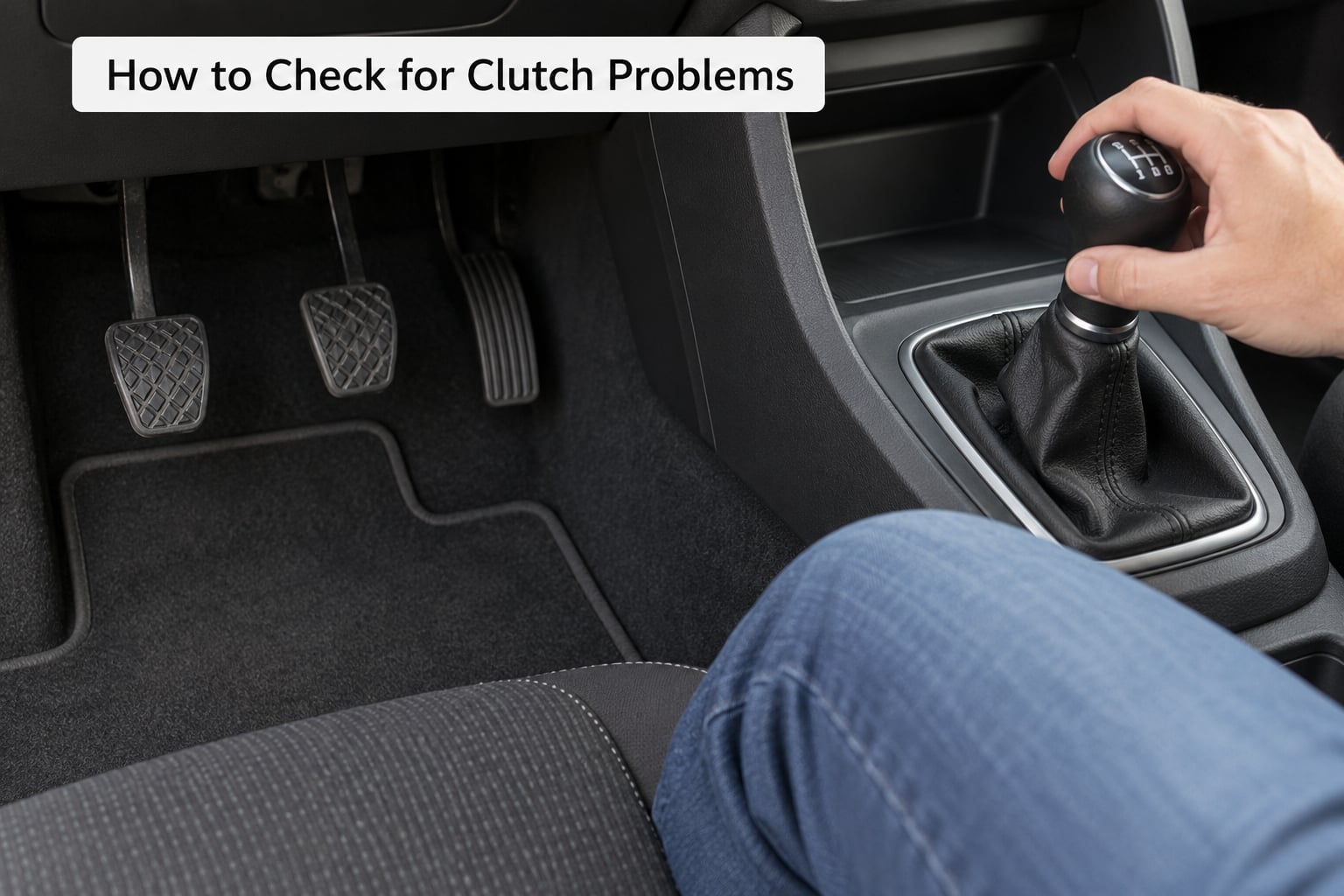
Work through this in order, in a flat empty car park, engine running, with the handbrake firmly on and the vehicle in gear for any test that involves the clutch. Your owner’s manual covers the correct procedure for your specific model, and it is worth a look before you start.
Check pedal feel
Press the pedal slowly and note the resistance. Steady and firm means the hydraulics are probably fine. Hollow, soft, or a pedal that drops to the floor with nothing holding it back is a hydraulic fault, and you should not be checking anything else until that is resolved.
Find the bite point
With the engine idling in neutral, press the pedal until you feel the car start to move. Note where that happens. Do it three times. If the point sits high and gets higher every few weeks, the disc is thinning. If the point is close to the floor, something in the hydraulics or release mechanism is not fully retracting.
Test engagement in each gear
Select each gear with the clutch down, pausing at the bite point. They should all go in cleanly and quietly. Grinding that appears in one gear only is often a synchroniser or shift mechanism issue rather than the clutch. Grinding that appears in all gears, especially reverse and first, points to incomplete disengagement.
Watch the revs under load
In a safe, clear area on a closed road, drive in fourth gear at a steady road speed and apply enough throttle to hold around 3000 rpm. Now accelerate hard enough to get to 5000 rpm without changing gear. If the car does not pick up speed in proportion to the revs, the clutch is slipping. Stay on private ground or an empty road and keep it brief.
Look for leaks and warning lights
Check the reservoir on top of the master cylinder and the fluid level. Then look at the bell housing area from underneath, and at the firewall around the master cylinder, for wetness. Any burning smell that lingers after a drive is a reason to stop pushing the car and get a proper diagnosis.
Then get a second opinion
None of these checks tell you whether the disc, the pressure plate or the flywheel is the worn part. That requires the transmission coming down, and a shop can usually look at the friction material and the flywheel surface while it is apart.
Clutch Problems vs Transmission Problems
This is where most of the wasted money happens. A mechanic quotes for a clutch, the owner pays, and the same symptom comes back because the real fault was in the gearbox or in a hydraulic line. Use this table to narrow things down before you authorise anything.
| What you notice | Likely clutch | Likely transmission or hydraulic | Something else |
|---|---|---|---|
| Revs climb, speed does not | Worn disc or pressure plate | Engine power loss, not a gearbox fault | Fuel or ignition fault, slipping belt |
| Grinding when selecting a gear | Clutch not fully releasing | Worn synchroniser or shift mechanism | Rusty gear teeth on a cold morning |
| Soft or spongy pedal | Rarely clutch wear | Air in the line, master or slave cylinder | Worn pedal bushing or pad |
| Hard to shift in one gear | Stick shift linkage or cable | Synchroniser in that gear | Worn shifter bushings |
| Car hesitates or bucks in gear | Judder from a warped flywheel | Worn gear teeth | Worn engine or transmission mounts |
| Shudder on take-off only | Contaminated or uneven disc | Rare | Mounts, wheel bearing, warped rotor |
| Grinding noise with no gear selected | Release or pilot bearing | Input shaft bearing | Exhaust or wheel bearing noise |
Two patterns are worth remembering. If the problem appears in every gear and changes when you press or release the pedal, it is the clutch or its hydraulics. If it appears in one gear and ignores the pedal entirely, it is the gearbox. If it happens only when you lift off or brake, start looking at mounts and brakes instead.
Intermittent faults make this harder, so write down what you did when it happened: which gear, which direction of pedal travel, road speed, weather, and whether the engine was warm. That note is worth more than your description of the noise.
What to Do If You Suspect a Bad Clutch
First, change how you drive while you sort it. No aggressive launches, no holding the clutch on hills, no slipshifting. If the pedal feels normal and the car pulls cleanly, driving gently to a shop is fine.
Second, get the symptom recorded properly. Sit in a quiet car park and write down what you feel and hear, with the details above. Mechanics work from your description, and a specific note saves diagnostic time that you would otherwise pay for.
Third, look at the accessible parts yourself. Check the clutch fluid reservoir level and look underneath for wetness at the bell housing. Look at the pedal linkage or cable for fraying or a disconnected clip if your car has a mechanical linkage. Those are safe, non-invasive checks.
Fourth, gather the records. When the clutch was last replaced, and whether it was ever done as part of a transmission rebuild. If the clutch is original and the car has covered a lot of ground, that is useful context. If a slave cylinder has been repaired recently and the pedal now feels soft, say so first, because it changes the diagnosis.
Finally, ask for a clutch or transmission specialist and ask them to confirm whether the flywheel is being replaced at the same time. A flywheel with a hot spot or a warped surface will spoil a fresh clutch, and it is the most common reason a replacement clutch appears to fail early. Get the diagnosis in writing, along with the parts they intend to fit.
Frequently Asked Questions
Can a bad clutch damage the transmission?
Yes, indirectly. A slipping clutch generates heat that can glaze the friction material and damage the pressure plate and flywheel surface, and shifting into a gear that has not fully disengaged grinds the synchronisers. Driving on for months with a slipping clutch is what turns a clutch-only job into a flywheel job, so early diagnosis protects more than just the clutch.
Why does my clutch slip when I accelerate?
Because the clutch is not clamping hard enough to hold engine torque. A worn friction disc has less material left to grip, and weakened pressure plate springs reduce the clamping force, so the disc slides instead of locking. You see it first where torque demand is highest: pulling away in first, or accelerating uphill in a tall gear, where the revs rise and the car does not follow.
Is it normal for a clutch pedal to feel spongy?
No, a spongy clutch pedal is a fault rather than normal wear. It usually means air trapped in the hydraulic line or a master cylinder that is not holding pressure, and sometimes a slave cylinder taking in fluid. Fluid on the floor of the reservoir means the circuit is picking up moisture, which corrodes seals and can contaminate the friction material, so it is worth fixing before it spreads.
What is the difference between a worn clutch and a bad transmission?
A worn clutch changes how the car transmits power: revs climb without matching acceleration, the bite point rises, and gears grind because the clutch is not releasing fully. A transmission fault stays tied to one gear and ignores the clutch pedal, such as a specific gear that will not select or grinds every time. A hydraulic fault changes the feel of the pedal rather than the behaviour of the car.
How much does it cost to replace a clutch?
It varies a lot by vehicle, and labour usually makes up the larger share of the bill. A small front-wheel-drive car with a transverse engine is generally the cheapest, while rear-drive and mid-engine layouts need the gearbox lowered, which adds hours. Replacing the flywheel at the same time and adding the slave cylinder, release bearing and fork will change the quote, so ask for a written breakdown of parts and labour.
Can I replace a car clutch myself?
Possible on some cars, but it is a major job. The gearbox usually has to come out, which on many vehicles means unbolting it from the engine bay, dropping the subframe, or lowering the whole rear of the car. A clutch also has to be aligned with the input shaft, and getting that wrong damages the new clutch quickly. Most people get better results and less downtime from a shop that specialises in clutches and transmissions.
What to Do First
Start with the cheapest check: press the pedal slowly and feel for resistance, then find the bite point three times in a row. That tells you in about five minutes whether you are looking at friction wear or a hydraulic fault, and it decides who you call. If the pedal feels normal and the bite point is climbing, book a clutch inspection and ask whether the flywheel is being replaced at the same time. Those are the signs your clutch is going bad, and catching them early keeps the job to the clutch itself. If you want a second opinion on a warning light that came on alongside any of this, start with how to diagnose a check engine light in a BMW.