
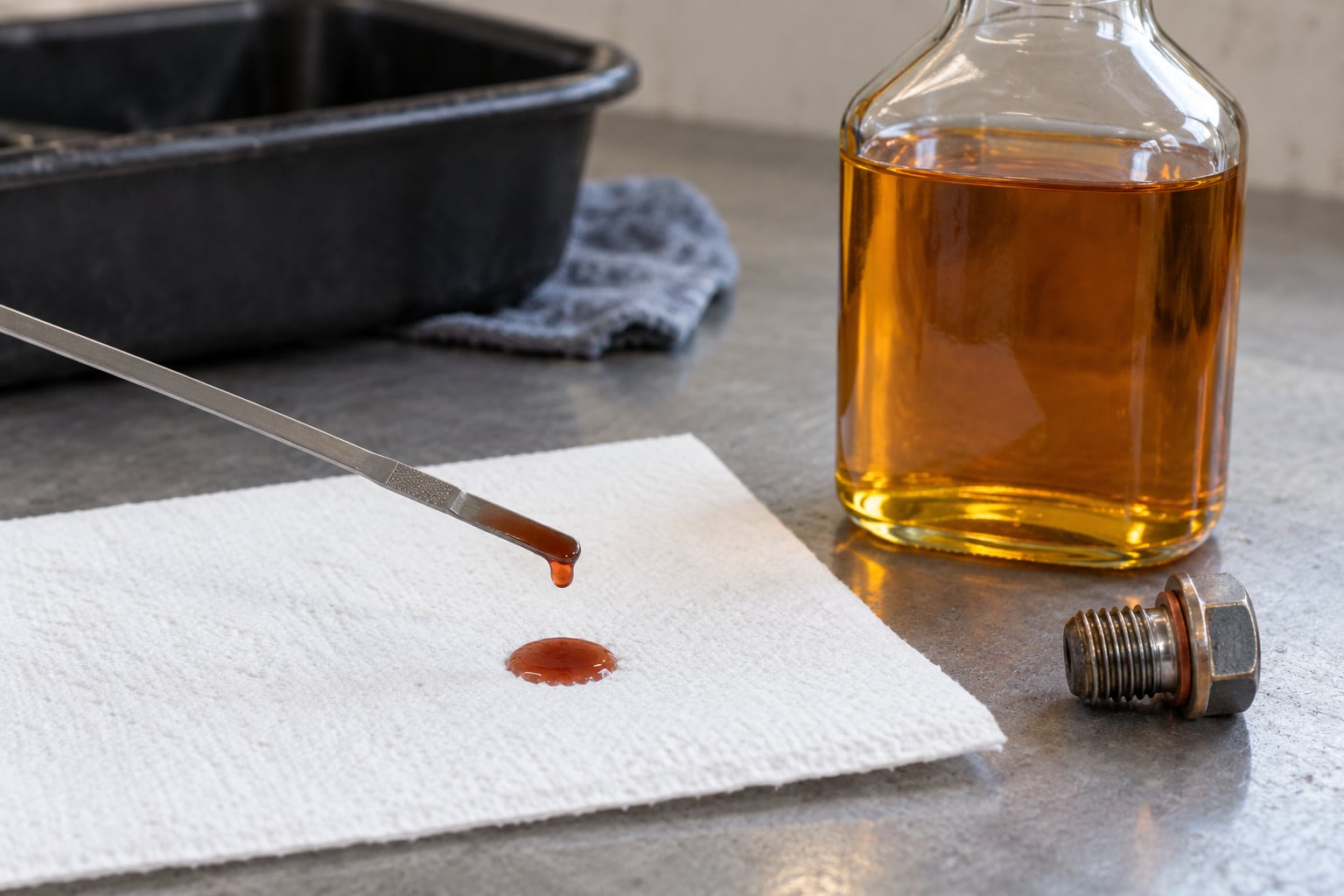
Healthy automatic transmission fluid is usually a translucent red, amber, or reddish-brown, and healthy manual transmission fluid is commonly clear, pale amber, or golden. That is the short answer to what color should transmission fluid be, but it is only a starting point: your owner’s manual and the fluid specification printed on the cap override any general rule, and color on its own never tells you the condition of the fluid.
I have pulled enough drain plugs to know that a photo of a dipstick tells you almost nothing. A drop of fluid on a white paper towel in daylight tells you a lot more. The difference between those two checks is the difference between guessing and diagnosing.
Table of Contents
- What Color Should Transmission Fluid Be?
- Why Transmission Fluid Color Can Look Different
- Automatic vs. Manual Transmission Fluid: What to Expect
- What Color Means Your Transmission Fluid Needs Attention
- How to Check Transmission Fluid Color Safely
- Why Checking the Dipstick Is Not Enough
- Frequently Asked Questions
- Conclusion
What Color Should Transmission Fluid Be?
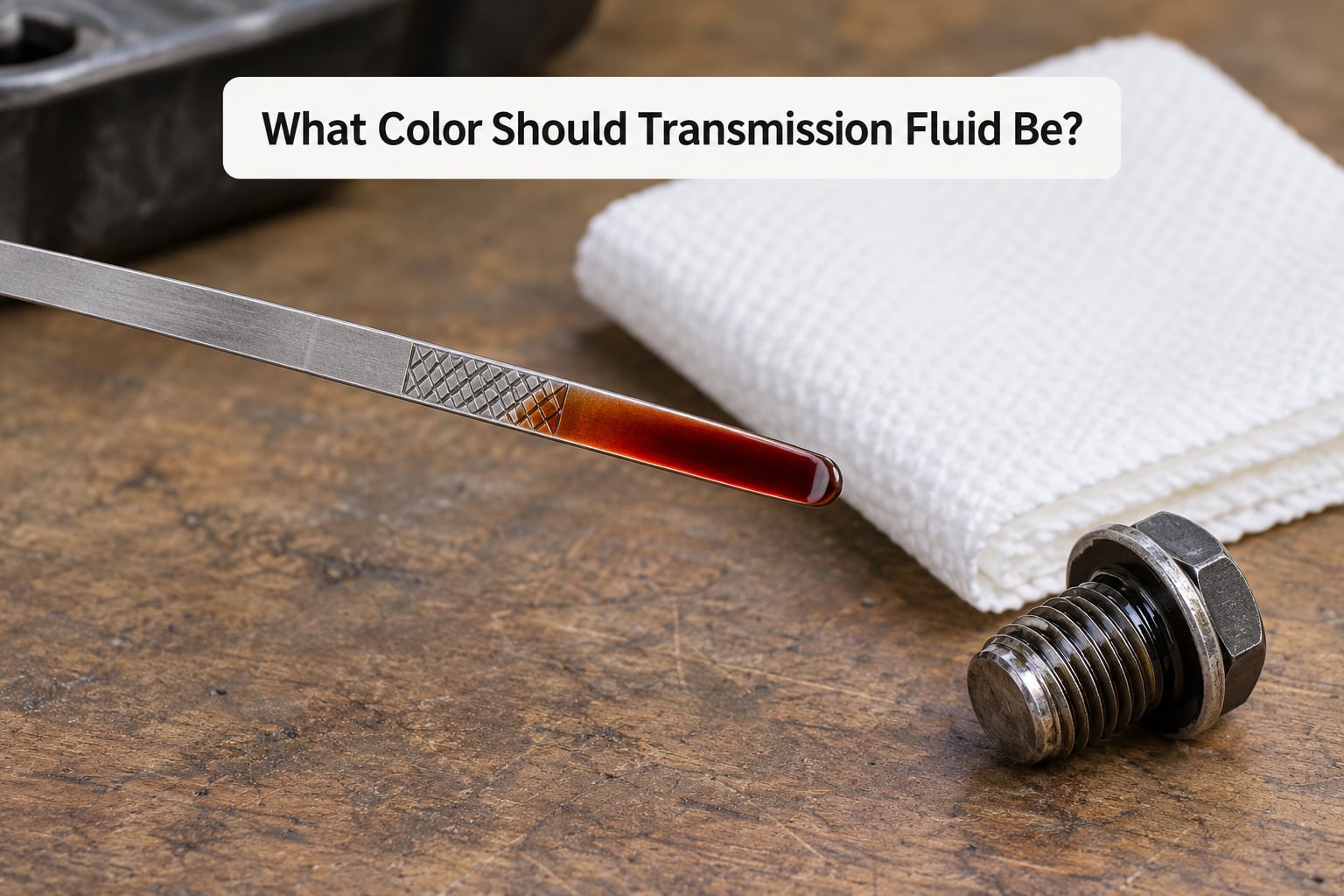
Automatic transmission fluid is dyed so it can be identified at a glance and mistaken for engine oil, so a healthy sample reads translucent red through amber to a deeper brick red depending on brand and age. Manual gearbox oil is rarely dyed at all, which is why it comes out clear, pale amber, or golden.
Three other things you will run into are normal too. A fresh dipstick sample can look almost colorless in sunlight, a brand-new Toyota WS fluid is a clear green, and some Subaru and Aisin manual fluids are dyed purple or green. None of those are faults on their own.
The part people get wrong is treating color as a verdict. Color tells you the dye, the type, the age, and sometimes a contamination story. It does not tell you the friction modifier is still there, so pairing the sample with a smell check and a look for particles is worth the extra thirty seconds.
Why Transmission Fluid Color Can Look Different
Manufacturers pick their own dye, and they are not required to match. Two cars from the same year with the same broad spec can show noticeably different reds on the same day.
Heat is the biggest reason for a slow color change. Fluid that has spent years cycling between cold mornings and stop-and-go traffic oxidizes, and oxidized fluid loses its friction modifier before it loses its color. That is why a dark sample matters more when you also feel a shift delay.
Where and when you pull the sample matters too. A sample taken straight off the drain plug after a drive carries suspended wear particles and looks dirtier than the same fluid drawn from a warm dipstick tube.
Contamination adds its own signature. Coolant turns ATF milky pink, water beads at the bottom of the dipstick tube, and coolant or antifreeze from a leaking cooler line is one of the most common reasons a transmission fails in a car that was otherwise fine. Owners on MechanicAdvice have posted milky pink samples that traced straight back to a failed cooler, not a bad transmission.
Automatic vs. Manual Transmission Fluid: What to Expect
| Transmission type | Typical healthy color | First thing to check |
|---|---|---|
| Automatic (conventional) | Translucent red through amber to dark brick red | Smell and level, then color |
| CVT | Often clear, pale green or red depending on brand | Debris on a clean filter; many have no dipstick |
| Manual | Clear, pale amber or golden | Magnetic plug for metal particles |
| Dual-clutch (DSG) | Matches the automatic spec, usually red or amber | Clutch wear and mechatronic warnings |
Specifications differ widely by vehicle, so treat that table as a set of expectations rather than a rulebook. A BMW manual takes gear oil with no red dye at all, and a Honda under the same roof uses a blue-green fluid that would look wrong in a Toyota.
What Color Means Your Transmission Fluid Needs Attention
When you have a sample in front of you, this chart sorts the common colors by what they mean and how quickly you should act. Your manual’s fluid spec and the fluid under the cap always win over anything in a chart on the internet.
| What you see | What it usually means | What to do |
|---|---|---|
| Translucent red or clear amber | Healthy, near-new fluid | Nothing; note the mileage and move on |
| Light brown, still translucent | Normal aging with normal use | Monitor; plan a change at the next service |
| Dark brown, opaque | Heat oxidation and used friction modifier | Schedule a fluid and filter change soon |
| Black, thick, burnt smell | Fluid cooked past its service life | Change promptly; stop using it if shifts are slipping |
| Milky pink, foamy, strawberry-milkshake look | Coolant or water mixing in through a failed cooler | Do not drive; book a diagnosis |
| Green or purple | Usually a brand-specific dyed fluid | Check the spec; replace only if it does not match |
| Blue or gray, gritty | Wrong fluid or cross-contamination from another service | Have the fluid sampled and replaced with the correct spec |
| Bright metal flecks on the magnet or towel | Wear debris from gears or bearings | Talk to a transmission specialist, especially with a noise or shudder |
Dark brown and black fluid
Darkening on its own is expected with age, and plenty of healthy high-mileage cars are nowhere near the spec’s stated life. What turns it into a problem is a burnt-toast smell, a slipping clutch pack, or harsh engagement. Dark plus any of those is a change-now situation. Dark with a clean smell and smooth shifts usually just means the fluid has done its job for a long time.
Milky or pink fluid
Milky pink, or a foamy strawberry-milkshake texture, is coolant in the transmission. A transmission is a closed system, so any fluid appearing from outside means a leak, usually at a cooler line, a cooler fitting, or an internal radiator. Do not top it off and keep driving. That is the one color on this list where pulling over is the right call.
Fluid with metal in it
A light dusting of dark grey friction material on the magnet is normal for an automatic. Bright silver or coarse shavings are not, and neither is a mound that keeps growing between changes. Ridgeline owners have posted tan fluid at low mileage after a service, and shop forums have plenty of threads debating how dark is too dark, which is exactly why a specialist read beats an owner’s forum guess.
Fluid that is not the color it should be
Green and purple show up constantly in manual gearboxes because brands dye their oil differently. It becomes a genuine problem when the color does not match the specification, when the texture is gritty, or when the fluid has been topped up with whatever was on the shelf. If you are comparing fluids, our guide to how to check brake fluid level and color covers the same habit on a different fluid, and fluid crossings are the number one cause of trouble after a shop visit.
How to Check Transmission Fluid Color Safely
The paper towel method is the one I trust, and it takes about five minutes on a car with a serviceable dipstick. Work on level ground, follow the manual’s instructions for engine state and transmission temperature, and never pull a dipstick on a hot transmission unless the manual says it is safe.
- Confirm the specification. Read the fluid type from the dipstick handle, the filler cap, or your owner’s manual before anything else.
- Set up the conditions the manual specifies. Many manuals want the transmission at a stated fluid temperature, and some want the engine running with the transmission in park or neutral.
- Park level, engine off or idling as required, and pull the stick. Wipe it on a clean rag, put it back, then wait the time the manual gives for the fluid to resettle.
- Pull it again and drop the sample on a white paper towel. Spread it out so you can see through the thin edge, and hold it up to daylight. A garage with a yellow bulb will lie to you.
- Compare it against your fresh fluid. Keep a dab of the correct new fluid in a sealed bag or on a printed label. Seeing new next to old is faster than any description on a website.
- Run the smell and particle checks. Healthy fluid smells faintly of petroleum or is nearly odorless. A burnt smell, or grit you can feel between your fingers, changes the whole answer.
- Put the stick back and check the level. Low fluid is its own problem on a closed system, because it usually means a leak somewhere.
Keep the stick out of the engine bay while you look at it. A dropped dipstick that bends in the tube can leave a small piece of steel in the pan, and you will be back at the shop for something entirely avoidable.
Why Checking the Dipstick Is Not Enough
Many modern transmissions, including a large share of BMW automatics, ship without a conventional dipstick. The fluid level is set at the factory with the transmission at a specific temperature, and the only way to check it properly is a scan tool reading fluid temperature and condition, or a prescribed test drive that loads the transmission at controlled temperatures.
That matters for a second reason. On a sealed transmission, a low fluid level is not a maintenance item, it is a symptom of a leak. You cannot top your way out of it, and the interval debate you may have read about in our piece on the BMW transmission fluid lifetime fill myth only applies to fluid that is still inside the transmission.
Where there is no dipstick, the practical routine is a fluid and filter change at the interval in your manual, plus attention to behavior. Slipping, delayed engagement, a shudder under load, or a rising fluid temperature reading on a scan tool are all reasons to have a qualified technician look at it, with a transmission specialist preferred over a general mechanic when the symptoms are real.
Frequently Asked Questions
Is red transmission fluid always the correct color?
No. Red is the standard dye color for most automatic transmission fluid, but brands differ: Toyota WS is a clear green, some Subaru manual gear oils are dyed purple, and Honda fluids are blue-green. Manual transmission fluid is usually undyed, so clear, pale amber, or golden is normal. Check the specification on the dipstick handle or filler cap before judging any sample by color alone.
Why does my transmission fluid look clear?
A clear sample is usually healthy fluid that is thin, or a new low-viscosity synthetic that has not picked up much dye. It can also mean the fluid is not the specification your transmission requires, since many manual gearboxes and some CVT applications use clear or lightly tinted oil. Check the color against a dab of the correct new fluid and confirm the spec before assuming nothing is wrong.
Is dark brown transmission fluid bad?
Not on its own. Transmission fluid darkens with heat and age, and light brown fluid on a healthy high-mileage car is normal aging. It becomes a problem when the darkness comes with a burnt smell, harsh shifts, slipping, or a shudder. Change it promptly if any of those are present, and follow the owner’s manual if the fluid is simply old but the car drives normally.
Can you just add transmission fluid if it’s low?
You can, and a matching top-up buys time, but on a closed transmission a low level means there is a leak rather than normal consumption. Topping up hides the evidence and does not fix worn clutches or a failing cooler. Use the exact specification, never a universal or multi-vehicle fluid, and get the leak found. If the car shifts differently once the fluid is full, stop driving it.
Why is my transmission fluid milky pink?
Milky pink fluid means coolant or water is mixing into the transmission, almost always through a failed cooler line, a bad fitting, or a leaking internal radiator. The oily, foamy, strawberry-milkshake look is the classic giveaway. This is not a color that improves with driving. Stop driving and have the source of the leak diagnosed, because coolant in an automatic can destroy the clutch packs quickly.
How often should transmission fluid be changed?
Use the interval in your owner’s manual, which commonly falls between 60,000 and 100,000 miles for many automatics but varies widely by brand and by how the vehicle is used. Shorten it if you tow, drive in stop-and-go traffic, or run long hot highway trips. Severe service schedules exist for exactly those conditions, and a transmission specialist can advise if your symptoms suggest a change sooner.
Conclusion
Start with the transmission type and the manufacturer’s specification, not with a color chart. If your car has a serviceable dipstick, pull a clean sample in the conditions the manual specifies, spread it on a white paper towel in daylight, and compare it with a dab of the correct new fluid.
Treat unusual color, odor, grit, or shifting changes as reasons to investigate rather than something to watch. Milky pink fluid and a burnt smell both mean stop driving and get it looked at. If the transmission is hesitating or slipping, read our guide to what limp mode is and what causes it before you book the appointment, since a slipping transmission is one of the triggers that brings the warning flag on.