
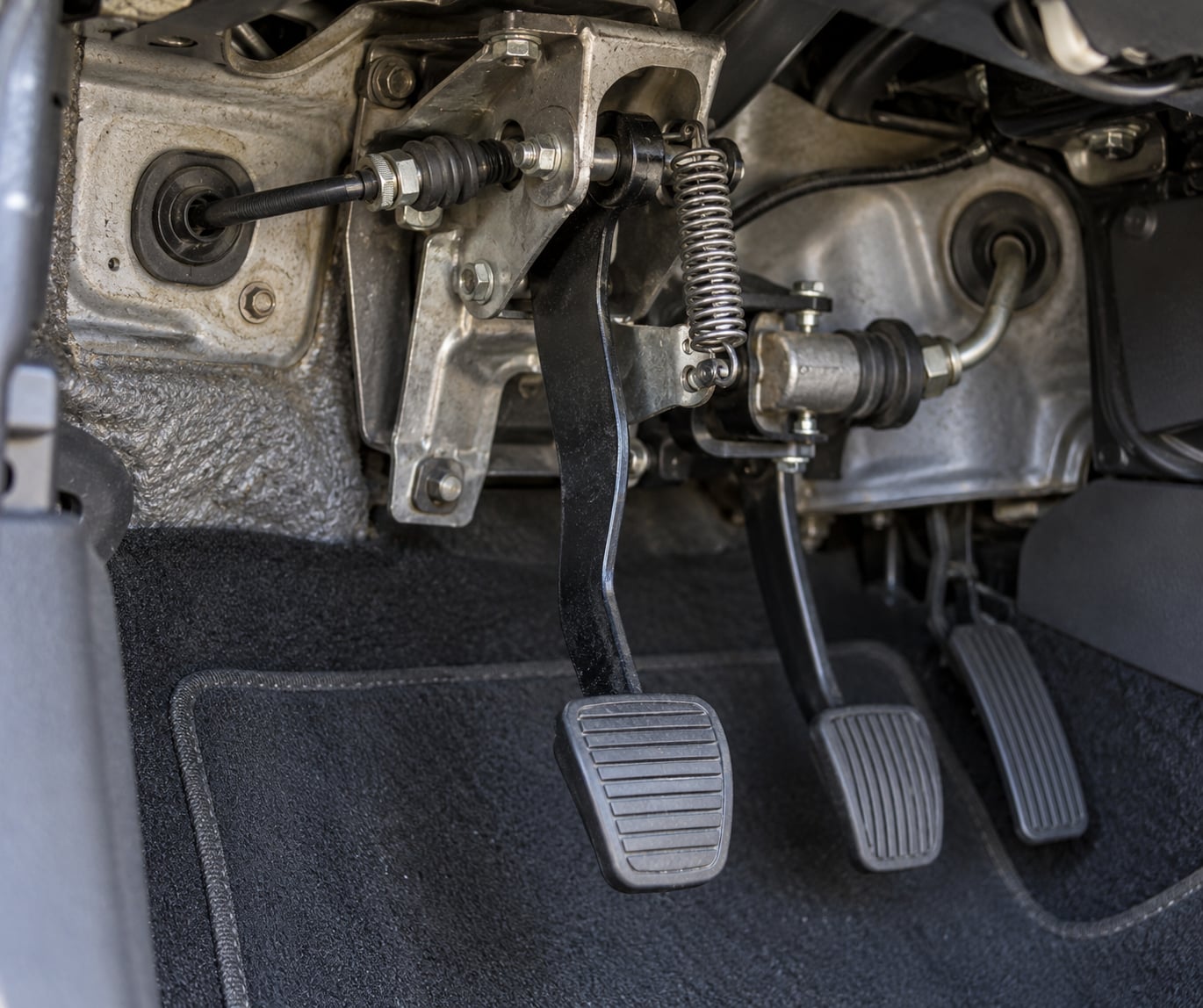
A clutch pedal that sticks to the floor is nearly always a return-path problem: something that is supposed to push the pedal back up is broken, weak, or full of air. Air or low fluid in the hydraulic line, a failed clutch master cylinder, a bad clutch slave cylinder, a snapped pedal return spring, and a cracked pedal bracket cover most cases.
This guide walks through clutch pedal sticking to the floor causes in the order you should actually test them, so you can tell a cheap fix from a transmission-out job before you buy parts.
Table of Contents
- Clutch Pedal Sticking to the Floor: Common Causes
- What Does a Sticking Clutch Pedal Feel Like?
- Is It Safe to Drive With a Sticking Clutch Pedal?
- How to Diagnose Clutch Pedal Sticking to the Floor
- Worn or Damaged Clutch Release Components
- Master Cylinder or Slave Cylinder Problems
- Pedal, Mount, or Floorboard Restriction
- Clutch, Flywheel, or Pressure-Plate Problems
- What to Repair or Replace
- Frequently Asked Questions
- Why does my clutch pedal stick to the floor?
- Can a sticking clutch pedal be caused by cold weather?
- Is a high clutch pedal normal in a manual-transmission car?
- Should I drive if the clutch pedal does not return fully?
- What does a stiff or spongy clutch pedal mean?
- How much does it cost to fix a clutch pedal that stays down?
- Conclusion
Clutch Pedal Sticking to the Floor: Common Causes
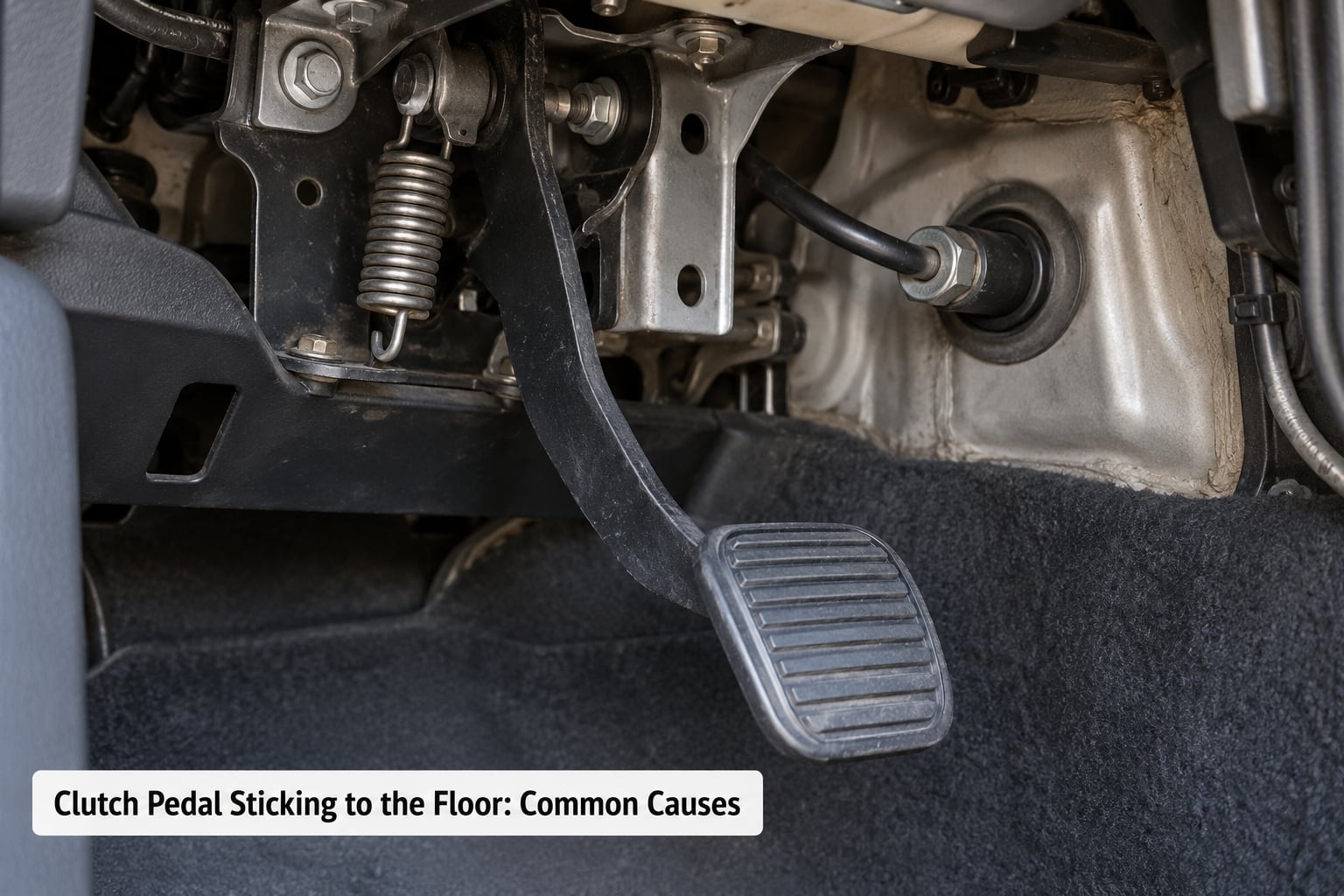
Here are the eight causes, roughly in the order they show up on a manual-transmission car with this symptom, starting with the ones you can check yourself in a few minutes.
| Cause | Typical symptom | When it shows up | Realistic DIY check? |
|---|---|---|---|
| Air in the hydraulic line | Spongy or soft pedal that travels too far before doing anything | After any fluid work, or after the fluid reservoir was drained | Yes, if the system has a bleeder valve |
| Low or contaminated fluid | Pedal goes gradually lower over months, sometimes only when cold | Slowly, on an aging car | Yes, check the reservoir first |
| Failed clutch master cylinder | Fluid level stays steady, pedal has no firm bite, sometimes wet carpet | Intermittent at first, then constant | Partly, diagnosis is easy but the part may be non-serviceable |
| Failed clutch slave cylinder | Pedal returns partway and stops, or stays fully down with the clutch still engaged | Constant, often worse hot | Diagnosis is visual from the bellhousing area; replacement is shop work |
| Broken or weak pedal return spring | Pedal creeps down while you are not touching it, pops inward and stays | Suddenly, often after a footwell intrusion | Yes, the spring is cheap and accessible |
| Cracked pedal bracket or worn pedal bushing | Pedal feels loose or wobbly, sits lower than it used to | Sudden or after corrosion | Partly, bracket repair means pulling the pedal box |
| Stretched or kinked clutch cable | Pedal takes up slack and then binds, engagement point creeps toward the floor | On older cable-equipped cars | Partly, adjustment is easy, cable routing is fussy |
| Binding clutch fork or worn release bearing | Pedal reaches the floor but the clutch is still partly engaged, gear shifts grind | Gradual, usually with a droning noise | No, transmission has to come out |
Only the last one reliably means the transmission comes off. Everything above it lives in the footwell, the firewall, or the top of the bellhousing.
What Does a Sticking Clutch Pedal Feel Like?
Three behaviors get lumped together under this symptom, and they point at different parts.
A pedal that stays exactly where you leave it, at or near the floor, is a return failure or a pressure failure. Nothing is pushing the fork back into the clutch.
A pedal that comes back slowly and only reaches half height is usually a slave cylinder that stops pushing, or a cable that binds on its routing. A pedal that feels spongy, with no bite point at the top of the travel, is air or a leak.
A pedal that creeps downward while you are cruising is different again. That is usually fluid slowly escaping past an internal seal, and it often gets worse over a single drive.
None of this is the same as a normal high pedal. Many manual cars sit with the clutch pedal roughly level with or a little above the brake pedal, because the clutch takes more free travel than the brake. If your pedal has always been up there and it stays there, nothing is wrong.
A rising hum that comes and goes with road speed is a different fault entirely, and worth telling apart from a pedal problem. We covered that in what causes a humming noise that changes with speed.
Is It Safe to Drive With a Sticking Clutch Pedal?
No. A pedal that will not return means the clutch is not re-engaging predictably, and that ends with a broken car or a crash.
The specific risks: the clutch can slip under acceleration and burn the disc, it can drag and overheat the flywheel, and it can creep the car forward at a stop with no clutch torque holding it back. Unintended engagement on the wrong side of a gear is the one that gets people hurt.
Stop driving and arrange a tow if you see any of these:
- Fluid on the floor, under the dash, or around the bellhousing
- The clutch drags noticeably on every shift
- Engagement changes unpredictably between stops
- The pedal will not return at all, or has come to rest on the carpet
- Any grinding or squealing when you engage
If you need the car to go somewhere, a flatbed is the safe choice. Drive it only if the pedal returns fully every single time and the car shifts cleanly, and treat that as a temporary trip to a repair shop.
How to Diagnose Clutch Pedal Sticking to the Floor
Work in this order. Most people skip straight to buying a slave cylinder and end up doing the job twice.
1. Read the owner’s manual for your specific car
Fluid type and location, reservoir bleeding procedure, and whether the master cylinder is serviceable are all model-specific. Check it before you touch anything.
2. Identify your actuation system
Look under the hood. A hard line running to a round cylinder on the bellhousing means hydraulic. A flexible sheath running through the firewall means a cable. A clutch pedal under an assist or load-assist mechanism is a hydraulic pedal box that still pulls a cable, and those have their own quirks.
3. Check the fluid reservoir
Open the hood and look at the clutch reservoir. Low fluid or a reservoir that has crept down over a few days is your answer, and it costs almost nothing to fix. If the fluid is dark, gritty, or smells burnt, the whole system needs flushing. A wet spot on the carpet under the dash is the same fault seen from the other side of the firewall, and our wet passenger floor mat causes guide covers the other sources of that puddle.
4. Check the pedal by hand
Engine off, key on, transmission in neutral. Push the pedal down and release it. It should snap back to its stop by feel. Then check free play at the top: a couple of millimetres is normal, a pedal with no free play is worn, and a pedal that will not come all the way back is a return fault.
5. Look for pedal-side damage
Look at the pedal, the bracket, and the return spring. Cracked pedal brackets are a documented failure on several cars, with multiple owners on rx8club confirming the metal bracket snaps and holds the pedal down. Broken return springs show up on the same car more than once, on talkmorgan threads.
6. Follow the line to the bellhousing
Trace the cable or hard line to the slave cylinder. Look at the push rod position and whether the clutch fork is pushed outward. A fork that sits out and can be wiggled by hand points at the slave or the linkage rather than at the fluid.
7. Bleed it and use an acceptance test
After bleeding, the pedal must hold firm pressure with the bleeder closed and return fully to the stop every time. If it feels fine and then binds the moment you select a gear, bleeding did not fix the cause.
Worn or Damaged Clutch Release Components
The clutch fork, release bearing, and pressure plate are what actually release your clutch. Anything that stops them retracting leaves the pedal with nothing to push against.
A stretched or frayed cable loses tension gradually, so the pedal takes up slack, then binds. Kinks from poor routing or a sharp bend cause the same complaint on a cold morning and nowhere else.
A dry or corroded pivot ball where the fork swings will not move freely, and neither will a fork with hardened grease in its bore. Both are cheap to lubricate and a common source of a pedal that returns only halfway.
A worn release bearing can drag on the pressure plate fingers. That one grinds or drones at idle with the clutch in, which is a sound you do not confuse with anything else.
If the pedal reaches the floor but the clutch is still partly engaged, no amount of bleeding will help. That is a clutch-side fault.
Master Cylinder or Slave Cylinder Problems
These two do most of the work in hydraulic clutch pedal sticking to the floor cases, and they fail in different ways.
Master cylinder
The master sits under the hood or on the firewall, converts pedal push into fluid pressure, and is where most pedal assist happens. Internally, a seal can start bypassing and pressure never builds. The tell is a reservoir that stays full, fluid that stays clear, no visible leak, and a pedal with no bite. Owners on focusrs.org and ls1tech both landed on the master cylinder after the pedal stopped moving.
Slave cylinder
The slave sits at the bellhousing and pushes the fork. Internally it can also bypass, which leaves the push rod extended and the clutch still engaged. On my350z.com a poster documented exactly this: fluid full and clear, no leaks, no pressure after bleeding, slave pin stuck out, fork sitting outward and movable by hand.
Air, and the case bleeding does not fix
Air in the system gives you a spongy pedal with no bite point, and honda-tech threads consistently identify it as the first thing to try. Bleed it with the bleeder valve open, pressing the pedal and watching for fluid without bubbles, then close it.
Here is the trap: if you have bled the system three times and the pedal still sticks, stop bleeding. Air can pocket inside the master cylinder where no bleeder reaches it, and only bench bleeding on a pressure bleeder clears it. That answer appears in exactly one thread in our research, from r/mazdaspeed3, and it fixes a surprising share of repeat-failure cases.
If a brand-new slave cylinder and clutch are already fitted and the pedal is fine until you select a gear, the remaining suspects are an unseated slave push rod in the clutch fork, a clutch disc binding in the bellhousing, or a pedal bracket that is still cracked. That exact sequence was posted on r/MechanicAdvice by a Mk4 GTI owner who had bled three times already.
Pedal, Mount, or Floorboard Restriction
Sometimes the pedal cannot come back up because something is physically holding it there, and no amount of hydraulics will change that.
A cracked pedal bracket is the classic one. The bracket carries the return spring and the pedal pivot, and when it fractures the pedal loses its stop. Multiple independent confirmations on rx8club describe the same snap-and-hold-down failure.
A collapsed pedal bushing gives you a pedal with free play at the top and a resting position lower than it used to be. Some drivers never notice it because they compensate without thinking.
A disconnected or broken return spring lets gravity and residual hydraulic pressure do the work, which is why those pedals creep down at a traffic light.
A carpet mat, a piece of trim, or a pedal stop covered with grime can also rest against the pedal face. It sounds too simple to be real, and it is still worth a glance before you order parts.
Clutch, Flywheel, or Pressure-Plate Problems
This is the case people misdiagnose most, because it looks exactly like a pedal fault until you watch the bite point.
Watch where the clutch engages across several stops. If the engagement point stays in roughly the same place on the pedal while the pedal itself now sits lower, the fault is on the pedal or hydraulic side. If the engagement point creeps steadily toward the floor while the pedal sits where it always did, the clutch itself is going.
On my350z.com that creeping engagement point came with screeching and shudder on pull-up. That pattern is a worn release bearing or a warped pressure plate, and the my350z.com owner eventually found the pedal problem was a symptom of a dying clutch, not the fault.
A worn clutch disc, a glazed pressure plate, a contaminated flywheel face, or a pressure plate that is not bolted flat will all make the pedal feel wrong and will not be fixed by a master or slave cylinder.
These are transmission-out jobs. Once you are in that territory, replacing the clutch disc, pressure plate, release bearing, and pilot bearing as a kit is the sensible move, and it is why a sticking pedal should never be ignored for months.
What to Repair or Replace
Once you know which side is at fault, the repair options sort themselves by difficulty.
Clean and lubricate accessible pivots, the fork bore, and the pedal pivot points. Replace a return spring. Top up or flush the fluid and bleed the system. Adjust or replace a stretched cable. All of these are weekend work with hand tools and the manual open.
Replacing the slave cylinder means working at the bellhousing, which is tight on many cars and sometimes needs the transmission lowered for clearance. Replacing a master cylinder is often simpler, but on many modern cars the master is a non-serviceable combination unit with the reservoir and pedal assist built in, sold only as one assembly.
If a clutch is already out, replace the master and slave as a pair. A large share of repeat failures on these threads come from replacing only the slave, then finding the same fault months later. When the same fault returns within about a year on the same side, treat the pair and the fluid as the problem rather than the one component.
Get a technician involved when the diagnosis points at the clutch itself, when the master cylinder is a combined non-serviceable unit, when the bellhousing area is inaccessible without dropping the transmission, or when bleeding three times changed nothing. That last case means bench bleeding the master, and it is worth paying for rather than guessing again.
Frequently Asked Questions
Why does my clutch pedal stick to the floor?
The pedal returns because a spring and, on hydraulic cars, fluid pressure push it back up. If it stays down, one of those return paths has failed: air or a leak in the line, a bypassing internal seal in the clutch master cylinder, a slave cylinder that has stopped pushing, or a broken return spring or pedal bracket. Check fluid level and carpet first, since those cost almost nothing to fix.
Can a sticking clutch pedal be caused by cold weather?
Cold alone rarely causes it, but cold does expose two real faults. Fluid viscosity changes, so an internal leak that dribbles at operating temperature can bind or barely move in the morning. A stiff rubber bushing or a dry pivot ball also tends to seize when cold and free up once the car warms up. If the pedal is fine on a warm day, look at seals, bushings, and lubricated pivots rather than the clutch.
Is a high clutch pedal normal in a manual-transmission car?
Yes. The clutch takes more pedal travel than the brake, so on many manual cars the clutch pedal sits level with or slightly above the brake pedal when fully released. That is normal and has nothing to do with sticking. The concern is change over time: a pedal that has crept lower, now has free play you did not used to have, or returns slower than it did a year ago is a leading indicator worth checking now.
Should I drive if the clutch pedal does not return fully?
Not for general driving. A pedal that does not return means the clutch is not re-engaging predictably, so it can slip under acceleration, drag and overheat the flywheel, or creep the car forward at a stop. Tow on a flatbed if there is fluid on the floor, the clutch drags, engagement is unpredictable, or the pedal rests on the carpet. A short trip to a shop is only reasonable if it returns fully every single time.
What does a stiff or spongy clutch pedal mean?
Spongy means air or a leak: the pedal travels too far with no firm bite point, and it gets worse as fluid heats up. Stiff means the opposite problem, usually a cable or linkage binding, or fluid that has thickened with contamination. A pedal that is soft and then suddenly firm at the very end of the travel is more often a worn fork, a seizing pivot ball, or a pedal bracket taking up slack.
How much does it cost to fix a clutch pedal that stays down?
It depends almost entirely on which cause you have. Fluid, bleeding, a return spring, or a pedal bushing are cheap parts and modest labor. A cable or a single hydraulic cylinder lands in the middle. A combined non-serviceable master cylinder costs more in parts and may need the pedal box out. If the bite point is also creeping toward the floor, add a full clutch kit and transmission removal, which is the most expensive branch by a wide margin.
Conclusion
If the clutch will not fully disengage, stop driving. Then start narrow: check the reservoir and the carpet for fluid, look at the pedal, bracket, and return spring, and work out whether your car uses a cable or hydraulics before you order anything.
Fluid and bleeding fix the most cases. A failed master or slave cylinder explains the rest, and a clutch-side fault explains the ones where the bite point creeps toward the floor. Persistent symptoms after repeated bleeding usually mean bench bleeding the master cylinder, not a fourth round of pumping the pedal.
Updated for 2026. Applies to most manual-transmission cars; check your owner’s manual for fluid type and procedure.