
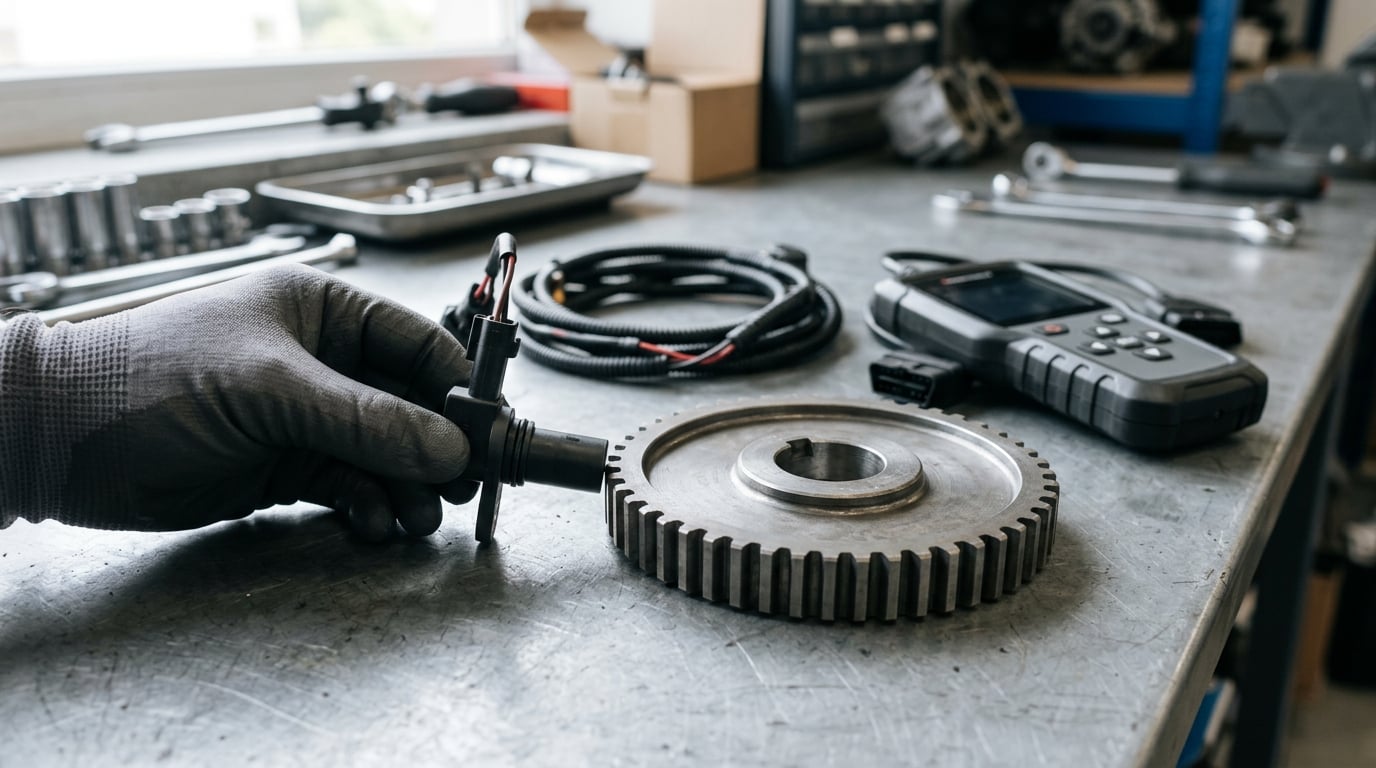
A bad crankshaft position sensor tells the engine computer it can no longer tell where the crankshaft is and how fast it is turning, so spark and fuel go out at the wrong moment or not at all. The result is a stall, a crank with no start, misfires, a loss of power, or a check engine light. Sometimes it is only a flicker, and sometimes the engine dies at an intersection.
That last scenario is the one that worries people, and rightly so. Most drivers who search this question are not trying to fix a warning light — they are trying to decide whether the car is safe to drive to work tomorrow.
This guide covers what the sensor actually does, the symptoms in the order they tend to show up, the trouble codes the computer stores, and a diagnostic order that stops you buying a part you do not need.
Table of Contents
- What Does a Bad Crankshaft Position Sensor Do?
- How the Crankshaft Position Sensor Works
- Symptoms of a Bad Crankshaft Position Sensor
- Why Crankshaft Position Sensors Fail
- How to Tell If It’s the Sensor or Another Engine Sensor
- Bad Crankshaft Sensor vs. Bad Cam Sensor or Timing Issues
- Can You Drive With a Bad Crankshaft Position Sensor?
- How to Replace a Crankshaft Position Sensor
- Frequently Asked Questions
- Can a crankshaft position sensor fail intermittently?
- Does a bad crankshaft position sensor mean the engine timing is wrong?
- Will replacing the crankshaft position sensor clear the check engine light?
- What happens if I keep driving with a bad crankshaft position sensor?
- Is the crankshaft position sensor the same as the camshaft position sensor?
- Can bad wiring make the crankshaft position sensor appear failed?
- What to Do First
What Does a Bad Crankshaft Position Sensor Do?
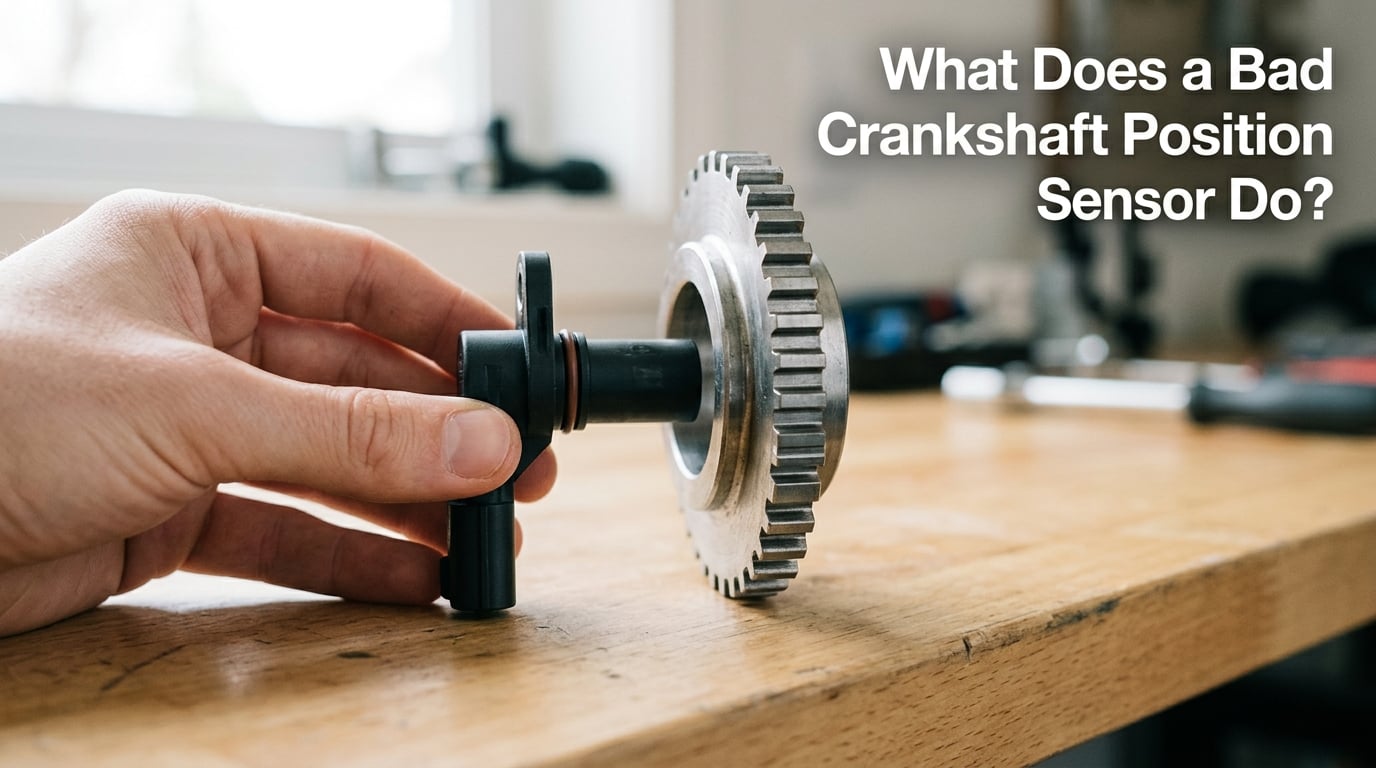
The crankshaft position sensor is the engine’s reference for where the pistons are. It reads a toothed wheel called a reluctor wheel that is pressed onto or cast into the crankshaft, and it reports crank speed and position to the Engine Control Module (ECM) dozens of times per second.
When that signal goes weak, noisy or intermittent, the ECM does not degrade gracefully. It loses its main timing reference, so ignition timing goes to a fixed fallback value, fuel injection gets trimmed wrongly, and if the signal drops out entirely the engine shuts off. Depending on how much signal is left, a failing sensor produces one of three behaviours: a hard no-start, a running-but-wrong engine, or an intermittent staller that is fine until it isn’t.
| What you feel | What is happening under the hood | What it usually means |
|---|---|---|
| Crank, no start | ECM never sees a valid crank signal, so it never commands a spark | Total signal loss, or a code-cleared fault that is still there |
| Stalls while driving | Signal drops out at road speed and the ECM cuts fuel and spark | Heat-related failure, cracked connector, damaged harness |
| Stalls hot, restarts cold | Sensor works until the engine warms and the failure temperature is reached | Aged sensor element or oil-contaminated connector |
| Rough idle and shudder | Signal is present but noisy, so timing hunts from cycle to cycle | Weak magnetic pickup or a damaged reluctor wheel |
| Misfires under load | ECM cannot tell a real misfire from a bad signal and cuts fuel | Intermittent loss, often a P0300-range code plus P0336 |
| Sudden loss of power | Engine enters a reduced-power or limp mode on a single lost cycle | Weak sensor on the edge of failing |
| Tachometer drops to zero | Nothing is transmitting pulse data to the gauge | Sensor or circuit open, engine may still be running |
| Check engine light on | ECM stored a crankshaft circuit or correlation code | Often a circuit fault, not necessarily a failed sensor |
How the Crankshaft Position Sensor Works
There are two common types. A Hall effect sensor contains a semiconductor that switches its output voltage on and off as each tooth of the reluctor wheel passes. A magnetic pickup, older and still common on some four-cylinder engines, generates a small alternating sine wave as a magnet on the shaft moves past a coil.
Either way the ECM counts the pulses. More pulses per second means higher RPM. The spacing of the pulses, measured against a known position, tells it exactly where top dead center is. From that one number it calculates ignition timing, when each injector opens, and how far the crankshaft and camshafts have rotated relative to each other.
One clarification worth making, because it comes up constantly: the crank sensor does not control engine timing. It reports crank position, and the ECM uses that report to decide timing. Same for fuel injection and, on engines with variable valve timing, the camshaft position.
Because so many systems hang off that one signal, a crank fault shows up in places that have nothing to do with the engine’s basic firing. Torque converter clutch behaviour, transmission shift strategy, fan control and even the tachometer can all change when the reference signal is unreliable.
Symptoms of a Bad Crankshaft Position Sensor
Grouping symptoms by what a driver actually notices makes the list far more useful than one long alphabetical dump. Most of the complaints that reach a shop fall into four groups.
Starting and running problems
The classic hard failure is crank, no start. The engine turns over, may crank faster than normal because there is no compression drop from a partly fuelled charge, and simply never fires. Warm starts tend to fail more than cold ones, and many owners first notice it on the first start of the day after a long drive.
Stalling, especially when hot
This is the pattern most associated with the crank sensor, and the most frustrating one. The car runs fine cold, dies after twenty minutes of motorway driving, and starts again once it has sat for an hour. A truck owner on r/MechanicAdvice described exactly this pattern — sometimes it fired up, sometimes it started and puttered, and on two occasions it died at idle in traffic.
Warning lights and stored codes
Usually the check engine light comes on. Occasionally it does not, because the failure is fast enough that the ECM sees a plausible but wrong value and never crosses its threshold. Some cars will run for weeks with an intermittent crank fault and no light at all.
Performance and driveline feel
Sluggish throttle response, an idle that hunts up and down, misfires that come and go, and reduced fuel economy all show up. A subtler one showed up in an r/MechanicAdvice thread where an Astra J owner noticed the clutch bite point had changed and the car was shaking at idle with no other obvious fault. Nobody expects the crank sensor to affect the clutch, and yet it can affect how the whole driveline feels when the engine is firing irregularly.
Symptom patterns also shift with conditions. Failures that appear only at idle usually point to a weak signal. Failures that appear only at highway speed usually point to a heat or vibration problem — expansion, a connector that opens up under load, or a harness chafing against something. Temperature, moisture and engine shake are what separate a diagnosis from a guess.
Why Crankshaft Position Sensors Fail
Sensors themselves are the most obvious suspect and the least common actual cause. In practice the failure splits into two very different groups, and telling them apart is most of the diagnostic work.
Component failure. The internal magnetic element or Hall semiconductor ages and the signal amplitude drops below what the ECM will accept. Heat accelerates this. Oil contamination inside the sensor changes its electrical behaviour, which is why an engine that has been neglected for a long stretch often fails the sensor and the rest at the same time.
Wiring and connector faults. This is the more common group. A connector that has pulled slightly out of position, one with green corrosion from a nearby coolant leak, a harness abraded where it crosses an engine mount or a hot exhaust manifold, or a broken wire inside the loom. A marginal ground connection on the sensor circuit is a well-documented cause of intermittent stalls that a brand new sensor will never fix — several users on r/MechanicAdvice reported that exact outcome.
Mechanical causes that mimic a bad sensor. A damaged reluctor wheel with a chipped tooth produces an erratic signal that looks identical to a failing pickup. A stretched or jumped timing chain throws the crank and cam signals out of correlation, which the ECM reports as a crank fault. A reluctor wheel that has separated from the crank and is sitting loose will also give you a crank circuit code. If you want to know what a healthy signal should look like, the basic tools a home mechanic actually needs section is worth a read before you buy anything.
How to Tell If It’s the Sensor or Another Engine Sensor
This is the section that saves people money, because P0335 does not mean the sensor is bad. It means the circuit is not working, and the circuit includes the sensor, the connector, the wiring, the grounds and the reluctor wheel. A technician on the carjunky forums put it plainly: a crank sensor circuit code can be anything in the circuit.
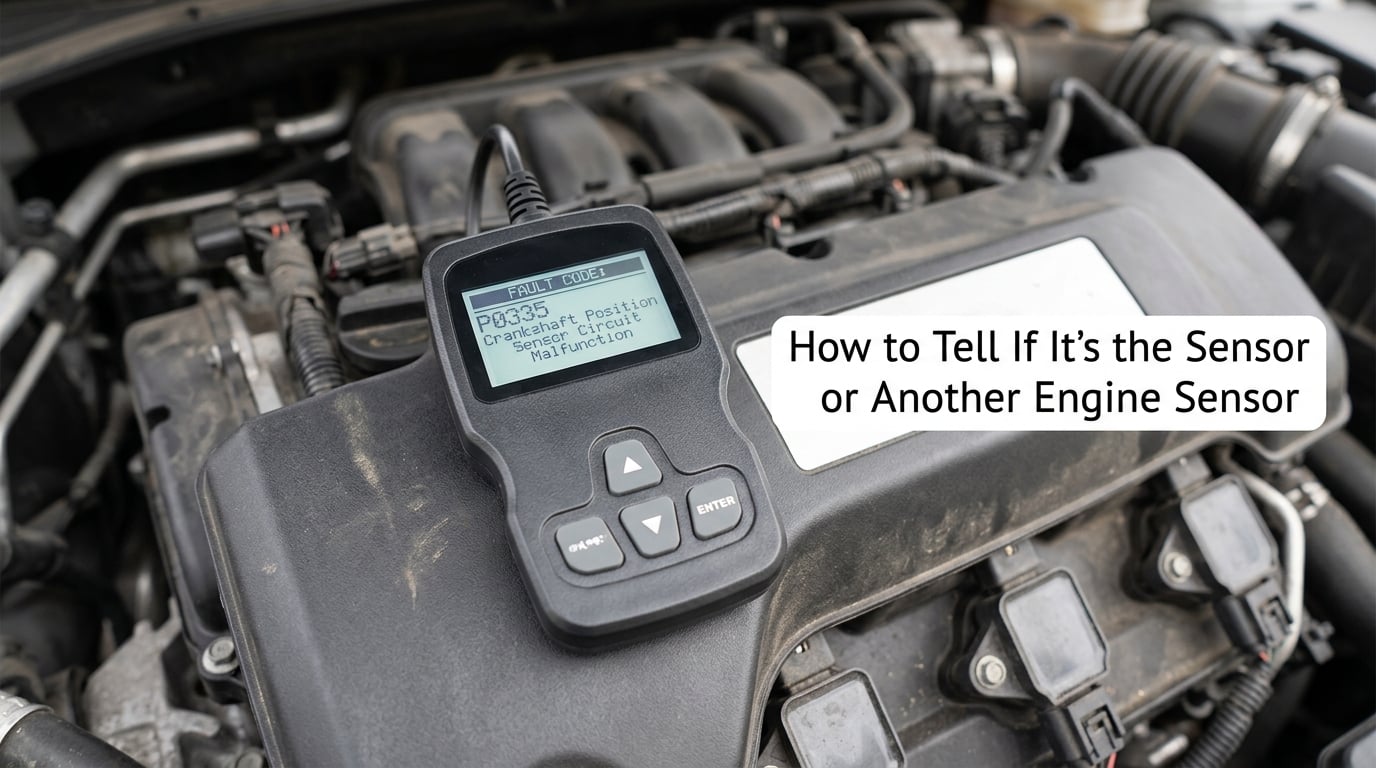
Work through this order and stop when the evidence stops.
Read the codes and the freeze frame. Note the code and the conditions stored with it — engine RPM, coolant temperature, whether the car was moving. Freeze frame data tells you whether the fault happened hot at idle or cold at speed, which halves the list of suspects before you touch anything.
Look at live data while it happens. Watch crank RPM on the scan tool during the failure. RPM that drops to zero, blanks, or jumps erratically while the engine is running is a signal problem, not a fuel or spark problem. RPM that stays smooth with a misfire points somewhere else entirely.
Inspect before you disconnect. Look at the connector and the harness where it runs near heat and vibration. Unclip it and look inside for corrosion, bent pins, or oil. A connector that has thermal-cycled enough times often has a crack you can only see with the parts separated.
Test the signal, do not just test for voltage. A digital multimeter can confirm the sensor is producing an alternating signal while the engine cranks, and an oscilloscope shows the shape. A healthy waveform is even and rhythmic. Dropouts, jagged peaks or a collapsing amplitude tell you the pickup is degrading. Testing during cranking matters, because a healthy sensor produces almost nothing at a stopped engine.
Heat-soak and wiggle test. If the fault will not reproduce, get the car fully warm, then work the wiring loom and connector by hand while someone watches the live data. Intermittent faults that only show when hot are the ones shops struggle with, and this is the routine that catches more of them than guessing at parts. If you can do that, a multimeter and a scan tool cover most of it.
Then, and only then, replace the sensor. A widely shared mechanic video is titled “DON’T Replace Your CRANK SENSOR Until You TEST It Like THIS,” which tells you how common the mistake is.
Bad Crankshaft Sensor vs. Bad Cam Sensor or Timing Issues
Crank and cam faults overlap enough that owners routinely replace the wrong one. The cam sensor is on the cylinder head, the crank sensor is on the block or the front cover, and they report the same rotation from two ends. When the crank signal is lost, the ECM cannot correlate the two and often stores both a crank code and a correlation code.
| Problem | Typical symptom pattern | Common codes | First check |
|---|---|---|---|
| Crankshaft position sensor | Crank no start, stalls hot, tach drops to zero | P0335, P0336, P0338 | Connector and harness near the block |
| Camshaft position sensor | Runs rough, stumbles on acceleration, sometimes starts and stalls | P0340, P0341, P0016 | Connector on the head, oil contamination |
| Crank/cam correlation | Sudden power loss, engine shuts down under load | P0016, P0017 | Timing chain stretch, jumped chain |
| Ignition coil or plug failure | Misfire at a fixed RPM, one cylinder rough | P0300-P0304 | Swap coil to cylinder, plug condition |
| Fuel delivery fault | Crank, no start, sputtering, stalls on the hill | P0171, P0172, or none | Fuel pressure, pump feed, filter |
| Battery or charging fault | Slow crank, crankshaft variation not learned | P0315, P0562 | Battery state of charge, alternator output |
| Incorrect engine timing | Hard start, low power, knock under load | P0016, P0011 | Timing marks, chain wear |
If both a crank code and a cam correlation code are stored, read them together. A cam code that appears alongside a crank code is usually a consequence, not a second fault.
One warning sign that gets ignored: a fuel smell on startup, especially if you have been chasing a running fault. Unburnt fuel finding its way into the exhaust is a real secondary problem here — why does my car smell like gas after starting is worth a look if that is what you are noticing.
Can You Drive With a Bad Crankshaft Position Sensor?
Sometimes, but not the way most people hope. If the failure is purely a stored code and the engine runs cleanly, the car is usually drivable until you can get it looked at. The moment the signal starts dropping out under load, the car can stall without warning, and a stall at highway speed or in traffic is the reason not to.
Stop driving and arrange a repair or a tow if any of these apply.
- The engine stalls while you are moving, at any speed
- Power drops out suddenly and comes back, especially under load
- It cranks but will not start, and you need repeated attempts in traffic
- The tachometer drops to zero while the engine is running
- It runs fine cold and dies once fully warmed up
The specific scenario that shows up constantly in forums is worth dwelling on: a garage clears the code, the car drives perfectly for a few days, and then it fails again at an intersection. Clearing a code on an intermittent fault does not repair anything. The failure is still there, the ECM has simply forgotten it for the moment, and the light coming back later is confirmation rather than a new problem.
How to Replace a Crankshaft Position Sensor
On many engines this is a straightforward job. The sensor sits on the block or the front timing cover, usually held by one or two bolts, and the connector unclips. On others it is buried behind the starter, the intake manifold, or the transmission, and the labour is mostly access. Both layouts are common, so check your own engine layout before deciding whether this is a weekend job or a shop job.
The general process looks like this.
Confirm the correct part for your engine before ordering. A sensor that is physically wrong for your engine will not fit, and near-identical variants exist across makes. Then disconnect the negative battery cable so you cannot short the connector or the harness while working.
Label and unplug the connector, and treat the pins carefully. This is where a lot of the damage happens, not during removal. Corroded pins can snap if you force them, and the wire often breaks just inside the boot where you cannot see it.
Remove the mounting bolts, allowing for the fact that the old O-ring or seal may be part of the sensor and will need replacing. Some sensors are press-fit and need a puller rather than bolts, and those are the ones that snap.
Fit the new sensor with a fresh seal lightly coated in the correct lubricant, then tighten to the manufacturer’s torque specification rather than by feel. Over-tightening cracks the housing, and that crack is the reason a lot of sensors fail a year later.
Finally, clear the codes, and on many vehicles run the crankshaft variation relearn. That is a short procedure the scan tool performs so the ECM learns the actual wheel variation of your engine. Skip it on some vehicles and you will get a P0315 crankshaft variation not learned code, or a running fault that looks like the sensor is still bad.
One recurring horror story from r/AskMechanics is worth a warning: the sensor housing snapping during removal and leaving the internals inside the block. It happens because someone twisted instead of pulling straight out. If the housing cracks, the fragments need to be retrieved before the engine runs, otherwise you are introducing metal into the engine. If you find metal in the oil afterwards, what metal in engine oil means covers how to tell whether it is a sensor fragment or something more serious.
Exact steps, torque values and relearn procedure vary by vehicle. Use the owner’s manual and vehicle-specific service information for your car rather than a general guide like this one, and take the diagnostic work to a shop if the diagnosis needs the engine apart or electrical testing you cannot do.
Frequently Asked Questions
Can a crankshaft position sensor fail intermittently?
Yes, and it is the most common failure pattern of all. A sensor can work perfectly cold and lose its signal once the engine reaches operating temperature, or the fault can depend on vibration, engine load or a connector that opens up when the harness is moved. These are why the code clears, the car drives fine for a week, and then it stalls at an intersection. Heat-soak testing with live data while you wiggle the wiring is the only reliable way to catch one.
Does a bad crankshaft position sensor mean the engine timing is wrong?
No. The sensor reports where the crankshaft is; it does not set timing. What goes wrong is that the Engine Control Module loses its reference, so it falls back to a default ignition timing value and trims fuel wrongly until the signal returns. A genuine timing fault is a separate condition and usually comes with a P0016 or P0011 code, or knock under load.
Will replacing the crankshaft position sensor clear the check engine light?
It will, but that is not proof the problem is fixed. Codes are cleared by the scan tool regardless of what was wrong, and an intermittent fault that was never really repaired will set the code again. If the light stays off for a week, that is encouraging but not conclusive. Watch for the original symptoms, because a car that is driving normally with a new sensor may just have a worse connector or harness underneath.
What happens if I keep driving with a bad crankshaft position sensor?
The engine may run fine, run rough, or stall without warning. Once the signal drops out under load, the ECM removes spark and fuel, so the car can die at highway speed or in traffic. That is the reason to stop driving. Also check the oil regularly while you wait, because a sensor that keeps cutting fuel can wash oil off the cylinder walls over a long drive.
Is the crankshaft position sensor the same as the camshaft position sensor?
No, they are different parts in different locations that do different jobs. The crank sensor reads a reluctor wheel on the crankshaft and gives the ECM engine speed and crank position. The cam sensor reads a cam-driven target and identifies which cylinder is firing, which matters for sequential fuel injection and variable valve timing. A lost crank signal often makes the cam code appear too.
Can bad wiring make the crankshaft position sensor appear failed?
More often than not, yes. A crank circuit code covers the sensor, the connector, the wiring, the grounds and the reluctor wheel as one system. A slightly unseated connector, corrosion from a nearby coolant leak, a chafed harness against an exhaust manifold or a marginal ground all produce the same codes as a dead sensor. Testing the wiring and connector before ordering a part is the step that separates a real fix from a repeat visit.
What to Do First
Write down the symptom and when it happens. Cold only, hot only, at idle, or under load. That single note is worth more to a technician than any guess.
Read the stored codes and the freeze frame data before clearing anything, because clearing destroys the conditions that make the fault diagnosable. Then inspect the connector and the harness where it passes near heat and moving parts.
Watch live crank RPM data while the fault occurs, and test the signal rather than guessing at the part. Only when the wiring, the connector and the signal have all been checked does replacing the sensor make sense.
If the engine has stalled in traffic or loses power under load, stop driving it and get it seen. That is the one case where towing is the sensible answer rather than the cautious one.