
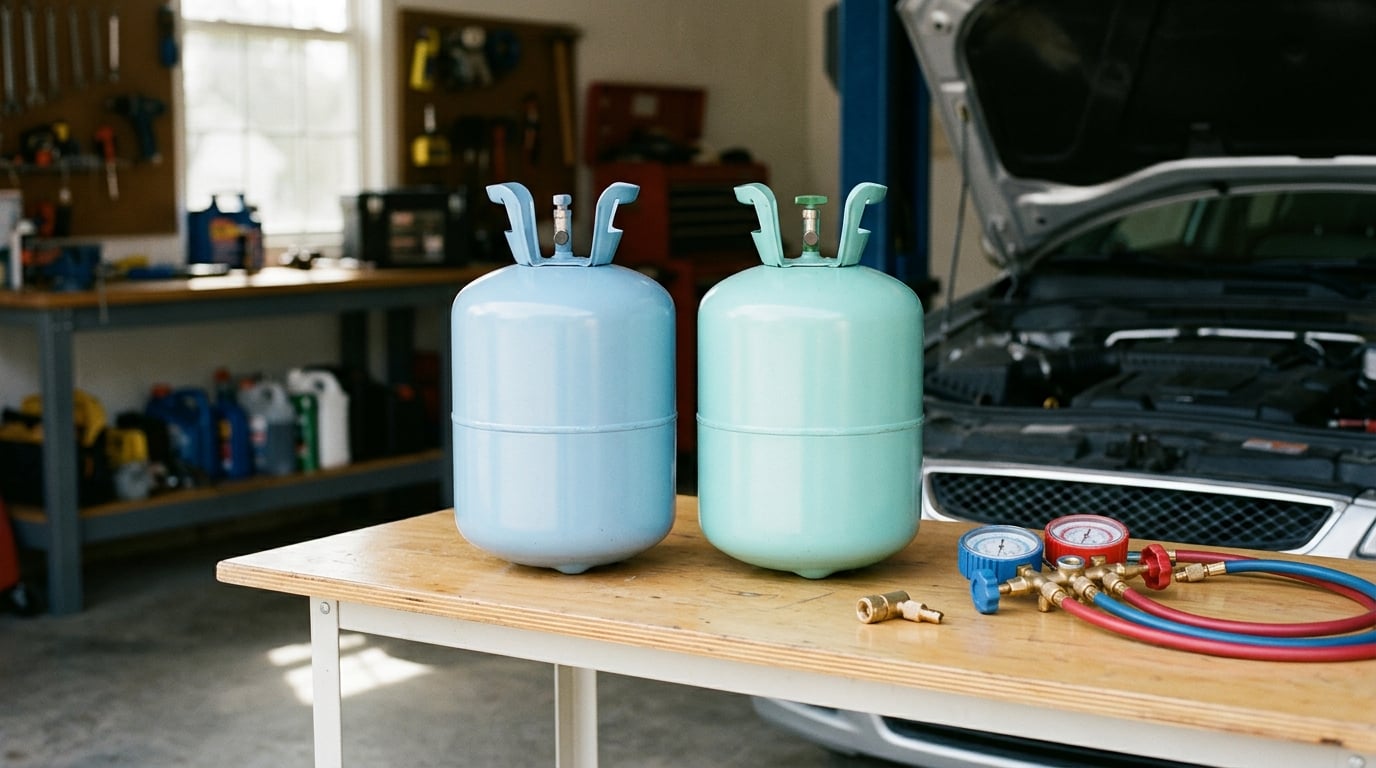
Two refrigerants, one rule: R-134a and R-1234yf both cool a car, but they are not interchangeable inside a sealed air conditioning system. R-134a is a hydrofluorocarbon with a 100-year global warming potential of 1430, while R-1234yf is a hydrofluoroolefin with a GWP of 4.
Your BMW was engineered for one specific refrigerant and one specific compressor oil. Get that combination right and the system works exactly as the factory intended. Get it wrong and you risk a failed compressor, a contaminated system, or an evaporator that has to be replaced.
If you searched for r134a vs r1234yf refrigerant explained because your A/C stopped blowing cold, or because a shop quoted you for a recharge, the first question isn’t which refrigerant is better. It’s which one your car actually takes. Here is how the two differ, and how to confirm what a BMW needs before anyone touches it.
Table of Contents
- R134a vs R1234yf Refrigerant Explained at a Glance
- What Is the Difference Between R134a and R1234yf?
- Which Refrigerant Does Your BMW Require?
- R134a vs R1234yf: Compressor Oil and System Compatibility
- R134a vs R1234yf: Cooling Performance and Serviceability
- Environmental and Safety Differences
- R134a vs R1234yf: Which One Is Better for a BMW?
- How to Tell If a BMW Has R134a or R1234yf
- Frequently Asked Questions
- Conclusion
R134a vs R1234yf Refrigerant Explained at a Glance
| Criterion | R-134a | R-1234yf |
|---|---|---|
| Chemical family | Hydrofluorocarbon (HFC) | Hydrofluoroolefin (HFO) |
| Global warming potential | 1430 | 4 |
| Ozone depletion potential | 0 | 0 |
| ASHRAE safety class | A1, non-flammable | A2L, mildly flammable |
| Normal boiling point at 1 atm | About -16 C (-5 F) | About -29 C (-20 F) |
| Critical temperature | About 101 C | About 122 C |
| Compressor oil | PAG, with viscosity per the BMW label | POE (polyol ester) |
| Service port fitting | 1/4 inch or 1/2 inch ACME, valve core seal | Commonly 1/2 inch ACME sealed by a port gasket |
| Typical BMW application | Most BMWs built through roughly 2016 | Increasing on later models, common on 2020 and newer |
| Relative refrigerant cost | Much cheaper per pound | Several times more per pound |
| Recovery and handling | Recover and recycle before service | Recover and recycle, plus ignition control |
Read that table as a decision aid, not a shopping list. Every BMW leaves the factory with exactly one row of it filled in, and the vehicle data label under the hood tells you which.
What Is the Difference Between R134a and R1234yf?
R-134a is 1,1,1,2-tetrafluoroethane, an HFC that arrived in car air conditioning in the early 1990s to replace R-12, the ozone-damaging chlorofluorocarbon banned under the Montreal Protocol. It is chemically stable, non-flammable, and cheap, which is why it ran in BMWs for close to three decades.
R-1234yf is 2,3,3,3-tetrafluoropropene, an HFO built in the 2000s. Because it breaks down in the atmosphere within about two weeks instead of lingering for roughly 14 years, its warming impact is hundreds of times smaller.
Different chemistry means different physical behaviour. R-1234yf boils at a lower temperature and reaches a higher critical temperature, which gives it a mild advantage in extreme heat. Neither refrigerant is a “stronger coolant” in the everyday sense. The cabin temperature you feel comes from the system design, the charge amount, the airflow across the evaporator, and whether the system holds vacuum.
Neither one can be poured into the other. The molecules have different boiling behaviour, different oil miscibility, and different effects on the elastomer seals and hoses the OEM chose. BMW, like every other manufacturer, specifies one refrigerant per system.
Which Refrigerant Does Your BMW Require?
Most BMWs built through roughly 2016 use R-134a, and that covers nearly every E-series and F-series car still on the road. Later BMWs increasingly use R-1234yf, and it became the norm on many 2020 and newer models across the range.
The messy middle is 2017 through 2019, where you can find both refrigerants depending on market, build date, and trim. Hybrids and EVs often moved to R-1234yf earlier in the timeline, since those vehicles frequently carry a high-voltage electric compressor instead of a belt-driven one.
Treat any year cut-off as a hint, not a fact. A used car can have had its system converted, or it can be a market car with different cooling hardware than a US-spec example of the same model. The label on the vehicle is the authority, not a forum post or a parts catalog listing.
R134a vs R1234yf: Compressor Oil and System Compatibility
This is where most of the real damage happens, and it is the part a lot of write-ups skip. R-134a systems use PAG oil, a synthetic polyalkylene glycol lubricant in grades such as PAG 46 or PAG 100 depending on the model. R-1234yf systems use POE, a polyol ester oil that circulates and mixes completely with the refrigerant.
Why the oil has to match the refrigerant
PAG oil is only partly miscible with liquid refrigerant, so it travels in slugs carried by the flow. It relies on correct viscosity and additive packages to protect the compressor. POE oil behaves differently: it mixes fully with R-1234yf, but it absorbs moisture quickly and it can swell some elastomer seals that were designed for PAG.
Put the wrong oil in and the compressor pays. Slugging oil leads to starved lubrication, metal wear, and scoring. Swollen seals show up as slow refrigerant leaks that are miserable to find. On a BMW with an electric compressor, that compressor is also a very expensive part, and the oil it takes is not interchangeable with a belt-driven unit.
What a retrofit actually involves
Retrofit kits exist, and shops offer them, but the honest version of a conversion is a teardown, not a hose swap. Expect the system to be recovered, evacuated, and opened, the residual oil replaced with the correct POE charge, new service port fittings, and the low side of the system flushed to clear the PAG that will never leave on its own. A nitrogen purge is part of a properly done job.
BMW does not publish an approved conversion procedure for most of these systems, and a converted car is no longer the car the warranty and the service manual describe. Forum discussions on r/MechanicAdvice and r/AskMechanics include BMW owners weighing a retrofit against the cost of an original evaporator replacement, which is where this question usually comes up. Do the arithmetic with a written estimate for both paths before deciding.
R134a vs R1234yf: Cooling Performance and Serviceability
Factory-correct, either refrigerant will cool a BMW about the same in daily use, and mechanics routinely report the real-world cooling from a sound R-1234yf system matching a sound R-134a one. The differences show up in gauges, in heat, and in how a technician has to work on the car.
Reading the gauges on either refrigerant
R-1234yf runs at somewhat lower pressures than R-134a for the same conditions, so a low side reading that would look obviously wrong on an R-134a car can be correct on an R-1234yf car. Pulling a r134a vs r1234yf pressure chart is not optional when you are diagnosing one of these systems.
The table below is a rough reference for a healthy system at idle with the fan running. It is not a specification, and a real diagnosis uses the pressure-temperature chart for the specific refrigerant plus superheat and subcooling measurements.
| Ambient temperature | R-134a low / high side | R-1234yf low / high side |
|---|---|---|
| 70 F (21 C) | About 30 / 180 psi | About 25 / 155 psi |
| 80 F (27 C) | About 36 / 215 psi | About 30 / 185 psi |
| 90 F (32 C) | About 43 / 250 psi | About 36 / 220 psi |
| 100 F (38 C) | About 52 / 290 psi | About 44 / 255 psi |
Charge by weight, always. Both BMW labels state the factory charge in grams or ounces, and a scale is the only way to land on it. Adding refrigerant by feel or by “can of R-134a” behaviour is how systems end up overcharged and how owners end up back at the shop.
R134a vs R1234yf on leakage and fittings
Service ports are one of the better visual clues. Many R-134a ports use a 1/4 inch or 1/2 inch ACME thread with a valve core. R-1234yf ports very often use a 1/2 inch ACME thread sealed by a flat gasket at the top of the port rather than a core, which is one of the SAE J639 changes intended to reduce cross-connection mistakes.
Leak detection differs too. R-1234yf is not picked up reliably by every electronic detector, and technicians report using infrared or heated diode style sensors for it. Ultraviolet dye still works, but the dye and the fittings a shop carries tend to be refrigerant-specific, and some shops simply do not stock R-1234yf consumables.
What a shop has to own to service either one
R-134a work needs a recovery machine, manifold gauges, and EPA Section 609 certified staff. R-1234yf work adds a recovery machine certified to SAE J2843, which is expensive equipment, and stricter procedure around ignition sources, ventilation, and vent recovery. Shops that bought that equipment pass the cost into every R-1234yf job, and that is a large part of why service on these cars costs more.
Environmental and Safety Differences
R-134a’s global warming potential of 1430 is the headline number. R-1234yf sits at 4, so a full charge released into the atmosphere has a fraction of the effect. Both have an ozone depletion potential of zero, so neither harms the ozone layer directly; R-1234yf simply leaves the atmosphere in days instead of years.
Safety is the sharper difference. R-134a is ASHRAE class A1, meaning it does not burn under any normal circumstance. R-1234yf is A2L, mildly flammable: its lower flammability limit is about 6.2 percent by volume in air, far above the concentration in a ventilated workshop, but it can ignite under the wrong conditions. That is why R-1234yf work happens with ventilation running, no open flame, and no hot work nearby.
There is a second safety point people rarely mention. When R-1234yf burns, it decomposes into hydrogen fluoride, a corrosive and genuinely hazardous gas. Firefighters get specific guidance about it for that reason, which tells you the material is not to be trifled with.
Both refrigerants must be recovered rather than vented, and in the US technicians need EPA Section 609 training to buy and handle refrigerant. The European phase-down that turns up in search results as a so-called “2025 mandate” is tied to the F-Gas rules and the mobile air conditioning directive. In the US the driver is the American Innovation and Manufacturing Act, which phases down production and consumption of HFCs such as R-134a, which is why new cars moved to R-1234yf here without a single model-year switch.
R134a vs R1234yf: Which One Is Better for a BMW?
Neither is better in the abstract. The factory-correct refrigerant and oil, filled to the labelled weight, is the correct answer for every BMW, and that is the only answer that keeps the car in specification.
Owning an older R-134a BMW, there is no reason to convert. The system is designed for that refrigerant, parts and service knowledge are widely available, and the environmental cost of the existing charge is small next to the cost of a conversion. Keep servicing it as built.
Owning a newer R-1234yf BMW, keep it that way. Original components are the expensive part, not the refrigerant itself, and a system filled with the wrong fluid can be flushed or damaged beyond a quick recharge. If a shop wants to convert your car to R-134a to avoid servicing it, treat that as a serious red flag rather than a practical shortcut.
For a car with an expensive evaporator or compressor problem, conversion is worth pricing purely as a financial comparison against the factory repair, and the decision is yours, not the parts counter’s. Factor in that a converted car loses its original specification, that the work has to be done properly, and that you will still want a shop that can service R-1234yf eventually.
How to Tell If a BMW Has R134a or R1234yf
The five-point identification check
Start with the vehicle data plate, normally on the driver side door jamb or in the engine bay on a strut tower or radiator support. It lists the specified refrigerant and the required oil. In older cars the sticker has faded or peeled off, so keep going down the list rather than assuming.
Next, look under the hood for a second sticker near the service ports or on the A/C unit itself, and note the port fitting style as a cross-check. A 1/2 inch ACME port sealed with a gasket at the top points toward R-1234yf on many vehicles, though port styles alone are not proof.
Third, check the service records. A previous recharge or conversion leaves a paper trail in most shops, and it is the fastest way to catch a car that has been modified from its factory state.
Fourth, read the oil specification. A system that has been converted to R-1234yf will show POE, and the oil in the system tells you what the last person who worked on it decided. If the oil and the label disagree, find out which one is current before adding anything.
Fifth, if any of that is unclear or the car is a 2017 to 2019 model, have a qualified technician verify it. They can identify the refrigerant by recovery or sample, and they can tell you whether the system is still factory-correct. That check is cheap next to replacing a compressor.
Frequently Asked Questions
Can I put R1234yf in a BMW A/C system that uses R134a?
Only as a full professional conversion, never as a drop-in top-up. R-1234yf needs POE oil, and the PAG oil in an R-134a system does not mix with it, so it slugs and starves the compressor. Seals, service ports, and the low side of the system also have to be addressed. BMW publishes no approved retrofit for most of these systems.
What is the main difference between R134a and R1234yf in a BMW?
The main difference is the oil the system was built around, plus flammability class. R-134a systems use PAG oil and are classified A1, non-flammable. R-1234yf systems use POE oil and are classified A2L, mildly flammable. Both have zero ozone depletion, but R-1234yf has a global warming potential of 4 against 1430 for R-134a.
Does R134a vs R1234yf affect A/C cooling performance?
Not much, when the system is correct and charged properly. A sound R-1234yf system cools a cabin as well as an R-134a one. What changes is the pressures you read on the gauges, since R-1234yf runs somewhat lower, and how much the system struggles in extreme heat, where the higher critical temperature of R-1234yf helps slightly.
Which BMW models use R1234yf refrigerant?
Most BMWs through roughly model year 2016 use R-134a, and many 2020 and newer models use R-1234yf. Models from about 2017 to 2019 can go either way depending on build date and market, and hybrids and electrics often took R-1234yf earlier. Check the vehicle data plate on the door jamb or in the engine bay, because the model year alone is not a reliable guide.
What happens if the wrong refrigerant is used in my BMW?
Usually you get weak cooling, a compressor running without proper lubrication, and eventually failed components. Mixing R-134a into an R-1234yf system leaves PAG oil behind, and that oil will not be flushed by topping up. A system contaminated with the wrong refrigerant and oil can need a full recovery, flush, correct oil charge, and sometimes a new compressor to cool properly again.
Conclusion
Do this first: read the vehicle data plate or the sticker under the hood, and match what you find to the refrigerant and oil specification. That single check settles the r134a vs r1234yf question for your car, and it takes about a minute.
Beyond that, keep the system as the factory built it. Factory-correct refrigerant and oil, charged to the labelled weight, is the answer for every BMW, whether it is an R-134a car or an R-1234yf one. If the documentation is faded, the car is a 2017 to 2019 model, or a previous owner may have had the system converted, let a qualified technician confirm what is in there before anything is added.