
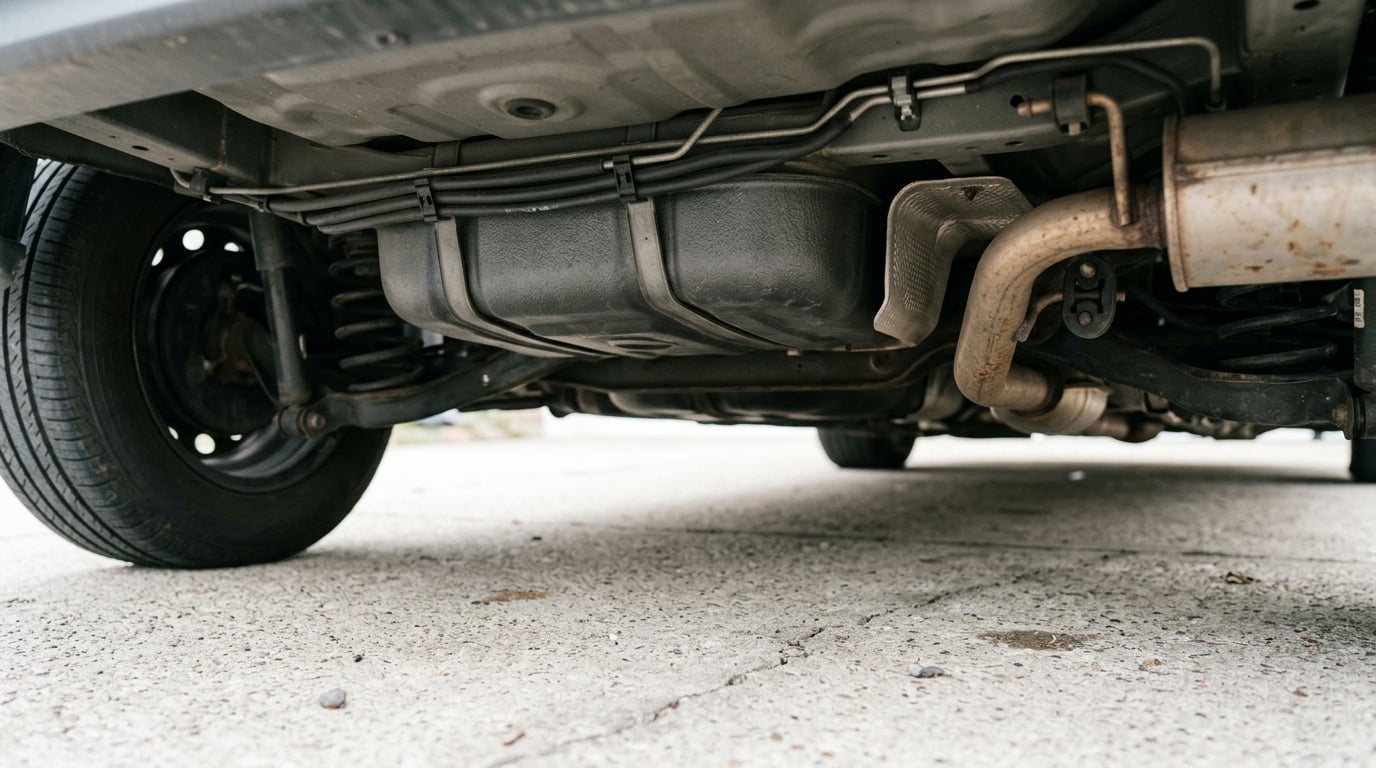
A faint fuel smell in the first few seconds of a cold start is common, because a cold engine runs a richer air-fuel mixture while the oxygen sensor and catalytic converter warm up. A smell that hangs around past warm-up, or reaches you inside the cabin, points at a real leak, an evaporative system fault, or an exhaust problem. Gasoline vapour is highly flammable, and breathing it causes headache, dizziness and nausea, so treat a strong or lasting odour seriously.
I have seen both ends of this on cars with well over 100,000 miles on them. The car that only smells for the first 30 seconds and then goes quiet is usually fine. The one that smells every time you start it, every time you fill up, and leaves a damp patch under the fuel rail is telling you something specific, and it is worth finding out what before you drive it another week.
This guide walks through the causes in the order they actually show up, then the checks you can do in your own driveway with nothing more than a phone and a flashlight. The most useful single test takes about a minute: time how long the smell lasts.
Table of Contents
- Why Does My Car Smell Like Gas After Starting?
- Is a Brief Fuel Smell After Startup Normal?
- What Causes the Gas Smell After Starting?
- How to Tell Whether the Smell Is a Fuel Leak
- Why Does the Smell Appear More in the Cabin?
- Is It Safe to Drive With a Gas Smell?
- What Checks Can a DIY Mechanic Do?
- Why Does My BMW Smell Like Gas After Starting?
- Frequently Asked Questions
- Can a loose gas cap make my car smell like fuel after starting?
- Why does my car smell like gas only for a few seconds after I start it?
- Does a check-engine light always come on when there is a gas smell?
- Is a strong gas smell from my car an exhaust leak?
- My car smells like gas but there is no visible leak. What should I check?
- Why does my car smell like gas and struggle to start?
- Conclusion
Why Does My Car Smell Like Gas After Starting?
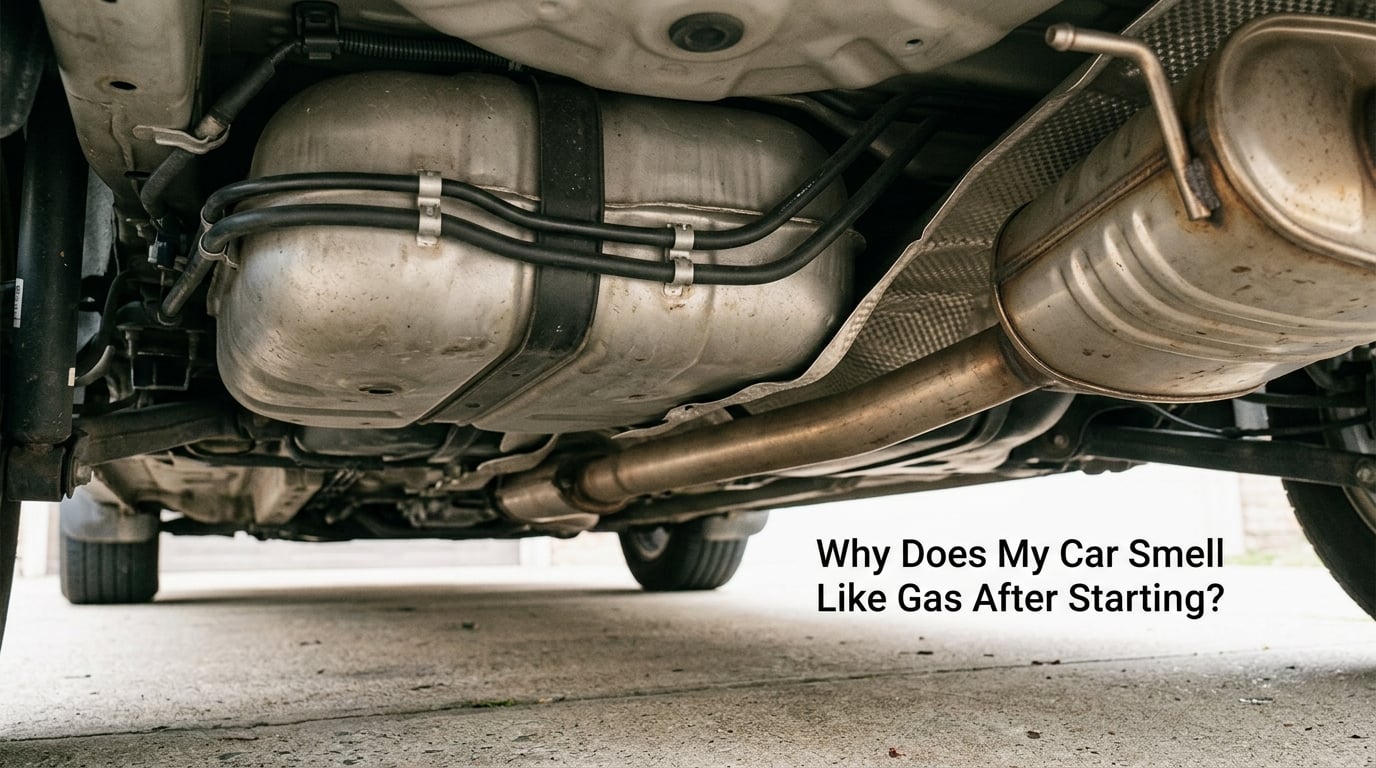
Most of the time the answer is a normal cold-start rich mixture. The engine control unit commands a high injection pulse width for the first moments after a start so the engine idles smoothly and the catalyst lights off quickly, and a small amount of unburned fuel vapour escapes past the exhaust seals. If the smell fades within about a minute, that is the whole story. If it stays, gets worse, or comes with rough idle, a long crank or a warning lamp, something is leaking or venting where it should not.
Is a Brief Fuel Smell After Startup Normal?
Normal means short, faint and occasional. Cold weather makes it more likely, because fuel vapour does not evaporate as readily and more of it collects in the tank and the intake. A tank topped off at the pump hours earlier is more likely to smell at the next start, and a car driven in stop-start traffic that never gets fully warm is the classic case.
Here is the duration test, and it matters more than anything else you can check. Start the car cold, step outside, stand near the exhaust, and time the smell. If it fades in under 60 seconds, the rich cold-start mixture is the likely explanation. If it is still there once the engine is at operating temperature, keep looking.
Several things move a brief smell from the normal column into the fault column. A steady raw-fuel reek at idle. Smell that shows up every single start rather than now and then. A check-engine light. An idle that surges or stumbles. A puddle or a wet spot under the car. A smell that greets you before you even turn the key.
One more thing to clear up early: plenty of owners say they cannot smell it inside the car, so they assume it is nothing. Not necessarily. Gas vapour is lighter than air, so it rises and drifts to the back of an enclosed space, which is exactly where you sit. A smell you notice from outside and not from the driver seat can still be a genuine leak.
What Causes the Gas Smell After Starting?
Here are the causes in rough order of how often they turn up, with the mechanical reason each one smells.
Loose or worn fuel cap and filler neck seal
The cheapest and most common thing to check. A cap that is not tightened until it clicks, a cracked rubber seal, or a worn filler neck lets tank vapour escape near the rear of the car. On many cars the fuel cap is the only part of the evaporative system an owner can legally service.
Fuel injector O-rings and seals
High-pressure injectors seal against the fuel rail with small O-rings. As they stiffen, fuel seeps around the nozzle while the engine is off, pools in the intake or rail area, and burns off in a raw burst on the next start. Owners on r/MechanicAdvice with high-mileage, running-well cars report exactly this pattern: a cold-start-only smell, a car that drives fine, and no puddle anywhere. The seep is small enough to evaporate and too small to leave evidence on the driveway.
Fuel pressure regulator
The regulator holds fuel pressure at the rail. When its diaphragm fails internally, it vents raw fuel into the intake instead of returning it to the tank, so the engine runs rich and the exhaust carries unburned fuel. A vacuum hose that has come off or perished does the same thing by starving the regulator of the vacuum it needs.
Evaporative emission control system
The EVAP system captures vapour from the tank in a charcoal canister and later feeds it to the engine through a purge valve. A purge valve stuck open, a cracked vent line or a canister that has saturated lets stored vapour out near the front of the car, which is why the smell is often strongest right after startup, when the system first opens.
Fuel lines, fittings and heat damage
Steel lines can corrode, and rubber sections near the exhaust or a catalytic converter can be cooked by heat. Add a car that has lived its whole life in a hot, dry climate and it is not a stretch. These leaks usually weep while the engine is running, which is why you often catch them with a car parked overnight rather than on a warm day.
Exhaust leak ahead of the catalytic converter
This is the one that fools people. Raw exhaust gas can carry enough unburned fuel and combustion vapour to smell like gasoline, and an exhaust leak forward of the catalytic converter lets that gas enter the cabin air supply. A ticking or hissing noise at startup that changes with engine speed is the giveaway, and the smell grows when the fan is on.
Flooded engine and fuel-soaked oil
A long crank, a stumble, or repeated start attempts flood the cylinders and dilute the oil. Forum owners on my350z.com describe the diagnostic clue clearly: once fuel soaks the engine oil, the car smells like gasoline from the oil filler cap even though nothing external is leaking. A dipstick check will show it.
Once you have a shortlist, narrow it down with location and timing. This table is the fastest way to sort the common causes without taking anything apart.
| Where and when you smell it | Likely cause | What to look at |
|---|---|---|
| Strongest at the rear or near the filler neck | Loose cap, filler neck seal, tank or vent line | Cap click test, then the vapour lines at the tank |
| Under the hood, only for the first 30 to 60 seconds | EVAP purge valve opening, or a small injector seep | Wet spot at the fuel rail, EVAP codes |
| Whole time the engine runs, worst at idle | Failing fuel pressure regulator or a rich running condition | Vacuum hose, regulator diaphragm, fuel trims |
| Only after filling up, clears after a drive | EVAP system not sealing or not purging properly | Cap seal, purge valve, vent line |
| Inside the cabin, stronger with the fan on | Exhaust leak forward of the catalytic converter, or vapour drawn in through the air inlet | Ticking at startup, under-hood air inlet, cabin filter |
| Smell plus long crank or won’t start | Flooded engine, leaking injector, failed regulator | Oil on the dipstick, spark plug condition |
| Also smells burnt, sweet or sharp | Not fuel. Coolant, burnt oil, or sulfur | Fluid colour, warning lamps, coolant level |
How to Tell Whether the Smell Is a Fuel Leak
Start outside. If the car is in a garage, open the door and move it out, and never run an engine in a closed space. While you are looking, keep cigarettes, lighters and anything electrical away from the engine bay.
With the engine off and cool, crouch beside the car and look straight up underneath. Fuel is thin, clear to amber, and slightly greasy, and it beads rather than soaks. Check the area around the fuel tank and the lines running forward to the engine, and look at the pavement under the car for a patch that is darker and damp rather than dusty.
Next, compare where the smell comes from. Stand at the rear bumper, then at the front bumper, then beside the open driver door. A rear-biased smell points at the cap, tank or vent line. A front-biased smell points at the injectors, regulator or purge valve. A smell that only appears once the fan is running usually means the vapour is arriving through the air intake.
Then check the things that are not fuel but get reported as fuel. Burnt oil smells acrid and gets worse as the engine warms. Sweet coolant smells like syrup and usually comes with a warning lamp or a rising temperature. Sulfur from a catalytic converter or dirty fuel smells like rotten eggs, especially at startup. Brake dust is a hot metallic smell after driving, not a raw fuel smell. New-car interior off-gassing is strongest when the car has been closed up in the sun and is not related to the engine at all.
Book a professional inspection, do not just keep driving, if you find visible liquid, a dripping line, a smell that never fades, a hissing sound near the tank, or a check-engine light that stays on.
Why Does the Smell Appear More in the Cabin?
There are two routes vapour can take to reach you. The obvious one is the outside air inlet on the engine bay, which on most cars sits low and forward, right where a front-of-engine leak or a venting EVAP system will be. With the fan on low or the defrost running, that air gets pulled straight in.
The second route is the exhaust. An exhaust leak forward of the catalytic converter can pull hot gas into the cabin through the fresh-air duct, and it is the reason a bad exhaust gasket can smell like gasoline from the driver’s seat. The distinguishing test: turn the fan to low, and see whether the smell grows. Fuel vapour from a leak is more likely to be noticeable outside the car; exhaust gas pulled in under fan power is far more likely to be noticeable inside it.
Windows and an aging cabin filter do not seal the car, they just recirculate whatever is already in the cabin, so a filter change will not fix a leak. A closed recirculation setting can make an existing smell worse, not better. Opening a window and running the fan on high for a minute is a reasonable temporary measure, not a repair.
Is It Safe to Drive With a Gas Smell?
A faint scent that clears in under a minute, with no warning lamp, no visible liquid and no trouble starting, is low risk for the trip to a shop. Anything beyond that, use this rule: if the smell is strong, constant, or getting worse, do not drive it.
Stop, and arrange a tow rather than a drive, if any of these apply. Visible fuel on the ground or a wet spot under the fuel tank. A puddle, a drip, or a line that is clearly weeping. A smell strong enough that you can smell it from several feet away with the engine off. A long crank, a stumble, or an engine that will not start. A check-engine light or a fuel-system warning. A hissing sound near the tank or an exhaust leak you can hear and see. Any smell reaching the cabin.
If the smell is moderate and the car runs normally, park outside on level ground, switch the engine off, keep people away from the car, and do not park it next to a building, a wooden garage or any ignition source. If you feel dizzy, nauseous or headachy after being around it, get away from the car and get fresh air. That reaction is exposure, not sensitivity, and it is a reason to stop driving it.
One practical note: on a car that only smells for the first minute, the technician may not catch it. Tell the shop the exact weather conditions and engine temperature that produce the smell, and ask them to check the cap, the fuel rail area, the regulator and the EVAP system cold, before anything is started.
What Checks Can a DIY Mechanic Do?
These are checks you can do cold, with the engine off, without opening any pressurised or hot fuel component.
- Fuel cap click test. Park, release the cap and listen. You should hear a distinct click as the seal engages. No click means the cap is not sealing, and replacing the cap and its seal is the first cheap thing to try.
- Look, then soap test. With the car on a lift or safely supported, inspect the tank, lines and fittings first. For a dynamic leak, mix dish soap and water in a spray bottle and mist the lines, fittings and fuel rail with the engine running. Bubbles mean a leak at that spot. Keep a fire extinguisher within reach and never spray near an open flame or hot exhaust.
- Read stored codes. A basic OBD-II scanner costs less than a single diagnostic hour and will tell you whether the car has stored a code. EVAP-related codes are worth knowing: P0442 means a small evaporative system leak, P0455 a large leak, P0456 a very small leak, and P0445 a leak detected at the fuel filler cap. A code stored after a drive is a strong hint about where to look.
- Check the oil on the dipstick. Pull the dipstick with the engine off. Fuel-diluted oil smells strongly of gasoline and often looks darker or thinner. If the oil smells like raw fuel and the car has had starting trouble, that is your flooded-engine answer.
- Watch the area under the car. Park overnight on clean, level concrete. A leak that seeps while the engine is off shows up as a damp or dark patch by morning, which is the whole reason people miss a small leak.
Leave these to a qualified technician: pressure testing fuel rails and lines, replacing or resealing injectors, replacing the fuel pressure regulator, welding or bending steel fuel lines, work on the exhaust ahead of the catalytic converter, and anything involving a hot vehicle or a fuel tank. Injector cleaning is sometimes worth a look on a high-mileage direct-injection engine, but it is a guess until codes and pressure readings say otherwise, and a clean injector that is still weeping at the O-ring is a repeat visit.
Why Does My BMW Smell Like Gas After Starting?
BMW ownership is not itself a cause. What matters is the age of the vehicle and where it sits on the fuel-system timeline, and two chassis come up repeatedly on these questions.
On older E39 and E60 cars, the usual suspects are the fuel cap and filler neck seal, aged fuel hoses, injector seals, and an EVAP purge valve that has been open for twenty years. Those are wear items, not a design defect, and a stored EVAP code plus a proper pressure test will usually point straight at the section that has failed.
Use the correct BMW manual for your specific model and engine, read the code first rather than swapping parts, and have a technician interpret it. If the car is still under factory or extended warranty, or the fault appeared after recent fuel-system work, describe the smell to the dealer in writing and keep the work order. A documented case is the difference between a goodwill repair and a paid one.
Frequently Asked Questions
Can a loose gas cap make my car smell like fuel after starting?
Yes, and it is the first thing to rule out. A cap that is not tightened until it clicks, a cracked rubber seal or a worn filler neck lets tank vapour escape, most noticeably at the rear of the car and often only for the first moments of a start. Park, turn the engine off, and check that the cap gives a distinct click when you press it closed. If it does not, a new cap and seal often resolve the smell completely.
Why does my car smell like gas only for a few seconds after I start it?
A brief smell in the first 30 to 60 seconds of a cold start is usually the engine running a rich air-fuel mixture while the oxygen sensor and catalytic converter warm up, plus a small amount of fuel vapour escaping past the exhaust seals. It becomes concerning when it lasts past warm-up, happens on every start, or comes with a warning lamp, rough idle or a puddle. Timing the smell is the fastest way to tell the two apart.
Does a check-engine light always come on when there is a gas smell?
No. Some fuel and evaporative system problems are noticeable by smell long before the car stores a trouble code, and a small injector seep often never sets one. When a code does appear, EVAP codes are the ones to look for: P0442 for a small leak, P0455 for a large leak, P0456 for a very small leak, and P0445 for a leak at the fuel cap. Reading codes before replacing parts saves a lot of guessing.
Is a strong gas smell from my car an exhaust leak?
It can be. An exhaust leak forward of the catalytic converter can release hot gas that carries enough unburned fuel to smell like gasoline, and it often pulls fumes into the cabin through the fresh-air duct. A ticking or hissing noise at startup that changes with engine speed, and a smell that gets worse with the fan on, point that way. A soap test on the exhaust joints or a listening check will separate it from a fuel leak.
My car smells like gas but there is no visible leak. What should I check?
Start with the cap click test, then look underneath on clean concrete the morning after the car has sat, since a seep while the engine is off leaves a damp patch with no drip to catch. Mist soapy water along the fuel lines and fittings with the engine running to raise bubbles, and check the dipstick for fuel-diluted oil. Finally, scan for stored codes. Small injector seepage and a failed fuel pressure regulator are the two causes that most often hide without a puddle.
Why does my car smell like gas and struggle to start?
A long crank floods the cylinders, and a car that smells like fuel and will not start usually points at one of four things: a flooded engine from repeated attempts, a leaking injector or a failed fuel pressure regulator, a weak or failing fuel pump, or an exhaust leak that has grown into a misfire. Check the oil on the dipstick first, since fuel-diluted oil confirms the flooding. If the engine will not start reliably, have it towed rather than kept turning the key.
Conclusion
Start with the one-minute test. Time how long the smell lasts, note whether it comes from the front, the rear or the cabin, and check the cap while you are out there. A faint scent that clears in under 60 seconds with no warning lamp is not an emergency, but a strong, constant or worsening smell is, and so is any sign of liquid under the car.
If it is more than a whiff, move the car outside, shut it off, keep people away and arrange a proper diagnosis rather than another week of guessing. Most of these repairs are small. The expensive version is the one you drove to the shop with a weeping line.