
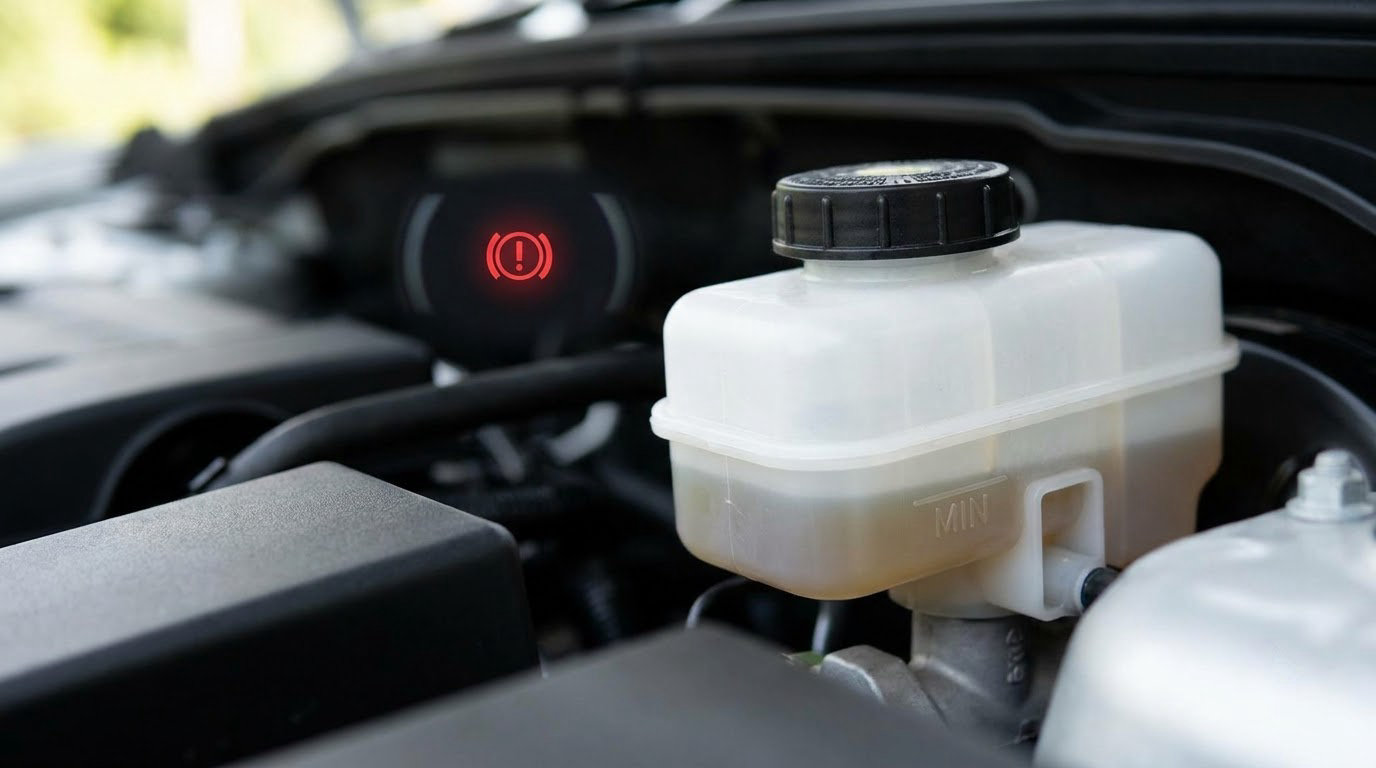
A low brake fluid warning light usually means the fluid in the brake fluid reservoir has dropped to the level of a float switch inside the reservoir, and the switch has closed to tell you. The usual suspects, in order of how often they turn up: worn front brake pads pulling the caliper pistons back into their bores, a slow hydraulic leak at a hose, line, caliper or master cylinder, aged or moisture-laden fluid, a leaking or sticking level sensor, and a stored fault in the ABS module. Add fluid and the light may go out for a while, but on its own that fixes a symptom rather than the cause.
I’m going to walk through what the light actually reports, the causes ranked from most to least likely, and the point where continuing to drive stops being a reasonable option. This is general guidance for BMW owners; your owner’s manual and vehicle service information always take priority, because symbols and reset procedures changed across generations.
Table of Contents
- What Does the Low Brake Fluid Warning Light Mean?
- What Causes a Low Brake Fluid Warning Light?
- 1. Worn front brake pads moving the caliper pistons back
- 2. A slow hydraulic leak
- 3. Moisture absorption and fluid age
- 4. A leaking, sticking or failed float switch
- 5. A stuck brake pedal position switch or aftermarket module
- 6. A stored fault in the ABS module
- 7. Reservoir and fitting problems
- What Causes a Low Brake Fluid Warning Light on a BMW?
- Is It Normal for the Light to Stay On After Adding Fluid?
- How Low Is Too Low to Keep Driving?
- What Fluid Level and Condition Should You Expect?
- How to Check Brake Fluid Safely
- What Should You Check Before Topping Up the Fluid?
- Low Fluid or a Faulty Brake-Level Sensor?
- When Should You Stop Driving and Arrange Repairs?
- Frequently Asked Questions
- Conclusion
What Does the Low Brake Fluid Warning Light Mean?
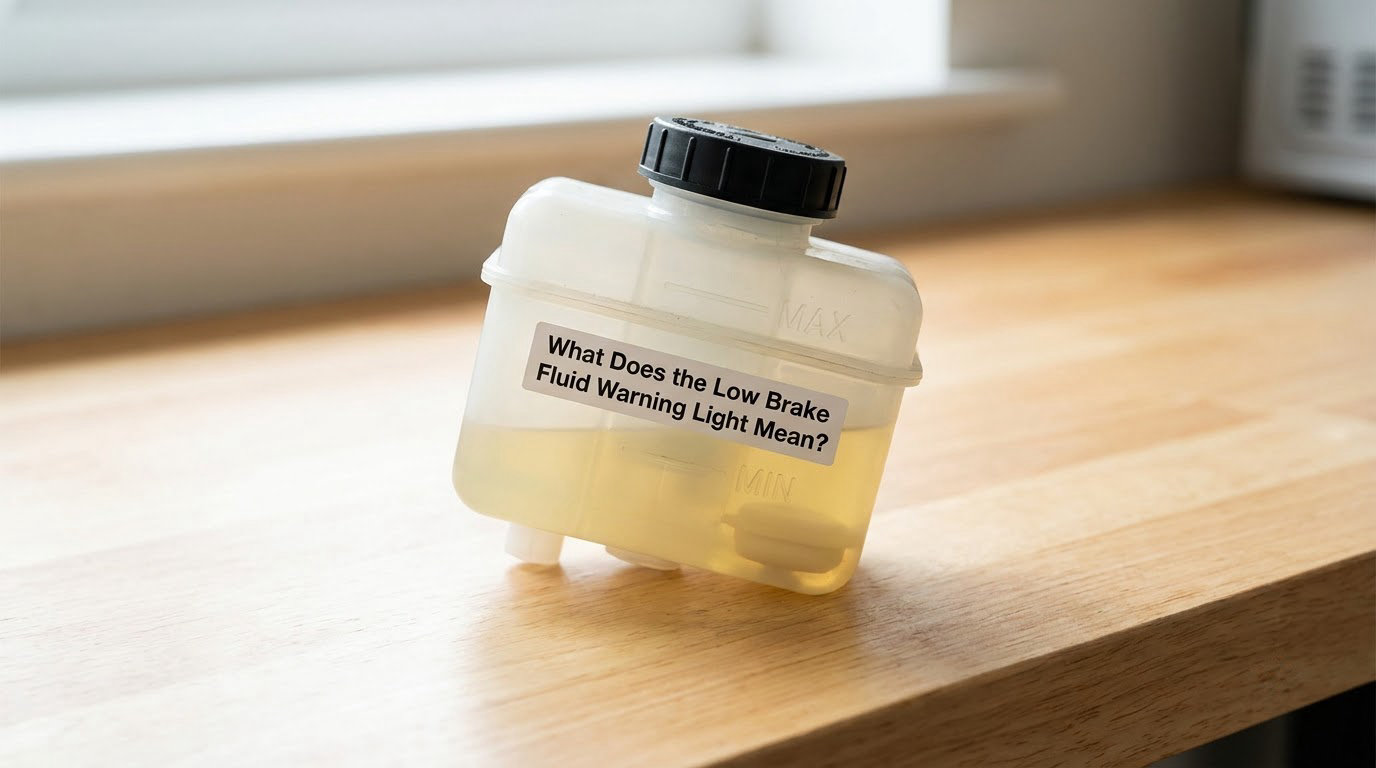
The low brake fluid warning light is a level report, not a performance report. Under the reservoir cap on most BMWs sits a plastic reservoir with MIN and MAX moulded into the translucent body, and inside it a float or a reed switch that closes once the fluid falls past the low threshold. Closing that circuit lights the dash symbol.
The fluid itself is the working medium. You press the pedal, the master cylinder converts that force into hydraulic pressure, and the fluid carries it through the lines to each caliper, where pressure clamps the pads onto the rotor. Take the fluid volume away and the pressure has less fluid to work with, so the pedal travels further before pressure builds and the pedal can feel soft or spongy. Once fluid gets low enough, a corner of the system can pull air, and air compresses instead of transmitting pressure.
Colour matters when you are reading the cluster. A red circle with an exclamation mark, or the word BRAKE, generally means a system-level condition. A smaller amber or yellow symbol that looks like a brake pad with a wavy line behind it is the pad wear indicator, a separate sensor. A yellow ABS or brake system fault message points at the electronic side. Some clusters display all three, and some show a text line instead of a symbol, so check what your specific car does.
A standing note worth keeping: a red brake warning with an exclamation mark can also simply mean the parking brake is applied. Releasing the parking brake should clear it within a second or two if that is all it was.
What Causes a Low Brake Fluid Warning Light?
Ranked roughly by how often each one shows up in a BMW workshop, from the mundane to the mechanical. The evidence column is what you or a technician would actually see or feel.
1. Worn front brake pads moving the caliper pistons back
This is the single most common cause of a slow, recurring low-fluid light, and it is the answer mechanics reach for first on r/AskMechanics and r/MechanicAdvice. As pads wear, the friction material gets thinner and the caliper pistons have to extend further to meet the rotor. Retracting the pistons takes fluid volume out of the reservoir. Nothing is leaking; the level is simply lower because the pads took up room, and the light comes on when the float switch threshold is crossed. Owners on turbobricks.com and terrainforum.net describe exactly this after having pads and rotors replaced, which is a confusing symptom because it happens right after a repair and looks like the shop made it worse.
Evidence: a gradual drop over months, no puddle anywhere, no change in pedal feel, and usually a worn or serviceable set of front pads still fitted.
2. A slow hydraulic leak
Fluid leaves through rubber hoses that perish from the inside out, steel lines that corrode at a fitting or a bracket, a caliper or wheel cylinder seal that weeps, or a master cylinder that seeps at the boot. A leak slow enough to never reach the ground is the most common kind, because it beads on the caliper boot or inside the wheel and then evaporates or gets absorbed. What reaches the reservoir is only a fraction of what escaped.
Evidence: fluid on the caliper, a wet mark on the inner face of the wheel, dark brake dust that looks damp and sticky at the hub, a puddle on the ground in the morning, or a level that drops measurably between two checks a week apart.
3. Moisture absorption and fluid age
Brake fluid is hygroscopic. It pulls water from the air through rubber seals and through the reservoir vent, and the water content climbs with time and humidity. Old fluid also has a lower boiling point, so repeated hard braking can flash to vapour in the lines. Vapour compresses, and the pedal goes soft. A low reading here usually shows up as contamination first: dark fluid, cloudiness, or a layer that separates after the car has sat.
Evidence: dark or murky fluid in a reservoir that should contain clear amber fluid, a pedal that feels different after a hard drive, corrosion or a stained cap, and a vehicle that has gone years without a fluid service.
4. A leaking, sticking or failed float switch
The switch is a simple part, but a reservoir that has been topped up with the wrong fluid, a reservoir from a different model, or a cap that admits dirt can leave the float sitting low, jammed, or coated in gunk. Some owners on r/kiastinger found that when the level reads correctly between MIN and MAX and the light still comes on, the level sensor itself is the fault. The same symptom comes from a reservoir sitting tilted because of a loose mount or a bent bracket, which makes the fluid read low on one side.
Evidence: the level is visibly between MIN and MAX on level ground, yet the light is on. The light may flicker over bumps or through corners, which is fluid slosh moving the float.
5. A stuck brake pedal position switch or aftermarket module
The brake pedal switch is an electrical part, not a hydraulic one, and several owners in forum threads traced an inexplicable brake-system message to it. A switch that does not return to its rest position, an aftermarket alarm or remote-start module wired into the brake circuit, or a trailer-brake circuit added badly can all send the cluster a signal it reads as a brake fault. The same electrical fault will usually show a stored code, which is how you separate it from a fluid problem.
Evidence: the light appears with no level change at all, the fluid is fresh, and the car has had an alarm, remote start, hitch or tow wiring installed recently.
6. A stored fault in the ABS module
The anti-lock brake system is hydraulic and electronic at once. A fault in the ABS hydraulic control unit, a failed wheel speed sensor, or a low-voltage condition can put a brake system fault message on the display that reads a lot like a fluid warning. If the ABS light is on alongside the brake light, read the stored codes before touching the reservoir.
Evidence: ABS light on at the same time, a stored DTC readable with a BMW-capable scanner, or a fault that appears on cold start and clears after the engine runs.
7. Reservoir and fitting problems
A cracked reservoir body, a loose or worn reservoir cap that no longer vents, a seized reservoir fitting, or a wrong-style reservoir swapped in during a previous repair can all produce a low or erratic reading. Overfilling matters too: pushing the fluid above MAX squeezes the float upward hard enough that the switch can behave erratically and the light can flicker on and off.
Evidence: visible seepage at the reservoir seam, a cap that looks chewed or brittle, or a light that behaves strangely right after topping up to the brim.
What Causes a Low Brake Fluid Warning Light on a BMW?
BMW-specific patterns come down to three things. First, modern BMWs run brake pad wear sensing through the cluster rather than a purely mechanical squeal, so a pad-related condition can be reported electronically. Second, the electronic parking brake and the electronic brake system management on newer cars can raise a brake system fault message that looks like a fluid warning but is stored as a code. Third, because the fluid reservoir and level sensor are genuine service items on most generations, a cheap plastic reservoir or a connector that is not seated can behave differently from a healthy one.
Across the range, worn front pads remain the leading explanation for a level that has quietly crept down over several months with no visible leak. A pad replacement moves the level too, so check the level before and after that work rather than assuming either direction means a fault.
Is It Normal for the Light to Stay On After Adding Fluid?
Occasionally, yes, and it is usually a procedural issue rather than a bad part. Most systems clear the message when the ignition cycle sees a level above the switch threshold, so you may need to switch the ignition off, leave the car closed and level for a few minutes, then start it. On many BMWs the fluid must be filled to near MAX, not just past MIN, because the switch sits lower than people expect and the hysteresis band around it is wide.
If the light stays on with the reservoir filled to MAX on level ground, you have moved past the top-up stage. That points at a leaking circuit, a fluid that is not the specified type, a switch or float problem, or a stored electronic fault. Follow the reset procedure in your owner’s manual rather than assuming an ignition cycle will clear everything, and get the codes read if it does not.
How Low Is Too Low to Keep Driving?
The short version: the moment the light is on, stop treating the trip as normal. The car will usually still brake, but how much braking you get is not something you can predict from the dash, and the underlying leak can get worse between one stop and the next.
| Situation | What to do |
|---|---|
| Fluid between MIN and MAX, pedal feels normal, light on after a slow drop | Drive gently to a shop or home, avoid heavy braking, and do not wait weeks. This is a schedule-a-repair situation, not a drive-it-forever situation. |
| Fluid at or below MIN, or the light has come on repeatedly after a top-up | Top up to MAX with the correct fluid, then arrange an inspection. Do not drive any distance until the cause is known. |
| Pedal soft, spongy, or it reaches the floor, ABS light on, fluid on a wheel or caliper, or the level visibly falling between checks | Do not drive. Arrange a tow and a brake inspection. |
The real question is not how many miles remain but whether the pedal feels the same from one stop to the next. If it does, you have more time than if it does not.
What Fluid Level and Condition Should You Expect?
Read the reservoir on level ground with the engine cold and the car parked. The fluid should sit between MIN and MAX, and the fluid itself should be clear and amber, not dark or cloudy.
| What you see | What it means |
|---|---|
| At or below MIN | Do not drive until topped up and the cause is looked at. The switch is reporting a genuinely low level. |
| Between MIN and MAX | Normal range for a top-up, but if the light is on something else is wrong. Check for a leak and get the code read. |
| At or above MAX | Full. Overfilling past MAX can cause a long, soft pedal and erratic switch behaviour, so fill to the mark and stop. |
| Dark, brown or black fluid | Old fluid loaded with moisture and contamination. A fluid service is due regardless of the level. |
| Cloudy, milky fluid | Emulsified water in the fluid. Do not top this up with more old fluid; it needs a proper service and bleed. |
| Clear layer over a dark layer | Separated fluid, usually from moisture or the wrong type being mixed in. |
| Greasy, oily film at the top | Something has been spilled into the reservoir. Contamination that should be cleaned out, not topped over. |
Use only the fluid specification and container type printed in your owner’s manual or on the reservoir cap, and keep the cap sealed afterwards. Do not mix DOT 3, DOT 4 and DOT 5. DOT 5 is a silicone-based fluid that is not miscible with the glycol-based fluids most BMWs use, and putting it in the wrong reservoir causes exactly the spongy pedal and corrosion problems you were trying to avoid.
How to Check Brake Fluid Safely
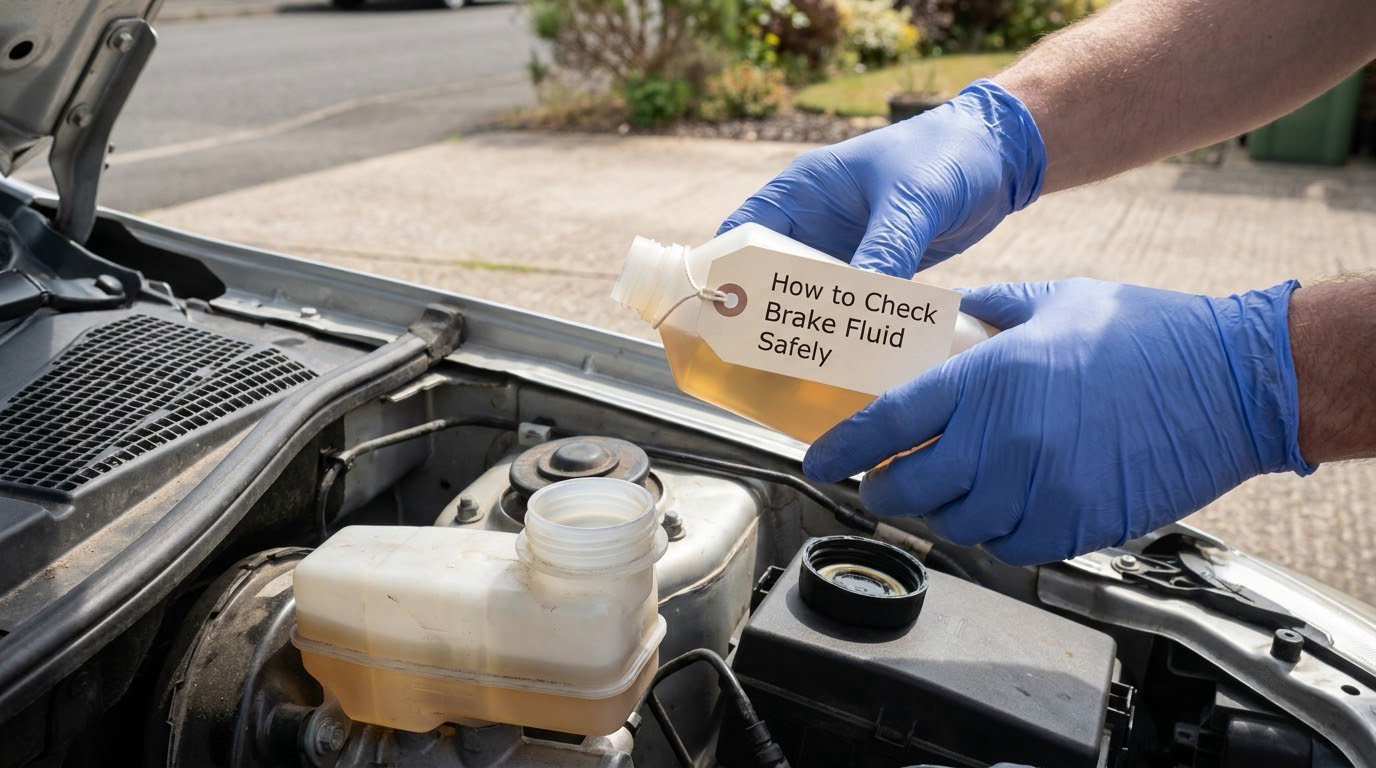
This takes about five minutes and needs no tools beyond clean gloves. Wear eye protection, keep your hands off hot exhaust components, and work away from traffic.
- Park on level ground. A slope or a driveway with a camber skews the reading, because the float follows the fluid surface.
- Let the engine go cold. Warm fluid expands and hot brake parts are unpleasant to reach, so check before the first drive or after the car has stood for several hours.
- Set the parking brake and, on an automatic, leave the selector in Park. Chock the wheel if the street slopes.
- Look at the reservoir through the translucent body without removing the cap first. Read the level against MIN and MAX with your eyes level with the fluid.
- Check the fluid colour and clarity in the same look. You are reading two things at once: height and condition.
- If topping up, use a sealed container of the specified fluid and fill slowly to MAX, not past it. A paper towel under the cap catches drips before they reach the paint or the parking bay.
- Refit the cap, close the hood, cycle the ignition and see whether the message clears. If it does not, the level is not the whole story.
Gloves matter more than they sound. Brake fluid takes paint and it will not rinse off, and it is harsh on skin over time.
What Should You Check Before Topping Up the Fluid?
Topping up hides a symptom. Before you do it, spend five minutes looking for the reason, because fluid that left the system is not coming back on its own.
- Under and around the reservoir. Look for a damp film, a stain trail, or a crust of dried fluid along the seam where the reservoir meets the master cylinder. A weep there is the single most expensive cause on this list.
- The lines and hoses. Follow the hard lines along the bulkhead and under the floor for a rust bloom at a fitting, and check each flexible hose for a bulge, a cracked outer layer, or a wetness at the crimped fitting.
- Calipers and wheel cylinders. Brake dust at the hub is normal. Dust that looks damp and sticky, or a wheel with a wet mark on its inner face, is not. A weeping caliper boot shows up as a dark, greasy ring at the piston seal.
- The ground and the driveway. A small dark spot under one corner after a night parked is a lead, not a conclusion. Clean the area, drive a few miles, and look again.
- The pads and rotors. If the front pads are near the end of their life, that alone explains a slowly lower level. Check pad thickness at the same time as the fluid.
- Recent work. Note any pad, rotor, caliper, hose or wheel work in the last few months and who did it. The level change may be explained by the repair itself.
Keep away from hot and moving parts: exhaust, wheels, suspension and anything the car could roll onto. If you need to get underneath it, use ramps and jack stands properly, never a jack alone.
Low Fluid or a Faulty Brake-Level Sensor?
These two look identical from the driver’s seat, so the reservoir reading and the code list are what separate them.
| Signal | Genuinely low or leaking fluid | Sensor, float or cluster fault |
|---|---|---|
| Level in the reservoir | At or near MIN, and visibly lower over a week or two | Between MIN and MAX, often sitting comfortably mid-range |
| Light behaviour | Steady on, or on after a long period of gradual drop | Flickers over bumps, through corners, or only at a particular speed |
| Visible fluid | Wetness at a caliper, wheel, hose, or the ground under the car | Nothing visible anywhere, including a clean, dry engine bay |
| Pedal feel | Normal at first, softer or longer if the level keeps dropping | Unchanged and normal |
| Other lights | Usually only the brake symbol | Often an ABS or brake system fault message, or a stored code |
| After topping up to MAX | Light goes out for a while, then returns as it leaks down | Light stays on with a full reservoir, which is the tell |
| Next step | Pressure test and leak inspection | Read stored codes and check the switch wiring and reservoir mount |
Owners on r/kiastinger have settled on the same test: if the level reads correctly on level ground and the light persists, the fault is the reservoir level sensor or its wiring, not the fluid. A gentle press on the reservoir body while a helper watches the dash will sometimes move the light, which confirms the switch without any parts removed. Resetting the light after a real repair is a different job: fix the fault, then follow the owner’s manual procedure for clearing the message, and expect a scan-tool reset on newer cars where the warning is stored as a fault rather than a live signal.
When Should You Stop Driving and Arrange Repairs?
Do not drive the car, and tow it in, if any of these are true.
- The fluid level falls between two checks with no fluid added.
- There is fresh fluid on a wheel, the caliper, the underbody, or a puddle on the ground.
- The pedal feels soft, spongy, or travels much further than it used to, or it sinks and stays down.
- The brake system fault or ABS light is on at the same time.
- You hear grinding or metallic scraping, or you feel the car pull to one side under braking.
- Braking response has changed: more pressure, more distance, or a pedal that is unpredictable.
- Fluid on the rotor surface. That is not only a level problem; heat and contamination can damage the rotor face before the fluid is even low.
Towing beats driving when you cannot be sure the car will stop cleanly. If the car must move, keep it short, flat and slow, avoid repeated stops, avoid towing a trailer, and have someone else watch the pedal behaviour. But the honest answer for most of the list above is to leave it parked.
Frequently Asked Questions
Can I drive with the low brake fluid warning light on?
Only carefully, and only if the pedal feels normal and the fluid is still above MIN. Drive gently to a shop, avoid heavy braking, and do not put it off for weeks. If the pedal is soft, the ABS light is also on, or fluid is on a wheel or the ground, do not drive at all and have the car towed.
Does the low brake fluid light mean my brake pads are worn?
Very often, yes. As pads wear, the caliper pistons extend further and draw fluid back into the reservoir, so the level drops with nothing leaking. This is the most common explanation for a slow, recurring light. Check pad thickness when you check the level, because a pad replacement also moves the level and is not a fault.
Why is my brake fluid level dropping?
Four things account for nearly all of it: worn pads retracting the caliper pistons, a slow leak at a hose, line, caliper or master cylinder, fluid that has absorbed moisture and changed volume with temperature, and a reservoir that is losing fluid through a bad cap or crack. A full inspection of the hoses, lines and calipers tells them apart. Topping up alone never does.
How often should brake fluid be changed?
Follow the interval in your owner’s manual, and treat age as more important than mileage. Fluid absorbs moisture from the air through the seals and the reservoir vent, and its boiling point drops as it ages, so a car that sits unused still ages. Colour is a useful shortcut: clear amber is good, dark or murky fluid is due for a service regardless of how few miles you have driven.
Can adding brake fluid fix the warning light permanently?
Only if the level dropped for a reason that topping up genuinely covers, which is rare. If the light returns within days, something is leaking or the fluid was only filled to MIN. Use the exact fluid type specified on the reservoir cap or in the manual, fill to MAX, and never mix DOT 3, DOT 4 and DOT 5. A repeated warning means an inspection, not another bottle.
Conclusion
Park the car on level ground, let it go cold, and look at the reservoir against MIN and MAX while you are also judging the colour. That single check splits the problem in two: fluid at or below MIN is a real level fault, while a full reservoir with the light on points at the switch, the wiring or a stored electronic fault.
Whatever the reading, a low brake fluid warning light that keeps coming back needs a leak inspection, not another bottle of fluid. Use only the fluid your BMW specifies, keep the reservoir cap sealed, and hand a soft pedal, an ABS light or visible fluid to a workshop on a tow.
Updated for September 2026. This is general guidance, not a substitute for your vehicle’s service information or an inspection by a qualified technician.