
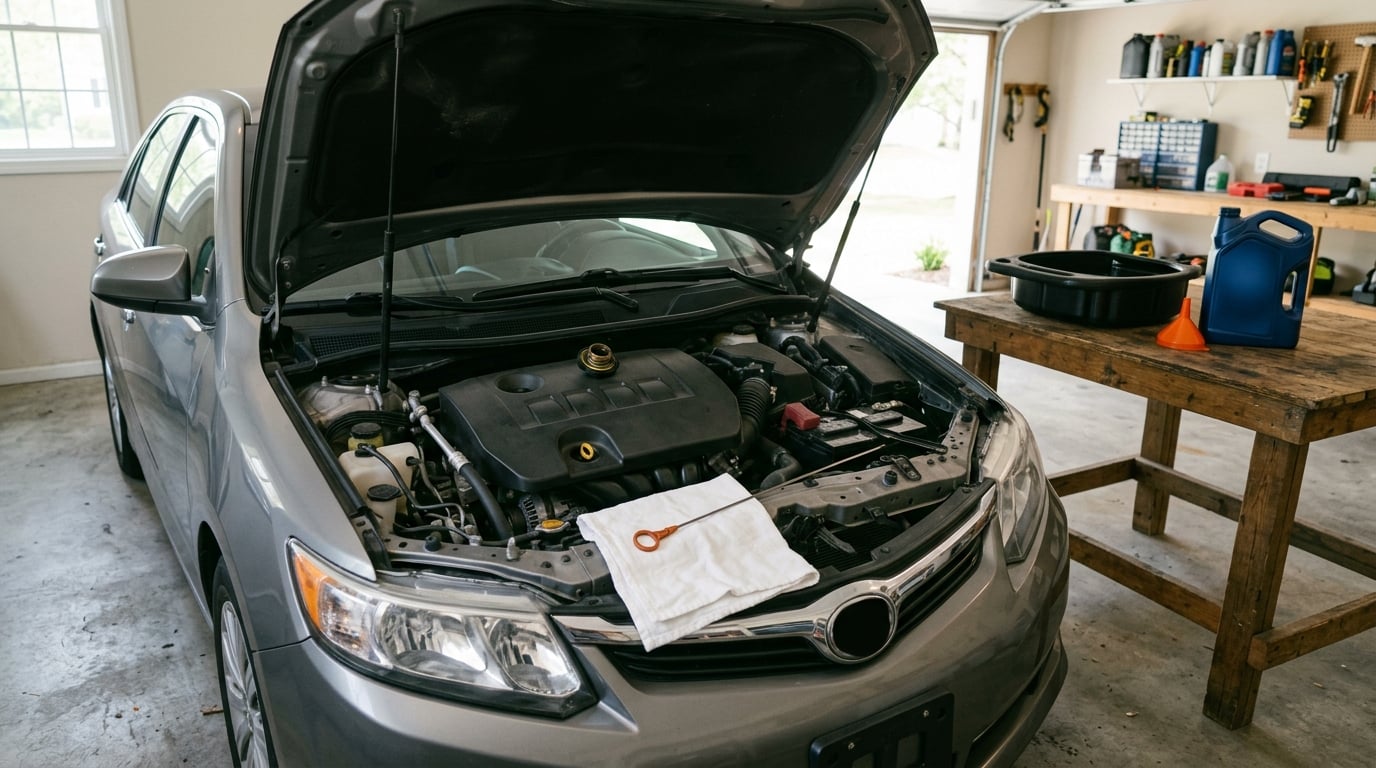
If your car sits for weeks at a time or only covers a few miles a week, change the oil every six months and never go past twelve, even if the odometer barely moved. Time ages engine oil faster than distance does, and the dashboard reminder will not warn you.
Most of the wrong advice on this topic comes from mixing up three completely different cars: one that is genuinely in storage, one that is driven a handful of miles a day, and one that is parked but started and idled regularly. They wear the oil in different ways, and they deserve different answers.
Here is what actually happens to oil while a car is parked, how to set an interval you can live with, how to spot oil that has aged out, and how to do the change yourself without wrecking anything. Updated for 2026.
Table of Contents
- What Does Sitting Do to Engine Oil?
- How Often Should You Change Oil in a Car That Sits?
- How Often Should You Change Oil by Usage Pattern?
- What About Time, Mileage, and Short Trips?
- How Do I Tell Whether the Oil Still Needs Changing?
- How to Change the Oil Safely in a Stored Car
- Frequently Asked Questions
- Conclusion
What Does Sitting Do to Engine Oil?
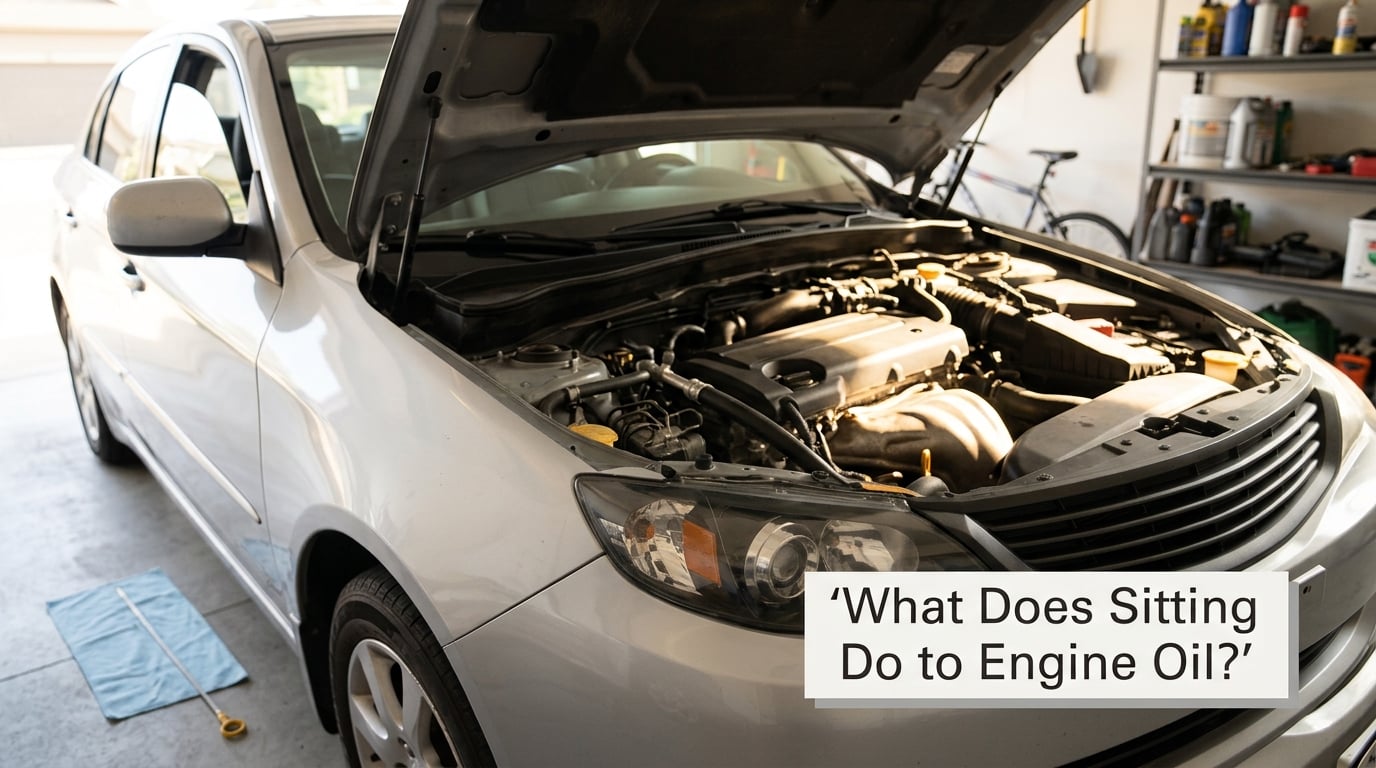
Oil is a consumable that ages on the calendar. From the day it goes in, it is slowly oxidising, absorbing water, and losing the additives that keep it clean and slippery. A parked car does not stop that clock.
There are four mechanisms working against you, and they all speed up when the car is driven in short bursts or barely driven at all.
Oxidation happens with or without mileage
Heated oil reacts with oxygen and forms acids and varnish. The odometer is irrelevant to that reaction. A car that ran twenty times in a year still cooked its oil twenty times.
Condensation collects instead of evaporating
Every engine makes water as a normal combustion byproduct, and that water normally boils off once the block reaches full temperature. If the car never gets properly hot, the water stays in the oil and forms acids that wear metal. Look under the oil filler cap on a garage-kept car and you will often find a milky or tan film pooling in the cap.
Fuel dilutes the oil on short trips
An engine running rich during warm-up washes unburned fuel into the sump. Long trips burn it off. Ten-minute errands do not, so the fuel level in the oil creeps up and the viscosity drops. Pull the dipstick after a short drive and the oil can smell like petrol, which is the clearest sign of dilution.
Cold starts do most of the wear
There is no oil pressure for the first second or two after firing, and that is when the bearings and cylinder walls take the most damage. On a lightly used car the starts are also disproportionately cold, because the engine has been sitting and has lost its heat. Old, thick oil holds onto water and is at its thinnest and most acidic exactly when you need it most.
How Often Should You Change Oil in a Car That Sits?
Change it every six months, and treat twelve months as a hard ceiling, whichever comes first. Read the oil change schedule in your owner’s manual along with the severe service page, because the manual always overrides any general rule. If the manual’s severe schedule calls for 5,000 miles or a yearly change, use that instead. Reset the service indicator after the work, and keep the receipt.
Mechanics broadly agree on the six-to-twelve-month range for infrequent drivers, and the overwhelming consensus in owner forums is that changing early costs you nothing but a little time. Nobody ever regrets a shorter interval.
Where does twelve months come from? It is a manufacturer convention, not a law of physics. Most manuals pair a distance interval with a calendar interval, and a year is simply the largest gap they will stand behind before the oil and the additives inside it are considered spent. The severe service schedule is the other half of that convention, and it exists because the manufacturers know some drivers never approach the standard distance.
One more thing worth saying plainly: changing oil more often than the manual asks does not void a warranty. Manufacturers set minimums for protection, not maximums. More frequent changes are simply conservative, and on a car that sits, conservative is the right side to land on.
How Often Should You Change Oil by Usage Pattern?
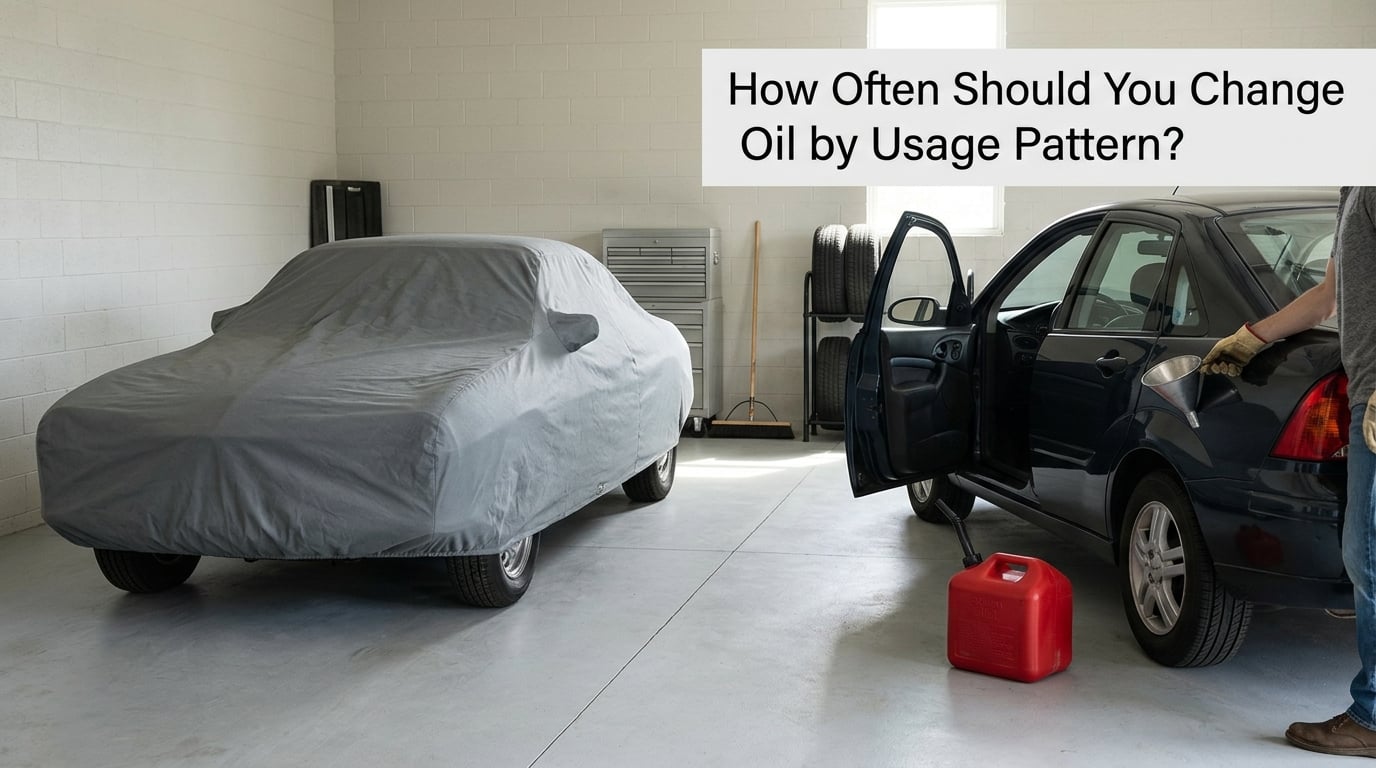
Pick the row that sounds like your week. The way you use the car matters more than any single number, because a car driven 400 miles a year in ten-minute bursts ages its oil faster than a car driven 400 miles a year in one long weekend trip.
Car parked for a full season (wintered over)
Change the oil before it goes into storage, not after it comes out. Six months of sitting with old oil in the sump is six months of moisture and acid with no driving to flush anything. Coming out of storage, a full warm drive of 20 to 30 minutes is more useful than an early oil change, but do not skip the change if the oil went in over a year ago.
Car stored indoors and started occasionally
Short idle sessions are the worst case. The engine runs, condensation forms, and it never gets hot enough to clear it. Treat these cars as six-month intervals, and if you are only starting it to move it around the block, park it instead.
Occasional weekend driver
Your interval is fine as long as each drive is long enough to reach full operating temperature. A 60-mile highway run burns off moisture and fuel; a 3-mile errand does not. Keep to the annual change if the drives are long, and move to six months if most of them are not.
Short-trip commuter (5 to 10 miles each way)
This is classic severe service, and the oil life monitor on the car will usually show 100 percent for a very long time. Six months, or the manual’s severe schedule, whichever is shorter. Check the oil level monthly, because fuel dilution and combustion on worn rings can drop it faster than the gauge shows.
Second car used a few times a month
Six months is comfortable here. A weekly 20 to 30 minute drive to full temperature keeps moisture from accumulating and does more for the engine than any additive you can pour in.
What else ages while the car is parked
- Battery. A parked lead-acid battery drains in weeks, and it is the single most common failure on cars that sit. A battery maintainer on a correct charge rate is worth the money if the car stays put for months.
- Tire pressure. Rubber loses pressure while parked, and a flat spot can develop on one section of tread. Inflate to the door-jamb figure, not the sidewall maximum, and move the car a few feet each month if you can.
- Fuel. Gasoline degrades and absorbs moisture if the tank is left partly empty. A full tank, stabiliser if the car will sit for a year or more, and a run to the station on the way back into service are all worth doing.
- Seals and rubber. Door seals, wiper blades, and tyres all degrade faster indoors in a warm damp garage than outdoors. Crack the doors occasionally and check the wipers before spring.
What About Time, Mileage, and Short Trips?
Time wins when the two disagree, and that is the single most useful thing to know about oil change intervals. Here is how it works out by annual mileage.
| Annual mileage | Typical driving pattern | Recommended oil change interval |
|---|---|---|
| Under 500 miles | Stored or garage-kept, driven only for the occasional errand | Every 6 months, 12 months maximum |
| 500 to 2,000 miles | Second car, most trips short, engine rarely fully hot | Every 6 months |
| 2,000 to 5,000 miles | Mixed short commute plus some longer drives | Every 6 months, or the manual’s severe schedule |
| 5,000 to 10,000 miles | Regular driving, some city traffic | Follow the manual, usually 7,500 to 10,000 miles or 12 months |
| Over 10,000 miles | Normal use with highway miles | The standard manual interval applies |
What counts as severe service
Your owner’s manual will define it, usually on a page with a header along the lines of severe service, demanding service conditions, or maintenance schedule. The common triggers are consistent across brands.
- Trips shorter than about 5 to 10 miles, especially in cold weather
- Frequent idling, or driving in stop-and-go traffic
- Sustained high-speed driving, which some manuals also list
- Towing a trailer, or carrying heavy loads
- Dusty, muddy, or salted road surfaces
- Alternating between very cold and very hot ambient temperatures
Short trips and idling are the two that catch light drivers out, and idling counts as severe driving rather than a warm-up allowance. A twenty-minute idle produces condensation with no temperature to burn it off. On turbocharged or diesel engines, long idling is worse still, because the charge air cooler has no airflow and the oil sees higher temperatures than normal running.
Can you trust the oil life monitor?
Partly. It is a model, not a measurement, and it works from engine hours, temperature cycles, and load. On a car that sits, those inputs barely move, so the monitor can sit at 100 percent for two years while the oil quietly acidifies. Where the vehicle supports manual reset, reset it when you do the change and treat the six-month reminder as the real trigger.
Synthetic or conventional for an infrequent driver?
Full synthetic is the better fit, and the reason is flow at temperature rather than marketing. Synthetic holds its viscosity across a wider range, resists oxidation and fuel dilution better, and does not thicken as much when it absorbs water. A conventional oil in a car that starts cold once a month is doing harder work than it was formulated for. Use the viscosity and specification printed in your manual or on the oil filler cap, and match it.
Do not skip the oil filter
Even at 300 miles a year, the filter matters. Most filters have a bypass valve that lets oil through if it gets blocked, and an anti-drainback valve that stops the sump draining into the engine when the key is turned. A filter that has been sitting in bypass can let unfiltered oil past at the moment it is most needed. Change both, every time, and never fit a cheap filter to save a few dollars.
How Do I Tell Whether the Oil Still Needs Changing?
Appearance tells you a lot, but never treat one clue as proof on its own. Check on level ground, engine off, and follow the manual’s dipstick procedure exactly, since some cars specify a specific wait time after shutdown.
Level and film on the dipstick
Pull it, wipe it, reinsert it, and pull again. The level should sit between the min and max marks. Look at the film on the blade: a thick, even film is healthy, while a thin, watery film that drips like petrol points to fuel dilution. If the level is low, add the specified oil before you drive it and find out why it dropped.
Colour, smell, and texture
Good oil on the dipstick is amber to dark brown and smooth. Milky or milky-grey, foamy, or gritty sludge means water, coolant, or wear particles. A hot-paint or burnt smell from the filler cap means oxidation, and so does a rough, uneven idle on a cold morning that clears once the engine is warm.
Condensation under the filler cap
A light film on the underside of the cap is normal after a short trip. Water pooled in the cap or a thick tan emulsion is not. It points to a car that is not reaching temperature, and it is a reason to shorten the interval now rather than later.
Warnings, leaks, and records
Check for fresh oil under the sump plug and around the filter housing. Then check the service records and the oil life data, because a documented interval tells you more than a clean dipstick does. If the car was recently bought, assume the service history is incomplete and treat the first 6 to 12 months as a fresh interval, particularly if the previous owner ran the car mostly short trips.
What about a car sitting for a year or more with a full tank? Old fuel and old oil age together. Change both before the first real drive, then take a long warm drive to full temperature, and expect the first few minutes to be noisier than usual as the oil and the fuel systems settle.
How to Change the Oil Safely in a Stored Car
This is a straightforward job on most cars, and the safety rules matter more on one that has been sitting, because the brake pedal can be stiff and the jack stands are doing all the work. A basic oil change takes 45 to 90 minutes once the engine is warm.
What you need
Engine oil in the grade and specification your manual requires, usually 4 to 6 litres for a small four-cylinder, an oil filter, a crush washer for the drain plug, a drain pan, a socket set, a jack and rated jack stands, a drip tray, rags, and a wheel chock. Add a funnel and a new drain plug gasket if yours is a single-use crush washer.
Warm the engine properly
Run it for 10 to 15 minutes or drive it 15 to 20 miles until the thermostat opens and the cooling system is warm. Cold oil holds more sludge and drains slower. Park on level, level ground, in the shade, and leave the engine running for a minute or two after switching off.
Check the level, then drain
Pull the dipstick and confirm a full reading. Then remove the drain plug and let it run into the pan. Ten minutes is plenty; the hose or extension bar can catch what runs down afterwards. Be ready for a small surge when the pan comes off the way.
Fit the new filter and plug
Wipe the mounting face clean, fill the new filter with fresh oil, coat the gasket with a little oil, and screw it on hand-tight plus about three-quarters turn. Refit the drain plug with a new washer and torque it to the figure in your manual. A stripped plug thread costs more than the change did.
Refill, reset, and record
Pour in the specified quantity, start the engine, and watch the dipstick within a few minutes, since the filter will absorb some oil. Check the level again, look under the car for leaks, then shut down, reset the oil life monitor if the car allows it, and write the date, mileage, and oil spec on the receipt and in the glovebox. That log is what you will want when the car comes up for sale.
Frequently Asked Questions
Do I need an oil change if I barely drive my car?
Yes. Oil ages on the calendar, not just on the odometer, so a car driven 300 miles a year still burns through its oil through oxidation, condensation, and fuel dilution. Change it every six months and treat twelve as the ceiling, even if the mileage interval has barely started. Check the manual’s severe service page, since short trips and idling usually put a light user on the shorter schedule anyway.
How long will oil last in a car that is rarely driven?
Realistically six to twelve months, depending on how the car is used. A car stored in a dry garage and driven long enough to reach full temperature can comfortably go a year. A car driven only in five-minute errands will have degraded oil in half that, because the engine never gets hot enough to evaporate moisture and fuel. The mileage figure matters far less here than the calendar.
Should I change my car’s oil every 5,000 or 10,000 miles?
For a lightly used car, the calendar matters more than either number. If the car sits or mostly does short trips, it belongs on the severe service schedule, which is usually 5,000 miles or 6 months. For normal highway-driven use, 7,500 to 10,000 miles with the oil specified in your manual is a reasonable interval. Changing early costs a little time and does not void the warranty.
Is idling for 20 minutes bad for engine oil?
It is not dangerous to the engine itself, but it is poor for the oil. A stationary idling engine makes condensation and can wash unburned fuel into the sump, and neither gets burned off without airflow and full operating temperature. That is why idling appears in most owners’ manuals as a severe service condition. A twenty-minute idle is fine once a month; a habit of it is what shortens your oil’s life.
Can I trust the oil life monitor on a low-mileage car?
Only loosely. The monitor estimates remaining life from engine hours, temperature cycles, and load, so on a car that barely drives it can show 100 percent for a year or more while the oil quietly acidifies. Treat the six-month reminder as the real trigger, and reset the monitor manually when you do the change if the vehicle supports it. The oil life monitor is a helpful ceiling, not a calendar.
What is the 30-60-90 rule for cars?
It is a rule of thumb for cars that are stored or driven very little, not an official standard. Check the car every 30 days, take it out for a 20 to 30 minute drive that brings the engine to full temperature once a week or so, and aim to inspect the oil condition about every 90 days. The weekly warm drive is the part that genuinely protects the engine, since it burns off moisture and circulating oil.
Conclusion
Start with the owner’s manual. Find the oil change schedule, then find the severe service page, and note both the mileage and the calendar interval they give you. For a car that sits, run it on the severe schedule with a six-month reminder and a twelve-month ceiling, and change the filter every time.
Then make the driving habit do the work. One 20 to 30 minute drive a week that brings the engine to full temperature, a battery maintainer while it is parked, and a monthly glance at the dipstick will keep that oil fresh longer than any interval on a sticker. If you are buying a low-mileage car, treat the first year of ownership as a fresh interval and keep the receipts.