
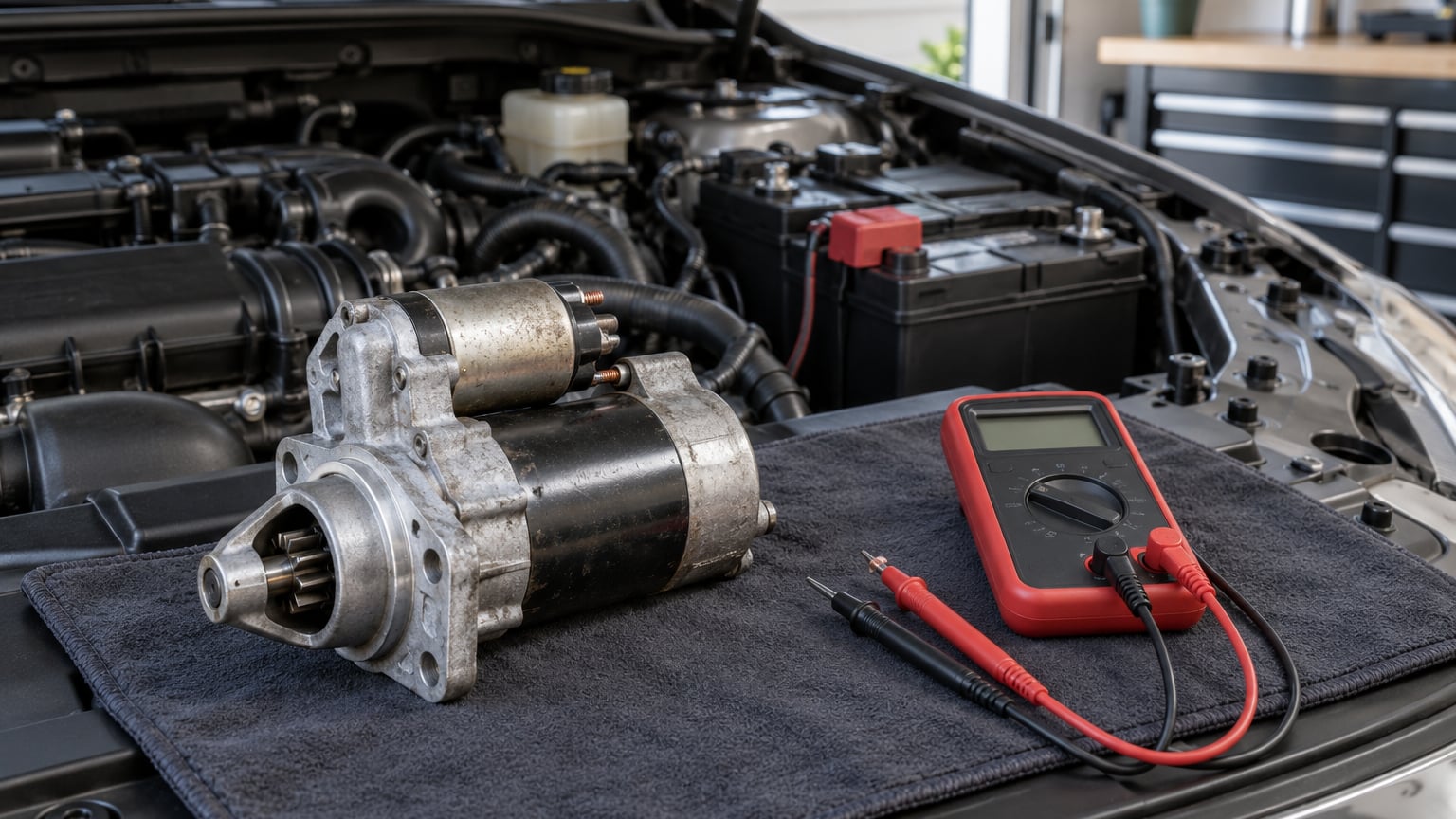
The short answer: yes, you can usually get a car with a bad starter running at least once. Charge or jump the battery to rule that out, then push the car in neutral with the clutch in and release it at a rolling 5 to 10 mph — that works on manual transmissions only, and it gets you to a shop rather than home. Every other fix below is diagnosis first, repair second.
A dead starter is the diagnosis people reach for fastest and get wrong most often. A corroded battery terminal, a blown starter fuse, or a tired ignition switch all produce the same silence at the key, and each one takes about ten minutes to check with a basic multimeter and a socket set. Which is why the first move is never to order a starter. It is to listen.
Here is the short version before we get into the wrench work:
- Charge the battery first. A battery at 12.0 volts or lower under load will not crank anything, starter or not. This fixes more “bad starters” than any other single step.
- Push or bump start it. Manual transmission only. Key on, second gear, clutch in, roll the car to 5 to 10 mph, then dump the clutch. The engine fires and the bad starter becomes a passenger.
- Tap the starter body. A light tap with a wrench handle can unstick a starter that is hanging on the solenoid but not driving the flywheel. It buys minutes, not days.
- Bench the voltage at the starter. If the starter gets full battery voltage and still does not turn, the starter is the fault. If it does not, keep looking upstream.
Everything above is temporary. Read to the end before you start cranking on a roadside.
Table of Contents
- What You Need to Start a Car With a Bad Starter
- Step-by-Step: Diagnose and Start a Car With a Failed Starter
- Common Mistakes That Cost People Time and Money
- Frequently Asked Questions
- Can you start a car with a bad starter?
- Will jumping the battery start a car with a bad starter?
- Is a clicking sound always a bad starter?
- Can you push-start a modern BMW with a bad starter?
- How much does it cost to replace a car starter?
- Should I replace the starter or the battery if the car will not start?
- Conclusion
What You Need to Start a Car With a Bad Starter
Gather this before you turn the key, because half of the diagnostic steps happen with the engine off and the lights on. Missing one item is how a twenty-minute job turns into a two-hour one.
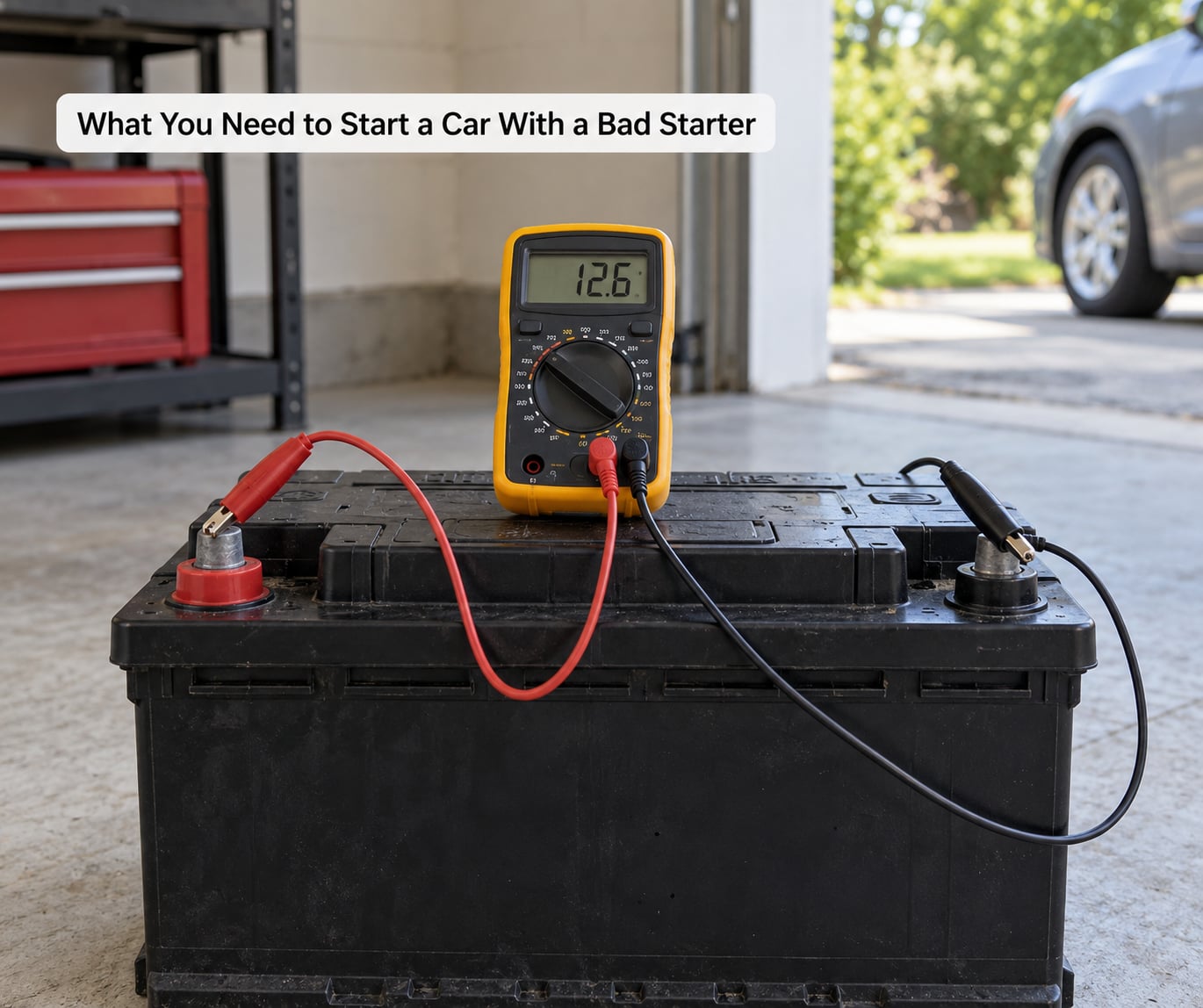
- The owner’s manual for your specific make and year. Fuse box locations, starter mounting bolts, and even the gear selector position for push starting all live here. Modern manuals are usually in the glove box.
- A digital multimeter for resting voltage, state of charge, and the voltage drop test at the starter terminals.
- A socket and ratchet set with extensions, plus a wrench or pliers. You will need 10, 12, 13, 14, and 15 mm depending on the vehicle.
- Wire brush or terminal cleaner and a clean rag. Corrosion on a battery post is common enough to check every time.
- Jumper cables rated for the vehicle, or a properly rated portable jump pack.
- A battery charger if you have one. A slow charge recovers more sulfated batteries than you would expect.
- Safety gear: gloves, eye protection, and sturdy footwear. A starter motor throws sparks and hot metal grit, and batteries vent explosive hydrogen when charging.
- Hand crank or socket extension only if you are willing to do the starter removal with the engine cold and the car on stands.
Safety first, and this part is not optional.
- Never work under a car supported only by a jack. Use jack stands rated above your vehicle’s weight, on level concrete.
- Remove the negative battery cable before touching starter wiring, and do not let the wrench bridge the battery posts. A short circuit will fry wiring and ruin the battery.
- Keep hands, clothing, tools and the key well clear of the fan, belts and pulleys. They move whenever the engine does.
- A starter that just worked gets hot fast. Wait at least 30 minutes before touching it.
- Do not hold the key in the start position. Each extra second drains the battery and adds heat to a motor that may already be failing.
- Never hammer hard on a starter. Light taps on the body only; a hard hit can drive the armature out of alignment and turn a repairable starter into scrap.
- Charge and jump in a ventilated space. Batteries release explosive gas, and a loose clamp near one is a serious hazard.
- Never push start an automatic transmission. Put that aside entirely and call for a tow.
Step-by-Step: Diagnose and Start a Car With a Failed Starter
1. Confirm the Battery and Listen for the Starter
Battery voltage under load is the single most useful measurement you will take, and it takes two minutes. Set the meter to DC volts, connect across the battery terminals, and read it.
- 12.6 volts or higher with the engine off: fully charged, move on.
- 12.2 to 12.5 volts: partially charged. It may crank weakly and it will not crank repeatedly.
- Below 12.0 volts: dead or sulfated. Charging and testing it is step one, not the starter.
Then watch the engine while you crank. The sound tells you where to look next.
- Fast, steady whir that fades after start: the starter is fine and the engine is not firing. Look at fuel, spark or compression, not the starter.
- Slow, laboured crank that eventually starts: usually a weak battery or a corroded ground. Corrosion adds resistance that the meter at rest will not show.
- One sharp click, then nothing: a dead battery, a bad cable connection, or an open control circuit. The solenoid may not be getting the signal to close.
- Rapid clicking, like a machine gun: almost certainly battery. Each click is the solenoid trying and failing to bridge the main contacts.
- Total silence, no click at all: an open fuse, a failed starter relay, a dead ignition switch, or a starter with a severed field circuit. This is the one people call a bad starter most often, and it is sometimes a cheap fuse.
Clean the terminals while the battery is out or switched off, tighten the clamps, and make sure the negative cable lands on solid metal. Then re-check voltage. Watch the headlight brightness while cranking; lights that dim hard point at the battery, and lights that stay bright point away from it.
2. Check Fuses, Ignition Switch, and Starter Relay
Start at the fuse box. The location is in the owner’s manual under the fuse chart, and it is not always under the hood on newer cars — some put it inside next to the driver’s knee, and push-to-start models often keep it in the body controller instead.
Pull the starter fuse with pliers and look at it face-on in good light. A blown fuse shows a thin dark line across the metal instead of the continuous ribbon you see on a good one. Check every fuse on the same circuit, not just the obvious one, because a shared circuit kills the whole starting system.
Beyond that, look at three things in this order:
- The starter relay or control module. Many cars use a high-current relay near the battery that boosts the small signal from the ignition switch. A failed relay behaves exactly like a dead starter. Swap it or check it with an ohmmeter; it is cheap and easy to replace.
- Ignition switch wear. Contacts inside the switch pit and corrode with key cycles. Symptoms are intermittent and annoying: works cold, fails hot, or works when the key is held slightly off-center. It is also what fails when a key chain snaps inside it.
- Wiring from the relay to the solenoid. Look for chafed insulation near the transmission bellhousing, where two sections of harness flex against each other through every drive. Repaired splices under tape and heat-damaged insulation near a hot exhaust are both common finds.
If a scan tool is available on a car with electronic starting, pull the codes before you start replacing parts. Our guide on reading fault codes with a scanner covers the basic routine, and on many vehicles a stored starter-circuit fault code is the difference between a guess and a diagnosis.
3. Test Voltage Reaching the Starter
This test tells you whether to buy a starter or chase wiring, and it takes about five minutes.
- Set the multimeter to DC volts.
- Connect one probe to the battery positive terminal and the other to the battery positive lead on the starter itself. This sets the reference to whatever the starter is actually being fed.
- Have someone hold the key in the start position while you read the meter.
- A reading of about 0.0 to 0.5 volts means the starter is receiving the full supply. If the motor does not turn with full voltage present, the starter or solenoid has failed.
- A reading of 1.0 volt or more means real voltage is being lost somewhere between the battery and the solenoid. Clean the terminals, check the ground strap, then follow the cable.
That 0.5 volt figure is worth remembering, because it applies everywhere on a car. Any connection dropping more than half a volt under load is a bad connection, whether it is a battery post, a ground strap, or a starter terminal.
Also test the ground side. The negative cable from the battery to the engine block or chassis should show the same under a half-volt drop when the engine is cranking. A loose or corroded engine ground is a classic cause of a starter that works when the battery is fresh and refuses when the battery is tired, which is exactly the pattern that sends people back for the second battery.
No voltage at the solenoid during crank means the problem is upstream: no key signal, no relay, no fuse, no ground. A full volt of power to a starter that hums and spins the flywheel without turning it means the drive or the flywheel is the failure.
4. How to Start the Car Without a Working Starter
These methods start the engine once so you can drive to a shop. They do not fix anything, and a starter that starts on the fourth try may not start on the fifth.
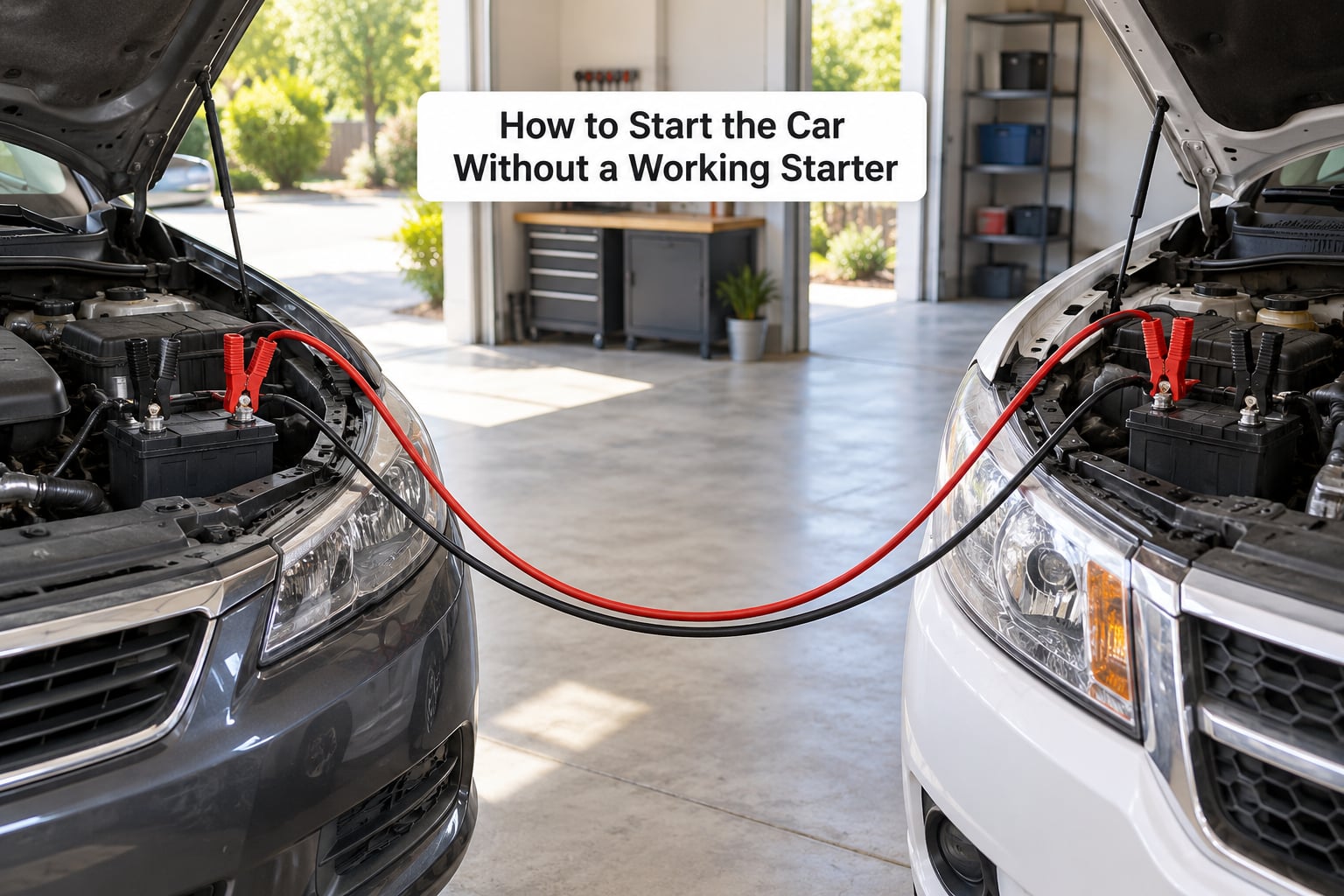
Method A — Charge or jump the battery. If the battery is simply flat and the starter is healthy, this solves it properly. Connect a charger and leave it for a few hours, then test voltage again. With donor batteries, park the vehicles nose to nose, engines off, and match polarity: positive to positive, negative to negative, negative last on both ends. Start the donor engine, give it a couple of minutes, then crank your car. Remove the cables in reverse order. Never let the clamps touch, and keep them away from moving fans.
Method B — Push or bump start a manual transmission car. Turn the ignition on without starting, leave the key in the on position so fuel and spark are live. Put the transmission in second gear, hold the clutch in, release the parking brake, and push the car from behind until you reach roughly 5 to 10 mph on a slight downgrade or with two strong people. Release the clutch quickly. Most engines fire within a rotation or two.
Do not do this on an automatic. There is no clutch to release and no safe, supported way to build enough engine speed; push-starting an automatic can damage the transmission, and the gear selector often needs a specific procedure on modern electronically shifted models. There is no quick fix for an automatic with a dead starter. Call a tow.
Method C — Tap the starter body. On a gasoline engine, have a helper turn the key while you give the starter casing a firm tap with a wrench handle or the wooden handle of a hammer. A stuck solenoid or a binding armature often releases with a jolt, and the engine starts on that crank. Light taps only. Do this in park with the parking brake set, and stay clear of the exhaust and any hot pipes.
Owners on forums describe this working one to three times before the starter stops responding altogether, which is a fair expectation rather than a fix. If the tapping keeps working and you want to know how much time you have, walk through our starter motor test before you rely on it.
Method D — Bridge the solenoid terminal. This one is rarely worth the risk and we list it mainly so you recognise the videos. It means touching a metal tool to a live battery post and a solenoid terminal to close the circuit by hand. It bypasses the ignition switch and dumps full battery current through your tool. Skip it on a roadside, and never on a car with an automatic unless you know the transmission type.
One more thing worth saying plainly, because it confuses people: a jump start that “fixes” a bad starter for a few weeks does not mean the starter is healthy. Several owners on MechanicAdvice describe exactly that pattern on older cars. The starter is drawing abnormal current, the battery cannot supply it under load, and the fault has not moved — it is just hidden while the battery is fresh.
5. Figure Out Whether the Starter Is Actually Bad
If you have confirmed a good battery, good voltage at the solenoid and a good ground, the starter assembly is the remaining suspect. It has four failure modes and they sound similar but need different repairs.
- Solenoid failure. You hear a click but the motor never spins, because the solenoid fails to bridge its main contacts. One click, silence, no hum. The solenoid is often a separate small unit bolted to the starter, which can sometimes be replaced alone.
- Motor failure. You hear the solenoid click, then a hum or a grind, but the engine does not turn. Worn brushes, a damaged armature, or seized bearings do this. The hum that fades within a second or two is typical of brushes worn past their last inch of contact.
- Drive failure. The starter spins but never meshes, and you hear a high-pitched whine without any crankshaft movement. The Bendix drive or its spring is broken or the pinion is stripped.
- Flywheel or ring gear damage. The starter engages, the engine twitches or lurches once, and stops. The teeth on the flywheel ring gear are damaged, which can shred the starter pinion. Replacing the starter will not fix this one — the flywheel has to come off.
A grinding, bouncing sound at crank time can also mean a worn motor mount letting the starter jump its teeth. A clicking that comes from under the hood but only when the key is held in a slightly different position points back at the ignition switch rather than the starter.
Symptoms that justify pulling the starter for replacement: a click with no crank, a hum with no crank, or a spin with no engagement, all with confirmed good power at the solenoid. Symptoms that do not: fast whirring that fades, slow crank, or nothing at all in a way that correlates with key position. Pulling a starter is a two-hour job on a transverse engine where the intake manifold is in the way, so confirm before you start.
6. Repair or Replace the Starting System Correctly
Once you have decided the starter is at fault, the replacement itself is straightforward on an engine with open access and frustrating on one buried under an intake manifold.
- Disconnect the battery. Negative terminal first.
- Unbolt the nut on the starter cable where it lands on the solenoid. Keep a magnet or a rag around the nut because starter bolts frequently thread into the solenoid housing and will drop into the bellhousing if you are not holding it.
- Unplug the connector from the solenoid if your starter has one, then unbolt the mounting bolts.
- Withdraw the starter. Compare the new unit’s tooth count, drive type and rotation direction with the old one before installing.
- Fit the new starter, reconnect the connector and cable terminal, and reconnect the battery. Clean the battery posts and tighten the clamp properly.
- Torque the main cable nut snug and check for drag on the body of the starter with the key on. If the engine cranks slowly or the cable heats, the cable terminal or ground is loose rather than the starter being wrong.
On an automatic, check for a parasitic drain before you blame the old starter. A starter that stays powered with the key off can pull a battery down within a day, and installing a fresh starter without finding the wire that stays hot leaves you stranded again in a week. Many circuits route through a relay or a fusible link near the battery for exactly this reason.
Some starters carry a new starter relay or solenoid and a fresh pigtail, which is why the parts look different even on the same engine. Use your vehicle-specific part number rather than a generic that physically bolts on, because a mismatched drive tooth count or rotation direction will chew through the flywheel ring gear.
Hand-rebuilt starters exist and are cheaper than dealer units, and the rebuild genuinely is doable on a bench. It also demands a vise, a pinion press and a brush holder, and mistakes there cost you a second starter. If the first one is already off the car, a reputable shop or a remanufactured unit is the better value.
If the starter sits inside an engine bay where you would be working over the transmission tunnel, or the flywheel itself is damaged, stop and hand it to a technician. Knowing when a repair crosses from a driveway job into a shop job is a skill, not a failure.
Common Mistakes That Cost People Time and Money
Charging a dead battery and calling it a starter fix. If the battery has been sitting for weeks, it will often not hold a charge. Test it after charging; a battery that drops below about 12 volts under load after sitting is finished and the starter is innocent.
Buying a starter before pulling a fuse. The starter fuse is often next to the battery, and it is a five-minute check against a few hours of parts fetching. Replace a starter relay while you are there, since it costs little and causes the same symptoms.
Assuming a click proves the starter is bad. A click means the solenoid is being asked to close and something upstream did not deliver enough current. More often than not, that is the battery, a cable, or the ignition switch. We covered this in more depth in how to test a starter motor: 5 simple checks.
Hammering the starter. The tap method exists because a light jolt can free a sticking armature. A hard hit on the drive end can bend the armature shaft and destroy the very gear you are trying to save, turning a temp fix into a new part.
Push-starting an automatic or popping the clutch. There is no safe push start on an automatic, and clutch-popping a manual while it is in a parking lot or on a slope risks both a transmission and the person behind the car.
Leaving the key in the start position. Every extra second costs battery charge and adds heat to a motor that is already struggling. Release the key the instant the engine catches.
Touching hot or moving parts. A starter that has been cranking is hot enough to burn, and the engine fans start instantly on many cars. Gloves and eye protection are not optional.
Driving on for months because the jump works. A temporary start is a trip to the shop, not a workaround. The next time, the car may simply not crank at all, and you may be facing the repair from the wrong side of town.
Frequently Asked Questions
Can you start a car with a bad starter?
Usually yes, at least temporarily. A manual transmission car can be push started in second gear with the clutch in, released at about 5 to 10 mph. A jump start only helps if the battery was the actual cause, so test battery voltage before assuming the starter is dead. On an automatic there is no safe emergency method, so the car needs a tow.
Will jumping the battery start a car with a bad starter?
Rarely. A jump start supplies the voltage the starter was short of, so if the starter motor or solenoid has actually failed, the engine still will not crank. If the car starts fine on a jump every time, the battery is weak rather than the starter being broken, and the real fix is a battery that holds a charge.
Is a clicking sound always a bad starter?
No. A click usually means the solenoid is being energised but the circuit cannot carry enough current. That points first at a weak battery, corroded terminals, a loose ground or a worn ignition switch. Check battery voltage and the starter fuse before condemning the starter. A repeated fast clicking is almost always a discharged battery.
Can you push-start a modern BMW with a bad starter?
Only with a manual gearbox. Most modern BMWs are automatic, and push starting them risks transmission damage or needs a specific gear selector procedure that varies by model. Pull the manual transmission check first. If the car is automatic, use roadside assistance or a flatbed tow rather than attempting to force a start.
How much does it cost to replace a car starter?
Cost varies widely by vehicle and region, and it depends on the part itself, the labour time, and how difficult access is. A starter on an engine with a transverse layout and an intake manifold in the way takes considerably longer than one on a rear-drive engine with open access. Get a written quote covering the part, labour and any relay or wiring.
Should I replace the starter or the battery if the car will not start?
Test the battery before replacing anything. A battery reading at or below about 12 volts off, or one that drops far under load, is the more likely cause and the cheaper repair. Replace the starter only after you have confirmed good battery voltage at rest, clean connections, a good ground and correct voltage at the solenoid while cranking.
Conclusion
Start with the battery, then listen. A voltage reading and a crank sound tell you more in five minutes than a starter purchase does in a week. Clean the terminals, check the starter fuse and relay, then confirm voltage is actually reaching the solenoid while cranking.
Once the diagnosis is solid, choose the fix that matches the failure. Push start or tap to get to a shop, replace the solenoid or starter once the cause is confirmed, and check for a parasitic drain on automatics so the same fault does not return next week. If the diagnosis still feels like a guess, a technician with a meter and a scan tool will be faster than another guess.