
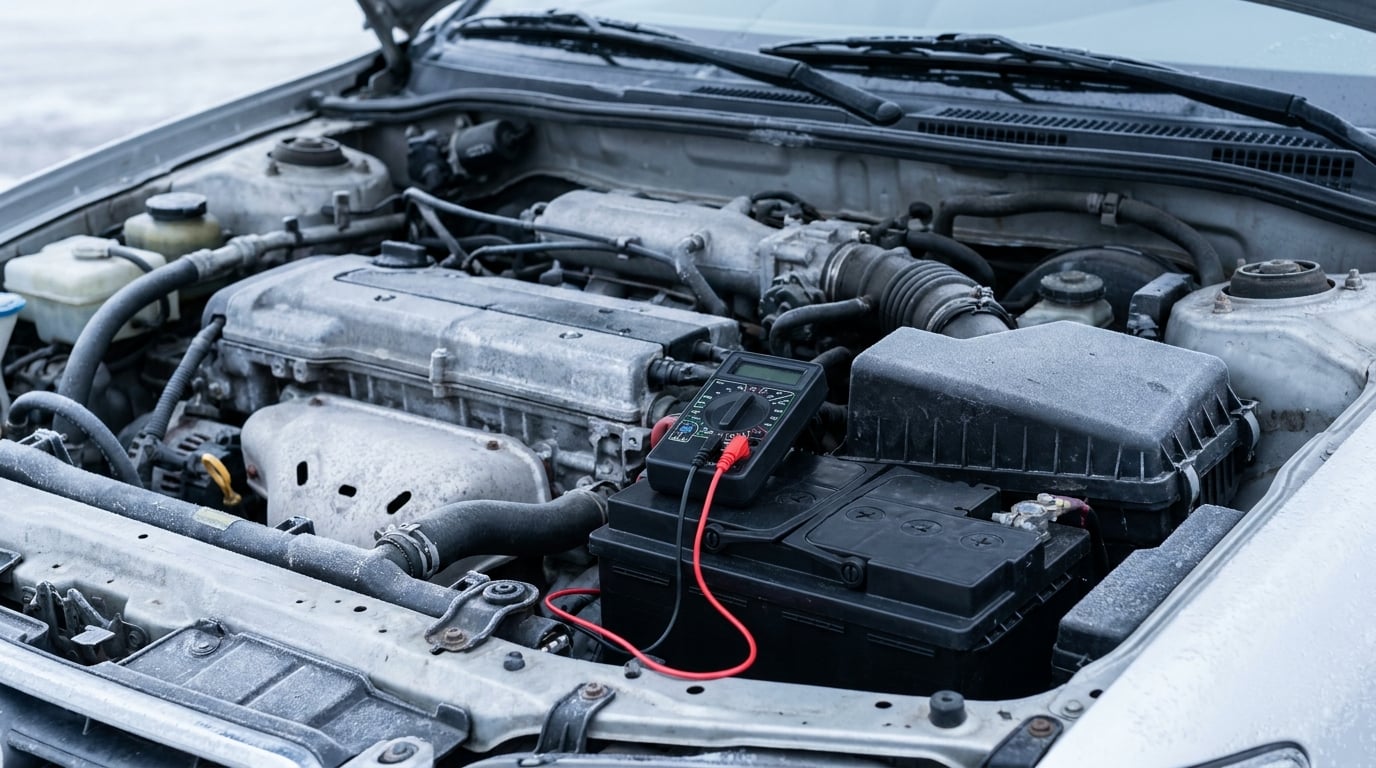
Short answer: cold does not kill your car battery, it exposes a battery that is already worn out. Low temperatures slow the lead-acid chemistry inside the cells and thin out the power the battery can deliver, while cold engine oil demands more cranking amps at the same moment. A battery that is a year past retirement has no margin left when the temperature drops below freezing overnight.
The part most people miss is what happened the summer before. Heat is what cooks a battery, boiling off electrolyte and cooking plate sulfation into the mix. That damage is invisible in August and obvious at 6 a.m. in January.
So if your car turned over fine last March and will not budge this week, cold is the trigger and something else is the cause. This guide walks through what cold actually does to the chemistry, what drains a battery overnight, how to tell a weak battery apart from a charging-system fault, and which voltages to read with a cheap multimeter before you buy anything.
Table of Contents
- Why Does My Car Battery Die in the Cold?
- Does a Car Battery Freeze?
- What Drains a Battery During Cold Weather?
- Is It a Weak Battery or a Charging-System Problem?
- How Can You Test the Battery and Charging System?
- What Should You Do If the Car Will Not Start?
- How Can You Prevent Another Cold-Morning Failure?
- Frequently Asked Questions
- Will driving my car for 15 minutes recharge the battery?
- Why does my car start in the rain but not on a cold morning?
- Is an AGM or gel battery better for extreme cold?
- How often should I replace a car battery?
- Can a car battery die from sitting in the cold?
- Do I need a new battery if jumping the car works?
- Conclusion: Start With a Load Test
Why Does My Car Battery Die in the Cold?
Because cold slows the chemical reaction that produces electricity, cuts the battery’s usable capacity, and raises what your engine needs to start. You end up with less power available at the exact moment more power is required, and a marginal battery crosses from starting to not starting overnight.
Here is what is happening underneath the hood, in the order it unfolds on a cold morning.
Cold chemistry slows down
A lead-acid battery stores energy by reacting lead plates with an electrolyte solution. Reaction speed tracks temperature the way a person tracks warmth: slow when cold, quick when warm. As the electrolyte gets colder, internal resistance climbs, and a battery that pushed 400 amps easily in July might manage 250 amps at 0 degrees Fahrenheit.
Available capacity falls off a cliff
The electrons are still in there, you just cannot get at them. Below freezing a typical flooded battery gives up roughly 30 percent of its capacity at 32 degrees Fahrenheit, and close to 60 percent once the temperature drops below zero.
Cold oil doubles the cranking load
Engine oil thickens as it cools, roughly like cold honey through a straw. Turning a cold engine past compression takes up to twice the current of a warm one, so the starter asks for more amps at the same time the battery is offering fewer.
Accessories pile on instantly
Heated seats, the steering wheel heat, the blower on high and the rear defroster all come on in the first thirty seconds. Those loads run off the alternator through the same battery terminals, and an alternator turning slowly at idle does not put back what a cold battery just spent.
A discharged battery can freeze
Losing capacity is not the same as freezing, but a deeply discharged battery can actually freeze solid and suffer permanent damage. More on that below.
| Temperature | Capacity available | Cranking power needed |
|---|---|---|
| 77 degrees F (25 C) | Roughly 100 percent | Normal |
| 32 degrees F (0 C) | About 70 percent | Noticeably higher |
| 0 degrees F (-18 C) | About 40 percent | Up to double normal |
| -20 degrees F (-29 C) | Roughly 25 percent or less | Highest of all |
Read that table twice. At 0 degrees Fahrenheit the battery gives up about 40 percent of its punch and the engine asks for twice as much as it wanted in July. That is the whole answer to why does my car battery die in the cold.
One more thing worth adding to the physics: an aging battery has higher internal resistance to begin with. Cold does not create a new problem, it removes the cushion that used to hide the old one.
Does a Car Battery Freeze?
Usually not, and the distinction matters. A healthy, fully charged lead-acid battery holds its charge fine down to roughly minus 6 degrees Fahrenheit. Freezing is a problem for a battery that has already been drained, because the acid concentration drops with state of charge and the freezing point rises.
A lead-acid cell is roughly six volts when empty. Once the electrolyte gets thin enough, the water in it has nothing holding it liquid, and expansion can crack plates and case seams. If that battery thaws, it is often permanently weaker even if it still holds a charge.
| State of charge | Approximate freeze point |
|---|---|
| 100 percent (12.6 volts resting) | About -6 degrees F (-21 C) |
| 75 percent | About 20 degrees F (-7 C) |
| 50 percent (12.4 volts) | About 40 degrees F (4 C) |
| 25 percent (12.2 volts) | About 55 degrees F (13 C) |
| Discharged | Around 60 degrees F and above |
That table is the practical answer to “how cold is too cold for a car battery.” If your car sits outdoors for a week in northern January, a half-charged battery is a frozen battery waiting to happen.
Never try to charge or jump a battery that is swollen, cracked or visibly leaking sulfuric acid. Move away from the vehicle, keep sparks and flames clear, and let a shop handle it.
What Drains a Battery During Cold Weather?
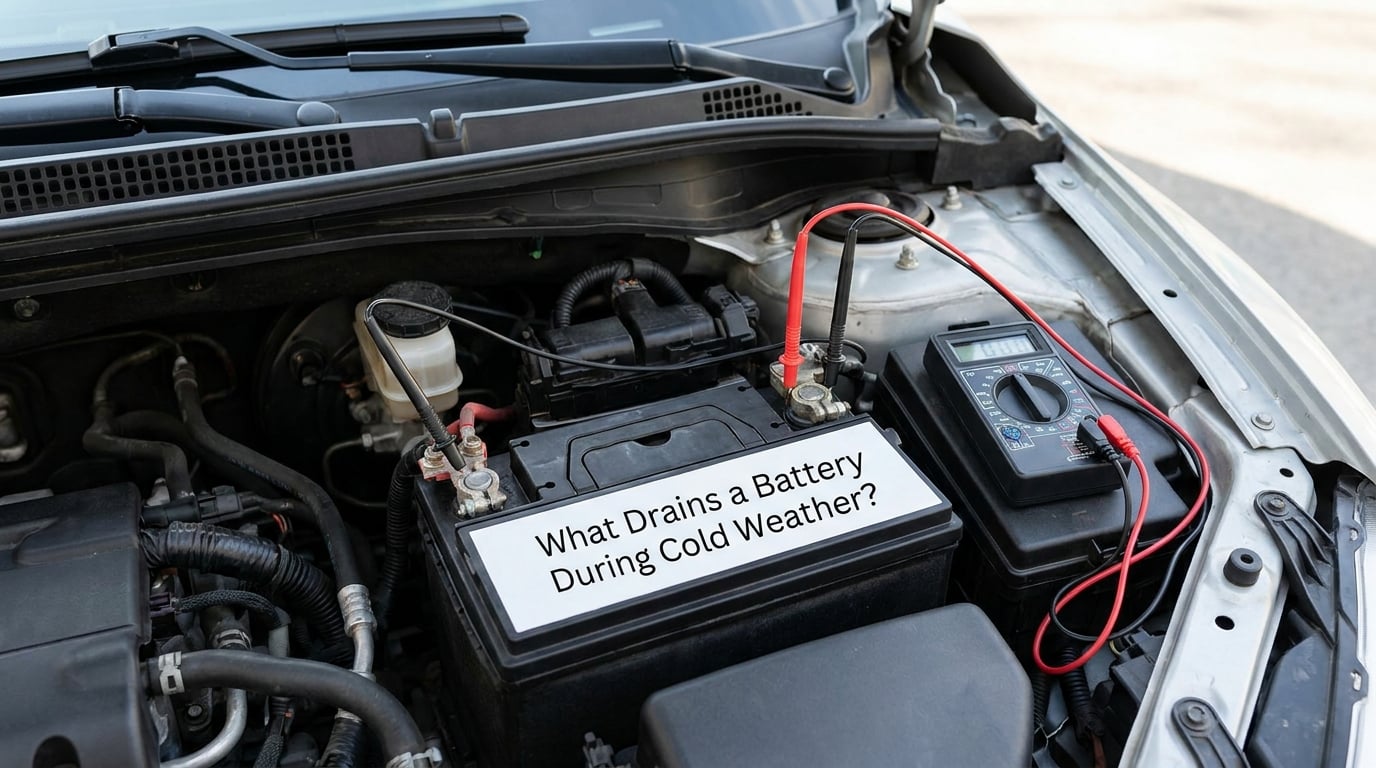
Cold itself drains almost nothing. A parked car loses a normal fraction of an amp with the alarm, clock and computer memory alive, and that trickle can stay flat all winter if the car never drives far enough to put the charge back. Here is what actually empties it.
Short trips. Fifteen minutes of driving does not put back what a cold start took out. The alternator spins with the engine and its output depends on engine speed and load, so it never reaches full charging voltage during short hops with the cabin heater running.
Repeated starts. Each start in cold weather is one of the heaviest draws a battery ever handles. Several starts in a day during a cold snap can take a borderline battery below the point where it will turn over tomorrow morning.
Accessories and charging ports. Cabin and exterior lights, an aftermarket amplifier, a dashcam plugged into a live USB port and an interior light that never shuts off all run on stored charge. Some cars keep a phone-charging port powered with the ignition off.
A weak alternator. If charging voltage sits low, the battery slowly empties no matter how far you drive. Cold weather is simply when you finally notice, because every cold start takes more out than a marginal alternator gives back.
Parasitic draw. Every car draws a small baseline amount with the key off. When a module, relay or aftermarket device short circuits, that baseline climbs and the battery dies while the car sits. Owners on r/MechanicAdvice repeatedly run into this with a healthy battery under a year old that keeps dying after a day of standing, and corrosion on the terminals is often the visible clue that something has been working too hard.
The short-trip pattern shows up constantly in the same forums: the car starts fine in the morning, then will not restart after a quick trip in the cold. Commenters there usually call it not a battery problem, and they are often right.
Is It a Weak Battery or a Charging-System Problem?
Match what you hear and see before you open a hood. Slow cranking that eventually starts usually means a weak battery in cold. A single click and silence usually means low voltage or a bad connection. A crank with no start at all points at fuel, timing or a seized starter instead.
| What you notice | Most likely cause | Next test |
|---|---|---|
| Slow crank, starts after a few seconds | Weak or aged battery | Resting voltage and load test |
| Single click, nothing else | Low voltage or corroded connection | Resting voltage, clean and tighten terminals |
| Grinding crank, no start | Starter or engine mechanical fault | Check fuel, then starter current draw |
| Headlights dim while driving | Alternator or voltage regulator fault | Read charging voltage at the battery |
| Starts in the morning, will not restart after a short trip | Alternator not charging at idle, or parasitic draw | Charging voltage with engine running, then a parasitic draw test |
| Dead after two or three days parked | Parasitic drain or aged battery | Multimeter in series, key off |
| Battery light on the dash while driving | Charging system not holding charge | Charging voltage at the battery |
Bad grounds and corroded terminals mimic a weak battery beautifully. Voltage that reads fine at the meter but sags hard at the starter means you have a resistance problem in the cable, not a dead cell. A steady voltage drop of more than a couple of tenths of a volt between the battery post and the starter case during crank points straight at it.
How Can You Test the Battery and Charging System?
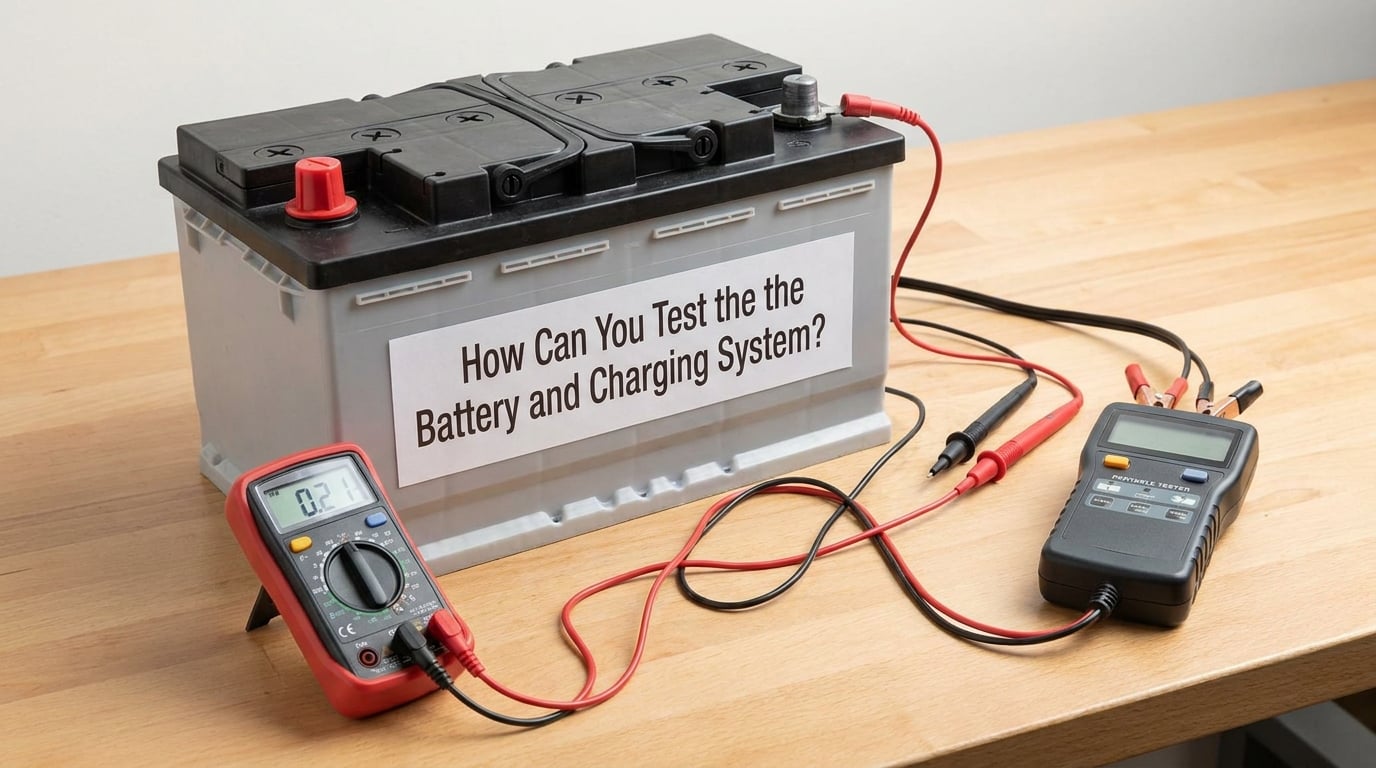
A twenty dollar multimeter answers most of the question in about five minutes. Engine off, lights off, keys out, then let the car sit for an hour or two so the readings settle. Measure across the two battery posts, not the ground.
Battery condition at rest, before anything else: 12.6 volts or higher means full. Between 12.4 and 12.5 volts means about 75 percent charged, acceptable but worth watching. Between 12.2 and 12.3 volts means half charge, and in real cold that is often not enough to start. At or below 12.0 volts means it is spent and needs charging or replacement, and a fully discharged battery sitting in freezing weather can freeze.
Then watch the crank. A healthy battery holds above 9.6 volts while the engine turns over. Anything dipping toward 8 volts or lower under crank load means the battery cannot carry what this engine asks of it, regardless of what it read at rest.
With the engine running, read charging voltage at the battery. A healthy system sits between 13.8 and 14.8 volts. Below 13.5 volts means the alternator is not keeping up with the load, which explains batteries that never seem to recover no matter how long you drive.
Finally, park it, switch everything off, wait a few minutes, then put the multimeter in series between the negative post and the negative clamp with the key off. A healthy modern car draws roughly 20 to 50 milliamps and settles lower after a few minutes as modules go to sleep. A few hundred milliamps that stays there means something is staying awake. Owners on Bimmerforums and the Subaru forums tend to measure it the same way, and a shop is still the right call if the number will not come down.
Two things need a shop. A conductance or load test tells you true internal health, and most parts stores run it free. Carbon monoxide inspection and anything involving fuel belongs on a lift, not in a driveway.
What Should You Do If the Car Will Not Start?
Turn every accessory off, put the car in park or neutral, set the parking brake, and give it one controlled crank of about 10 seconds. Before that, pop the hood and look at the battery. If the terminals are caked in blue-green corrosion or you can see a swollen case, do not keep cranking.
If it cranks slowly and starts, you have a battery at the edge. Drive straight to a shop for a load test rather than hoping the warm engine buys you another week.
If it does not start, a jump from another vehicle or a portable jump pack is the next step. Give it one attempt. Repeated cranking drains a weak battery further and can stress the starter, so do not sit and hold the key.
If the jump fails, stop guessing. The battery could be dead, the alternator could be dead, or the cable could be loose, and no amount of turning the key tells you which. Arrange a tow or roadside jump, and let a technician read it properly.
Anyone on r/autorepair faced with this exact question said the same thing in the video that surfaced on this search: hard to say whether it is the battery, the charging system or a drain, so test before replacing.
How Can You Prevent Another Cold-Morning Failure?
Keep the terminals clean and the clamps tight. Corrosion adds resistance right where you need current most, and a wire brush and a terminal protector spray cost less than a coffee. A bad ground strap does the same damage from the other end of the cable.
Drive long enough to recharge what you spend. A 20 to 30 minute drive on the highway with the cabin heater on is more useful than three short hops around town. If your driving is mostly short winter trips, a smart charger or a battery maintainer is the honest fix. Our guide to what a battery tender is and how to use one covers picking the right type and keeping it safe on a battery stored indoors.
Do not idle to recharge. Ten minutes at idle in cold weather is not enough to restore what the start cost, and people on the forums waste a lot of fuel repeating it. If the car sits for more than a week, that is a storage problem rather than a driving problem.
Keep it charged indoors if you can. A car parked outside all winter in single-digit temperatures stores its charge far slower and can end the season at half charge. A heated garage or an indoor trickle charger makes a measurable difference, and the same advice applies to tires once snow is in the picture, which is covered in our piece on what tire siping does and whether it helps.
Replace on age rather than on failure. Most batteries last three to five years, and once yours passes three a load test every fall beats a 6 a.m. roadside surprise. Expect shorter life in hot southern climates than in northern ones for the same reason: heat, not cold, is what does the damage.
Hybrid and EV owners should note that the 12-volt battery is a separate, ordinary lead-acid unit in most of those cars, with the same cold weaknesses and no hybrid-specific magic. Plenty of owners report hybrid 12-volt batteries going dead in subzero weather within the first year of ownership, so treat the symptoms exactly as described here.
Finally, replace a demonstrably weak battery rather than jumping it again. A battery that reads below 12.2 volts at rest, sags under 9.6 volts while cranking, and passes no load test is done.
Frequently Asked Questions
Will driving my car for 15 minutes recharge the battery?
Sometimes, but rarely enough. A 15-minute drive at idle speed with the heater and defroster running often puts back less current than a cold start took out, which is why owners see a car that starts in the morning and will not restart an hour later. A 20 to 30 minute drive at highway speed with a modest cabin temperature gives the alternator enough time and RPM to bring the battery back to a full charge.
Why does my car start in the rain but not on a cold morning?
Rain has nothing to do with it. The difference is temperature. A wet battery at 60 degrees keeps enough power to crank, while the same battery at 20 degrees delivers sharply less current and higher internal resistance. Cold engine oil thickens at the same time, so the starter demands more than the battery can give.
Is an AGM or gel battery better for extreme cold?
An AGM battery generally handles deep cold better than a standard flooded lead-acid unit because its electrolyte is absorbed in glass mats rather than sitting as free liquid. Gel cells also resist freezing at low charge. Neither fixes a weak charging system or a parasitic drain, and AGMs are less forgiving of overcharging, so match the battery to your vehicle rather than swapping type casually.
How often should I replace a car battery?
Most lead-acid batteries last three to five years, and heat-heavy climates see the short end of that range. Get a free load test once the battery passes three years and once a year after that. Replace it when a test shows weak capacity, not simply because winter arrived and it cranked slowly once.
Can a car battery die from sitting in the cold?
Cold by itself drains almost nothing. A car parked for weeks loses charge slowly, but the cold weather and the storage period together push the battery toward discharge, and a discharged battery can freeze in single-digit temperatures. Heat, corrosion and repeated short trips in cold weather do far more damage than the temperature alone.
Do I need a new battery if jumping the car works?
A successful jump only proves the battery can deliver enough current once, which a weak battery can often still manage. Read the resting voltage and charging voltage after the car is running, then have the battery load tested. If it sits below 12.2 volts at rest, cannot hold 9.6 volts while cranking, or fails the load test, replace it instead of jumping it again next month.
Conclusion: Start With a Load Test
Cold slows the chemistry, cuts available capacity and doubles the cranking demand at the same time, so a worn battery crosses the line overnight. The fix is not a colder-weather ritual, it is finding out whether the fault is the battery, the alternator or a drain.
Read resting voltage, watch the crank, check charging voltage with the engine running, then get a free load test at a parts store. If the battery fails, replace it and stop jumping it. If it passes, chase the parasitic draw.