
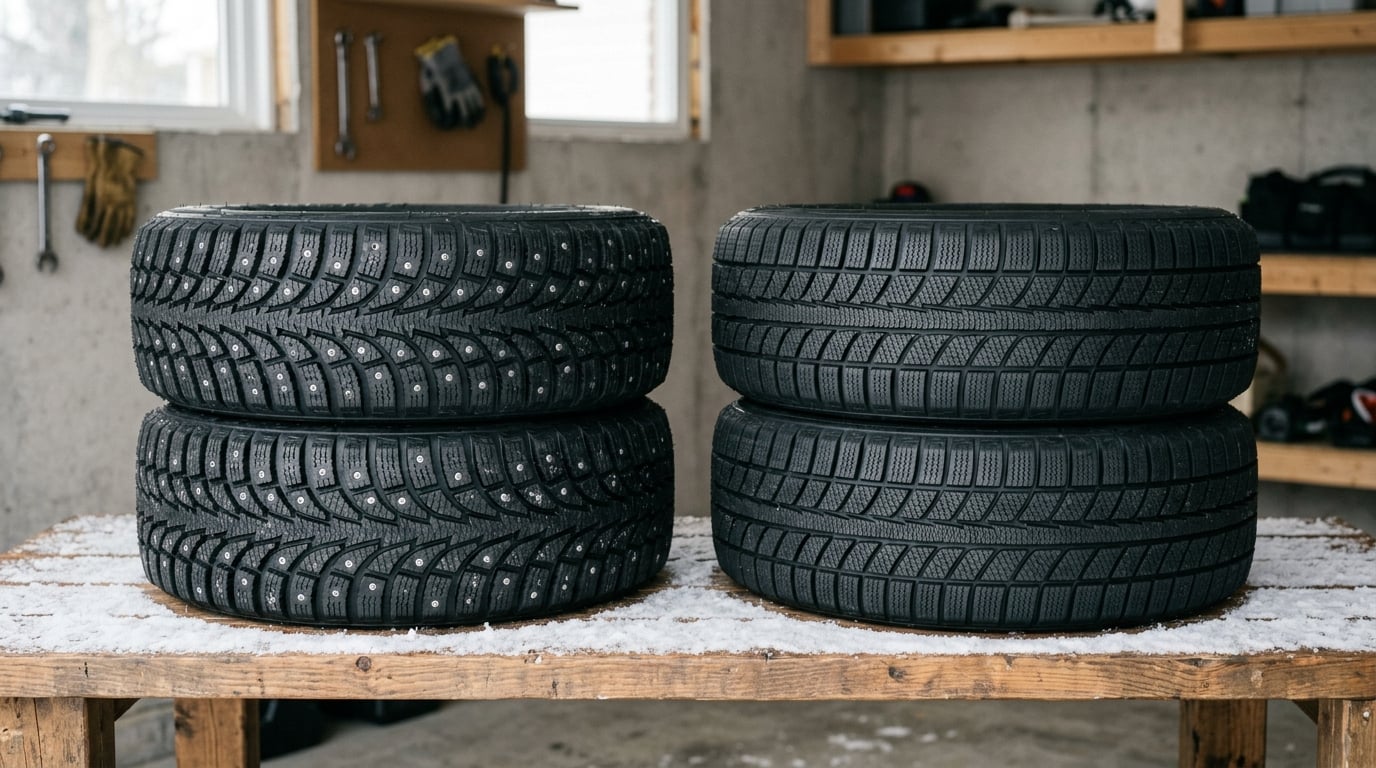
If you face real ice every winter, studded tires give you a measurable edge on polished, glassy surfaces. For almost everyone else, a good studless winter tire is the quieter, cheaper, more legal choice and it handles snow, slush and wet pavement just fine. The honest answer is that this is not a battle with a winner, it is a question about which surface spends more time under your tires.
Both options are cold-weather tires built with soft rubber compounds and thousands of tread sipes. Neither is a cheap all-season that you are bolting on. The only structural difference is the metal, so let us start there.
Over the years I have swapped seasonal tires on everything from a loaded family wagon to a rear-drive coupe, and the pair that gets forgotten about most is the “studdable” tire, a studless winter tire that happens to have empty stud wells in the tread. I will get to that, because a lot of confusion in this topic starts with those holes.
Table of Contents
- Studded Tires vs Studless Winter Tires at a Glance
- How Do Studded and Studless Winter Tires Differ?
- Which Tire Has Better Snow and Ice Traction?
- Which Tire Has Better Braking and Handling?
- Are Studded or Studless Winter Tires More Comfortable?
- How Much Do Studded and Studless Winter Tires Cost?
- Are Studded Tires Legal in My State?
- Which Should You Choose?
- Frequently Asked Questions
- Conclusion
Studded Tires vs Studless Winter Tires at a Glance
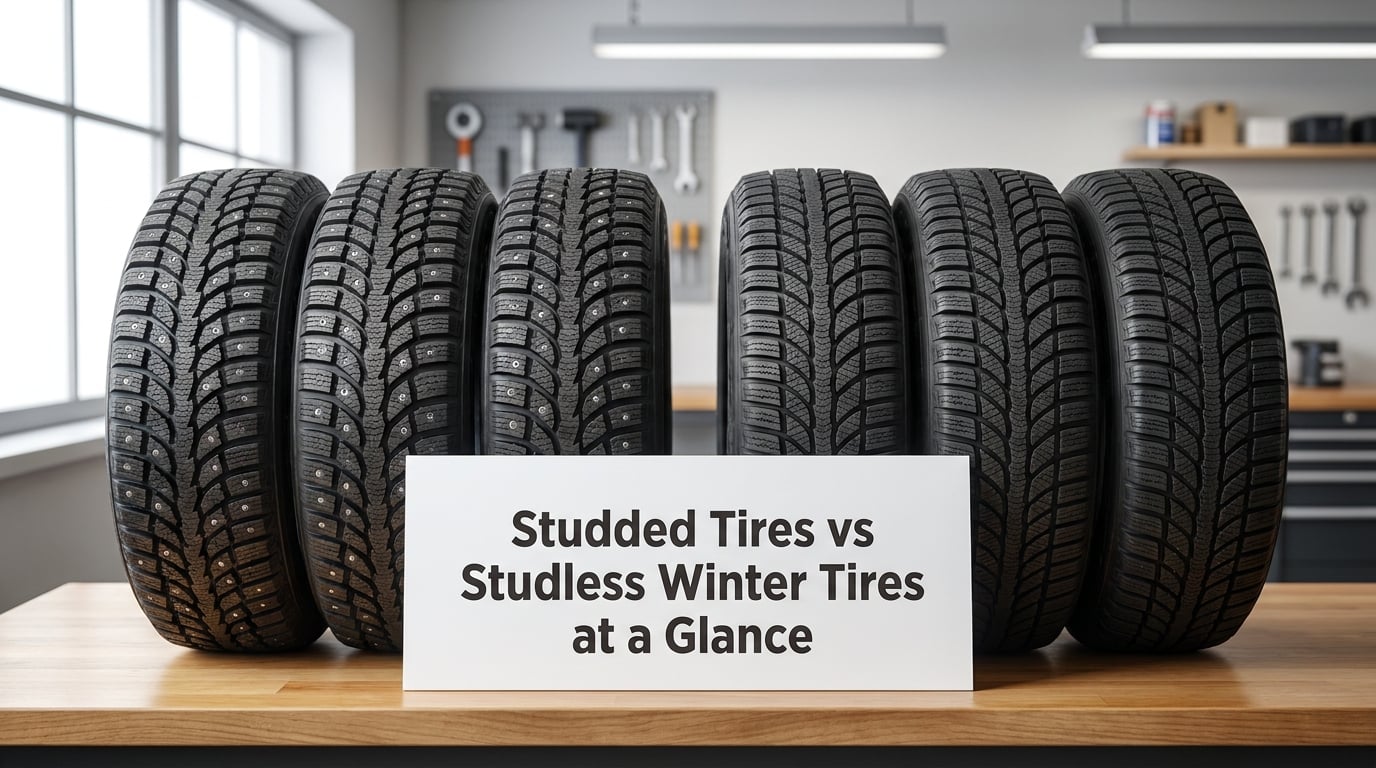
Here is the short version before the details. Studs are a specialist tool for one surface, and everything else in this table is a side effect you accept in exchange for it.
| Criterion | Studded winter tires | Studless winter tires |
|---|---|---|
| Traction on glare ice | Best available, studs bite into the ice | Very good, entirely from compound and sipes |
| Traction on packed snow | Strong, cleats push snow aside | Strong, V-shaped grooves do the work |
| Traction in deep snow and slush | Good, but tread design still matters more | Good, tread design still matters more |
| Wet pavement | Excellent, winter siping carries across | Excellent |
| Dry pavement braking | Slightly longer under hard braking | Consistently shorter |
| Cornering on ice | Firm, predictable bite | Good, requires more gentle inputs |
| Road noise | Noticeably loud, a humming tread | Quieter, closer to a good all-season |
| Rolling resistance and fuel use | Higher, harder compound and added weight | Lower |
| Year-round use | No, pavement wear and noise rule them out | Poor, a soft summer compound is the problem |
| Seasonal upkeep | Studs typically pulled and reinstalled | Swap on and off, nothing else |
| Legal use | Restricted by state, province or country | Legal nearly everywhere |
Quick verdict: choose studs if your regular winter driving includes polished ice, unplowed mountain or rural roads, or a heavily loaded vehicle on curvy packed snow, and only where they are legal. Choose studless if your winters are mixed snow and slush with a lot of highway and city commuting, if you drive a daily-driven car where noise matters, or if you want the lowest hassle and cost.
How Do Studded and Studless Winter Tires Differ?
A studded winter tire is a normal three-peak mountain snowflake tire with small metal pins pressed into hollow stud wells in the tread blocks. A studless winter tire is the same category of rubber with no metal at all, and it gets its grip from a very soft compound and a heavily siped tread pattern.
How each tire grips a cold surface
Studs work physically. Each pin presses down into the ice, punching through the thin layer of water and loose snow on top and seating itself in the hard surface below, so the stud is what actually carries the load. On top of that, the studs act like tiny cleats and flick loose snow out of the contact patch, which is why a studded tire feels so much more willing to climb through ruts in deep snow.
Studless tires work chemically and geometrically. Winter compounds stay soft and flexible below about 7°C, roughly 45°F, where a summer or all-season compound turns hard and glassy. Those soft compounds conform to the texture of the surface, and thousands of sipes, the small slits cut across the tread blocks, create thousands of biting edges that hook into snow and ice as the tire rolls. Blizzak is the best-known example of this approach and remains the benchmark that tire makers measure studded designs against.
That gap explains why a top-tier studless tire is no longer the compromise it used to be. The compound and tread engineering closed most of the distance in the last two decades, and the remaining difference concentrates almost entirely on glare ice.
What the 3PMSF rating actually tells you
Look for the three-peak mountain snowflake symbol on the sidewall of any tire you buy. It certifies that the tire passed severe snow traction and ice traction tests, and it applies to both categories. The rating says nothing about studs, because a studless tire can carry the mark and never touch a stud.
A tire labeled studdable has those empty wells. It is still a legal, warrantable studless winter tire when you leave it alone, and many owners never add studs and are perfectly happy. The wells exist so you have the option later, which is useful if you move to a stud-legal state or your winter changes.
Which Tire Has Better Snow and Ice Traction?
On glare ice, studded tires win, and this is the one place the answer is not close. On packed snow, deep snow and slush, the gap narrows fast, and a good studless winter tire with an aggressive V-shaped or blocky tread is at least as capable in practice.
How studded tires vs studless winter tires handle glare ice
Glare ice is that smooth, polished, almost glassy surface that forms when freezing rain, melting snow refreezing, or traffic repeatedly compacts a road. It is the surface that catches people out, because it looks wet and normal until you are already on it. Long-time stud owners in the Pacific Northwest and the Northeast consistently report that their studs matter almost exclusively on this surface, and on packed snow they say modern studless tires are nearly as good.
Long-time owners also make the same point from the other direction. Veteran posters on owner forums have argued for years that studs help on glaze ice and cost you on everything else, and the noise complaint in those threads has never once been disputed. That is a reasonably fair summary of the physics.
Packed snow, deep snow and slush
On packed snow, both tread designs rely on the same thing: a wide, open, blocky pattern with deep grooves that sheds snow instead of packing it into a smooth sheet. Studs add a modest benefit here by clearing the contact patch, and a much bigger benefit if the pack is rutted and the studs can find hard spots underneath. Deep snow and slush are mostly a tread volume problem, and if the tire has the volume, the studs matter less than people expect.
Two things change the result more than stud choice does. Speed does, enormously, because a winter tire is asked to do its best work at low speed and no compound survives being approached too fast on ice. So does compound condition, since a cheap winter tire that has spent three seasons hard-drilling on a studded car will not feel like the tire it was new.
One community consensus worth repeating comes from the long-running tire subreddit, where the recurring advice for years has been that unless you genuinely live with ice, buy a dedicated winter tire and skip the studs. That is good advice and it matches how the physics actually breaks down.
Which Tire Has Better Braking and Handling?
On a brake test on clean pavement, studless tires win by a small margin, and on an emergency stop in a corner the studless tire also gives you more consistent pedal feel. On ice, the studded tire pulls you to a stop in less distance. There is no setting where one of these tires brakes well and the other is dangerous.
Braking on wet and dry pavement
Cold pavement is where the argument gets misstated. A winter tire’s siping and soft compound give it strong wet grip, and that benefit belongs to both options equally. On dry asphalt, the soft compound that makes a winter tire great in snow becomes a liability, it deforms more under load and heats up faster, and a stud adds a hard point that can skitter under hard braking.
Independent testing of matched studded and studless winter tires has found dry braking distances within a few percent, with the studless tire typically ahead. One instrumented A-B test in recent winter testing went the other way on wet asphalt, which is the useful reminder here, the gap is small and it moves around, so do not build a decision on a single number.
Cold matters more than studs. A winter tire needs to be at road temperature to work, which is why driving a set hard for twenty minutes then checking the patch makes sense. Tire age matters too, since rubber stiffens with time regardless of remaining tread. Getting pressures right is the free part of the job, and our winter tire PSI guide covers why cold readings are lower than the door-jamb number.
Do you need studs if you drive AWD or 4WD?
No, not for traction reasons. AWD and 4WD help you get moving, and they do almost nothing for your stopping distance, because all four tires lock up on ice no matter what drives them. The overwhelming majority of winter capability comes from having dedicated winter tires in the first place, and putting studless winter tires on an AWD car beats putting all-seasons on anything.
Where drivetrain layout and studs interact is a narrower case, for example a loaded rear-drive wagon carrying a family and gear up a curving plowed-but-icy mountain road. More driven wheels plus studs plus weight gives you margin that a front-drive crossover with the same tires does not. That is a specific vehicle in a specific place, not a rule.
Are Studded or Studless Winter Tires More Comfortable?
Studless tires are more comfortable, and the gap is big enough that owners notice within days. Every stud that contacts the road hits like a small hammer at highway speed, and the pattern of studs in the tread sets up a periodic drone that rises and falls as the wheel rotates. Long-term stud owners describe it as a humming that follows you into the garage.
Steering feel is the other half. Studs add a slight, continuous chatter on smooth pavement, more noticeable in a car with alloy wheels and a stiff suspension than in an older sedan with steel rims. A sport sedan or a BMW will show it far more than a beater, and a performance car on studless winter tires keeps noticeably more steering precision, because nothing is chattering the contact patch.
There is an argument the other way that gets repeated by stud owners, and it is not nothing. Studs can feel more settled in a hard corner on ice, because the tire bites rather than skate, and drivers who care more about that than about refinement tend to keep them. Daily-driven comfort, though, is where studless wins cleanly.
How Much Do Studded and Studless Winter Tires Cost?
Studded tires cost more to buy and cost more to keep, and the extra spend is not in the studs themselves. The rubber is the expensive part, because a quality studdable winter tire with a reinforced carcass and studs-included pricing sits in the same bracket as a premium studless tire, and the budget comparison is where studded setups get squeezed.
Where the real difference shows is seasonal work. Most stud owners run studs seasonally, pulling them each spring and reinstalling in the fall so the tire can survive on bare pavement, and that is a service visit each time. Some shops do both directions in one appointment. A handful of drivers keep studs in year-round and accept the noise, the pavement wear and the shortened tread life.
Tread life is the quiet cost. A studded tire wears faster on dry roads than the same tire without studs, which is exactly why seasonal removal exists. If you budget studless tires as a two-season set and studs as a one-season set, the gap widens again.
Stud removal and re-studding: what it involves
Removing studs means threading a stud remover into each well, twisting, and pulling, which is a shop job for most people. The stud wells are part of the tread, and a well that gets chewed up during removal is a tire you may not be able to stud again. Reinstallation is a drilling and press job, and the tires need proper stud wells in the right places, so a wheel without a suitable stud seat is a mistake people make and regret.
Two rules keep you out of trouble. Never stud a tire or wheel combination that was not designed for it, and never run studs on less than all four tires of the axle, because a mismatched pair will fight itself and the trip is wasted. If the stud count, the cost and the process are turning you off, that is a legitimate reason to go studless. If you are still deciding, how long tires last in years is worth a look before you commit to a set that may sit in a garage half the year.
Are Studded Tires Legal in My State?
Studded tire rules vary by state, and that variation is the single most common reason owners get pulled over. Some states allow them only between specific dates, typically a window from early autumn into early spring, so running studs in July is a ticket even where studs in January are fine. Some states restrict stud weight or stud type. Some ban them outright.
California and Massachusetts ban studded tires entirely, and several large states allow them only inside a date window, with rules enforced differently in each city or county. Many states permit them year round. That is enough variation that nobody’s memory of a neighbor’s advice is worth trusting, check your state department of transportation or your local police before you buy.
Approved studs are the other half of the rule. The studs have to be the manufactured kind sized for the tire, installed in the specified wells, and a stud sticking out of the tread or a homemade screw in the block is not an approved stud. Outside the United States the same caution applies in a different vocabulary, several Canadian provinces and most European countries either restrict or prohibit studs outright, which is why studless is the default choice in much of the world.
Which Should You Choose?
Pick studs if your winter regularly includes polished ice or roads that stay unplowed for days, if you haul a heavy load over curvy packed snow, and if you have confirmed they are legal where you drive and you can live with the noise. Pick studless if your winter is mostly treated roads, slush and highway driving, if your car is a daily driver or a performance car where refinement matters, or if studs are illegal or restricted where you are.
One more case is worth naming. If you only get a handful of genuinely snowy days a year, studless winter tires on your existing all-season wheels, or on a cheap set of steel wheels if your car allows them, buys you most of the safety for a fraction of the complexity. Stacking rare snowstorms on top of an already busy seasonal swap is how people end up with summer tires in January.
A quick decision checklist
- Does your regular winter driving include glare ice or unplowed roads? If yes, look at studs. If no, studless.
- Are studs legal where you live, and inside the dates you would actually use them?
- How many days a year do you drive in snow? Fewer than about 20 usually means studless is plenty.
- Is the car a daily driver, a quiet luxury car, or a performance car? All three argue for studless.
- Are you willing to book stud removal and installation twice a year? If not, that is your answer.
- Do all four tires need to match, including on all-wheel-drive and four-wheel-drive cars?
Maintenance either way
Both tire types are cold-weather rubber, so the care is the same. Check pressure monthly, because cold air and colder rubber both drop readings. Look at tread depth and tread age together, since a deep-looking tire that is past its service life has lost its compound, and our guide to how much tread new tires have explains what the factory numbers actually mean. Store summer and winter sets away from sunlight and heat, and rotate the set you are not running.
If you stud, add one seasonal job to the list: walk the tread with a flashlight in the fall and look for missing or leaning studs before you need the tire, not during a storm. Replace the set if more than a few studs are gone, because a partly studded tire behaves unpredictably.
Frequently Asked Questions
Are studded tires better than studless tires on ice?
On polished glare ice, yes, studs are measurably better because the pins bite into the hard surface. On packed snow, wet pavement and dry pavement, the difference is small, and a quality studless winter tire performs almost as well. So the answer depends on how much of your winter is spent on ice.
Can I use winter tires on dry roads?
You can, and in cold weather they grip dry pavement well. The catch is that the soft winter compound that works below about 45F wears faster and picks up more heat once temperatures climb. If your winters are mild, all-season tires are the better daily choice and winter tires go on for the cold months only.
Do studded tires damage asphalt or car paint?
Studs can scuff and groove pavement, which is the reason many states limit them by date and why some ban them outright. On cars, a missing or loose stud can chip a wheel or fender liner, and a stud that has backed out of its well can damage the tire itself. The risk is small with the right wheels and studs, and real with the wrong ones.
How many winter tire studs should be in a tire?
Most factory studded winter tires carry somewhere in the range of 130 to 160 studs, and some manufacturers advertise counts up toward 200 or more for their own designs. More studs are not automatically better. The set is engineered as a package, and running a mismatched or over-stuffed set gets loud and wears unevenly.
Are studless winter tires safe for BMWs?
Studless winter tires are the default choice for most BMWs, and a good studless snow tire is the better match for the suspension and steering. Keep in mind a winter tire is a dedicated snow tire, not a summer tire. If you drive an all-season BMW, fit actual winter tires rated 3PMSF for the cold months rather than assuming the factory set is enough.
Should I replace my winter tires if the tread still looks deep?
Yes, if they are past the tire’s service life. Rubber hardens with age whether or not it has been used, and a deep tread on aged compound can grip worse than a shallower tread on fresh one. Check the date code on the sidewall and replace a winter set that is several seasons old regardless of how much tread is left.
Conclusion
Studded tires win on glare ice and nowhere else. Studless winter tires win on snow, slush and wet pavement, on comfort and noise, on cost and on legality, which makes them the right default for most drivers. Both are defensible choices and neither is the dangerous one.
Start by checking your state or province’s stud rules and dates, then count how many days a year you actually drive on ice. Confirm the tire size and load rating your vehicle manufacturer specifies, and buy a set with the three-peak mountain snowflake mark. Everything else on this page is a detail of how you get there.