
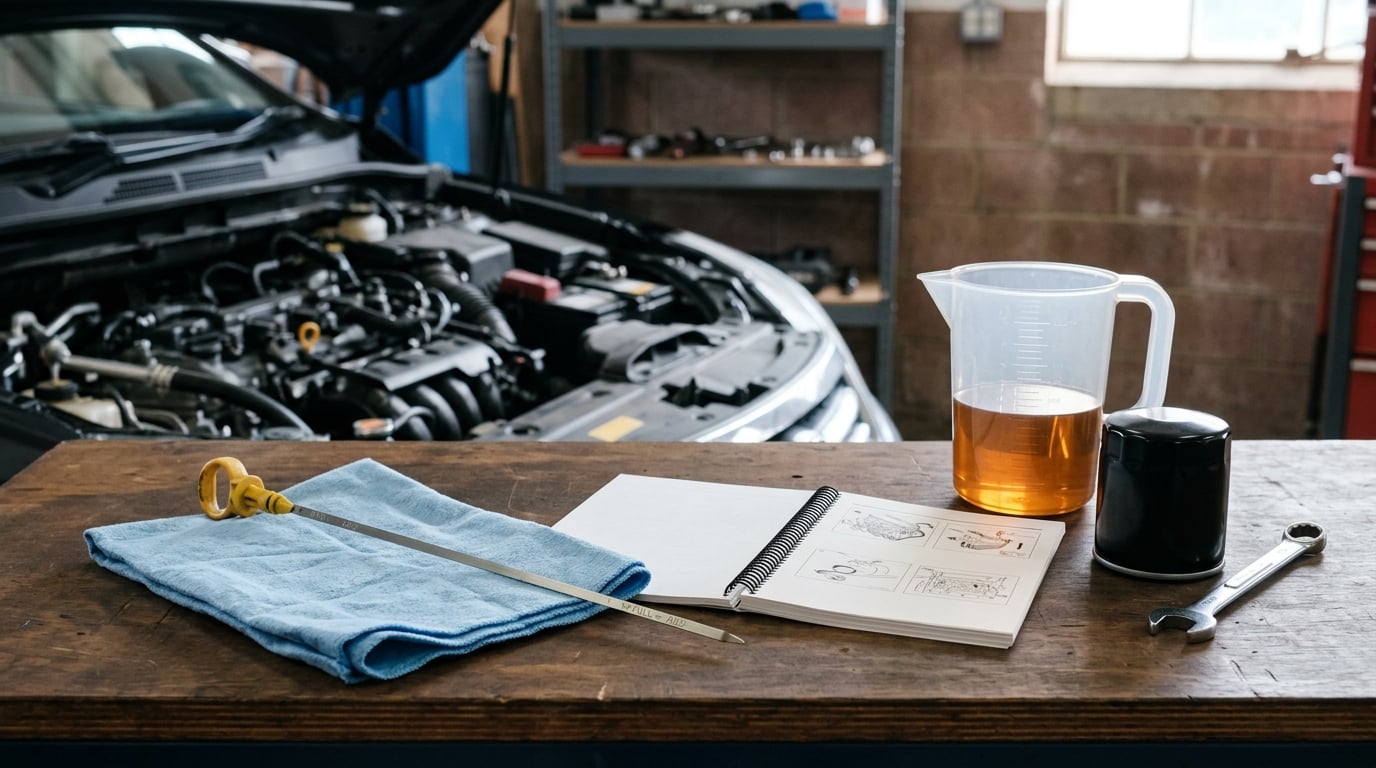
Engines burn some oil by design, and the ones that burn a lot do it through one of three doors: oil leaking out from underneath, oil getting past a seal into the combustion chamber and burning, or the lubrication system itself breaking down. Worn piston rings, hardened valve stem seals and a failed PCV system are behind most of what you’ll actually run into.
Here’s how to work out which one you’ve got, what a normal amount of consumption looks like on a healthy car, and what to do next. I’ve pulled the diagnostic order from what technicians check first, because guessing costs money and a compression test on a healthy engine tells you nothing.
Table of Contents
- How Much Engine Oil Consumption Is Normal?
- What Causes Engine Oil Consumption?
- External Leaks vs. Oil Burning
- How to Tell If Your Engine Is Burning Oil
- Common Causes of Excessive Oil Consumption
- What Causes Engine Oil Consumption in BMWs?
- Symptoms That Go With Excess Oil Consumption
- Can You Drive With Low Engine Oil?
- Fixes and Repairs for Excessive Oil Consumption
- How to Prevent Engine Oil Consumption Problems
- Frequently Asked Questions
- Is it normal to burn 1 quart of oil every 1000 miles?
- Why is my car losing oil but there is no visible leak?
- Can a bad PCV valve cause high oil consumption?
- Can an engine burn oil and not smoke?
- Will thicker oil stop my engine from burning oil?
- Do oil additives and engine flushes fix excessive oil consumption?
How Much Engine Oil Consumption Is Normal?
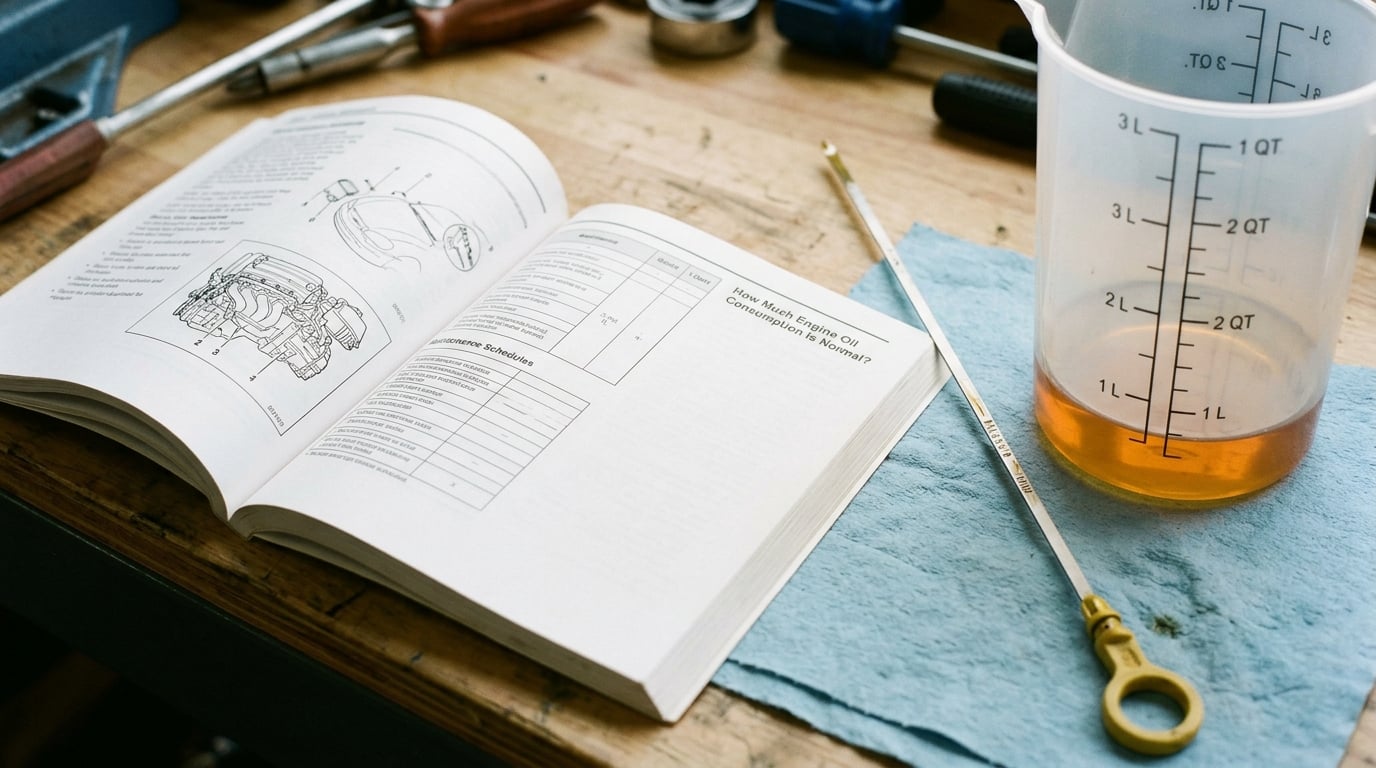
A healthy engine should use no more oil than the rate printed in your owner’s manual, and for most drivers that number is close to nothing. Anything beyond the manufacturer’s allowance is treated as a fault, not a quirk of the car.
That said, some manufacturers publish a generous allowance before they call it excessive. Some set the bar at a quart per 1,000 miles, which on a healthy engine sounds alarming and is usually just a very efficient lubricating system. BMW owner forums are full of M-series drivers describing a couple of quarts gone after a short drive with no smoke and no warning light, and the manufacturer treats that as acceptable on those engines.
Five things move the number around:
- Age and mileage. A 200,000-mile engine eating a quart every 2,000 miles is in a different conversation from a 30,000-mile engine doing the same.
- Driving pattern. Short trips, heavy idling, stop-and-go traffic and towing all keep the engine hot and the combustion cycle incomplete, which raises consumption.
- Oil grade. A thinner oil than the manual calls for burns more readily, especially on a worn engine.
- Engine design. Boxer layouts and some performance engines run more oil by nature than a transverse four-cylinder.
- Recent work. A fresh oil change resets your baseline; measure after a few hundred miles of normal driving.
The only measurement that settles the argument is a controlled one: park on level ground, check the dipstick warm, note the reading, drive 1,000 to 3,000 ordinary miles, then check again under the same conditions. A trip to the store is not a test.
What Causes Engine Oil Consumption?
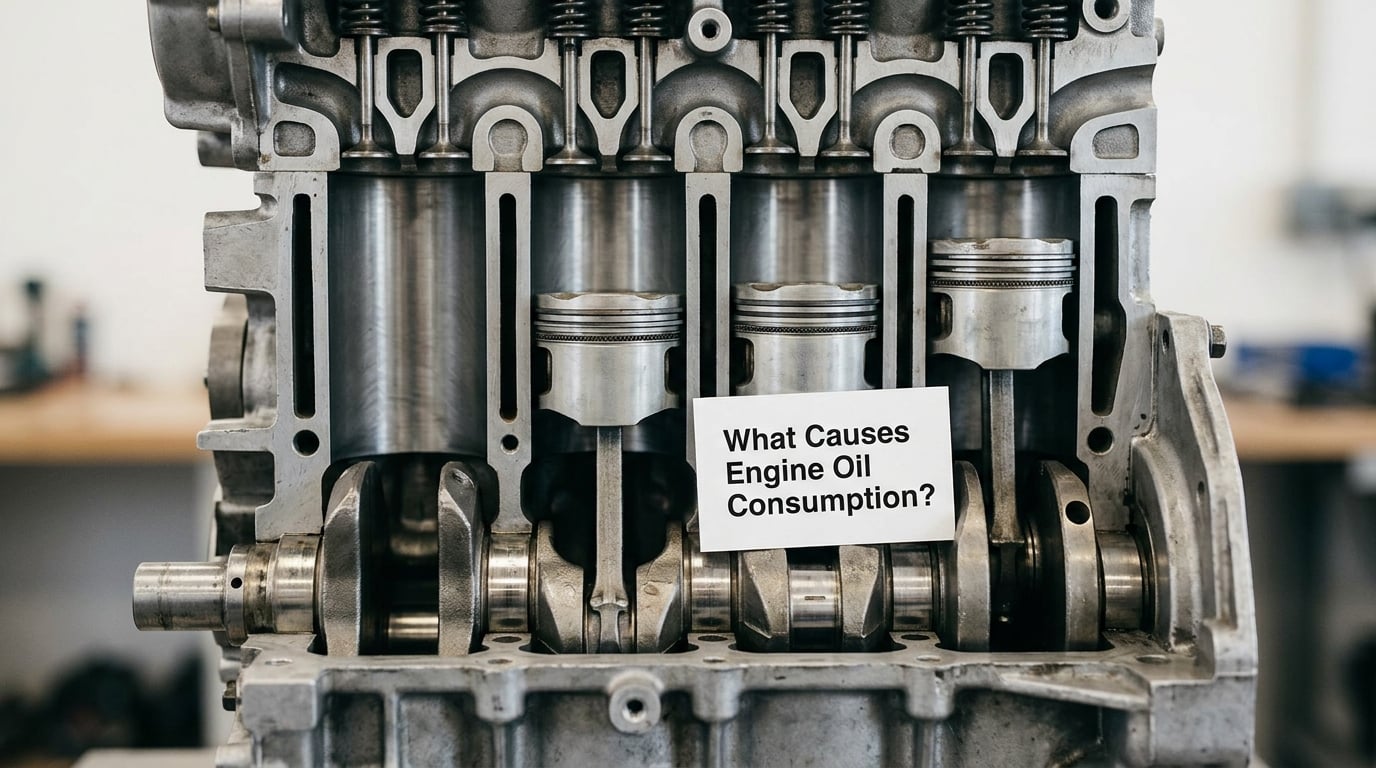
Excessive consumption comes down to oil escaping the sealed lubrication circuit. From there it either drips onto the ground, burns in the cylinders, or gets sucked into the intake as a mist and ends up in the exhaust anyway.
What causes engine oil consumption when there is no visible leak?
When nothing is on the pavement and the dipstick still drops, the oil is going somewhere else. Four internal routes account for the overwhelming majority of it:
- Past the piston rings. Oil control rings ride against the cylinder wall at every stroke. Worn ring lands, a stuck oil ring, or a scored wall lets oil slip into the combustion chamber.
- Past the valve stem seals. These small rubber or metal lips seal the intake and exhaust valves where they pass through the head. They harden with heat cycles, and once hard they let oil run down the guide and into the cylinder. The classic tell is smoke on a cold start that clears once warm.
- Through the PCV system. The positive crankcase ventilation system is supposed to pull blow-by gases out of the crankcase into the intake while keeping crankcase pressure near atmosphere. A valve stuck wide open over-ventilates, and the oil carry-over that should have been separated goes straight into the intake tract.
- Through a turbocharger or the head gasket. Turbo seals and the gasket between the head and block can fail, and both put oil where it does not belong.
A fifth category sits underneath all of them: the oil was never right. Too much oil overfill, the wrong viscosity, or a filter fitted after a run-on engine fault can all raise consumption on their own.
External Leaks vs. Oil Burning
External leaks and oil burning look nothing alike once you know where to look. A leak leaves a mark you can point at; burning usually leaves only a smell and a slowly emptying dipstick.
Oil that leaks out collects on the pan, at the filter housing, along the oil pan seam, around the cam seals or the rear main seal. Fresh oil on a warm engine thins and runs, so the drip shows up on the driveway after a drive and disappears after the car sits overnight in the right spot. A leak also leaves residue: an oily film, a wet film, or dirt that looks damp and sticky in cold weather.
Oil that is burning leaves evidence in the air instead. Blue or blue-grey exhaust smoke, an oily film inside the tailpipe, a fuel smell in the exhaust after a hard drive, and oil-fouled spark plugs all point inward. You may also find oil residue in the intercooler or charge pipes on a turbocharged car, which is a strong hint that the source is upstream of the compressor.
| What you see | Where it points |
|---|---|
| Drip or stain under the car, engine warm | External leak: pan, filter housing, gasket or seal |
| Oily residue on a pipe or in the tailpipe | Oil is leaving through the exhaust, burning or running |
| Blue-grey smoke on a cold start, clears when warm | Hardened valve stem seals |
| Smoke that grows when you lift off or hit high load | Piston rings, worn bores or a turbo fault |
| Oil residue in the intake or intercooler | PCV or oil separator failure |
| Milky residue on the filler cap, sweet smell, dropping coolant | Head gasket failure, not a consumption problem |
Our guide to what causes blue smoke from the exhaust goes deeper on the smoke side, because the timing of the smoke narrows the cause faster than any other clue.
How to Tell If Your Engine Is Burning Oil
Work the checks in order, cheapest first, and stop when the evidence points somewhere.
- Read the level and the condition. Warm engine, level ground, dipstick in, pull, wipe, reinsert, pull. Note the level and whether the oil is gritty, foamy or unusually dark. Grit points to wear; foam or a milky film points at coolant mixing in.
- Look underneath while the engine is warm. A few minutes of idling will show a weeping gasket that a cold look never reveals. Check the oil pan seam, filter housing, valve cover and the front and rear of the block.
- Note the smoke pattern. Cold start only, warm idle, under load, or after a long idle followed by a hard pull. Write it down with dates.
- Pull the spark plugs if it’s convenient. Oil on the ceramic insulator, the threads, or a sooty plug in one specific cylinder is a strong directional clue about which side of the engine is feeding the chamber.
- Read the service history. A recent PCV, valve cover, or turbo service tells you the easy things are already done. If a shop replaced valve stem seals and consumption did not change, that rules something out.
- Measure a real baseline. Fill to the mark, drive 1,000 to 3,000 normal miles, and check again. Now you have a number instead of a feeling.
If you get that far and still don’t know, the professional steps are a compression test, a leak-down test, a crankcase pressure reading, and a borescope look down a spark plug hole. Those four tell a technician which of the internal causes is actually present, and they’re worth doing before anyone quotes you an engine job.
Common Causes of Excessive Oil Consumption
These are the ones that come up repeatedly, roughly in the order a technician works through them.
- Worn or stuck piston rings. Low-tension rings are standard on modern engines for fuel economy, and they tolerate worn cylinder walls less well. Carbon can also bridge the ring land and hold the oil control ring open, which is the “stuck ring” case people ask about on mechanic forums.
- Damaged valve stem seals. Heat-hardened elastomer is the most common single cause on high-mileage engines, and it fits the cold-start smoke pattern neatly.
- Failed PCV valve or a failed oil separator. Cheap part, big effect. Owners on forums repeatedly describe fitting a new PCV valve and seeing no change, which almost always means the real fault is downstream: rings or seals.
- Turbocharger lubrication faults. Restricted oil feed or drain lines, worn turbo bearings, or a failed seal at the center section. Diagnosing the crankcase pressure first can save replacing a turbo twice.
- Scored or damaged components. A cylinder that has run low on oil can lose both compression and the surface the ring needs.
- Overfilling or the wrong oil. More oil is not protection. Too much oil foams at the crankcase and aerates, and aerated oil gets carried into the intake or the exhaust.
- Extended service intervals. Long-drain oil thins, carries more into the combustion chamber, and leaves deposits that work against the PCV system.
What Causes Engine Oil Consumption in BMWs?
On BMW engines the pattern is familiar enough to describe, and it usually comes down to a few recurring spots rather than a general failure.
Aged valve stem seals are the first suspect on higher-mileage four-cylinder and six-cylinder engines, particularly on cars that idle in traffic. Seepage that only shows on a cold start after an overnight stand is almost always seals rather than rings.
The oil filter housing gasket is a common source of a visible external drip on these engines, as is seepage from the valley pan or the oil pan. The valley pan is buried deep under the intake on a transverse layout, so the oil often takes a long, invisible path down the back of the block before it appears in the driveway, which is why owners report seeing nothing at all.
Turbocharged models add their own possibilities: a turbo that is starved of oil, a failed seal at the center housing, or a restricted drain. A rear-mounted turbo on older layouts is hard to reach, and a fitting routed through the charge pipe can put oil into the intercooler rather than the engine. VANOS and other variable valve timing hardware is a separate concern that usually shows as rough running or cold-start hesitation, but persistent oil in the intake can aggravate it.
Diagnosis still depends on the exact model, engine code and mileage. If you find metal in the oil, that is a different conversation entirely, and our guide to metal in engine oil covers the metals that matter most.
Symptoms That Go With Excess Oil Consumption
Ordered roughly by how fast you should be looking at them:
- A dipstick reading that keeps falling between changes, with no visible drip. This is the earliest and most common sign.
- Low oil level or oil pressure warnings on the dash. Treat the oil pressure light as a stop-driving signal, not a warning to schedule.
- Blue or blue-grey exhaust smoke, especially on a cold start, under hard acceleration, or after a long idle.
- Knocking, ticking or a hum that changes with RPM, or a misfire that clears after an oil top-off.
- Oil-fouled spark plugs, a rough or unsteady idle, and a check engine light.
- A burning fuel smell in the exhaust, especially after highway driving or a cold start.
- Overheating and a sweet coolant smell, or milky residue on the oil filler cap.
- Visible leaks that grow with the mileage rather than staying at a steady drip.
Can You Drive With Low Engine Oil?
You can add oil and keep driving, but only if the level is simply low and nothing else is telling you otherwise.
Stop driving and tow or call for help if the oil pressure light is on, you see a knocking noise, the temperature is climbing, the level drops again within days of a top-off, or there is smoke and a fuel smell at the same time. Running an engine low on oil takes the film off the crankshaft, rod and main bearings, and that damage is not a repair you come back from.
Adding oil is a top-up, not a fix. Use the grade and quantity the manual specifies, never go past the max mark, and write the mileage on the container. If the engine is burning what you put in, the number is your diagnosis.
Fixes and Repairs for Excessive Oil Consumption
Match the repair to the cause, because the cheapest fix that works and the most expensive one are usually six months apart.
- Wrong level, wrong oil, or overfill: correct it, reset the interval, and re-measure. Cheap, and it fixes a surprising share of complaints.
- PCV valve or separator fault: replace the valve, and the hoses and separator elements with it. Confirm crankcase pressure afterwards rather than assuming the job is finished.
- External leak: replace the gasket or seal, clean the area, and re-inspect after a drive so a weep shows itself. Oil filter housing and valve cover gaskets are common offenders.
- Valve stem seals: replace them. On some engines the head must come off; the work is moderate, the result is usually the disappearance of cold-start smoke and a large drop in consumption.
- Mild carbon and stuck rings: an intake cleaner or decarbonising treatment can free lightly stuck rings in early cases. This is worth trying before teardown and worth trying once, not repeatedly.
- Worn rings, worn bores or a scored cylinder: this is an engine job. Ring replacement, honing or sleeving, or a rebuilt engine depend on how many cylinders are affected.
- Turbo fault: fix the oil feed and drain restrictions first. Replacing the turbo without solving the pressure that damaged it is the expensive repeat repair.
- Head gasket failure: a different repair entirely, involving coolant and combustion gases, and it needs its own diagnosis.
Get a second opinion before you commit to anything that involves pulling the engine apart, and check for open recalls or technical service bulletins on your model first. A used oil analysis before teardown gives you hard data on what’s wearing and roughly how fast.
How to Prevent Engine Oil Consumption Problems
Most of the avoidable causes come from maintenance habits rather than bad luck.
- Use the exact viscosity and specification the manual calls for, and change on the stated interval rather than stretching it.
- Keep the PCV system intact. Replace the valve and its hoses when the engine is apart, and never run with a crankcase breather disconnected.
- Never overfill. The dipstick is a level check, not a target to reach.
- Check the oil level every few months between changes, warm and on level ground, so a drop shows up early.
- Look under the car after a drive now and then. Early seepage is minutes of work; a dry crankcase is a rebuild.
- Respond to blue smoke, a fuel smell, or a misfire with a top-off. A smoke plume is a request, not a mood.
- On direct-injection and turbo engines, a proper oil separator or catch can can be a sensible part of a service, though it is a maintenance item, not a cure. Our explainer on oil catch cans covers what they actually do.
Frequently Asked Questions
Is it normal to burn 1 quart of oil every 1000 miles?
It depends entirely on what your owner’s manual allows. A quart per 1,000 miles is within spec for some engines, particularly certain performance and performance-derived designs, and well outside it for others. The manual is the only authority. Measure a real baseline over 1,000 to 3,000 miles, and check whether the car is smoking, fouling plugs or running rough. Those signs turn a spec question into a repair question.
Why is my car losing oil but there is no visible leak?
Because the oil is leaving internally instead of dripping out. It is getting past worn piston rings, hardened valve stem seals, or a PCV valve stuck wide open, and burning in the combustion chamber or being carried into the intake. A slow smoke plume, a fuel smell after a hard drive, or oil-fouled spark plugs are the usual giveaways. A compression and leak-down test with a crankcase pressure reading will narrow it down.
Can a bad PCV valve cause high oil consumption?
Yes, and it is the first thing to check because it is quick and inexpensive. A PCV valve stuck open over-ventilates the crankcase, and the oil carry-over that should have been separated in the oil separator gets drawn into the intake and burns. You may also get oil residue in the intake tract, the charge pipes or the intercooler. If a new PCV valve changes nothing, the fault is probably rings or valve stem seals instead.
Can an engine burn oil and not smoke?
It can. At moderate consumption rates there is often no visible plume, especially on a warm engine, and what you notice instead is the dipstick level dropping between changes. Small amounts of oil oxidising in a hot exhaust also mask the smoke. Look for a fuel smell, oil-fouled plugs, a rough idle and a rising fuel trim. Measuring consumption over a controlled 1,000 to 3,000 mile interval catches what your eyes miss.
Will thicker oil stop my engine from burning oil?
Sometimes, and it is worth one cheap trial. A slightly heavier oil within the manufacturer’s allowed range can slow consumption where rings and guides are worn, because it resists being dragged past the seals. It is not a fix for a failed PCV system, worn bores or a leaking turbo, and going outside the allowed range can trigger warranty questions. Check the manual for what viscosities are permitted before you change anything.
Do oil additives and engine flushes fix excessive oil consumption?
They help in one narrow case: an engine with lightly carbon-stuck oil control rings can be freed by a decarbonising treatment. Beyond that, flushes and additives do nothing for worn rings, hard valve stem seals or a failed PCV valve, and aggressive additives can raise the risk of lifters sticking on some engines. Try one treatment, then move to a real diagnosis. Track consumption before and after so you know whether it changed anything.
Start with a controlled dipstick measurement and a look underneath the car while the engine is warm. That gives you a real number and rules external leaks in or out before you spend anything. Then work the internal causes cheapest first: PCV system, oil level and grade, then the compression and leak-down tests that separate worn rings from failed valve stem seals. If the answer turns out to be rings or a scored bore, that is a bigger job than a seal replacement, and it deserves a second opinion and a used oil analysis before anyone starts dismantling the engine.