
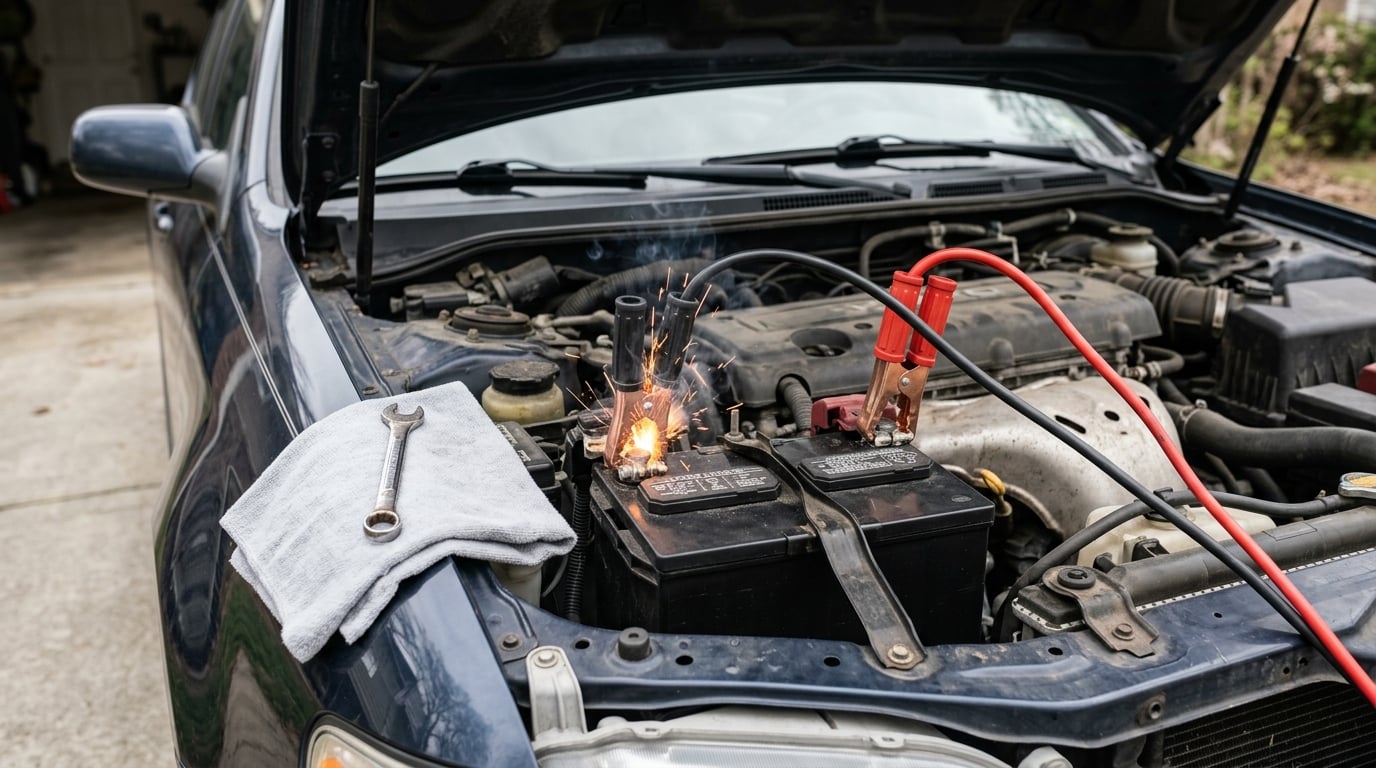
Connecting jumper cables backwards sends current into the wrong battery terminal and back through circuits that were never designed to carry it. The result is usually blown fuses rather than a dead car, but a reversal that lasts long enough can damage modules, wiring, or the charging system. It is also a genuine safety hazard, so the first instinct should be to stop touching the clamps.
Most people who reverse jumper cables are standing in a driveway at night with a set of borrowed cables and no idea whether they just made a cheap mistake or an expensive one. That uncertainty is the worst part. This guide walks through what actually happens electrically, the warning signs worth taking seriously, and the order to do things in while the car is still in front of you.
Two things are worth knowing before the rest of this. First, a good battery is rarely ruined by a reversed connection, and the cables themselves usually survive better than the battery does. Second, the length of time the cables sat reversed matters more than anything else, which is why the severity guide below is organized by duration rather than by car model.
Table of Contents
- What Happens If You Connect Jumper Cables Backwards?
- How Does a Jump Start Send the Wrong Current?
- What Warning Signs Mean the Connection Was Reversed?
- What Should You Do Immediately After Reversing the Cables?
- Is It Safe to Drive After a Reversed Jump Start?
- Can You Fix Damage From Reversed Jumper Cables Yourself?
- How to Prevent Connecting Jumper Cables Backwards
- Frequently Asked Questions
- Conclusion
What Happens If You Connect Jumper Cables Backwards?
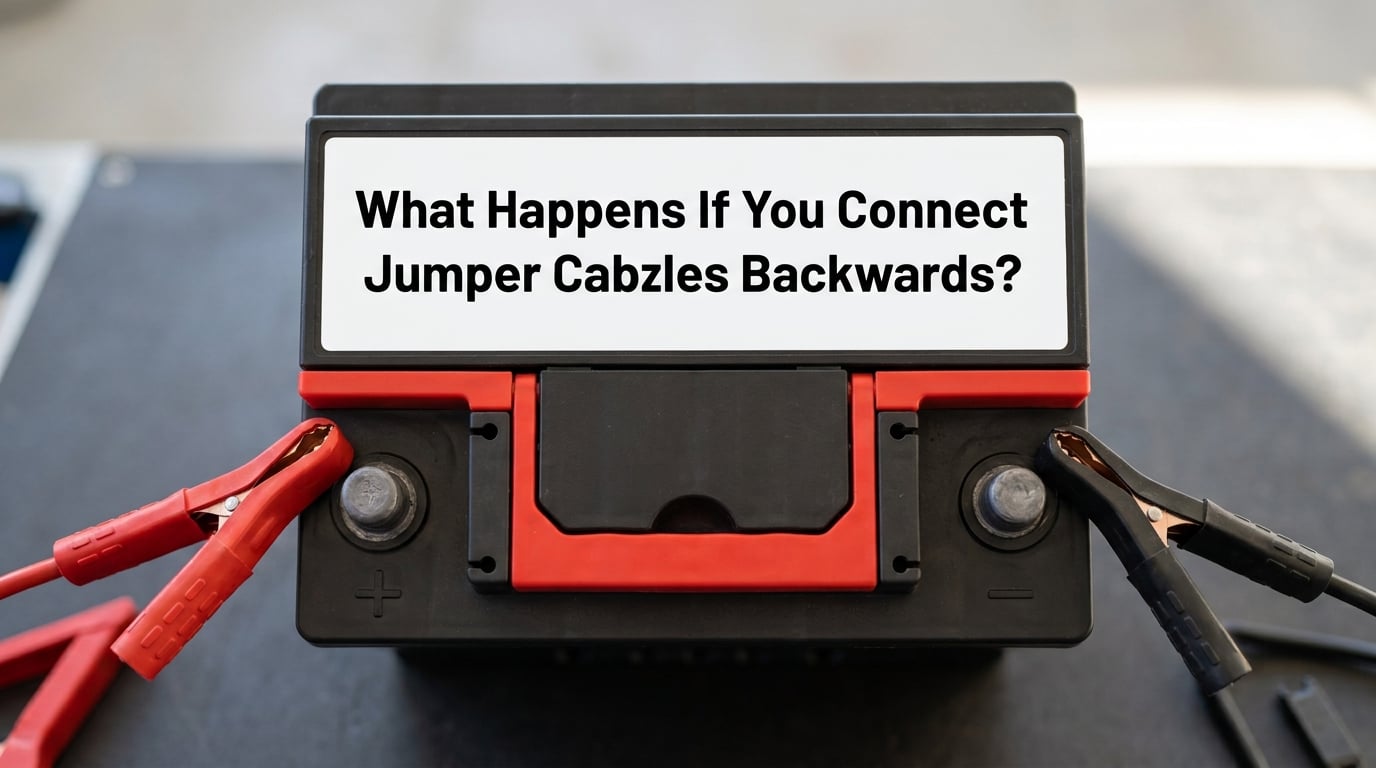
What happens if you connect jumper cables backwards is straightforward to describe: the donor battery pushes current the wrong way through the dead car’s electrical system. Small fuses and the main fusible link blow as designed, which protects the processors. In a short reversal, that is the whole story and the fix is a fuse replacement.
Damage goes deeper only when the reversal lasts long enough, or when the donor engine was running and pumping current the whole time. Then the protection on the wiring can be overwhelmed, and modules such as the body control module, instrument cluster, radio, or charging system can be destroyed. Melted wiring near the battery means the car should not be driven at all.
How Does a Jump Start Send the Wrong Current?
Think of a car battery as a pump that only pushes one way. The positive post is the outlet, the negative post is the inlet, and the whole car runs on that one-way flow. Put the red clamp on negative and the black clamp on positive and you are running the pump backwards through plumbing that was never pressure-rated for it.
Most of a vehicle’s wiring is not fed through the ignition switch. Circuits for the alarm, the clock, the keyless entry receiver, and the radio memory stay live the entire time the battery is connected, which is why they are called always-hot circuits. A reversed connection forces full battery current backwards into every one of those circuits at once.
Each module’s power input has a protection diode that normally blocks current flowing the wrong direction. Reversed polarity forward-biases those diodes, which effectively creates a short across the supply, so a handful of low-amperage fuses blow almost instantly. The design intent is deliberate: sacrifice a fuse and a cheap diode to save an expensive processor.
There is a second reason the last clamp goes to bare metal on the dead car rather than to its battery. Making the final connection to a chassis ground keeps the spark away from the battery post, where hydrogen gas collects. Many manufacturers now point at a dedicated ground point for exactly that reason.
Battery-side damage and vehicle-side damage are separate questions. The battery is a fairly robust chemical container, and the starter motor and solenoid do not care which way current arrives. The vulnerable parts are the electronics fed by the battery, and on a modern car that is a long list.
What Damage Can Reversed Jumper Cables Cause?
When you connect jumper cables backwards, the failures tend to arrive in a predictable order. The first thing to give up is always the cheapest and easiest to replace.
- Small fuses first, often several at once. The radio, interior lights, horn, and alarm circuits share fuse circuits and go dark together.
- The fusible link or mega fuse, the heavy-gauge wire between the battery and the rest of the car. This is the main current path and it is the last line of defense before the modules.
- The protection diode on a module’s power input, sacrificial by design and sometimes the only thing damaged.
- The module itself, once the diode is gone and current keeps flowing.
- Wiring and connectors, if the reversal continued. Melted insulation near the battery is the version that ends the discussion.
- The alternator diode pack, which is why a car can start and drive normally and then go dead again weeks later.
How long the cables sat reversed decides how far down that list you end up.
| How long it was reversed | Typical result | What you usually face |
|---|---|---|
| Under 2 seconds | A pop, a spark, maybe a couple of blown fuses | Fuse swap and drive it |
| 2 to 30 seconds | Several fuses gone, a module diode sacrificed, one system dead | Fuse swap plus a diagnostic pass |
| Over a minute, donor running | Module damage, burned wiring, possible charging system damage | Tow and a proper electrical diagnosis |
| Melted wiring or smoke | Short in a main harness | Do not drive, tow it |
An older carbureted truck with fuse-link wires and almost no electronics can come out of a reversal with nothing more than burned cable insulation and a new battery. The same mistake on a modern car with dozens of control modules is a very different bill, because the amount of electronics riding on those two cables is the variable that changed.
What Warning Signs Mean the Connection Was Reversed?
Some signs are immediate and unmistakable. A sharp pop or a shower of sparks at the clamp usually means you have current going where it does not belong, and the alarm going off at the moment of connection is a classic tell. A burning smell, smoke from under the hood, or a battery that is hot to the touch are the three that mean stop immediately and move away from the car.
Other signs show up after the fact. A dashboard full of warning lights with an engine that cranks but will not fire usually points at a blown mega fuse. One dead system, most often the radio or the interior lights, while the car still runs normally, is the mildest pattern and the easiest to fix. A car that starts fine and then goes flat over several weeks points at the alternator diode pack rather than anything you saw on the day.
A flashing security light after a jump is usually an immobilizer relearn, not destroyed hardware. That one sends people to panic-buy a module that was never damaged.
What Should You Do Immediately After Reversing the Cables?
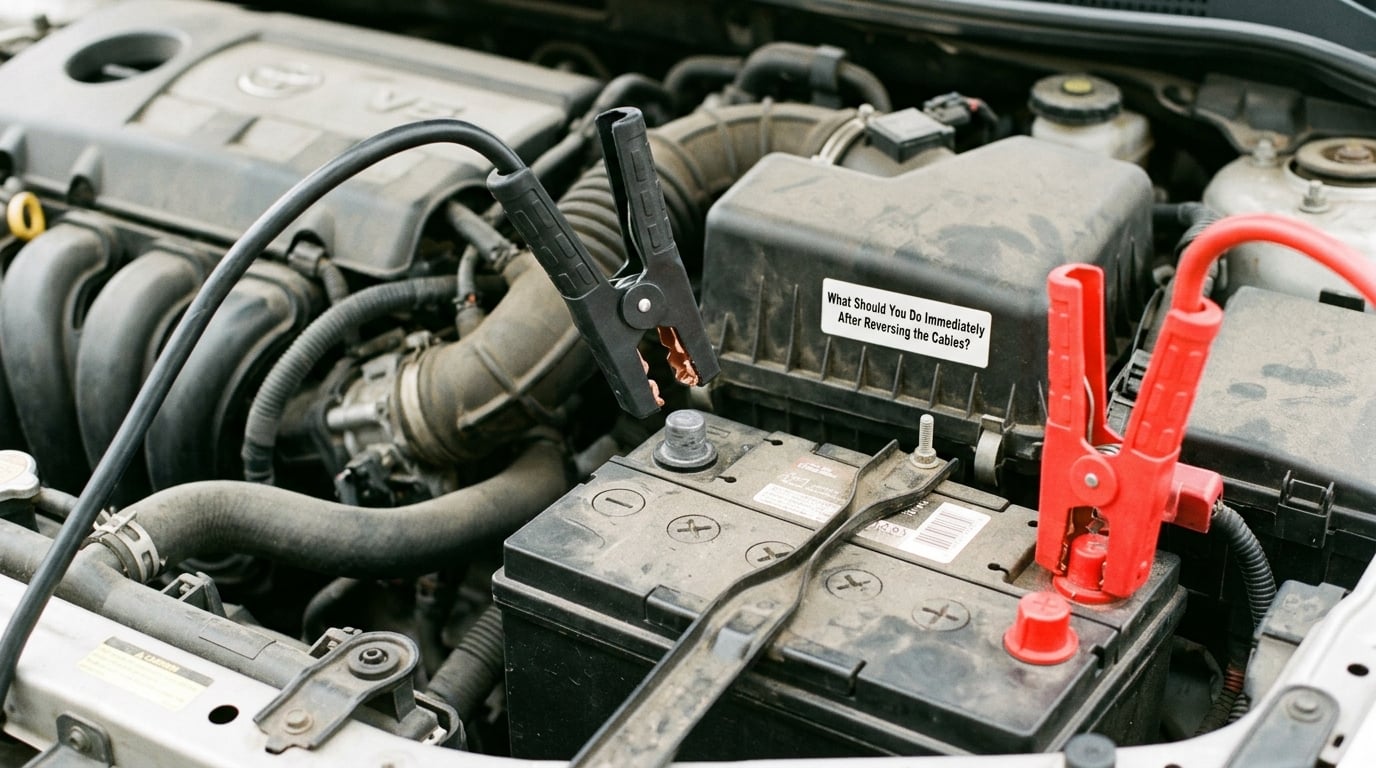
Do these in order, and only once the area is quiet and no smoke is coming from under the hood.
- Do not crank the engine. A starter pulls serious current, and cranking with a reversed connection multiplies the fault.
- Do not keep re-clamping to see what happens. Each attempt repeats the same overvoltage event.
- Disconnect the negative cable first, then the positive cable. Order matters here because it breaks the circuit before you lift the other side.
- Step back from the battery and the wiring near it. Look for smoke, melted insulation, or a swollen battery case.
- Note the time you made the connection if you can. Duration is the first question any technician will ask, and it determines the diagnosis.
- Only once everything is cool and dry, and if you intend to try again, connect in the correct order below.
The right sequence, for reference, is positive to the dead car’s positive post, positive to the donor’s positive post, negative to the donor’s negative post, then negative to a bare metal ground point on the dead car. Remove them in the reverse order, negative first. If you are unsure which post is positive, look for the plus sign or P, and on a BMW the positive terminal sits on the left side of the engine bay with a cover over it.
If the car is hissing, the battery is bulging, or the wiring near the battery is visibly burned, stop and call for help rather than handling it yourself.
Is It Safe to Drive After a Reversed Jump Start?
It depends entirely on what the car is doing and what you can see. A vehicle that starts cleanly, shows no warning lights, has no smell of burning, and holds a normal charge is usually fine to drive home, and swapping the blown fuses yourself is a reasonable next step.
Do not drive it if there is smoke, a burning odor, any electrical system that keeps failing after a new fuse, visible melted wiring, fluid under the car, or a battery that is hot or swollen. Those are not symptoms to test on the road.
When you are not sure, the cost of a tow is far below the cost of a burned harness. Roadside assistance can also document what they saw, which matters if the reversal was not your mistake.
Can You Fix Damage From Reversed Jumper Cables Yourself?
Some of it is genuinely in reach for an experienced owner. Checking every fuse in the interior panel and under the hood, looking at the fusible link, and testing battery condition with a load tester are all reasonable. Replacing a blown fuse and seeing the dead radio come back to life is the version of this story that people end up telling as a near miss.
Anything past that belongs in a workshop. Tracing a short through a harness, diagnosing a module, or testing alternator output needs the right equipment, and guessing tends to cost more than the diagnosis would have. A dead radio is sometimes just its memory circuit, which lives on a shared circuit with interior or brake lights, so the radio alone is not a reliable measure of damage.
One point worth repeating: a car charging fine is not proof the alternator survived. A single shorted diode in a 140-amp alternator can still push roughly 45 amps, which keeps a battery alive for a while and then lets it die weeks later. A proper check is a full-load output test, not a voltage reading at idle.
If a tow operator or roadside assistant made the reversal, get the cause and the work written into the repair order in words. Shops and insurers push back toward pre-existing conditions otherwise, and a documented cause is what keeps that conversation from going badly.
How to Prevent Connecting Jumper Cables Backwards
Identify the positive terminal before anything else, every time. Look for the plus sign or the letter P, and remember that on many cars it is the post with a plastic cover, often on the opposite side from the negative clamp. A cheap terminal cover or a clamp in a different color removes the guesswork entirely.
Read the battery owner’s manual if you have it. It tells you the correct order, and it will also tell you where the manufacturer wants that final ground connection to land.
Do not improvise with cables that are cracked, frayed, or whose clamps do not close cleanly. Loose or corroded clamps are how the connection slips off mid-attachment, which creates a different and equally expensive fault known as a load dump.
Consider a booster pack with reverse-polarity lockout. These units will not deliver current until they see a correct connection, and many also monitor for a clamp slipping off. For a driver who jump starts regularly, that removes the mistake rather than managing its consequences.
Avoid 24-volt truck or RV batteries as donor sources for a car. The system voltage is wrong by a factor of two, and the damage is not always confined to a replaceable fuse.
Frequently Asked Questions
Will a car start if the battery cables are reversed?
Usually not, and that is the better outcome. With reversed polarity, the small fuses and often the main fusible link blow immediately, so the car has little or no power when you turn the key. The exception is a very brief reversal on an older vehicle where nothing critical was on the reversed circuit, in which case the engine may crank normally. Either way, do not keep cranking or re-clamping to find out.
Can you ruin a car battery by jumping it wrong?
Rarely, and this surprises most people. A healthy 12-volt battery is a tough chemical container, and the cables typically overheat before the battery is harmed. The battery is at real risk only if the reversed connection lasts long enough to cook it, or if it was already weak, old, or damaged. Test it before buying a replacement rather than assuming the worst.
What fuse blows when you jump a car backwards?
Whichever fuses sit on the always-hot circuits, and that is usually several at once. The radio, interior lights, horn, and alarm circuits are live at all times, so they take the current first. If the reversal lasted a moment longer, the heavier fusible link or mega fuse between the battery and the main harness blows next, which is what cuts power to the whole car.
Is there a correct order to attach jumper cables?
Yes, and the order is positive to the dead car’s positive post, positive to the donor’s positive post, negative to the donor’s negative post, then negative to a bare metal ground point on the dead car. That last step is deliberate: connecting to chassis metal keeps the spark away from the battery post, where hydrogen gas collects. Remove them in reverse order, starting with the negative.
Can a jump start fry the car computer?
It can, though the protection is designed to prevent it. Each module’s power input has a protection diode that sacrifices itself and blows a fuse, saving the processor. Deep damage happens when the reversal lasts long enough to burn through that protection. On an older vehicle with few modules, the same mistake usually costs a set of fuses and nothing more.
Why did my car start but the warning lights all came on?
That pattern usually means the main power path is intact but one or more always-hot circuits are disrupted. Blown fuses for individual accessories cause a partial light-up, while a blown mega fuse usually leaves the engine cranking but not firing. A flashing security light on top of that is usually an immobilizer relearn, which a dealer or locksmith can reset rather than a destroyed module.
Conclusion
If you connect jumper cables backwards, treat it as a possible electrical incident rather than a dead battery. Disconnect the negative cable first, then the positive one, keep away from anything smoking, and do not crank the engine or try the jump again.
Before driving anywhere, rule out the warning signs listed above. If the car starts clean with no lights, smell, or damaged wiring, a fuse check is a reasonable next step. If anything is hot, melted, or intermittently failing, call roadside assistance and let a qualified technician run the diagnosis. Note the time the cables were attached, because that single detail tells you more about the damage than anything else you can describe from memory.