
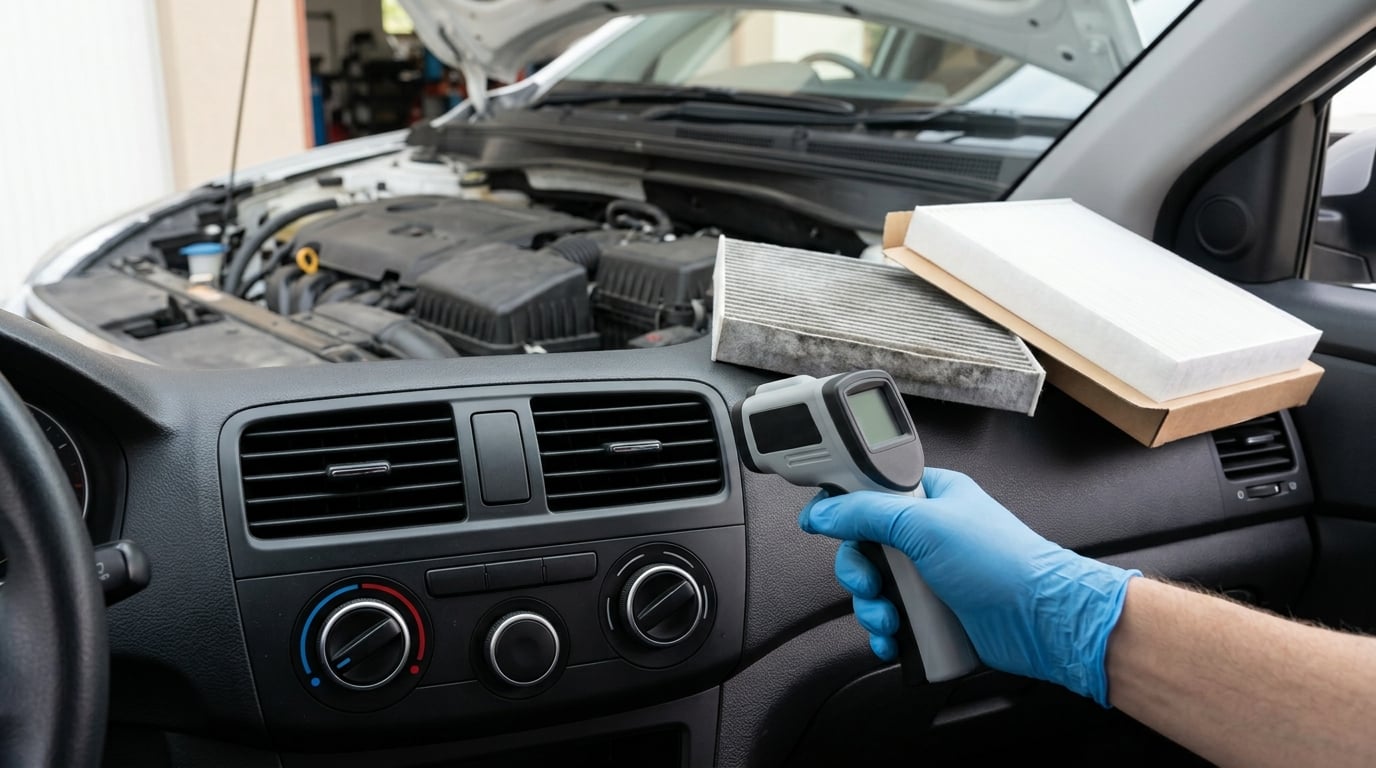
Most cases of a car AC that blows warm air come down to three things: the system is low on refrigerant, which almost always means a leak; the air is moving but the blend door is stuck sending heat instead of cold; or the compressor clutch is not engaging, so refrigerant never gets pumped. The full check takes about fifteen minutes with a thermometer, and most owners can do the early steps themselves.
Here is the order I would work through it. Diagnose before you buy anything, because refrigerant cans, new blend doors and rebuilt compressors are the three things owners most often purchase for a fault that lives somewhere else entirely.
What You Need
Start with the owner’s manual for your specific year and model. It tells you where the cabin air filter lives, whether the car uses a belt-driven clutch or an electric compressor, and which fuse or relay feeds the system. Manufacturer procedures differ enough that skipping this step causes most of the wasted effort.
Beyond the manual, a small infrared thermometer or a cheap probe thermometer for measuring vent temperature is the single most useful tool. An OBD-II scan tool that reads body control modules gets you the stored P-codes that tell you whether a pressure switch, an actuator, or a temperature sensor is complaining. A flashlight, a socket set and a hand vacuum or blower for debris all help. A refrigerant gauge set and a vacuum pump are shop tools, not garage tools, and there is a good reason for that.
Two things to stay away from: do not open a refrigerant line or vent refrigerant yourself, because the systems run at high pressure and venting is regulated in most places, and do not probe or unplug electrical connectors inside the dashboard beyond what the manual describes. On hybrids and EVs the air conditioning is often powered by a high-voltage electric compressor, and that circuit is not something to experiment on.
Step-by-Step
1. Confirm the AC Is Producing Warm Air
Cabin temperature lies early on. After ten minutes in a parked car on a mild day the interior may be warmer than the air coming out of the vents, so the AC can feel broken when it is actually working.
Get the system running with the doors and windows closed, engine at operating temperature, and give it ten to fifteen minutes. Then put the thermometer in the center vent and read it, then do the same at an outlet vent on the passenger side. Record both numbers. In hot weather a healthy system typically pushes somewhere between 50 and 70 F at the center vent; in mild weather, 35 to 40 F is a reasonable target. If you are seeing 70 F or higher while the compressor is running, the cooling side of the system is not working.
Decide which problem you actually have, because the fix list is completely different for each. Air that is weak but genuinely cold points to airflow. Air that is strong but room temperature or hot points to the cooling circuit or the blend door. Owners on r/MechanicAdvice and r/AskMechanics repeat the same advice over and over: describe the symptom properly, including whether the air is weak or just warm, before buying a part.
2. Check the Temperature and Fan Settings
Put the HVAC panel into AC mode, set both temperature zones to maximum cold, and pick a mid-to-high fan speed. Recirculate pulls air from inside the cabin so the system can cool it faster; fresh air brings in outside heat, which is why the same car can feel different on a humid day. Either mode will eventually cool, but recirculate is the right choice when you are trying to bring the cabin temperature down quickly.
Look at what the display tells you. Many cars show an A/C indicator, a temperature readout from a cabin sensor, and in some models an evaporator temperature or a high-side pressure reading. A flashing A/C light or an A/C that will not stay on when you press the button is a fault code, not a settings problem.
Now do the two-minute reset, which is the most-repeated free fix in the r/autorepair threads and costs nothing. With the AC switched completely off, turn the ignition off, disconnect the negative battery terminal, wait 15 to 30 minutes, reconnect it, then start the engine and let it idle for about 30 minutes with the AC off. After that, start a normal drive with the AC on max. This clears a latched compressor or pressure-switch fault after recent battery work, a jump start, or a long layover. It fixes genuine electrical latch-ups and does nothing for a leak, so treat it as a free test rather than a cure.
3. Inspect Vents, Airflow, and Passenger-Side Performance
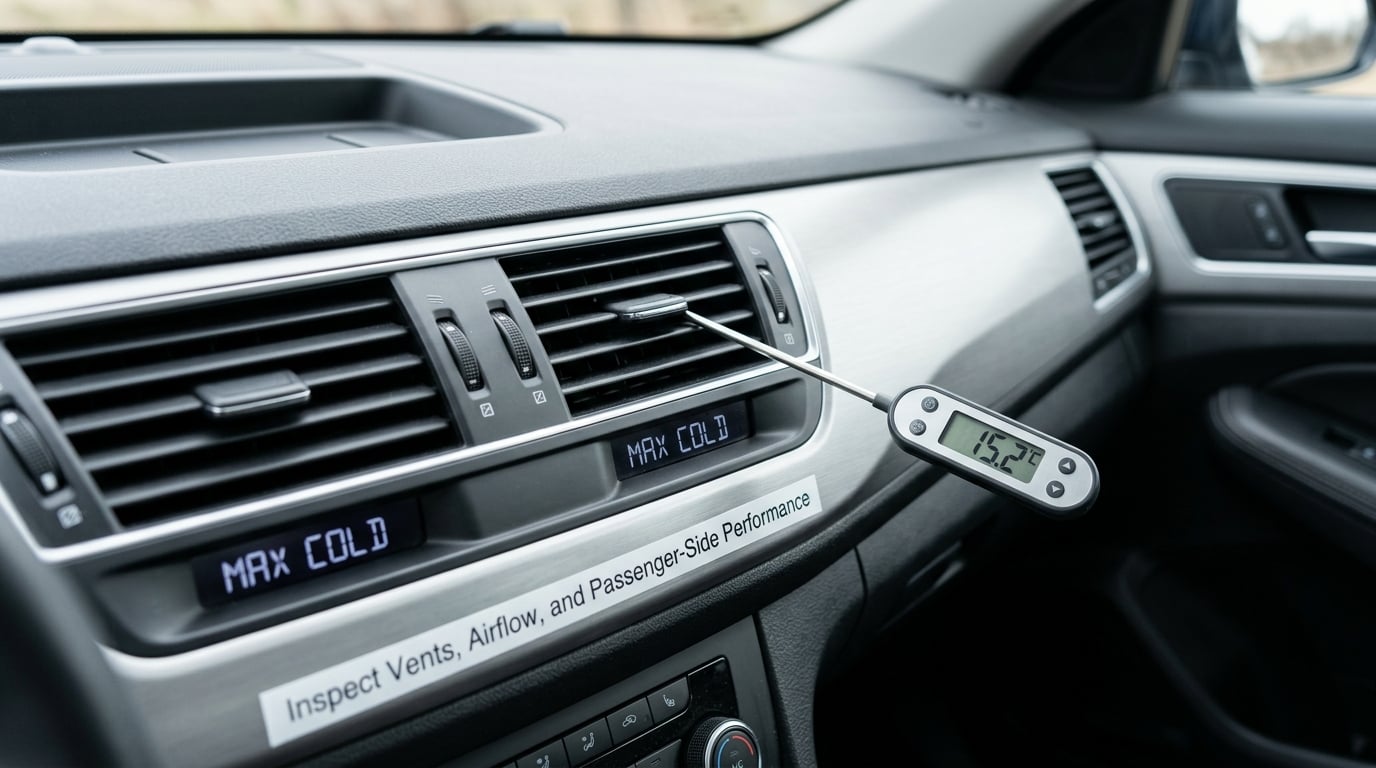
Walk around the car and check every outlet. Compare the center vents, the side vents, and the rear outlets one after another. All of them should be delivering air of similar temperature, and if the strong ones are cold while one outlet is warm, you have a blend door or duct problem rather than a refrigerant problem.
Weak airflow is its own fault. Check that nothing is blocking the vents, that the doors and windows are shut, and that the cabin air filter is not packed with dust and leaves. Most manufacturers specify a filter change somewhere between 10,000 and 15,000 miles, and a filter that has gone past that in a dusty climate can drop airflow enough that the evaporator ices over. A musty smell when the AC starts is the same filter telling you it needs attention. The blower resistor, on cars that still use one, usually shows up as a fan that only works on the lowest or highest speed.
Weak air and warm air get confused constantly, and the two have almost nothing in common. Weak air with a cold temperature reading is a filter, a blower, or a resistor issue. Strong air with a warm reading is a cooling circuit or blend door issue.
4. Check for a Stuck Blend Door or Actuator
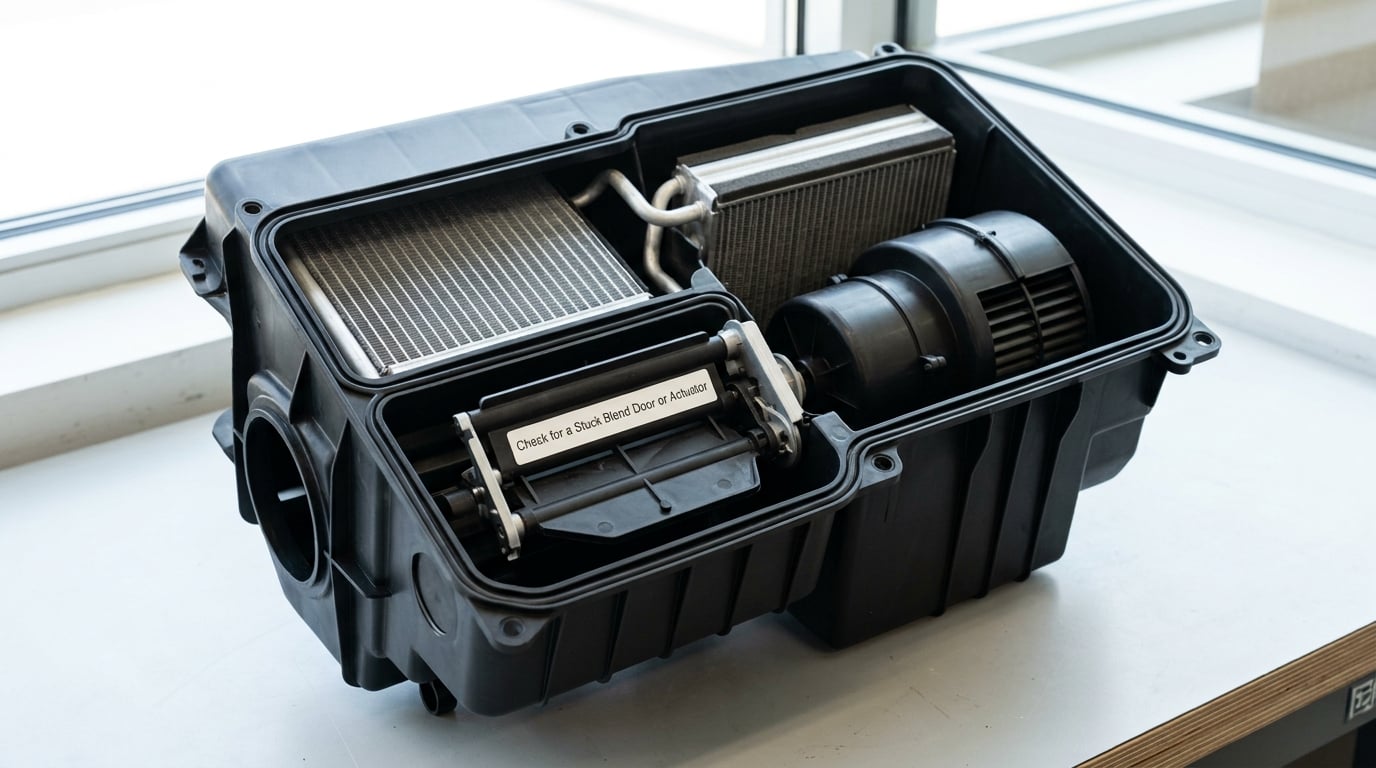
The blend door is a damper inside the HVAC case that mixes heated air from the heater core with cold air from the evaporator to hit the temperature you asked for. It is driven by a small electric actuator, and when that actuator fails in the middle of its travel, the air goes out lukewarm no matter where you set the dial.
The signature is uneven temperature. In a single-zone car you may notice the driver side is cool while the passenger side is warm, or the air swings between cool and warm on its own as the door sticks against something. In a dual-zone car, one side staying stubbornly warm while the other side gets cold almost always means a blend door actuator or a stuck door rather than a refrigerant problem, because the evaporator is shared and it cannot be cold on one side and starved on the other.
On some vehicles the HVAC case is reachable from the passenger footwell or under the glovebox without pulling the dashboard apart, and you can watch the actuator arm move when you change the temperature setting on the panel. That is a quick visual test. A scan tool will also show actuator codes on most modern cars. What you should not do is reach blindly into the dashboard: the door is on a plastic linkage with a sharp edge, the electrical connector is right there, and you will not see what is pinning it.
5. Check Refrigerant Leaks, Compressor Operation, and Related Faults
Refrigerant is not a consumable. The system is sealed, so if it is low there is a leak, and topping it up without finding that leak just buys you a few weeks. Signs of a leak include an oily residue around the compressor or the fittings, an oily patch on the pavement under a parked car, or a system that cools fine for a while and then goes warm again.
Watch the compressor while the engine runs with the AC on max. On a belt-driven car you should see the pulley at the front of the compressor engage with an audible clunk and a shudder. If the fan is spinning and the pulley is not engaging, the causes run from a low-pressure cutoff switch doing its job because the system is empty, to a blown A/C fuse, a failed clutch relay, a faulty pressure switch, or a compressor that has failed electrically. Owners on r/accord and r/350z report the same sequence constantly: compressor replaced, system charged, and the warm air comes back within weeks because the real fault was a pressure switch, a stuck expansion valve, or a clogged condenser.
Read the codes before you go further. A scan tool will surface P-codes for the A/C pressure sensor, the evaporator temperature sensor, the blend door actuator, and the compressor circuit, and those codes often identify the failed part faster than any amount of guessing. Behind the compressor, the condenser and its fan matter just as much: packed with leaves and road debris, the condenser cannot shed heat, the high side pressure climbs, and the system shuts itself down for safety. That is a ten-minute fix once you know to look, and it is one of the most common causes of a system that blows cold for a few minutes and then gives up.
Testing pressures properly means a gauge set, a vacuum pump, and recovery equipment, and that is shop work. Refrigerant recovery, leak location, recharge, and any work on a high-voltage hybrid or EV system belong to a qualified technician.
Common Mistakes
The most expensive mistake is treating refrigerant as a maintenance item. A can of R-134a from an auto parts store will get you cool air for a while, and if the system has a leak you will be back at the same shop in three weeks paying for a second recharge. It also does not fix the case where the system is full but has air or moisture in it, which is the classic reason an AC goes cold for five minutes, ices the evaporator over, and then blows warm air for the rest of the drive. A proper recharge pulls a vacuum on the system first, and without that vacuum the job is not finished.
Next mistake: setting the temperature dial to cold and assuming the system knows it. On a lot of cars the HVAC panel will happily sit in heat mode with the A/C button off, and one press of the panel changes what happens. Mode and zone both matter on dual-zone cars, and a passenger who has left their side at heat will happily hand you an air conditioning complaint that is really a seat-setting problem.
Third, calling weak airflow a refrigerant fault. If the air is weak, fix the airflow. Filter, blower, resistor. Adding refrigerant to a system that cannot move air does nothing except cost you money and, if the charge is wrong, can damage the compressor.
Fourth, ignoring stored codes. A scan tool takes about a minute and turns guessing into diagnosis. Any code related to the pressure sensor, the evaporator temperature sensor, or the blend door actuator is a direct pointer to a part and a test.
Fifth, replacing the blend door assembly without ever testing the actuator or the linkage. On plenty of vehicles the door is fine and the actuator is the cheap part that failed. Check the codes and, if it is accessible, watch the arm move before ordering anything.
A few habits keep an AC working: change the cabin air filter on the manufacturer’s interval, keep the condenser face clear of debris every few thousand miles or after heavy leaf fall, run the AC briefly once a month through the winter so the compressor and seals stay used, and keep the system charged year-round rather than letting it sit empty. Any time you see a cold-then-warm pattern, a new oily spot under the car, or a vent that stays warm while the rest cool down, get it looked at before the heat of the month makes the drive miserable.
If you do only one thing tonight, set both zones to maximum cold, switch to recirculate, run the system for fifteen minutes, and compare the center vent against the passenger-side vent with a thermometer. That ten-minute test separates an airflow problem from a cooling circuit problem, and it tells you whether the next stop is a filter in your hand or a gauge set in a shop.
Frequently Asked Questions
Why does my car AC blow warm air only sometimes?
Intermittent warm air usually points to something that cycles on and off, not a fully failed system. The common culprits are an evaporator that ices over and then thaws, a low-pressure cutoff switch switching the compressor off as pressures drop, a clogged condenser that cannot shed heat once the engine heats up, or a blend door actuator that sticks partway through its travel. A system that is cold at idle and warm at highway speed points at airflow across the condenser rather than a charge problem. Reading stored codes is the fastest way to separate these.
Can I just add more refrigerant to make the AC cold again?
Only if a technician has confirmed the system is low and there is no leak, and even then it should be done with a gauge set and a vacuum. The system is sealed, so low refrigerant means something is leaking. Topping it off buys a few weeks and then the same trip again, and an overcharge can damage the compressor. Drivers also need the right refrigerant: R-134a and R-1234yf are not interchangeable, and using the wrong one is an expensive mistake.
Why is one car AC vent cold when another vent is warm?
If one vent is genuinely cold and another is warm, the cooling circuit is probably working and the air is being mixed incorrectly. The blend door or its actuator has stuck partway, sending too much heat from the heater core past the evaporator. In a dual-zone car, one side staying warm while the other cools is almost always a blend door issue rather than a refrigerant problem, because the evaporator is shared by both sides. A scan tool will usually store an actuator code for it.
Can I test the AC compressor at home?
You can check whether it is engaging. With the engine at operating temperature, the AC on max cold and the fan on high, stand at the front of the car and look at the compressor pulley while an assistant revs gently. A clunk and a visible shudder means the clutch is pulling in. If the pulley never engages, the cause is electrical, a pressure switch, a fuse, a relay, or a failed compressor, and diagnosing which one takes a multimeter and a scan tool.
When should I take my car to an AC technician?
Stop at the shop the moment the diagnosis reaches refrigerant, pressure, or anything electrical. Recovering refrigerant, locating a leak, pulling a vacuum, and recharging the system are all regulated and require proper equipment, and an overcharge or moisture in the system can destroy a new compressor. The same applies to blend door repairs on cars where the dashboard has to come apart, and to any hybrid or EV with a high-voltage electric compressor. Filter, debris, and reset steps are safe at home.
Conclusion
Start with the settings, the airflow, and the vent temperature comparison, then read the stored codes before you buy a single can of refrigerant or a single part. If the readings point at a charge problem, a leak, a compressor that will not engage, or a stuck actuator, hand it to a technician who has the gauges, the recovery machine, and the wiring knowledge to sort it out in one visit instead of three.