
The best way to store a car battery over winter is to bring it to a full charge, keep it near full the whole time, and keep the electrolyte from freezing. In practice that means either a smart battery maintainer on the battery in the car, or a disconnected battery in a cool, dry place above freezing.
Charge to 100% before it goes into storage. That single step does more than anything else, because the freezing point of the electrolyte drops dramatically as the battery fills with charge.
Cold does not kill a healthy battery outright. It cuts available capacity and slows the rate at which a charger can put charge back, so a battery that is already partly drained can slip below freezing and suffer permanent damage to its plates or case. Get those numbers straight and the rest of the job is straightforward.
Last reviewed and updated for October 2026.
Table of Contents
- What You Need
- Step-by-Step: How to Store a Car Battery Over Winter
- Common Mistakes
- Storing a discharged battery
- Leaving the battery connected and unattended
- Using a charger that does not match the chemistry
- Storing it somewhere damp or unheated when the battery is part-charged
- Ignoring a swollen or leaking battery
- Charging a frozen battery
- Reconnecting and assuming everything is fine
- Leaving jumper cables or a charger clamped to a terminal indefinitely
- Frequently Asked Questions
- Can I store a car battery in my garage during winter?
- Should I disconnect a car battery before storing it for winter?
- Do I need a battery maintainer if my car battery is fully charged?
- How long can a car battery sit in storage before it dies?
- What cold temperature kills a car battery?
- What happens if a car battery freezes?
- Conclusion
What You Need
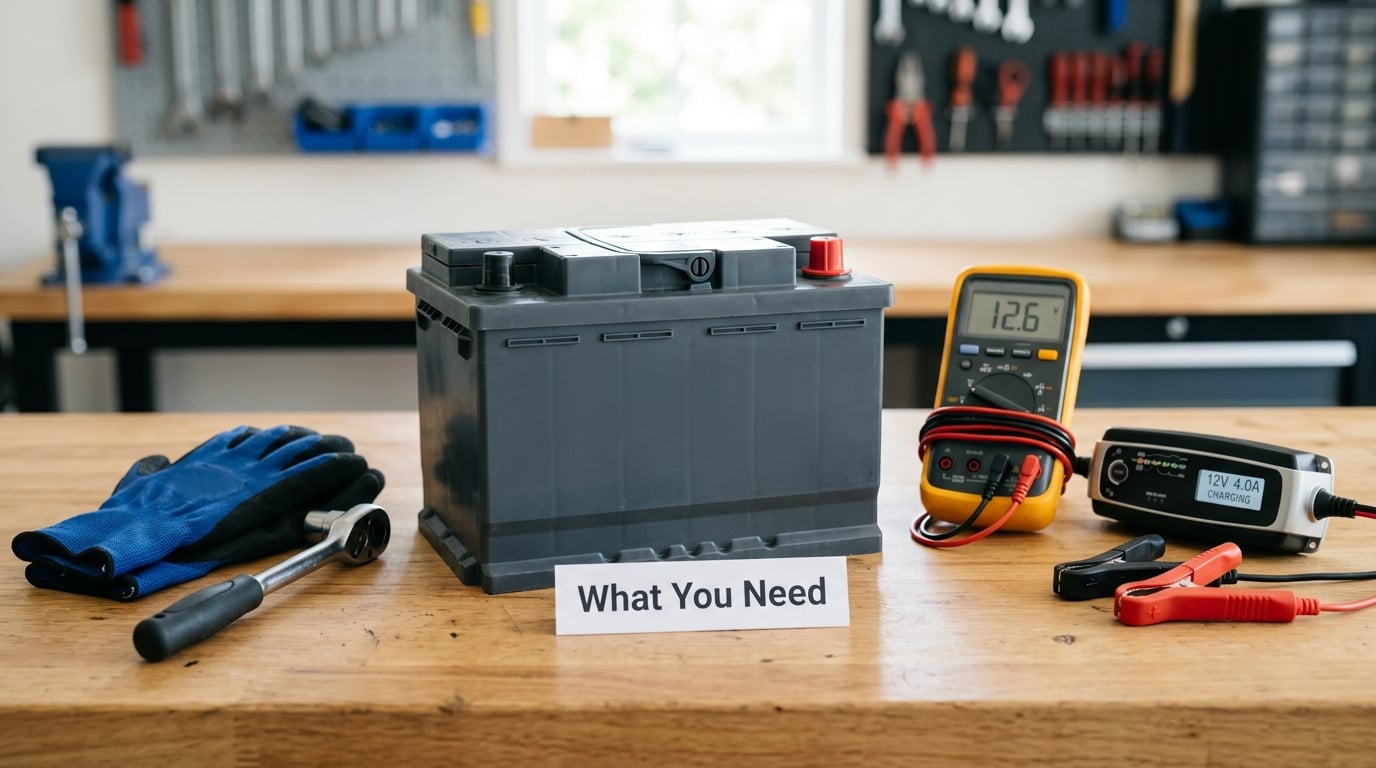
You do not need a workshop to do this. Most of the gear is things you already own, and the two items worth buying are a multimeter and a chemistry-matched battery maintainer.
- A 10mm terminal wrench (or the size your battery uses) to loosen the terminal clamps. Some cars use a 12mm or 13mm nut, so check before you start.
- Safety glasses and acid-resistant gloves. Lead-acid batteries vent hydrogen gas and the electrolyte is sulphuric acid.
- A wire brush or terminal cleaning tool, plus a baking soda and water mix in a spray bottle if there is visible corrosion.
- A terminal protector such as dielectric grease or a battery protectant spray, and small plastic terminal boot covers or rags to insulate after disconnecting.
- A digital multimeter or a battery tester so you are reading the state of charge instead of guessing from how the car cranked.
- A smart battery maintainer (battery tender) that matches your battery chemistry. A flooded lead-acid charger can overcharge an AGM battery and shorten its life.
- A clean, dry storage spot with ventilation, away from ignition sources and anything flammable.
One piece of safety gear people skip: a bucket or a sheet of cardboard to put under the battery. A flooded battery that has been overfilled or tipped will weep acid, and acid on a concrete garage floor etches the slab permanently.
Step-by-Step: How to Store a Car Battery Over Winter
1. Identify the Battery Type and Location
Most cars use one of three things: a flooded lead-acid battery with removable vent caps, a sealed AGM battery, or less often a gel cell. Some newer vehicles use a lithium-ion auxiliary battery, and those have their own rules. A lithium-ion battery should not be stored at or below freezing, so check the label on the case before anything else.
Look for the date code sticker on the top or side of the case; if it is hard to read, ask the parts counter to date it for you. A battery that is already three to four years old is unlikely to see many more winters, and that changes how much effort the rest of this is worth.
The battery is usually under a plastic cover in the engine bay, in the trunk, or behind a seat panel. On some BMWs and Audis it sits in the boot, which changes nothing about the procedure but everything about where you will be kneeling in January.
2. Measure the Battery’s Charge
Test the resting voltage before you do anything else. A battery that has been sitting needs a few hours, ideally overnight, before the reading means anything. Set your multimeter to DC volts, touch the probes to the positive and negative terminals, and compare against the table below.
| Resting voltage | State of charge | Specific gravity | Electrolyte freezing point |
|---|---|---|---|
| 12.65V or higher | Fully charged | 1.265 | About -75F |
| 12.45V | About 90% | 1.240 | About -40F |
| 12.20V | About 75% | 1.200 | About 0F |
| 12.00V | About 50% | 1.160 | About 20F |
| 11.89V or lower | Discharged | 1.120 | About 30F |
Read the top row before you read the bottom row. A fully charged battery can sit well below zero, while a discharged one starts to freeze around the freezing point of water. That spread is the whole reason the charge step is not optional.
If you are under 12.40V, roughly a 75% state of charge, put it on a charger before it goes anywhere near storage. Sulfation builds on lead plates as a battery sits partially charged, and a battery stored that way may still feel fine in March and fail the first cold snap after.
3. Disconnect the Battery Safely
Work on a switched-off vehicle with the key out of range, the doors closed, and the alarm disarmed if you can manage it. A door or hatch left ajar will wake the body control module and drain the battery through the interior lamp circuit while you work.
Remove the negative terminal first, then the positive. This is not optional: the negative is connected to the car body, and taking it off first breaks the circuit so a wrench bridging positive to the frame does not weld itself to the car. Take a photo of the terminal layout before you touch anything, and if the car has a battery monitor sensor on the negative cable, unplug that connector before the clamp comes off.
After both cables are off, slide terminal boot covers over the remaining posts, or wrap each one in a clean plastic bag and secure it with a tie so nothing can arc. Do not throw loose nuts into the bay either; they find wiring.
If you are only removing the negative and leaving the car otherwise intact, write down your radio presets and window auto-up/down settings first. You will probably need them again.
4. Clean and Protect the Terminals
Corrosion is usually white or bluish powder around the clamp. It is not what kills a stored battery, but a dirty terminal stops the charger from doing its job efficiently and it is the first thing you will notice when you reconnect.
Neutralise it with a mix of baking soda and water applied to a toothbrush or stiff brush, then wipe it back with a damp cloth. Keep the solution out of the vent caps on a flooded battery. Dry everything completely before applying protector.
Coat the posts, the clamps and the bare cable ends with terminal protector or a thin layer of dielectric grease. This blocks the moisture and acid mist that will otherwise creep under the clamp and eat the cable. It is five minutes of work that keeps the connection solid when you come back to it.
5. Charge or Maintain the Battery
There are three storage approaches, and which one is right depends on your garage, your outlet access and how long the car sits. Owners argue about this constantly; the answer is that it is situational.
| Method | Best for | Watch out for |
|---|---|---|
| Smart maintainer in the car | Cars with a nearby outlet, especially modern cars with adaptive electronics | Parasitic drain, a non-smart charger cooking the battery, no outlet at all |
| Disconnect and remove the battery | Unheated garages, long absences, no outlet, vehicles with a lithium-ion pack | Loss of presets and memory, more handling, battery must go somewhere above freezing |
| Drive the car periodically | Cars stored at home with the vehicle accessible | Short trips rarely charge a battery fully, and you have to remember to do it |
On the Ford F150 forum the majority view is that a quality maintainer beats disconnecting, because it keeps the vehicle’s memory intact. AudiWorld owners point out the other side: any decent tender shuts itself off, while disconnecting costs you the adaptive tuning. My take is that the tender wins whenever you have an outlet in a dry location, and the disconnect wins when you do not.
It is fine to leave a smart maintainer connected for the whole winter. A non-smart trickle charger is a different story: a cheap one with no float stage will boil electrolyte out of a flooded battery over months, and several owners in enthusiast forums have cooked batteries that way. Look for a charger that states flooded, AGM and gel compatibility and drops to a float or standby current once the battery is full.
A basic smart maintainer tops the battery up as it self-discharges, roughly 3% to 6% a month for a healthy battery, so it never actually does much. A fuller charger is worthwhile for a battery that has been sitting at partial charge, because it will do a proper absorption cycle and a conditional equalizing charge on flooded batteries. Do not equalize a sealed AGM battery unless the charger specifically says it is safe for the chemistry.
6. Choose the Right Storage Environment
A fully charged battery can be stored well below freezing, so an unheated garage is fine in most climates. What you are really avoiding is heat, moisture and sparks. Radiators, space heaters, water heaters and a welding bench are all worse enemies than a cold January.
Store the battery upright on a wooden board or a plastic mat. The myth that concrete kills batteries applied to old rubber-cased designs; modern polypropylene cases do not care, and the risk now is spilled acid etching your floor rather than the floor draining the battery.
Keep it away from direct sunlight, damp, rodent-prone spaces and anything that produces a spark. If the battery stays in the car, put a breathable car cover on before the first snow. Owners in r/alaska report the rest of the car handles deep snow fine once covered; it is simply a good idea when you are not driving a vehicle for months.
If you are removing the battery, a conditioned room is the simplest answer, and a basement is fine as long as it does not get cold enough to freeze electrolyte in a partially discharged battery. Do not store it in a living space for months; lead-acid batteries off-gas hydrogen and it needs ventilation.
7. Check the Battery During Storage
Set a recurring reminder, because a battery that is never checked is how people discover in March that it has been dead since December. Resting voltage reads lower than the real charge, so a battery measuring 12.40V after a rest is closer to three-quarters charged than it looks. If the number is marginal, put it on the charger for a few hours and re-test rather than guessing.
A healthy AGM or gel battery loses about 1% to 2% of its charge a month at normal room temperature, and flooded cells lose at least twice that. Cold slows self-discharge, so a battery in an unheated garage in January holds more charge than one sitting in a warm shed. Checking every two to three months suits AGM and gel; check flooded batteries every two to four weeks.
At each check, look at the case for bulging, cracks or a weeping stain, and look at the terminals for fresh corrosion. A swollen or leaking flooded battery is finished, not fixable. If the voltage is low, put it on the charger to full and re-test after it rests.
Common Mistakes
Storing a discharged battery
This is the big one, and it is the mistake that actually destroys batteries. A battery stored at partial charge can freeze, and it will sulfate while it waits. Charge to full first, every time.
Leaving the battery connected and unattended
Alarm systems, key-fob receivers, aftermarket stereos and GPS trackers keep drawing current while the car sits. Owners report a flat battery in three to six weeks this way. If you are not using a maintainer, disconnect it.
Using a charger that does not match the chemistry
A flooded-lead-acid charger running on an AGM battery overcharges it. Match the charger to the battery, and never leave a non-smart charger unattended for months.
Storing it somewhere damp or unheated when the battery is part-charged
Damp and corrosion are permanent damage. If the space is wet, move the battery. If it is below freezing and the battery is not at a full charge, bring it in.
Ignoring a swollen or leaking battery
Bulging cases and acid weeping mean the battery is finished. Get it out of the storage area and dispose of it through a proper battery recycling point, and neutralise the spill with baking soda before it etches whatever is under it.
Charging a frozen battery
Do not put current into a battery that is below freezing. Let it reach room temperature slowly, then charge it and test it. A frozen flooded battery is usually not recoverable, and a frozen lithium-ion cell is a fire hazard, not a charger project.
Reconnecting and assuming everything is fine
Reconnect the positive first, then the negative, and let the vehicle idle while you set the clock, radio presets and window auto-up and auto-down. The throttle and suspension adaptation on many modern cars relearns while you drive the first 20 to 30 miles.
Leaving jumper cables or a charger clamped to a terminal indefinitely
Clamps corrode terminals and cables together, and a permanently connected charger lead is a stray path for a short. Clip the maintainer on, confirm it, and check the connection at the first follow-up visit.
Frequently Asked Questions
Can I store a car battery in my garage during winter?
Yes, as long as the battery is fully charged. A charged lead-acid battery can be stored well below freezing without damage, and cold actually slows self-discharge. Keep it dry, ventilated, upright on wood or plastic, and away from heaters, sparks and flames. A temperature-controlled room is better only when the battery is not fully charged, or when it is a lithium-ion auxiliary pack, which should not go below freezing at all.
Should I disconnect a car battery before storing it for winter?
Only if you are not using a maintainer. Disconnect the negative terminal first, then the positive, and insulate both. The trade-off is real: on modern vehicles you may lose radio presets, window auto-up and auto-down settings, the clock, and adaptive throttle or suspension memory. Those usually relearn, but it is an annoyance nobody needs. If you have a dry outlet near the car, a smart maintainer is the better choice.
Do I need a battery maintainer if my car battery is fully charged?
For anything longer than a few weeks, yes. A healthy battery still loses roughly 3% to 6% a month to self-discharge, plus whatever the car’s alarm and electronics draw. A maintainer that matches your battery chemistry, flooded or AGM, replaces that loss as it happens. Pick a charger with a float stage, and never connect a charger to a battery that is swollen, leaking or frozen.
How long can a car battery sit in storage before it dies?
Depends on chemistry and temperature. A healthy AGM or gel battery holds roughly 98% to 99% of its charge a month at room temperature; flooded cells lose at least twice that, and a car with parasitic drain can be flat in three to six weeks. With a matched maintainer, a battery can sit indefinitely. Without one, top it up every two to three months for AGM, every two to four weeks for flooded.
What cold temperature kills a car battery?
Cold rarely kills a healthy battery outright, it just reduces what the battery can deliver. Capacity falls below 32F and can drop by around half below 0F, which is why a weak battery feels dead on the first freezing morning. The real killer is freezing electrolyte, and that only happens to a part-charged battery. At full charge the electrolyte does not freeze until roughly -75F; discharged, it starts around 30F.
What happens if a car battery freezes?
Let it warm to room temperature slowly before you do anything else, and never charge a cold battery. Then charge it fully and test it. A frozen flooded lead-acid battery has usually already been damaged internally, and a bulging case, leaking electrolyte or a short-circuit reading means replace it. Do not handle a frozen lithium-ion cell for any reason other than moving it away from anything flammable and getting it to a proper collection point.
Conclusion
Start with the battery type, because it decides your charger and your storage temperature. Test the resting voltage, and if it is under 12.40V, charge it to full before anything else. Clean the terminals, coat them with protector, and then either connect a smart maintainer matched to the chemistry or disconnect the negative first and move the battery somewhere cool, dry and ventilated.
Set a calendar reminder, check it every few months, and never charge a battery that is cold, swollen or leaking. Do that and you get a first-turn-of-the-key start in the spring instead of a jump start.