
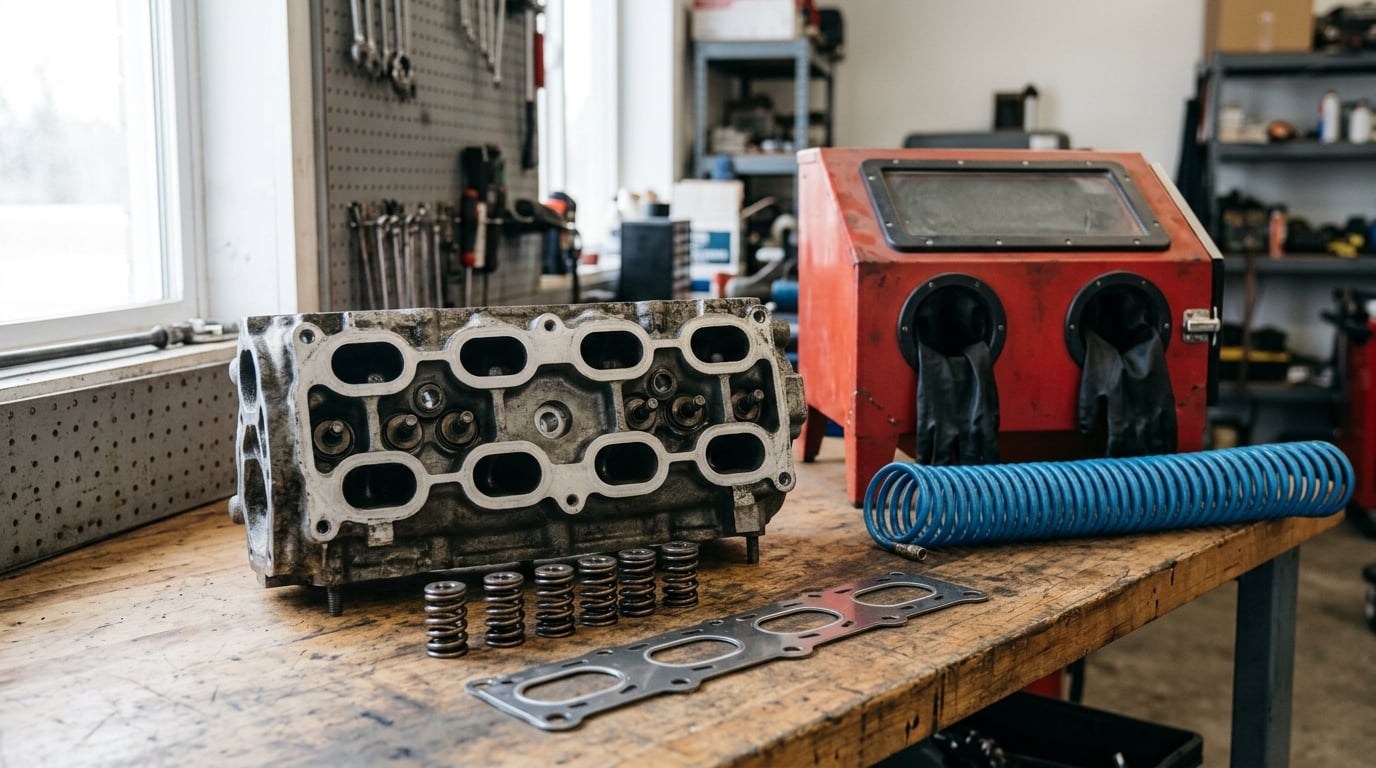
Walnut blasting for intake valves is a cleaning process where crushed walnut-shell media is fired at low pressure through the intake port to strip baked-on carbon off the back of the intake valves, the valve stems and the surrounding runners. The valves are held closed and sealed at top dead centre on the compression stroke, the debris is vacuumed away, and the head is inspected and reassembled.
On a direct-injection BMW such as the N20, B48 or N14, that is the only reliable way to clear heavy valve carbon once it has hardened. This guide covers what the process removes, what it leaves behind, when it is worth paying for, and the mistakes that turn a good clean into a half-finished job.
Table of Contents
- What Is Walnut Blasting for Intake Valves?
- Why Do Intake Valves Become Carbon-Covered?
- How Does Walnut Blasting Work?
- What Does Walnut Blasting Remove and What Does It Leave?
- Is Walnut Blasting Better Than Other Carbon-Cleaning Methods?
- When Is Walnut Blasting Worth Doing?
- What Are the Risks and Common Mistakes?
- How Do You Know the Intake Valves Are Clean?
- Frequently Asked Questions
- Does walnut blasting damage intake valve seats?
- Can intake valves be walnut blasted without removing the cylinder head?
- Do intake valves need lapping after walnut blasting?
- Is walnut blasting better than using a carbon scrub or chemical cleaner?
- How often should intake valves be walnut blasted?
- Can walnut blasting fix a misfire or rough idle caused by carbon buildup?
- Conclusion
What Is Walnut Blasting for Intake Valves?
Walnut blasting is media blasting, and walnut-shell media is the crushed, graded and filtered remains of walnut hulls. The grains are hard enough to break carbon that has been baked on for tens of thousands of miles, and soft enough that they will not scratch or etch the aluminium valve face underneath.
It is a non-metallic, biodegradable media. That distinction matters. Glass bead, aluminium oxide and steel shot are all common in body and restoration work, and all of them will dull a valve face, which is the one surface in the engine that has to seal against combustion pressure.
What is walnut blasting for intake valves, in plain terms?
Think of it as sandblasting for the intake side of the engine, done with something gentler than sand. A technician feeds fine walnut-shell media into a blast gun, holds the nozzle just inside the intake port, and works around the valve until the black crust breaks away and the metal underneath shows through. Whatever does not come off stays where it is, which is why a proper job ends with a borescope photo rather than a verbal assurance.
Walnut blasting intake valves only cleans the intake side: the valve backs, the exposed part of the stems, the port and the runner walls. It is a decarbonising service, not a rebuild, and it never touches what is happening inside the cylinder.
Valve seat is the machined ring on the cylinder head that the valve face closes against. Everything walnut blasting targets sits upstream of that seat, on the side the valve faces away from. Keep that distinction in mind, because it explains both why the process is effective and what it cannot fix.
Why Do Intake Valves Become Carbon-Covered?
Direct-injection engines spray fuel straight into the combustion chamber, so the intake valves are never washed by fuel. On a port-injected engine, the incoming petrol and air sweeps the valve back and keeps it comparatively clean. On a GDI engine that fuel route simply does not exist.
So what builds up instead? Crankcase ventilation. The PCV valve routes blow-by gases from the crankcase into the intake tract, where the oil vapour meets the cooler metal of the valve back and condenses into a thin film. Add the fuel that does land on the valve from injector wash and the exhaust gas that leaks past the piston rings, and you have a steady supply of oily, sooty material. Layer by layer, it hardens into a black shell.
Diesels get a different diet. Heavy EGR loading drops a similar oily soot onto the valve backs, often in a heavier dose because the EGR valve sits right in the intake path.
Some of that discoloration is normal and harmless. A light tan or grey film on the port side of a valve, especially low down near the seat, is what a healthy valve looks like. The warning sign is a thick, matte, uneven crust that does not wipe off with a rag, plus deposits bridging across the runner and into the port floor. Once the deposit is thick enough to matter, the intake charge hits a wall instead of a smooth path into the cylinder.
Driving style changes the rate. Short city trips, stop-start traffic and lots of idling never reach the temperature and airflow that burn deposits off. Long motorway runs at steady load do. Owners who only ever drive fifteen minutes to work tend to build carbon far faster than the mileage suggests.
Engine design matters too, and BMW families differ. Owners report the N14 as a heavy oil drinker that feeds a lot of vapour into the intake, while the later N18 in certain MINI models is described as not burning oil between changes and showing clean valves past 60,000 miles. Same badge, different deposit history.
How Does Walnut Blasting Work?
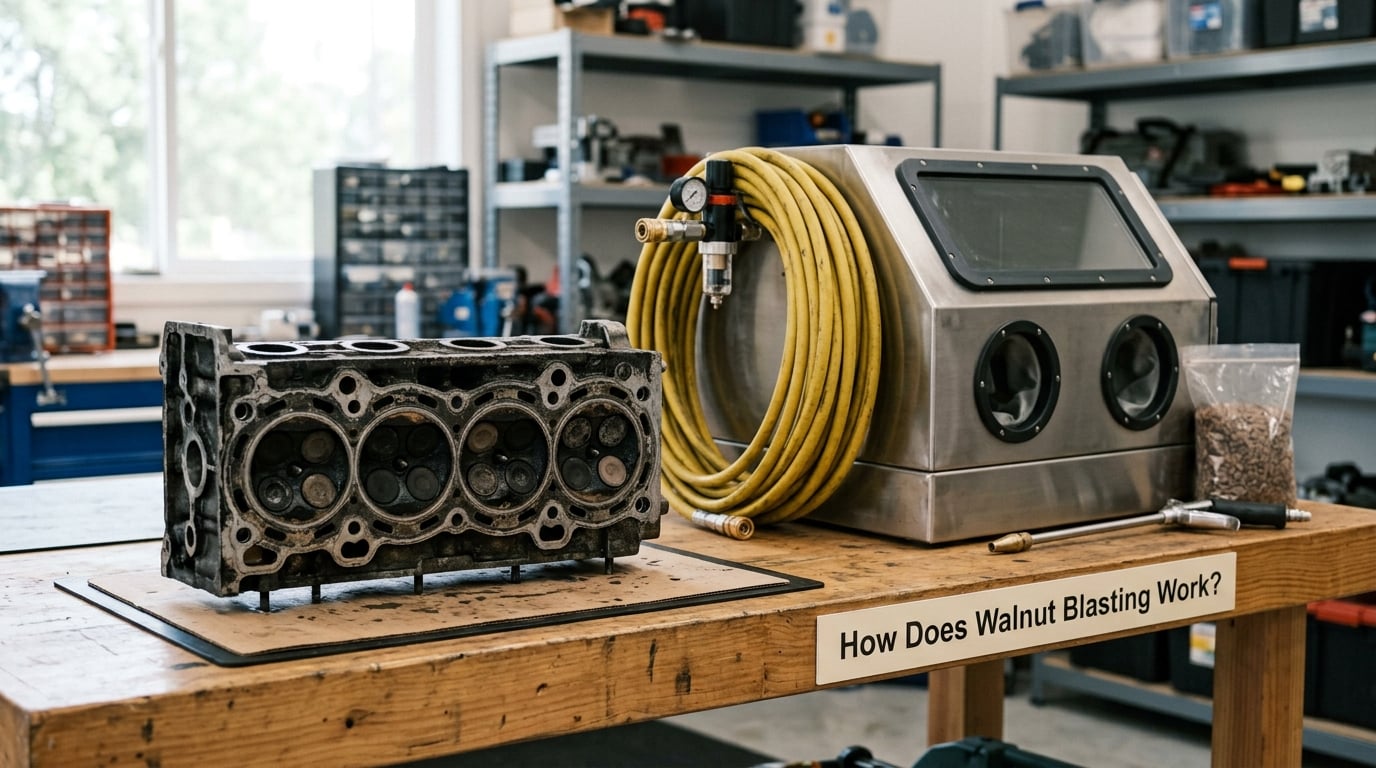
The sequence matters more than the blast itself. Position the valves wrong and the job either does nothing or damages the engine.
- Look before you touch. Run a borescope through the intake port and photograph each valve. If the valves are already clean, the job was unnecessary and you have saved yourself the labour charge.
- Test the engine first. A compression and leak-down test before disassembly tells you whether there is a sealing problem deeper down. A valve with a tired seat can read as a carbon problem and will still misfire after a clean.
- Remove the intake manifold. This is the bulk of the labour. The throttle body and, on some engines, the fuel rail stay on. The head and block go to TDC on the compression stroke so the valves are closed and loaded against their seats.
- Plug the neighbouring ports. Clean rags stuffed into the cylinders you are not working on stop walnut media and carbon fragments dropping past an open valve into the combustion chamber. Owners doing this at home on a Buick forum thread described exactly this as the step people skip.
- Blast at low pressure. Fine walnut media, gentle pressure, nozzle held close, working the valve face against its seal in small circles. High pressure is the fastest way to leave marks on the face.
- Vacuum and inspect. Spent media and loosened carbon come out with a vacuum, not a blast of compressed air that pushes the debris somewhere else. Then a borescope again, valve by valve.
- Reassemble properly. Clean the manifold runners and the throttle body while everything is apart, fit new intake gaskets and seals, set the valve clearances to the BMW specification, then refit. Reset the ECU and allow for a throttle body actuator relearn on engines that need one.
On safety: let the head cool completely before a single bolt comes out, wear eye protection, keep the blast pointed away from yourself, and never use metal media near a valve face. If a BMW service bulletin or manual sets a cleaning limit for the engine, follow the manual rather than a forum consensus.
What Does Walnut Blasting Remove and What Does It Leave?
Valve carbon comes in layers, and the media is honest about which one it takes.
| Deposit or surface | What walnut blasting does to it |
|---|---|
| Soft black carbon on the valve back | Breaks away quickly. This is the layer the process is designed for. |
| Thick deposits on the valve stem and guide | Cleans off well and frees a stem that was sticking in the guide. |
| Oily film on the port floor and runner walls | Removed fully. A clean runner is most of the airflow win. |
| Hardened grey carbon near the sealing area | Leaves it. The media stalls here; picks and solvent, or valve removal, are the next options. |
| Dried residue sealing a valve slightly off its seat | May be masked or made slightly worse. Found during reassembly by a seat leak test. |
| Combustion chamber, piston crown, turbo, DPF and exhaust side | Untouched. Different job, different method. |
| Worn valve guide, bent valve or pitted face | Cannot be repaired by cleaning. A lap, a replacement or a head job is the only answer. |
The hard grey layer is the one that causes disappointment. On a second-generation MINI thread, an owner described a dealer blast that took off the soft black layer and stopped, leaving a lighter grey deposit that walnut media would not shift and that needed dental picks and solvent near the sealing area. The same owner reported faint grey marks on the valve faces afterwards. That is the honest limit of the process, and a shop that tells you about it before it starts is worth finding.
Is Walnut Blasting Better Than Other Carbon-Cleaning Methods?
Walnut blasting wins on heavy, hardened carbon and loses on convenience. Every other method trades cleaning power for something else.
| Method | Cleaning power | Needs disassembly | Main drawback |
|---|---|---|---|
| Walnut-shell media blasting | High on soft and medium carbon; stalls on hardened grey deposits | Manifold off, valves seated at TDC on compression | Labour cost; light marks on valve faces if pressure is high |
| Chemical intake cleaner (Seafoam, Lucas, CRC, GDI-specific) | Low to moderate; works on light deposit as a maintenance habit | Usually none | Cheap, but owners on the Buick and Golf GTI forums repeatedly report near-zero change on coated valves |
| Manual picks and scraping | Slow but can reach hardened deposit the media will not shift | Yes | Enormous labour time, and risk of scratching the sealing face |
| Induction heating or steam cleaning | Good on deposit in place, no media involved | Varies by engine; some heads stay fitted | Heats the whole valve area; not every engine is suited to it |
The chemical route is worth keeping, just not as a replacement. Owners on the Stelvio forum described an induction or chemical treatment as a slower process that still cleaned well and cut oil consumption, which is a sensible maintenance habit rather than a fix for a heavily coated valve. The expensive mistake is doing the cheap treatment, seeing no change, and then paying for the blast anyway.
One more comparison worth knowing: walnut media against glass bead. Glass bead cuts faster and is widely available, but it is harder than the aluminium valve face and etches it. Walnut shell is the safer choice for a valve seat that has to seal. Use glass bead on a steel part, never here.
When Is Walnut Blasting Worth Doing?
Symptoms are the trigger, not the calendar. These are the complaints that justify a borescope first and a clean second.
- Rough idle that is worse cold and settles once warm.
- Hesitation or a stumble under light throttle, especially at low speed.
- A flat spot in pedal response that the ECU does not fully adapt to.
- Misfire codes that come and go with no injector, plug or coil fault found.
- Fuel consumption creeping upward with nothing obviously wrong.
- Heavy oil consumption, which feeds the PCV vapour that feeds the deposit.
None of these prove carbon is the cause. A worn throttle body, a failing idle control valve, weak plugs, vacuum leaks and low compression all produce the same picture, and a cheap diagnostic hour will usually tell you which one you are looking at. Blasting valves on an engine that has a vacuum leak buys you an expensive afternoon.
On interval, owner consensus lands between 35,000 and 60,000 miles, with short-trip city drivers and oil burners at the early end and long-distance drivers at the later end. If you only ever see the inside of a five-mile commute, treat the mileage figure as optimistic.
What owners report paying
Figures are typical US reports from owner forums and vary by region and shop. The main cost driver is cylinder count, because the labour scales with the number of valves to seat and blast.
| Engine configuration | Typical labour | Often added to the bill |
|---|---|---|
| Inline 4-cylinder petrol | Few hundred dollars, with owner reports from around 200 for the blast alone | Intake gaskets, spark plugs, throttle body clean, ECU reset |
| Turbocharged 4-cylinder (N20, B48, EA888) | Around 600 to 800 dollars | Manifold removal labour, actuator relearn, coolant and seals |
| V6 and V8 petrol | Four figures; the 1,100 to 1,400 range is common on owner reports | Throttle body removal, extra access labour |
| Diesel with heavy EGR loading | Varies widely; EGR access adds labour | EGR valve service, injector checks |
One MINI owner reported roughly 200 dollars for the blast plus 145 for plugs, against a dealer quote near 800. Another forum DIY comparison put a first home blast at about 120 dollars of blasting kit and 25 dollars of media against a 600-to-1,200 dollar shop job. That is the honest DIY arithmetic, and it does not include your weekend.
There is a real accusation behind some of this scepticism, and it deserves a straight answer. Owners on the Golf GTI and WRX forums describe it as GDI scare tactics to sell an expensive service, and the fear is not crazy: a shop that blasts an engine which did not need it has still taken your money. The defence is straightforward. Ask for borescope photographs before and after, ask them to tell you which valves they cleaned and which they could not reach, and ask for the quote in writing with the throttle body and ECU work listed separately. A shop that refuses the photographs has told you what it is.
A technician who looks at your engine and says it does not need the service yet is the one worth going back to. The same applies if you are buying a used GDI car: a borescope look through the intake port costs very little and tells you in a minute whether the previous owner ever cleaned the valves.
What Are the Risks and Common Mistakes?
Most damage traces back to one of six things.
- Too much pressure. Greedy blasting marks the valve face. Correction: low pressure, close nozzle, many light passes instead of a few hard ones.
- Metal media. Steel or aluminium shot etches an aluminium face and leaves it sealing worse than before. Correction: walnut shell only, and check the label before you load the gun.
- Blasting with the valve open. Media and carbon fragments drop into the cylinder and end up on the piston or, worse, in the combustion chamber as hard abrasive. Correction: TDC on the compression stroke, and rags in every port you are not cleaning.
- Contaminated or mixed media. Dust, oil and metal swarf in the media act as an abrasive slurry. Correction: clean the cabinet, use filtered media, never blast from a dirty container.
- Reassembly shortcuts. Old gaskets, a dirty throttle body, skipped valve clearance checks, no ECU reset. Correction: treat reassembly as its own job and work to the BMW service information for clearances and sealing checks.
- Cleaning only the valves. Leave the manifold runners coated and you have pushed the deposit somewhere new. Correction: clean the runners and port floors while the head is off.
Ignore the valve-guide wear while you are in there and you will be back with the head off twice. If a stem is loose in its guide, blasting the carbon off it will not restore the seal, and a clean valve that leaks still costs you compression and misfires.
How Do You Know the Intake Valves Are Clean?
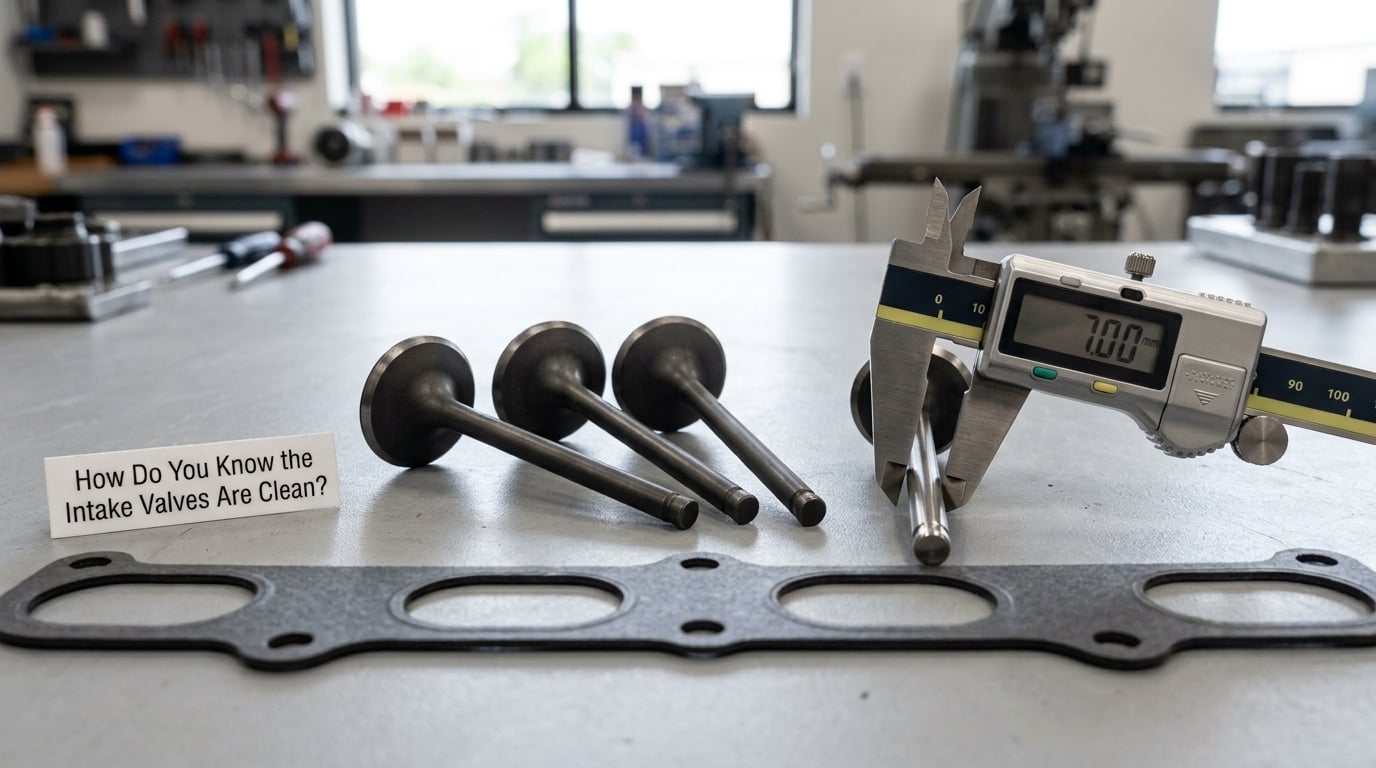
A clean valve face shows bare metal with a continuous sealing mark around its edge, and no black crust anywhere in the port. If light passes through the port and you can see clean metal rather than a matte black wall, the job worked. Ask for a borescope photograph of every valve, not one photograph of the easiest cylinder.
Mechanically, the stem should move freely in the guide with a light spring return, and the valve should sit square against its seat. A leak-down test after reassembly is the honest confirmation; a mist escaping at the seat or a low cylinder reading tells you the clean surface was hiding a wear problem rather than causing one.
Then check the symptoms against the same list you started with. A smoother cold idle, no stumble, no misfire codes and a throttle that responds to a light foot all point one way. If they have not changed, the carbon was not the cause, and you are now looking at injectors, plugs, coils, the throttle body or compression rather than deposits.
That distinction is the whole point. Clean valves are a good thing, but they are a symptom-level fix, not a cure.
Frequently Asked Questions
Does walnut blasting damage intake valve seats?
Done correctly, no. Walnut-shell media is softer than the aluminium valve face, so it breaks carbon without cutting metal. Damage comes from human error: too much pressure, metal media, or a contaminated cabinet. Light grey marks do sometimes appear on a face after a heavy clean, which is why a good shop works at low pressure with the nozzle held close.
Can intake valves be walnut blasted without removing the cylinder head?
Yes, the cylinder head normally stays on the engine. What comes off is the intake manifold, so the blast gun can reach the valves directly. The crankshaft is then positioned at top dead centre on the compression stroke to hold the valves closed and sealed. Access is tight on some engines, which is why a V6 or V8 carries more labour than an inline four.
Do intake valves need lapping after walnut blasting?
Usually not. Lapping is only needed if the sealing face is pitted, warped or physically damaged, and blasting does not cause that on its own. A light surface mark from aggressive cleaning can sometimes be corrected with a light lap and compound, but a valve that has never sealed properly, or one with a loose stem in a worn guide, needs replacement rather than cleaning.
Is walnut blasting better than using a carbon scrub or chemical cleaner?
For heavy, hardened carbon, yes. Walnut media shifts deposits that chemical intake cleaners barely touch, and owners repeatedly report paying for a chemical treatment, seeing no change, then paying again for a blast. Chemical cleaners still make sense as cheap ongoing maintenance on light deposit, and picks remain the tool for the hard grey layer near the sealing area.
How often should intake valves be walnut blasted?
Owner consensus sits between 35,000 and 60,000 miles, pulled towards the early end for short-trip city driving and for engines that burn oil between changes, and towards the later end for long-distance use. Check with a borescope rather than counting miles alone. If the valves look clean, cleaning them again gains you nothing and risks the face.
Can walnut blasting fix a misfire or rough idle caused by carbon buildup?
It often does, but only when carbon is genuinely the cause. A misfire that clears once the engine is warm, alongside a stumble under light throttle, matches the deposit picture well. A misfire that stays at any temperature points elsewhere. Walnut blasting also will not fix oil consumption caused by worn piston rings, since it cleans the intake side and not the cylinder.
Conclusion
Walnut blasting is a controlled, repeatable way to strip carbon from intake valves, stems and runners without touching the valve face, and on a direct-injection BMW with heavy deposit it is the method that actually works. It also has a clear ceiling: hardened grey carbon near the sealing area, worn guides and anything happening inside the cylinder are not its job.
So confirm the diagnosis before anyone opens the intake, ask for borescope photographs on both sides of the job, and follow the BMW service information for clearances and reassembly. The 2026 version of this engine is no different from the last one in the ways that matter: diagnose first, clean second.