
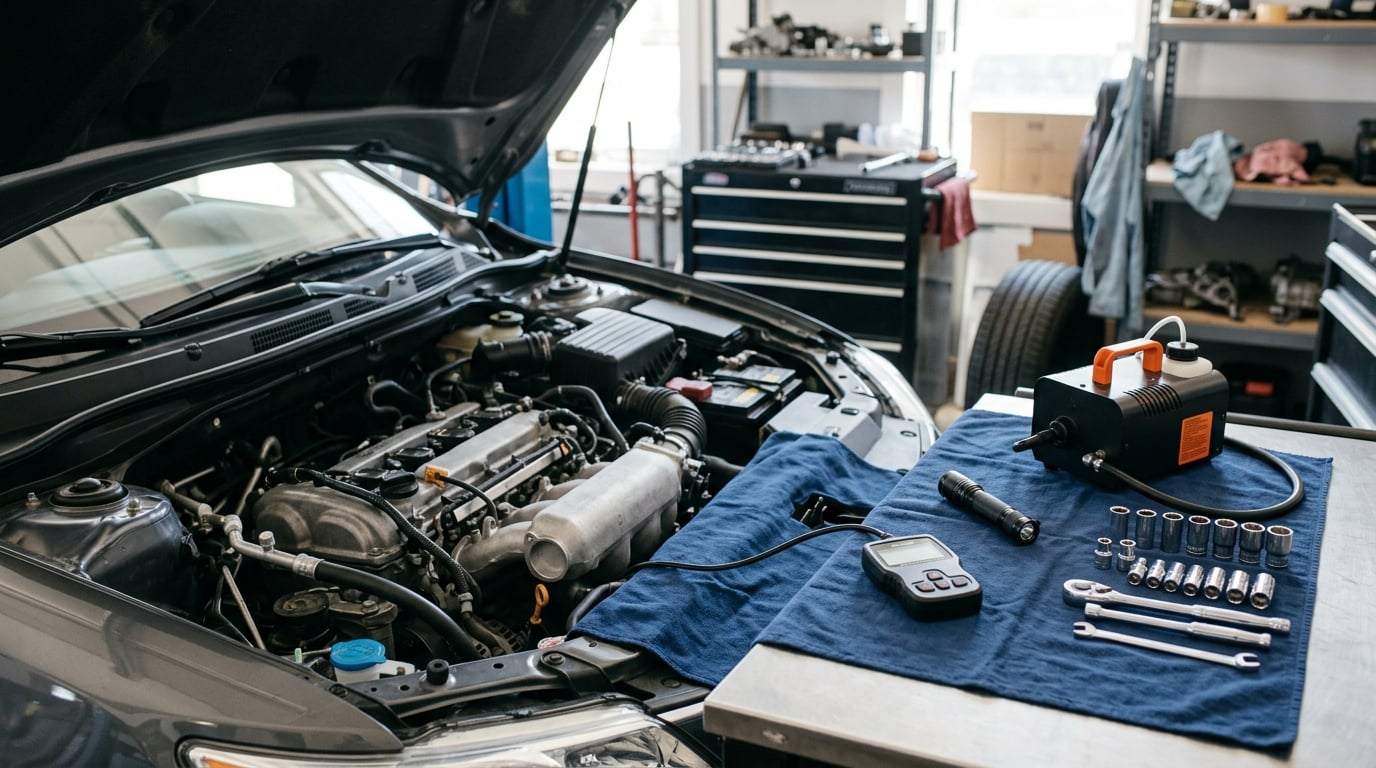
Knowing how to diagnose a rough idle comes down to testing the cheapest and most common causes first, in a fixed order, instead of swapping parts until something sticks. Start by reading the codes, then check the air and vacuum system, then ignition, then fuel and idle control. Most rough idles are found before you ever take a wrench to the fuel rail.
A healthy engine at a stoplight holds a steady speed in roughly the 600 to 1,000 RPM range with no shudder, no hunting needle and no stumble when you pull away. Anything outside that is a clue, and the trick is knowing which clue points where.
Idle is the hardest operating point an engine has. The throttle is nearly closed, so almost no air flows through the intake, and the ECU has to trim the mixture with tiny corrections. A single cracked vacuum hose or a slightly weak coil is enough to upset a balance that would be invisible at highway speed. That is also why the same fault that makes your car shake at a stoplight can leave it driving perfectly fine at 60 mph.
The nine checks below run in order. Stop when the idle goes smooth, because one fault was often masking another.
Table of Contents
- What You Need to Diagnose a Rough Idle
- Step-by-Step
- 1. Confirm the Symptoms and Check for Trouble Codes
- 2. Inspect the Air Intake and Throttle Body
- 3. Find Vacuum Leaks
- 4. Inspect Spark Plugs and Ignition Components
- 5. Check Fuel Delivery and Air-Fuel Mixture
- 6. Look for Exhaust and Air-Control Problems
- 7. Inspect Sensors and Engine Wiring
- 8. Test the Idle-Air Control or Equivalent System
- 9. Verify the Repair and Clear the Fault Memory
- Common Mistakes
- Frequently Asked Questions
- Conclusion
What You Need to Diagnose a Rough Idle
You need very little to start: the owner’s manual for your engine, a way to read diagnostic trouble codes, a flashlight and a set of basic hand tools. Everything beyond that is optional and only becomes necessary once the first four checks come back clean.
- The owner’s manual or service literature for your exact engine. It lists the specified plug gap, the idle relearn procedure and the expected idle speed. Guessing a plug gap is one of the fastest ways to create a new problem.
- An OBD-II code reader. Many cars built since the mid-1980s have a diagnostic port, and a phone app paired with a cheap Bluetooth or Wi-Fi adapter can read stored codes, pending codes and live data on most vehicles.
- A dedicated code reader with live data. If your car uses electronic throttle bodies, a scanner that shows real-time idle RPM, target RPM, short-term and long-term fuel trim is worth the step up. It lets you watch a repair work instead of guessing.
- Hand tools and an inspection light. Socket set, screwdrivers, pliers and a small mirror. Many intake hoses sit behind the engine where a phone camera is more useful than your eyes.
- Throttle body or carburetor cleaner and a lint-free cloth. Only for the throttle body plate and idle passages. Never spray it onto a mass airflow sensor, oxygen sensor, connectors or wiring.
- Optional: a smoke machine or a can of carburetor cleaner. This is the single best tool for finding a vacuum leak, covered in check 3.
Set up somewhere level, with the engine able to reach full operating temperature and the key available. If the car sits on a lift or the diagnosis runs under the car, a shop is the better place to do it.
Step-by-Step
Work through these checks in sequence: confirm the symptom and read the codes, inspect the intake, hunt vacuum leaks, read the spark plugs, test fuel delivery, check exhaust and air control, verify sensors and wiring, test the idle control system, then confirm the repair. The order is the whole trick, because the cheapest test usually eliminates four suspects at once.
1. Confirm the Symptoms and Check for Trouble Codes
A rough idle is the engine running unevenly, hunting, surging or shaking at a stop. Plug in your scanner before you touch a single hose, read the stored and pending codes, and write down the freeze-frame data before clearing anything.
Record when the problem happens. A rough idle that shows up only on a cold start points at a vacuum leak or a coolant temperature sensor reading, while a rough idle that appears once the engine is warm and in gear points toward ignition or idle control.
| What you notice | What it usually is | Next test |
|---|---|---|
| Shudder that grows with engine RPM and changes with load | Rough idle, combustion related | Read codes, then pull the spark plugs |
| Shake that stays the same at idle and at road speed | Wheel or tire balance, wheel bearing | Check for a vibration felt through the steering wheel or seat only |
| Shudder in gear that disappears in park, mild at idle | Transmission or torque converter shudder | Compare RPM and load in park against the same RPM in drive |
| Idle hunts up and down, needle never settles | Vacuum leak, idle air control, MAF signal | Watch live idle RPM while the engine idles |
That first table is where I start every time. Owners on r/MechanicAdvice regularly chase an engine fault for weeks when the shudder was a tire or a torque converter, and a transmission shudder at the stoplight is easily mistaken for a misfire.
Here are the codes that come up most often, and where each one sends you next.
| Code | Meaning | Go to |
|---|---|---|
| P0300 | Random or multiple cylinder misfire detected | Check 4, spark and ignition |
| P0171 | System too lean, bank or bank 1 | Check 3, vacuum leak first |
| P0172 | System too rich | Check 5, fuel delivery and injector flow |
| P0101 | Mass or manifold air flow circuit range or performance | Check 7, MAF sensor and wiring |
| P0506 | Idle air control system RPM lower than expected | Check 8, idle air control valve or throttle body |
| P0507 | Idle air control system RPM higher than expected | Check 8, and check for a vacuum leak |
Do not clear the codes yet. A misfire counter that resets itself after a few cycles of the key tells you far more than an empty memory. On r/944 owners describe chasing a symptom for months after a shop cleared the fault memory and the freeze-frame data went with it.
Forum regulars almost always say the same thing: check for codes first. Just as many admit they had already replaced four parts before scanning. Scanning first costs about ten minutes.
2. Inspect the Air Intake and Throttle Body
A disconnected intake hose, a cracked duct or a mass airflow sensor that is unplugged or installed backwards will wreck idle quality, and it is visible without taking anything apart. Work along the entire air path from the air filter housing to the throttle body.
Look for hoses that are soft, split, flattened or clamped too tightly. Check that every intake and vacuum hose is seated on its port and that the worm-drive clamps are snug but not crushed. A hose popped halfway onto a throttle body port can fool you completely, so look for the seating ridge on the port itself.
Then look at the MAF sensor. If it has been removed, check that the intake duct is seated correctly between the sensor and the throttle body. A common mistake is leaving a gap under the sensor after a cleaning, which lets in unfiltered air and throws the reading off.
With the engine running, listen for a hiss. A steady high-pitched hiss that gets louder when you spray a little carburetor cleaner over a hose joint is a leak right there. Hissing is the single most useful sound in this whole procedure.
3. Find Vacuum Leaks
Yes, a vacuum leak will cause a rough idle, and it is the most common cause on most engines. A leak lets unmetered air past the mass airflow sensor, so the ECU never sees it and never compensates for it.
The result is a lean mixture at idle, which shows up as hunting RPM, a stumble off idle, and a P0171 or a lean code with fuel trim numbers that never settle. Leaks often appear only when the rubber is cold and stiff, which is why the car can be smooth in the driveway and rough on a cold morning.
The best tool is a smoke machine. With the engine idling, feed smoke into the intake and watch where it exits. Never connect the smoke source to any fuel or electrical fitting, and keep the engine unattended.
You can also use a can of carburetor cleaner as a poor man’s smoke machine, a technique r/MechanicAdvice owners use constantly. Start the engine, listen to the idle, then spray a short burst of carb cleaner around intake manifold seams, the PCV hose, the brake booster hose connection and each vacuum line joint. If the idle speeds up, stumbles or changes pitch, you just brushed the leak. Spray a tiny amount only, keep the can away from ignition sources and open the throttle if the engine stumbles.
Common leak locations, in rough order of how often I find them:
- The PCV valve or the crankcase ventilation hose, especially on higher-mileage engines
- The brake booster hose at the firewall, which cracks with age and flexing
- Intake manifold seams and the manifold gasket on older engines
- The EGR valve and its vacuum supply
- The small vacuum lines to the fuel pressure regulator, purge valve and map sensor
One caution worth repeating: a can of carb cleaner near a running engine is a pilot light away from a flash fire. Do it outdoors, keep the can capped when you are not spraying, and never spray into a connector or onto a sensor.
4. Inspect Spark Plugs and Ignition Components
Read the plug face, not just the gap. The color and deposit pattern tells you what the cylinder is actually doing, and worn plugs alone rarely explain a rough idle on their own.
Pull the plugs and look at the ceramic nose. Sooty black and soft points to a rich mixture or an oil problem. Tan to light brown is normal. A sooty plug that wipes clean usually means unburned fuel, so check the injectors and the fuel pressure. Oil coating on the ceramic or plug boot points at valve stem seals, which is a bigger job.
Check the gap against the manual specification, not a chart you half remember. A gap that is too wide under load and too narrow at idle is a classic rough-idle pattern, and it will not show up on a road test.
For a misfire code, swap coils. Move the coil from cylinder 1 to cylinder 2 and the other way around, then clear the code and re-run. If the misfire follows the coil, the coil is the fault. If it stays on the same cylinder, the problem is the plug, the injector or that cylinder’s compression. On coil-on-plug engines, swap the coil first since it costs a few minutes and no parts.
Check the plug wires on older engines for hardened, cracked or corroded sections, and make sure the boots are seated. Also look at the wiring to the coils for chafing against brackets.
5. Check Fuel Delivery and Air-Fuel Mixture
A rich or lean air-fuel mixture makes an engine run roughly at idle, and fuel delivery is where many owners jump ahead of the evidence. Test the simple things before pulling injectors.
Start with the fuel filter, the fuel level in the tank, and whether the rough idle changes with the fuel level. Owners on multiple forums report a clear correlation between a low tank and a rougher idle, because a weak pump or a clogged pickup strains harder at low level.
Next, look at the fuel trims on your scanner. Short-term and long-term trims near zero mean the ECU is happy with the mixture. Large positive long-term trims mean the engine is running lean and the ECU is adding fuel. That immediately redirects you to check 3.
Injector cleaner and additives have limited reach. They can help slightly on a vehicle that has sat with old fuel, but they will not fix a leaking injector, a clogged filter or a failing pump. If a cylinder is running rich, a balance test or an injector flow test is the test that gives an answer.
Fuel pressure testing means attaching a gauge to the fuel rail against the manual specification, which is a job for a technician unless you already own the equipment. If you are not confident with fuel system work, stop here and hand it over. Pressurized gasoline is not something to experiment on.
6. Look for Exhaust and Air-Control Problems
A blocked or restricted exhaust, a stuck exhaust or emissions valve, and a contaminated idle air control system can all destabilize idle, and the exhaust side is where owners look least often.
Listen for a hissing or rasping noise near the exhaust manifold area, which points to a leak ahead of the oxygen sensor. A leak there lets in extra air and can trigger false lean codes. On V-shaped engines, listen from underneath with the vehicle on a lift if you can.
Check the EGR valve for a carbon-clogged pintle that is stuck open. A stuck-open EGR adds unmetered flow at idle, and it is common on vehicles that do short trips. Rapping the valve body gently with the engine off can sometimes free a light carbon jam, though a seized EGR needs removal.
Also check engine mounts. A collapsed or cracked mount lets the engine move under its own weight, which reads as a rough idle, and it can be mistaken for a combustion fault. Watch the engine while a helper applies a little throttle.
And check the crankshaft damper. A worn damper does not shudder the engine, it changes the feel of the whole car, and it is cheap to check compared to a misfire hunt.
7. Inspect Sensors and Engine Wiring
Diagnose sensors by evidence rather than by replacing them, because a rough idle sends owners through MAF, TPS, O2, coolant temperature and EGR sensors in one afternoon and the problem is still there. Look at the wiring first, then watch the live data.
Yes, a faulty MAF sensor can cause rough idling, and yes, a faulty MAP sensor can too. They measure the same thing in different engines, so treat them as one category. Signs of a failing MAF include an idle that hunts or surges, a stumble that appears under light acceleration, a check engine light with a P0101 code, and fuel trim numbers that swing far from zero.
Cleaning a MAF with proper sensor cleaner on a lint-free swab is often enough to fix it. Never touch the sensing element with a finger, and never use carb cleaner, which leaves a film that makes the reading worse.
Check the oxygen sensor for damage and for a connector full of water, since a lazy sensor swings fuel trim slowly. Check the coolant temperature sensor behaviour against the live data versus the actual temperature, since a sensor reading 20 degrees off makes the ECU command a rich cold start on a warm engine.
Look at the throttle position signal and the wiring. Chafed loom near the transmission, damaged connectors, and poor grounds on the ECM all produce idle symptoms that look like mechanical faults. Ignition coils next to an alternator wire are a classic source of misfire codes that come and go with moisture.
8. Test the Idle-Air Control or Equivalent System
The idle air control valve on a cable-throttle engine, or the electronic throttle body on a modern one, is what holds the idle steady with the throttle closed. When it is dirty or failing, the idle hunts, surges or runs high, and you get a P0506 or P0507.
To tell if your IAC is stuck: watch the engine at idle, then apply a little throttle and let it return to idle. If the RPM does not return to where it started, the idle control is not holding position. With a scanner, watch the commanded idle position against the actual RPM. A large gap between the two confirms it.
On an electronic throttle body, remove the throttle body and look at the throttle plate and the passages underneath. A light film of carbon is normal. A thick, hard deposit and a plate that does not close fully are the fault.
After cleaning the throttle body or replacing an idle air control valve, run the idle air relearn. This is the step most owners skip, and skipping it is why the idle is often worse right after the work than before it. With the engine fully warm, follow the idle air volume relearn in the manual, or use a bidirectional scan tool to command the throttle to open and close while the engine idles. Then clear codes and re-check. One owner on r/c4corvette cleaned the MAF, fixed the stumble, and still had a 900 to 1,100 RPM idle in park until the relearn was run.
Only test the idle control system once you have ruled out a basic leak or a fault code that points somewhere else. A dirty valve is the symptom, not always the reason.
9. Verify the Repair and Clear the Fault Memory
Confirm the repair at operating temperature, then clear the fault memory, not before. Warm the engine fully, let it idle for several minutes, and check that the idle is steady and at the speed the manual specifies.
Re-scan for codes. If nothing is stored, take a short road test including a full stop and a stop in drive, which is where the problem usually shows up. Then clear the codes and drive again, so you are confirming the fix in the same conditions that produced the fault.
If a code comes straight back, you have not found the cause yet. If the idle is smooth and no codes return, the repair held. Only now is the time to clear the memory, because a code that returns after clearing is the most useful diagnostic tool you have.
Common Mistakes
Most rough idle repairs that go wrong share the same handful of errors. These are the ones that turn a straightforward diagnosis into a parts bill.
- Replacing sensors without testing. A new MAF, IAC, throttle body, plug set and coil pack with no diagnosis first is guesswork with receipts. Read the code, watch the live data, then buy the part.
- Ignoring the vacuum leak. A leak makes every downstream reading wrong. It also keeps coming back after a repair, which is why owners on forums describe replacing the same idle control valve twice.
- Using the wrong spark plug gap. A gap off specification causes exactly the symptom you are trying to cure. Check the manual for your engine, not a generic chart.
- Forgetting the PCV system. A stuck PCV valve or a collapsed crankcase vent hose is a slow leak that gets worse with mileage and cold weather. On an r/944 thread a rough idle came down to a leaky fuel damper dripping into the vacuum lines plus a second leak, two small faults presenting as one symptom.
- Clearing codes too early. You destroy the freeze-frame data and the misfire counters that tell you which cylinder is at fault.
- Assuming the throttle body is always the answer. It is a frequent culprit, not a universal one. If a leak or a code points elsewhere, follow the evidence.
- Skipping the idle relearn. Service the idle control and the engine may idle worse until the ECM relearns the idle air volume. This is the most common failed DIY follow-up.
- Calling it a rough idle when it is a shudder. A wheel balance, a wheel bearing or a transmission shudder looks the same from the driver’s seat and sends you down the wrong repair path entirely.
Frequently Asked Questions
What is the most common cause of a rough idle?
An air or vacuum leak is the most common cause, followed by a dirty idle air control valve or throttle body. A cracked PCV hose, a failed brake booster hose, or a split intake hose lets unmetered air past the mass airflow sensor, so the engine runs lean and hunts at idle. Look for codes such as P0171, check fuel trim, and listen for a hiss before replacing parts.
Why does my car idle rough but drive fine?
Idle is the most demanding steady state an engine has. The throttle is nearly closed, the ECU has almost no airflow to measure, and it compensates with small fuel trim corrections. That makes faults that are invisible at speed, like a weak coil or a small vacuum leak, obvious at a stop. During driving the same fault is masked by load and higher airflow.
Will a vacuum leak cause rough idle?
Yes, and it is the first thing to rule out. Extra air arrives unmetered, so the mixture goes lean, fuel trim numbers rise, and the idle hunts, surges or stumbles off idle. The tell is a hiss that changes pitch when you spray a small amount of carb cleaner near a hose joint, plus a lean code such as P0171. A smoke machine finds the exact spot.
Can carb cleaner be used to check for vacuum leaks?
It works, and owners use it as a quick substitute for a smoke machine. Start the engine, note the idle, then spray a brief burst of carb cleaner around intake seams, the PCV hose, the brake booster connection and each vacuum line. A change in idle speed or pitch marks the leak. Work outdoors, keep the can away from ignition sources, and never spray a connector or sensor.
How do I tell if my IAC is stuck?
Watch the idle, apply light throttle, and let the engine return to idle. If the RPM settles somewhere other than where it started, the idle control is not holding position. On a scan tool, compare commanded idle with actual RPM; a large gap between them points at the valve. On an electronic throttle body, remove it and look for hard carbon on the plate and in the passages underneath.
Will fuel injector cleaner fix rough idling?
Sometimes, and only for a specific reason. Additives help when old fuel has been sitting in the tank or varnish has formed in the injectors, which is common on a car that has been parked or driven short trips. They will not fix a leaking injector, a clogged fuel filter, a weak pump, or a vacuum leak. If one cylinder runs rich or lean, test it instead of treating it.
Conclusion
To diagnose a rough idle, document the symptom first, then scan for stored and pending codes and save the freeze-frame data. Inspect the intake and vacuum systems, listen for a hiss, read the plug faces, check fuel trim, and test the idle control only after the simpler causes are clear. Run the idle relearn after any work on the idle air control or throttle body, and confirm the repair at operating temperature before you clear anything.
Order beats parts. The cheapest test in this whole process is a ten-minute scan, and it decides most of the rest.