
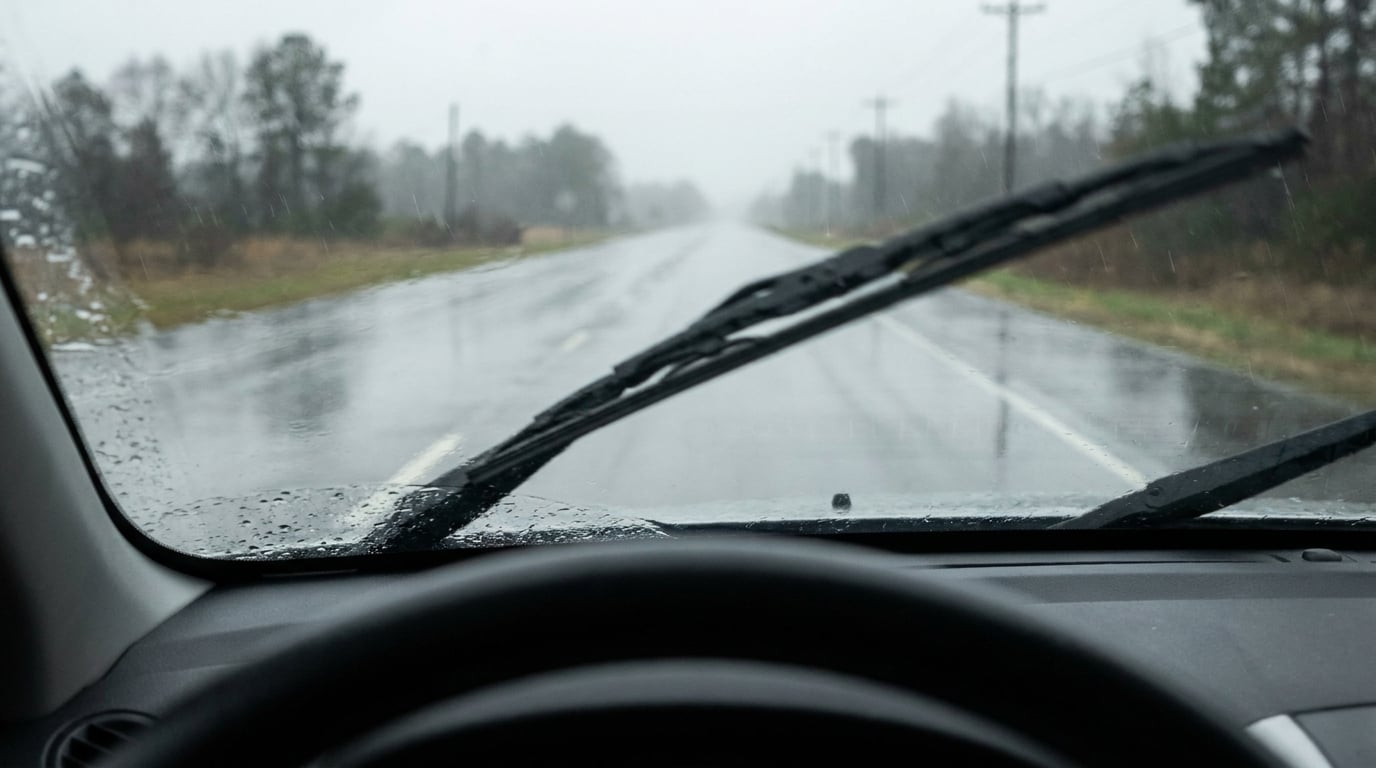
Hydroplaning happens when water builds up under your tires faster than the tread can push it aside, so the rubber lifts off the road and the car ends up riding on the film with no steering or braking grip. Recovering takes four calm moves: ease off the accelerator, hold the wheel steady, let the tires regain contact, and brake only if you have to. That is the short answer to hydroplaning causes and how to recover from one, and the rest of this guide fills in why it happens, how to spot it early, and what to inspect afterwards.
A few things worth keeping in your head before you read on:
- Speed, water depth, and tire condition are the three ingredients. Take away any one and the event becomes far less likely.
- The first minutes after rain starts are often the slickest, because asphalt oils and road grime float up ahead of the water.
- A tire on a water film has almost no friction, so steering and brake inputs do nothing until grip returns.
- The most dangerous instant is not the slide. It is the fraction of a second when the tires bite again and the car snaps to a new path.
Table of Contents
- What Is Hydroplaning and Why Does It Happen?
- What Causes Hydroplaning on a Wet Road?
- How Can You Tell That Your Car Is Hydroplaning?
- Why Does Hydroplaning Make Braking and Steering Worse?
- How to Recover When Your Car Starts Hydroplaning
- Should You Brake Hard During Hydroplaning?
- How to Prevent Hydroplaning in Heavy Rain
- When Is Standing Water Too Deep to Drive Through?
- Can Hydroplaning Damage Tires, Brakes, or the Transmission?
- What Should You Do If Hydroplaning Happens on a Motorway?
- Frequently Asked Questions
- How long should I wait after hydroplaning before accelerating again?
- Does hydroplaning mean the tires have lifted completely off the road?
- Can hydroplaning happen at low speeds during heavy rain?
- Should I turn the steering wheel toward the direction the car is sliding?
- Do new tires prevent hydroplaning?
- Conclusion: Make One Calm Correction at a Time
What Is Hydroplaning and Why Does It Happen?
Hydroplaning, also called aquaplaning, is a temporary loss of tire contact with the road caused by a water film that the tire can no longer clear. A spinning tire has a fraction of a second to squeeze water out through its grooves. When more water arrives under the contact patch than the grooves can move, pressure builds in front of the tire, hydrodynamic lift raises it, and the wheel skates on water instead of gripping asphalt.
That is different from ordinary skidding. A locked wheel on dry pavement is still touching the road and still has some friction, which is why a locked brake skid can be steered. A tire riding on water has next to nothing to work with, so the car keeps going whatever you ask the wheel to do.
Aquaplaning is the same event under the name used in most European vehicle manuals. If your car’s manual has an aquaplaning section, the recommended response there takes priority over anything written on the internet, including this page.
What Causes Hydroplaning on a Wet Road?
The two biggest causes are water depth and speed. When those combine with a tire that cannot clear the water, you get a full hydroplane, and worn tread, underinflation, and tire age decide how easily it happens.
Speed matters more than most drivers expect, because the amount of water a tire must displace rises sharply with road speed. Some guidance points to a risk band somewhere in the region of 35 to 50 mph (56 to 80 km/h) on a wet road, but that is not a line you can treat as a limit. A worn tire at 30 mph can hydroplane where a good tire holds at 70, and four inches of standing water will lift almost anything. Use the numbers as a reason to slow down earlier, not as permission to test them.
Controllable factors:
- Tire pressure. An underinflated tire has a larger, softer contact patch that deforms more and pushes less water per rotation.
- Tread depth. Grooves need volume to act as channels, and a worn tread loses that volume long before the tire looks bald.
- Tire age and condition. Rubber hardens with age and cracks, and some tread separation or sidewall damage shows up only when it is wet.
- Speed chosen in the rain, and how much following distance you leave so you never have to make a hard correction.
- Road surface. Rough texture and good drainage help; polished asphalt, painted lines, and metal plates hold water.
Factors you cannot control: how deep the water is, where the drainage failed, whether a truck has just washed oil across the lane, and the fact that the first minutes of a shower are the slickest because loose asphalt oils and rubber residue rise to the top of the surface and spread into a thin lubricating film. You do not need visible puddles for that one to happen.
| Road condition | What you are likely seeing | What to do |
|---|---|---|
| Wet sheen, no standing water | A film too thin to see, often early in a shower | Ease off slightly and add following distance |
| Thin film approaching a tenth of an inch (about 2.5 mm) | Rain rings, a faint darkening of the road | Reduce speed well before the water gets deeper |
| Shallow puddle or wheel-track water | Spray from vehicles ahead, water pushed to the road edges | Hold a steady line and let the tires clear it |
| Standing water over a wide area or an unknown depth | Road markings disappearing, no visible texture | Do not enter it. Turn around or find another route |
| Water flowing across the road, washout, or debris | Current visible on the surface, water moving sideways | Never attempt. This is a road-closure situation |
How Can You Tell That Your Car Is Hydroplaning?
The earliest tell is that the steering goes quiet and vague, as though the wheel is connected to nothing. The engine note may rise because you are still pressing the accelerator into a throttle that no longer does anything, and the car simply keeps going.
Other signs worth knowing:
- Water sprays higher than usual behind your own tires, or a curtain of spray appears in the mirrors with no vehicle in it.
- A sudden, gentle pull to one side that the wheel will not correct.
- Brake pedal travel that feels long and soft, or an ABS light and pedal pulse under braking.
- Speedometer readings that stop matching what the road feels like, and a sense of gliding rather than rolling.
There is a difference between brief uncertainty and full loss of control, and knowing it helps you decide how urgently to act. Brief uncertainty is a moment of vagueness that resolves as the tire finds its groove again. Full loss of control is sustained: steering inputs change nothing, the vehicle keeps its momentum, and no amount of pedal pressure produces a response.
The mistake people make is treating a small correction as an emergency. A sharp input at the moment grip is already returning is how a two-inch slide becomes a spin. If the car has already drifted, patience beats reaction.
Why Does Hydroplaning Make Braking and Steering Worse?
Friction is what lets a tire do three jobs at once, and a water film removes all three. Without contact there is nothing to push against, nothing to brake with, and nothing to transmit drive torque through, so every control input travels to a wheel that is skating.
Which axle loses contact changes the handling character, and this is the part most explanations skip.
| What happens | What you feel | What caused it | Reactions to avoid |
|---|---|---|---|
| Front axle hydroplanes | The car pushes wide and refuses to turn in, understeer | Front tires are the steering axle and carry the load at speed | Stabbing the brake or cranking the wheel to force the nose back |
| Rear axle hydroplanes | The rear steps out and the car rotates, oversteer | Wet grip ran out at the rear before the front | Any sudden steering input, which loads an already loose rear |
| All four hydroplane | Full glide, no response to anything | Deep or fast-moving water beyond clearing capacity | Anything at all. Hold the wheel and wait |
| Grip returns suddenly | A sharp snap toward a new heading | Tread recontacts the surface with steering angle still applied | Trying to catch it with more steering or more brake |
| ABS engages | Pedal pulse and a hard pedal sensation | The system is releasing and reapplying pressure it can control | Holding the pedal with everything you have |
On the steer-into versus steer-away question that drivers argue about: counter-steer, which is correct for a rear-end skid on a dry road, is the wrong reflex during a hydroplane. The rear is not sliding because of a friction imbalance you can correct with opposite lock. It is floating. Counter-steering in a hydroplane tends to swap the problem rather than fix it, so hold the wheel where the car is pointed and let the water clear.
ABS does not prevent hydroplaning. It also cannot help while the tire is off the surface, because there is no surface to bite into. What it does is stop you from locking the wheels during the recovery phase, which is where it earns its keep.
How to Recover When Your Car Starts Hydroplaning
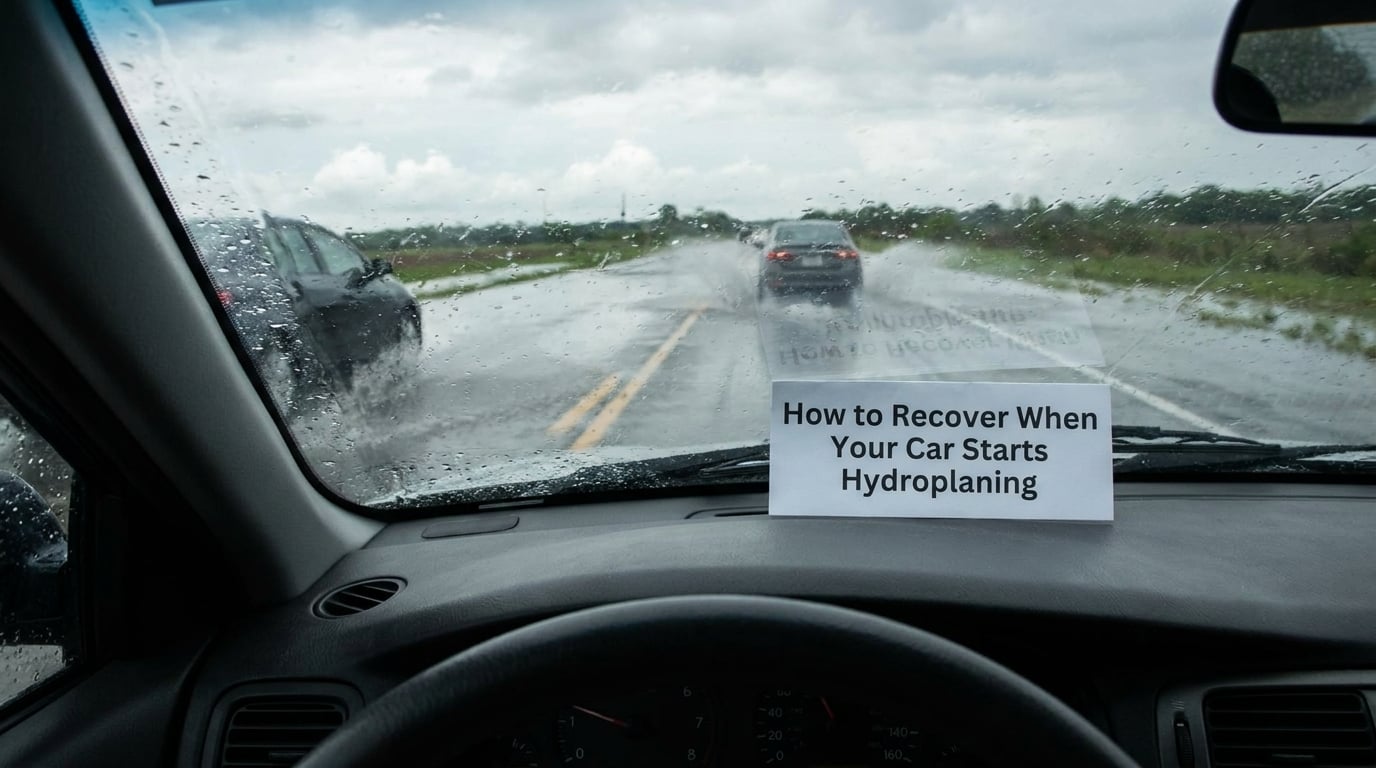
Recovering is mostly about doing less. The instinct to grab the wheel and correct is the one thing most likely to turn a survivable glide into a spin.
Hydroplaning Causes and How to Recover: Step-by-Step Actions
- Release the accelerator smoothly. Take your foot off the gas and let the engine slow the car. Speed is the single factor most in your control, and lifting reduces the water each tire must clear.
- Hold the wheel firmly without turning it. Both hands on the rim, thumbs hooked, and let the wheel stay pointed where the car is actually going. Not where you want it to go.
- Keep the car on a gentle, steady line. If the rear drifts, resist the urge to correct. A small, smooth input is safer than a fast, large one, and larger steering angles make the water problem worse.
- Wait for the tread to recontact the road. This can take a second or several seconds. You will usually feel it as the steering firms up and the engine note changes. Watch for the snap, because the car may move to a new heading the instant grip returns.
- Apply only the braking you actually need. Once the tires are biting, brake progressively to a speed you can handle. If traffic is pulling out or a wall is close, braking becomes the least bad option even before grip has fully returned.
- Recheck the traffic around you. Ease back into your lane only when you know where surrounding vehicles are, then rebuild your speed and following distance gradually rather than accelerating back to where you were.
Drivers describe the moment grip returns as the most frightening part of the event, often more than the slide itself. That reaction is what turns a save into a spin, so anticipate it. Keep your grip on the wheel, keep your foot light, and expect the car to move before you decide where you want it.
Should You Brake Hard During Hydroplaning?
No, hard braking on a water film does not shorten your stop, because there is no friction to convert into deceleration. It adds variables at the moment you have the least control.
Braking is still correct when avoiding a collision outranks the risk of a slide. If a car is pulling into your path, a pedestrian steps out, or you are closing on something solid, press the brake and let ABS do what it was designed for. A steady, firm application is the compromise most safety bodies recommend: it is a controlled input rather than a panic stab, and it gives the ABS system something it can modulate.
Two situations change the guidance. If the event started while you were already braking, lighten the pressure rather than adding to it, and let the car slow on the throttle lift. And on any vehicle with an owner’s manual section on aquaplaning, follow that section. The manual knows your braking system, including electric regen and one-pedal driving setups, which do not behave the way a conventional pedal does.
How to Prevent Hydroplaning in Heavy Rain
Most hydroplaning is decided long before the car starts to glide, and nearly all of it is decided by tire condition and speed.
- Check tread depth. Legal minimum in much of the US is 2/32 inch, and 4/32 inch is a more sensible floor for a car that lives in rain. A US quarter works as a field check: if the wear bar or the top of the quarter is visible across the tread, you are at the end. New tires typically start around 8/32 inch, and wear bars appear well before the legal limit.
- Run the pressure on the door-jamb sticker. It is usually lower than the number moulded into the sidewall, and it is the number the manufacturer tested with. Check cold, before you drive.
- Replace tires on age, not just wear. Six years is the usual point where manufacturers start advising replacement even if the tread looks fine, and older tires also tend to be the ones sitting underinflated in a driveway.
- Match the tire to the car. Low-profile performance tires on a heavy sedan or SUV are a poor pairing for standing water, and all-season compounds behave differently from summer compounds in the cold half of the year.
- Slow down before the water, not in it. Add following distance as soon as rain starts, in the region of five to six seconds rather than the usual gap.
- Switch cruise control off in the rain. It has no way to see a puddle and will happily hold the speed into one.
- Keep brakes and suspension in good order. Healthy braking and dampers give you the control and stability you need once grip does return.
- Postpone the trip if flooding is forecast or a weather warning is already in force.
If you suspect wear or damage, have a qualified tire professional look at it rather than judging from the sidewall in the rain.
When Is Standing Water Too Deep to Drive Through?
You cannot judge water depth from an unknown vehicle in front of you, and that is the whole answer. A sedan can hide a foot of water and a high-clearance SUV can be fully submerged, and the driver’s seat in either case is roughly the same height above the ground.
Other reasons to turn around rather than test it: current can move a car sideways well beyond the driver’s ability to steer, washouts and scoured road edges may be hidden under the surface, and water rising from a blocked culvert can trap you in a dip that looked harmless ten minutes earlier.
A workable framework, in order:
- Can you see the surface texture or the far edge of the water? If not, the depth is unknown and the answer is no.
- Is the water moving? Any visible current rules it out.
- Are road markings disappearing, and can you not see the crown of the road beneath the water?
- Are there barriers, cones, or official closures at the water’s edge? Treat them as the answer.
- Is there any doubt at all? Turn around. In most urban and rural driving, a detour is a smaller cost than a recovery you cannot control.
Can Hydroplaning Damage Tires, Brakes, or the Transmission?
Usually not. A brief hydroplane leaves no lasting mechanical damage on its own, because the tires are not gripping, tearing, or overheating. Brakes and transmission do not suffer because the drivetrain is unloaded rather than overloaded during the event.
Secondary damage is where problems appear. A tire that hits a pothole, curb, or submerged object at speed can take a sidewall cut or a bead failure, and a wheel that took a hit may be bent out of true. Deep water can also cool an engine or overheat it if you hold speed in a rising flood, which is a reason to get out rather than a reason to inspect afterwards.
After a severe episode, walk around the car with a flashlight and look for tread that is torn or feathering from a bad alignment, sidewall bulges or cuts, cords showing through the rubber, and a wheel sitting visibly out of line. If the car pulls to one side, steers oddly, or the tire keeps losing air, take it to a shop for a proper check of alignment, balance, and suspension. Do not drive on a tire you are not sure about in order to inspect it.
What Should You Do If Hydroplaning Happens on a Motorway?
On a motorway the recovery sequence is identical, but the margins are wider and the consequences of leaving your lane are worse. Stay in your lane. Do not attempt a move toward the shoulder or a barrier because it feels like the safe direction, and avoid any lane change until the tires are biting and you know your surroundings.
Keep both hands on the wheel, take the throttle off, and hold the current line. Look well back down the road, not just at the lane markings directly ahead, so you can see a vehicle coming up behind you in the adjacent lane. Other drivers will not expect your car to move, and the ones behind you are the ones most likely to be the problem.
Once control returns, increase your distance from the vehicle ahead well beyond the wet-weather norm and settle to a speed your tires can actually hold in the conditions. A hydroplane on a motorway often happens in exactly the shallow water that looks harmless, in traffic you cannot avoid.
Frequently Asked Questions
How long should I wait after hydroplaning before accelerating again?
Wait until the steering feels normal again and the car is tracking where you point it, which usually takes a second or two but can be longer in deep water. Then build speed back up gradually rather than stamping back on the throttle. If the road is still flooded, there is no waiting period that makes the water shallower. Pull over somewhere safe and let conditions improve instead of driving through a second event.
Does hydroplaning mean the tires have lifted completely off the road?
Not always. A tire can ride on a film of water while still touching the surface at one edge, which is why the car may still respond a little to steering or braking but feels vague and slow. Full aquaplaning is when the entire contact patch is supported by water and no input produces a response. The practical difference is small, because the correct response, easing off and holding a steady line, is the same either way.
Can hydroplaning happen at low speeds during heavy rain?
It can, though it takes a lot more water. Depth, speed, and tire condition combine, so a badly worn or underinflated tire can hydroplane at speeds that would be safe on good tires. Worn tread grooves cannot move the volume of water a downpour delivers, and an underinflated contact patch bulges and displaces less of it. Slower speeds buy you a large margin, but they do not cancel the other two factors.
Should I turn the steering wheel toward the direction the car is sliding?
No, not during a hydroplane. Counter-steering works on a rear-end skid because a friction imbalance is spinning the car, and that imbalance can be corrected. A floating rear tire has no grip to correct, so opposite lock simply sets up a different problem when the water finally clears. Hold the wheel where the car is actually pointing, keep your hands firm on the rim, and let the speed drop until the tires bite again.
Do new tires prevent hydroplaning?
New tires raise the margin considerably but do not make it impossible. Fresh tread has full groove volume and a compound that grips wet pavement well, and new tires are correctly inflated because they are fitted that way. Deep or fast-moving standing water will still lift a tire with excellent tread, so speed and judgment still matter. Keeping pressure at the door-jamb figure is what protects that advantage as the tires age.
Conclusion: Make One Calm Correction at a Time
If you are reading this mid-drive, the whole job comes down to four things: take your foot off the accelerator, do not crank or stab the wheel, wait for the steering to firm up as the tread recontacts the road, and only then brake as much as the situation requires.
Hydroplaning causes and how to recover from it reduce to depth, speed, and tire condition, and you get to set two of the three well before it happens. Slow down before the water rather than in it, run the pressure on your door-jamb sticker, keep real tread depth, and leave the five to six second gap that gives you room to think. Everything else, including what your own manual says about aquaplaning, comes second to that.