
The tire pressure warning on a BMW goes away once the car re-reads its sensors and finds them all reporting correct pressure. That means checking cold PSI against the door-jamb placard first, then running the reset or relearn procedure your model year actually uses, which lives in the owner’s manual rather than in a generic list. Most jobs take 15 to 30 minutes, and almost all of that is the pressure check.
The catch is that a reset only clears the message. If a tire is low, a valve is leaking, or a sensor has failed, the light comes straight back, sometimes within a day. Fix the cause, then clear the light, and never the other way around.
This guide covers the BMW side in detail because menu names and reset methods changed a lot across generations, but the same logic works on any car with a tire pressure monitoring system. Keep your owner’s manual open; it is the only source that matches your exact model year, and it changes the moment you do.
Table of Contents
What You Need
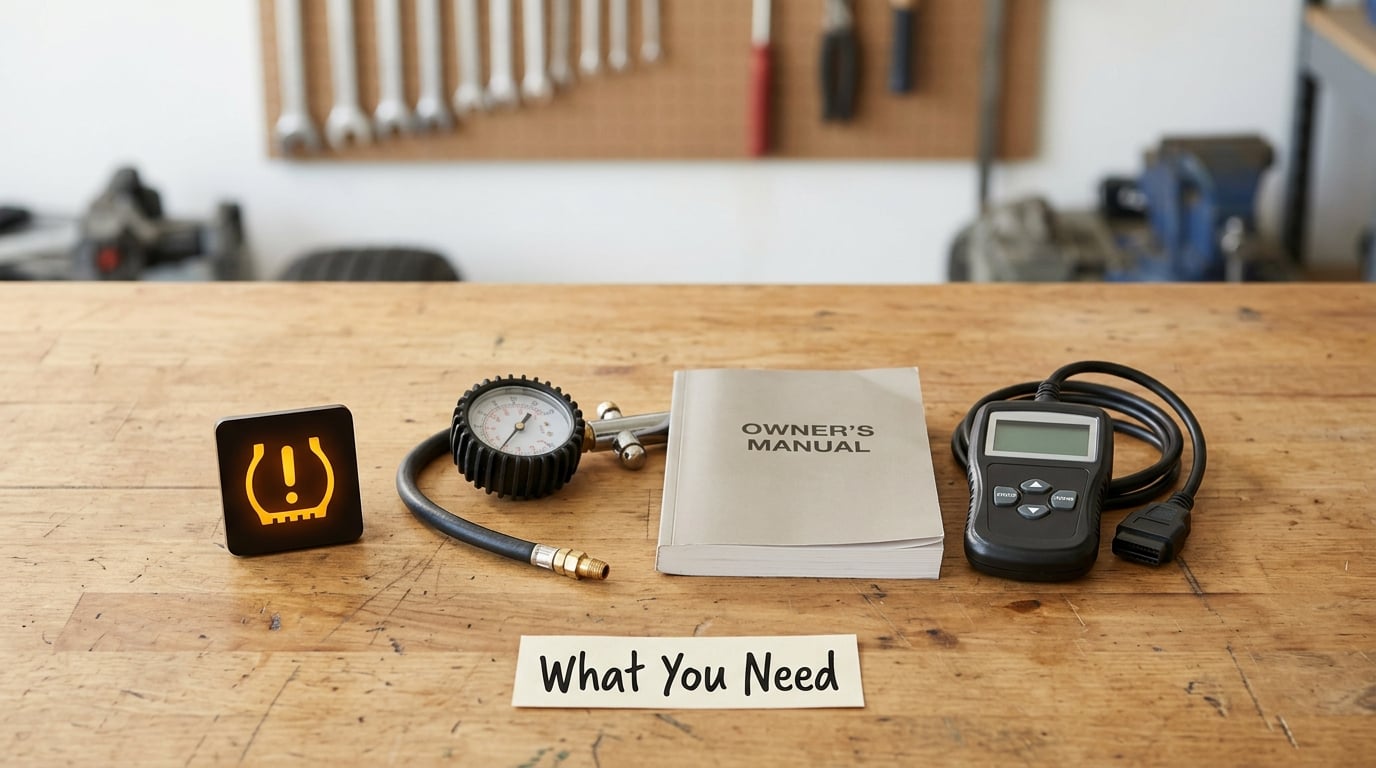
You do not need a workshop to do this. You need a trustworthy pressure gauge, the correct cold pressure for your car, and about half an hour.
- Your owner’s manual for the exact model year. It names the reset button location or the menu path.
- A quality tire-pressure gauge. A pencil gauge in the glove box is often off by 2 or 3 PSI, which is the difference between clearing the light and not.
- The door-jamb placard pressure for your specific tire size. Never use the sidewall maximum; it is not a target.
- Access to the TPMS controls, which may be a button, a menu, or both.
- A battery charger or stable supply on older cars, since some relearn modes hold the ignition on for several minutes.
- An OBD-II scan tool with TPMS functions if a button or menu reset does not take.
One important distinction before you start. A direct TPMS has a pressure sensor in each wheel valve and reports actual pressure per tire. An indirect TPMS watches the wheel speed sensors and infers pressure from how the tires behave, so it usually shows a general warning rather than four individual readings.
BMW has used both approaches across different model years, and the menu wording, the reset method, and even whether you need a relearn at all depend on which system your car has. The owner’s manual settles it in a minute of reading.
How to Reset the TPMS Light Step by Step
There are three reset methods, and most cars only need the first one.
| Method | What it involves | When you need it |
|---|---|---|
| Automatic relearn | Drive 10 to 20 minutes above roughly 30 mph after fixing pressure | Newer cars and most post-service situations |
| Reset button | Hold the TPMS button until the light blinks two or three times, then drive | Cars with a dedicated button, often older models |
| Menu or tool relearn | Start relearn mode in iDrive or with an OBD scan tool, then activate each sensor | After a tire change, sensor replacement, wheel swap, or a failed automatic relearn |
Here is the full order of operations.
- Read the recommended cold pressure from the door-jamb placard on the driver’s door frame.
- Check all four tires cold and set them to that number.
- Inspect each tire and valve for damage, bulges, and objects in the tread.
- Run the automatic relearn first by driving for 10 to 20 minutes above 30 mph.
- If the light is still on, use the reset button or the TPMS menu in your owner’s manual.
- If it still is not clear, run a full sensor relearn, either manually or with a scan tool.
- Verify all four corners report a plausible pressure and the light stays off.
Check Tire Pressure and Condition First
Cold tire pressure means the car has been parked for at least three hours or driven less than a mile. That is the only condition where the number on the placard is accurate, and it is the only number the sensors expect to see.
Air pressure drops by about 1 PSI for every 10F the temperature falls. Park outside on a cold morning after a warm drive and you can lose several PSI overnight with nothing wrong, which is why the light so often greets you in the morning and disappears after a fill.
While the gauge is out, walk around each tire. Look for cuts in the sidewall or tread, bulges, exposed cords, objects wedged in the grooves, and uneven wear across the tread. Run a finger around the bead to feel for anything embedded. A tire with a sidewall cut gets replaced, not reset.
Worth knowing: most systems warn when a tire is roughly 25 percent, or about 8 PSI, below the recommended cold pressure, not the instant it drops a single pound. That gap is deliberate so drivers do not chase the light constantly.
Watch what the light is actually doing, because each pattern points somewhere different.
| What you see | What it usually means | What to do |
|---|---|---|
| Solid warning, no message | At least one tire below the warning threshold | Check and set cold pressure on all four |
| Flashing at startup, then solid | Low pressure, and the light now latched | Fix pressure, then relearn |
| Flashing continuously with correct pressure | Sensor, receiver, or system fault, not a pressure problem | Read codes with a scan tool or see a shop |
| Text message on the cluster | Often names the specific tire or says pressure is critically low | Follow the message, then relearn |
| Flashes briefly every time you start | Normal communication check between sensors and receiver | Nothing, if it goes out |
Use the BMW TPMS Reset Menu
On many BMWs the reset is a physical button rather than a menu item. It is commonly located low near the steering column, on the driver’s knee bolster, or in the switch panel beside the headlight control, and it is a small button marked with a tire-pressure symbol that is easy to mistake for the trip-computer reset.
If it is a button, the sequence is simple: turn the ignition on, hold the button, and wait until the tire pressure light blinks two or three times. Release it, then drive for 10 to 20 minutes above 30 mph so the system collects readings from all four sensors.
On models with iDrive or the Control Display, the reset usually lives in a settings menu, often reached from the main menu into a vehicle or tire pressure item, where a reset or relearn option starts the process. The exact path and wording moved several times across BMW generations.
That is why I will not print a menu path here. A path that is right for a 2026-era 3 Series can send you hunting through Settings on a later car where nothing is called that. Open the owner’s manual, search for tire pressure or TPMS, and follow your own screen. Toyota Tacoma owners report the same button-and-drive behavior on their trucks, which tells you the button method is widespread rather than a BMW quirk.
Whichever route you use, the sequence underneath is identical: put the car in relearn mode, let the module wake the sensors, collect all four readings, then drive to confirm.
Run the TPMS Sensor Relearn When Required
A relearn is a full re-registration of every sensor with the TPMS module. The automatic drive-cycle method is a relearn too, but a manual one lets you activate sensors one at a time and hear confirmation.
You need a manual relearn after a tire or sensor replacement, a seasonal wheel swap, a wheel change, sometimes after a rotation, and any time a sensor has been disturbed enough to lose its pairing. Some cars relearn automatically after a rotation; others, especially older ones and many European models, expect a position relearn.
The manual sequence runs like this.
- Inflate all four tires to placard pressure, cold.
- Put the ignition on and start the relearn mode, whether through the button or the menu.
- Activate each sensor in turn, starting with the driver’s side front tire and working clockwise around the car.
- Wait for confirmation. Many cars chirp the horn or flash the light when each sensor is accepted.
- Exit relearn mode, then drive for 10 to 20 minutes above 30 mph.
There are two ways to activate a sensor. The tool-based method sends a radio signal to that corner from a TPMS activation tool, and it is the most reliable. The manual method works on many cars without a tool: deflate a tire by about 5 PSI, wait five seconds, and reinflate it. The pressure change triggers the sensor to transmit. Cadillac forum users describe exactly this trick, and owners on Chevy Bolt report that a simple drive after a rotation relearns on its own in 10 to 30 minutes.
A scan tool is the fallback when the manual method fails. A TPMS-capable scanner reads each sensor’s ID, tells the module to accept it, and clears the fault. Some scanners also copy the ID from an old sensor onto a new one so you are not paying for programming on top of the part.
Confirm the Warning Has Stayed Off
Do not judge success at the moment the light disappears. Confirm it later.
Check that the cluster reports four plausible readings, not two or a set of blanks. An indirect system will not show individual tire values at all, which is normal. Then drive for 20 minutes or so at normal road speed and check again.
Check it once more the next morning, before you inflate anything. If the light is on at cold start and the tires still hold placard pressure overnight, the light was telling you the truth and something is leaking. If it stays off, the reset took.
One cold-weather wrinkle: some cars keep a warning active after you fill the tires and need the full relearn rather than a simple clear, and the light can reappear the next morning if the pressure fell below the threshold again.
Common Mistakes
Resetting before fixing a low tire. This is the big one, and forums show it constantly. Clearing the code without correcting the cause means the same warning returns in a week and people conclude the sensor is dead.
Following instructions for a different generation. BMW, like every other brand, has changed its menus and reset behavior across model years. A walkthrough for a car ten years older than yours can send you to a button that does not exist.
Using the wrong activation method. The deflate-and-reinflate trick works on a lot of cars and none at all on others. If five seconds of pressure change produces no chirp, move to a tool or a shop rather than repeating it.
Disconnecting the battery to clear the light. This one gets repeated endlessly online and it does not work. Owners on Hyundai forums report that disconnecting the battery had no effect on TPMS behavior at all, and you lose unrelated settings, throttle-response adaptations, and window and radio presets in the process.
Assuming a flashing light means low pressure. A light that flashes continuously with correct pressure is a system fault. You are not fixing a tire, you are chasing a sensor or module problem.
Driving on a damaged tire. A sidewall cut or bulge ends the conversation. No reset makes that tire safe, and running it risks a blowout.
Confusing TPMS with the brake system. Both live on the cluster and both can light a warning. If you also see a brake fluid or brake system message, that is a different repair, and you can read about that warning in our guide to what causes a low brake fluid warning light.
Clearing the same code over and over. Every repeat reset without a diagnosis is wasted time. If two careful attempts do not clear it, the answer is a scan tool, not a third try.
What to Do If the TPMS Light Comes Back
A warning that returns after a proper reset is a diagnostic clue, not an annoyance. Work through it in order.
- Recheck all four cold pressures against the placard, before inflating anything.
- Inspect the valve stems and cores for corrosion, cracking, or a slow leak, and check for a nail or a screw in the tread.
- Confirm the wheels and tire sizes match what the car expects. Aftermarket wheels without sensors or a different tire size can trigger a permanent warning.
- Check the spare if your car monitors it. A 5-tire system will not clear until the spare reports too.
- Read the TPMS data with a scan tool. Look for a sensor that reports no signal, a battery voltage reading that is out of spec, or a stored module fault code.
- Consider per-wheel sensors. Some vehicles treat sensors as position-specific, so a replacement may need the ID programmed to that corner rather than just installed.
If the tire holds pressure, the valve is clean, and a scan tool shows a dead sensor, replacement is the fix. Sensor batteries typically last somewhere around 5 to 10 years, and they are sealed units with no replaceable cell, which is why failure tends to cluster in older vehicles.
When to Have a Professional Diagnose the TPMS
There is a clear line between a DIY reset and a repair job. Get a shop involved when any of these apply.
- The tire has a sidewall cut, a bulge, exposed cord, or tread that is worn to the bars.
- The light returns after a correct cold-pressure check and a proper relearn.
- The light flashes continuously and pressure is fine, which points to a sensor, receiver, or module fault.
- A sensor or valve is physically damaged, for example after a curb or a bad reseat.
- The dashboard reports a TPMS system fault or shows fewer than four tire readings.
- Your car requires a model-specific programming procedure or a rolling relearn on public roads, which is safer handled by someone doing it every day.
One more reason to get it sorted: in states that inspect vehicles, a tire pressure warning can be a failure item, and bypassing a sensor to silence the light is both illegal under federal rules and a bad trade against the reason the system exists.
Frequently Asked Questions
Can I drive with the TPMS light on?
Yes, usually, but fix it soon. A steady light with correct-looking tires means you should check pressure at the next stop and top up to the door-jamb placard number. Do not keep driving on a tire you can see is low, bulged, or cut. A flashing light with correct pressure is a system fault rather than a blowout risk, so drive normally and schedule a scan.
Why does the TPMS light come back after I reset it?
Because the cause was never fixed. Pressure that drifts below the warning threshold, a slow leak, a bad valve core, or a failing sensor all put the light straight back. Cold weather makes it worse, since air loses about 1 PSI for every 10F drop. If the light returns with cold tires still at placard pressure, the problem is a leak or a sensor, not the reset.
Do I need to reset TPMS after replacing a tire?
Usually, yes, and it depends on the car. Many vehicles relearn automatically once you drive for 10 to 20 minutes above 30 mph, so replacing one tire and driving may be all that happens. Others, especially many European models and cars with wheel-position sensors, need a manual relearn so the module accepts the new sensor. Your owner’s manual will say which.
How long does it take to reset a TPMS light?
Plan on 15 to 30 minutes for most cars. The pressure check and inflation takes the first ten minutes, then you either drive for 20 minutes above 30 mph for an automatic relearn, or hold the reset button and drive afterward. A manual sensor-by-sensor relearn adds another 10 to 15 minutes, and an OBD relearn with a scan tool is quicker once the tool is connected.
Should I reset TPMS before or after fixing a low tire?
After, always. Resetting first just clears the message while the tire is still low, and the light returns as soon as the system re-reads the sensor. Set all four tires to the recommended cold pressure from the door-jamb placard, confirm they hold, then run the reset or relearn. If you reset first, you will spend the next week wondering why the light keeps coming back.
Why does my BMW TPMS light stay on with correct tire pressure?
Correct pressure is only one of the conditions. The system also needs the sensors registered and reporting, so a fault in a sensor, a receiver module, or the wiring can keep the light on with perfect tires. A light that flashes rather than glows steady is a fault signal. Reading the TPMS data with a scan tool tells you whether the module sees four sensors and whether any ID failed to register.
Conclusion
Start with pressure. Check all four tires cold against the door-jamb placard, inspect the tread and sidewalls, and fix anything you find. That step solves more cases than any reset, and skipping it is why so many people believe their sensor is dead.
Then run the exact procedure your BMW manual specifies: hold the reset button and drive if your car has one, use the iDrive or Control Display TPMS menu if it does not, and do a full sensor relearn if the light survives both. Check the next morning before you inflate anything, because that is the honest test of whether the repair held.
If the light comes back, stop resetting and start diagnosing: valve, leak, wheel compatibility, then a scan tool for sensor data. Get a qualified shop involved for a damaged tire, a flashing light with correct pressure, or a model-specific programming job. A warning you understand is a minor annoyance; a warning you learned to ignore is how a slow leak turns into a blowout on the interstate.