
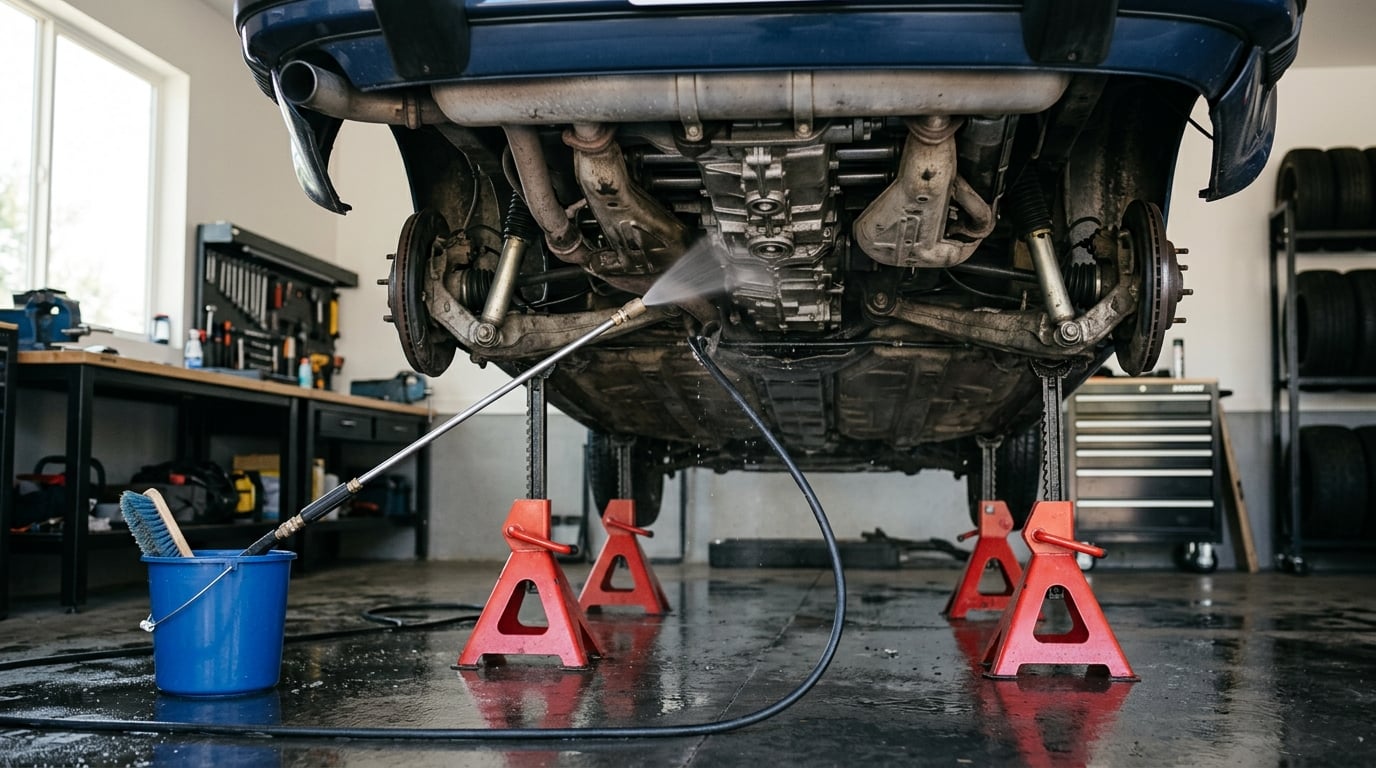
To clean undercarriage road salt off a car, get underneath it with low-to-moderate water pressure, loosen the dried brine with a car-safe cleaner, scrub the structural surfaces, rinse from several angles and dry everything before you park. The whole job takes 45 to 90 minutes on a calm cold day.
A quick body wash feels productive and does almost nothing. The salt you cannot see is packed into the subframe, the wheel wells, the bumper mounts and along the rocker panels, and that is exactly where corrosion starts. A layer of dried chloride brine holds moisture against bare steel and keeps an electrical charge, so the metal pits instead of simply getting wet.
The good news is that salt washes off. It does not need a shop, a lift or a pressure washer, though a lift makes it easier. Below is the process I use, including the parts most people skip and get wrong on the first attempt.
Table of Contents
- What You Need
- How to Clean Undercarriage Road Salt Off a Car Step by Step
- Common Mistakes
- How to prevent road salt from returning
- Frequently Asked Questions
- Is salt bad for the undercarriage of a car?
- Does vinegar actually neutralize road salt on a car?
- Can I use regular car wash soap to get salt off the undercarriage?
- Is it necessary to wash salt off my car in winter?
- How long does it take for road salt to corrode a car?
- Will a car wash undercarriage wash get all the salt off?
What You Need
Nothing here is exotic, and none of it needs to be new. The one item worth buying fresh is the cleaner, because old chemistry in an old bottle tells you nothing.
- Car-safe wash soap or a dedicated underbody cleaner. Look for a pH-balanced, vehicle-safe label. Household dish soap, engine degreaser and anything acidic are out.
- A garden hose with a low-pressure nozzle, ideally an undercarriage rinse attachment or a long wand so you can reach the middle of the underside without lying in a puddle.
- A pressure washer, only if you already own one. Household electric models work; more pressure is not automatically better.
- A long-handled stiff nylon brush. Steel wire brushes scratch powder coat and thin steel. Nylon is enough for road salt film.
- A bucket and a pump sprayer. A garden pump sprayer is a cheap way to apply cleaner evenly and let it dwell.
- Nitrile gloves and eye protection. Underbody grime from a winter road is unpleasant to handle, and brine runs downward straight into your eyes.
- Rated jack stands on level concrete, or approved lift or ramp access. A jack alone is never enough support.
- A creeper and an LED headlamp. You cannot see salt in a dark underbody with a phone flashlight bouncing off the frame.
- A drying plan. Compressed air, a blower, or a shaded dry period. Decide this before you start, not after.
- A drain cover or a spot that drains to a lawn, since wash water carries salt off your driveway. Salt on concrete is its own problem, similar to how to clean up a coolant spill in the driveway.
How to Clean Undercarriage Road Salt Off a Car Step by Step
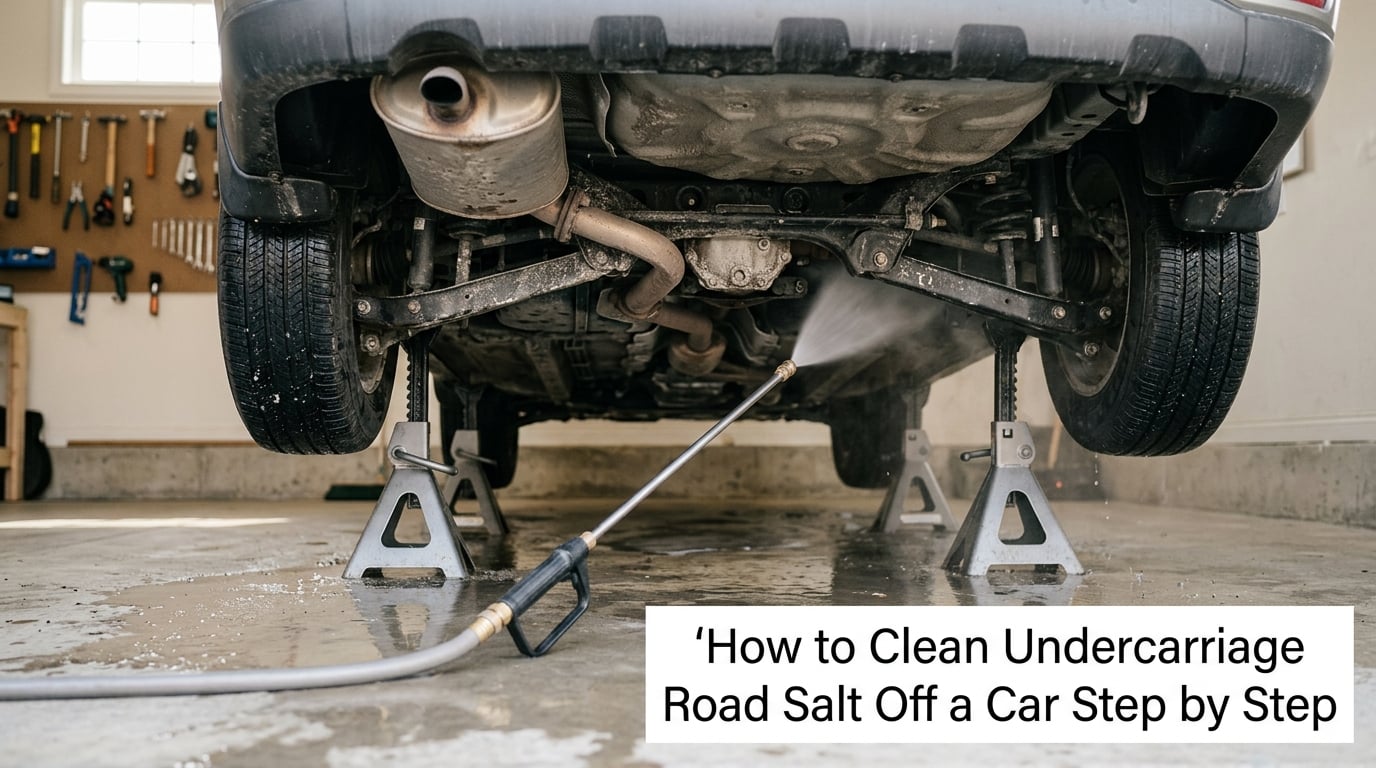
Read the whole sequence once, then work through it. The order matters: loose grit comes off before cleaner goes on, and the rinse only works if you move the water around.
Inspect the vehicle and choose a safe wash method
Start with the car on level ground, engine off and cool, transmission in park with the parking brake set. Look under the car before you touch a hose.
Find the components that must not be sprayed directly: brake calipers and hoses, wheel bearings, electrical connectors under the transmission, the exhaust tip and catalytic converter area, and any loose shield, cracked hose or hanging fastener. A bent shield or a dangling brake line is a stop-and-fix item, not a rinse-and-hope item.
You have three realistic ways to get underneath. A drive-through wash with an undercarriage cycle is fastest, self-serve spray bays with a ground-level wand are the compromise most owners use, and a driveway with rated jack stands gives you the most control and the least water pressure risk. Whichever you pick, the car must be wide enough that the spray or wand reaches the center of the underside rather than only the rocker panels.
Pre-rinse loose salt and winter grime
Loosen and rinse off the loose material first, using low-to-moderate pressure. Hold the nozzle about 12 inches from the surface and sweep along the frame rails and under the car rather than pointing a solid stream at one joint.
This step is the one people skip, and skipping it means dragging gravel and sand grit across the underbody with your brush. Grit under pressure acts like a blaster. If you find packed sand and salt slurry from a plow truck, break it up with water and a gloved hand before anything else touches it.
Skip the pre-rinse and the cleaner sits on top of the caked layer instead of under it.
Mix and apply an undercarriage-safe cleaner that dissolves undercarriage road salt
Dilute a pH-balanced car-safe cleaner in a bucket or pump sprayer following the label, and a measured example looks like this: one ounce of concentrated car wash soap per gallon of warm water, or roughly a quarter cup of a premixed underbody cleaner in a gallon of water.
Spray or scrub it onto structural surfaces that hold salt: frame rails, subframe, control arms, brackets, spring perches, the fuel and brake line runs, exhaust hangers and the areas where components meet. Let it sit for the dwell time on the label, usually 5 to 10 minutes, and work section by section so the whole underside is not drying out while you scrub the rear.
Do not use household detergents, engine degreasers, bleach or anything acidic. They strip wax and undercoating, attack rubber bushings and can leave a film that holds moisture against the steel. Vinegar is a separate question and I cover it in the FAQ, because it is a real option with real limits.
Scrub the salt from the undercarriage
Use the long-handled nylon brush with gentle pressure on flat and welded surfaces. The goal is agitation to break the bond, not force. You should see grey-brown foam coming off the metal and a white residue in the runoff.
Pay attention to the places that collect salt rather than the places that look dirty. Wheel wells and fender liners, the back of the front bumper, the tow hook recess, door sills and the rocker panel joints, the subframe mounting points, the spare tire well and the fuel filler area are all salt traps.
Be gentler around moving and friction parts. Do not scrub brake calipers, brake hoses, steering rack boots, CV boots, or the rubber boots on your suspension with anything abrasive. Those items fail from age and abrasion, and a stiff brush accelerates the problem.
Rinse thoroughly from multiple angles
The rinse is what actually removes the salt. Rinse the underside, the wheel wells and the lower body panels, changing the angle every few passes so water reaches the top of the subframe and the inside of the frame rails. Let the water run downward and out, which is why you approach from behind and to the side rather than straight underneath.
Use controlled pressure. A strong concentrated stream aimed at a body seam, a wiring connector or a rubber boot can force water where it does not belong. Break the stream up and move it, and work from the outside in.
Run your hand along the frame rail and the sill. If it feels slick and leaves a white film on your palm, keep rinsing that section. A faint film is fine; a visible crust means salt is still there.
Dry the undercarriage and inspect for remaining salt
Corrosion needs moisture as much as it needs salt, so drying is a real step and not a nicety. Blow the underside down with low-pressure air, paying attention to cavities, the wheel wells and inside the frame rails. Then give it time in shade with the doors open to move air through it.
Inspect before you put the car away. Look for white powdery residue, orange or brown rust staining, damp spots that should have dried, stone-chip damage to brake or fuel lines, weeping around fasteners, and any fluid leak you had not noticed. Loose rust scale flaking off a bracket is a mechanic question, not a scrubbing question.
If the forecast is below freezing, dry it before the temperature drops. Water trapped in a cavity that freezes expands and pushes joints apart, which is how a small leak starts.
Common Mistakes
Almost every undercarriage wash problem comes down to pressure, chemistry or timing. These are the ones I see most, with the fix next to each.
- Blasting with maximum pressure. A pressure washer pointed at the underside without a diffuser or a wide fan can lift seam sealer, force water into connectors and blow salt deeper into cavities. Fix: lower the pressure, widen the fan, keep moving.
- Washing a hot car. Hot paint and hot exhaust plus cold water is a bad combination for spotting, and crawling under a recently driven car to spray its exhaust area is a burn risk. Fix: let the car sit until the exhaust is cool to the hand.
- Reaching for harsh chemicals. Degreaser, bleach and acidic DIY mixtures cut through salt and also cut through wax, rubber and powder coat. Fix: a pH-neutral car-safe product every time.
- Spraying brake and steering components directly. High-pressure water at a caliper, wheel bearing or steering rack boot pushes contaminants into seals it was designed to keep out. Fix: rinse around them, keep the stream on the structural metal.
- Ignoring the wheel wells. The wheel well and fender liner are among the saltiest places on the car and the easiest to miss. Fix: wash these by hand, on every wash, not just at the underbody stage.
- Skipping or rushing the final rinse. Cleaner left on the underbody keeps working and leaves a film that traps moisture. Fix: rinse until a hand check comes away clean and slightly squeaky, not slick.
- Drying with a propane or radiant heater in a closed garage. This is the most dangerous item on the list. Unvented combustion heaters produce carbon monoxide, and a closed garage is exactly the wrong place for one. Fix: use electric air, or open the garage fully and ventilate.
- Washing over an unprotected storm drain. You are moving chloride brine across your driveway and into local water. Fix: cover the drain, and note that driveway runoff also drags brake dust into concrete stains, which is a separate cleanup problem worth reading up on if it has already happened.
How to prevent road salt from returning
Cleaning is a fix. Preventing the next round is cheaper and easier. Salt-heavy regions, including places that switched from rock salt to liquid brine, are harder on underbodies than rock salt alone, so the routine matters more there.
- Wash the underside after every salty storm, not on a fixed monthly schedule. If the roads have been treated and you drove through the spray, that is the day.
- Use a wash with a real undercarriage cycle, or a self-serve bay with a ground-level wand. If you rely on the car wash alone, expect a film, and follow up at home when the weather allows.
- Apply a rust inhibitor or underbody protectant to the cleaned, dry underside before winter. It does not remove salt; it slows moisture and corrosion on the cleaned metal. Forum regulars have made spraying a water-displacing protectant into the crevices each fall a long-running habit.
- Repair damaged undercoating and stone-chip damage early. Bare steel where the factory e-coat or undercoating has been scraped off will pit far faster than a protected panel.
- Fix leaks and dripping fluids promptly. Brake fluid, coolant and fuel on the underbody hold moisture and contaminate the surface underneath.
- Keep the car drier when you can. Covered parking helps, and so does keeping the car clean enough that dirt is not holding brine against the body between storms. Wash driveway grime off too, the same way you would approach cleaning brake dust off a driveway, so it does not hold salt against the rockers.
One thing rain will not do is clean your underbody. A passing shower wets the top of the car and leaves the underside damp, which is a better place for salt to sit than before.
Frequently Asked Questions
Is salt bad for the undercarriage of a car?
Yes. Road salt is a chloride-based electrolyte, and once it dissolves in moisture it holds an electrical charge that speeds up electrochemical corrosion on steel. Chloride ions actively break down metal, so the underbody, subframe, brake lines and exhaust hangers corrode faster than the painted body above the splash line. Salt also holds water against seams and cavities, keeping them wet long after the car dries.
Does vinegar actually neutralize road salt on a car?
Partly, and it is worth being honest about that. A solution of about two tablespoons of white vinegar per gallon of water will neutralize the alkaline brine film on the underbody and help it rinse away, and owners on detailing forums have used it for years. It is a partial step, not a replacement for rinsing, and plain water is what actually carries the salt off the metal.
Can I use regular car wash soap to get salt off the undercarriage?
Yes, and most people get acceptable results with it. Car wash soap is pH-balanced and vehicle-safe, which is why detailing forum owners routinely use it under the car. It will not neutralize the brine, so it relies on volume of water to do the removing. Apply it to the structural metal, dwell for a few minutes, scrub with a nylon brush and rinse until your hand comes away clean.
Is it necessary to wash salt off my car in winter?
Yes, in any region that treats roads. Salt damage accumulates quietly over weeks of wet, salty driving, and the underside is the part a body wash never touches. Wash the undercarriage after every salty storm if you can, and at minimum monthly through the worst of the season. If you cannot get underneath the car, a wash with a real undercarriage cycle is worth the detour.
How long does it take for road salt to corrode a car?
It depends on coating quality, moisture and how often the car is driven on salted roads. On bare or already damaged steel, pitting corrosion can start within a few weeks of repeated wet salty driving, and owners in Ontario describe liquid brine as eating through metal quickly. Galvanized or factory e-coated underbodies last far longer. Paint on the body is not a reliable indicator, since corrosion usually starts on the underside.
Will a car wash undercarriage wash get all the salt off?
Usually not entirely. Undercarriage cycles at tunnel washes and self-serve bays remove most loose salt, and Subaru XV forum owners report that a run through the car wash still leaves a film behind on the underbody. The missed areas are the inside of the frame rails, the back of the bumpers, the sills and the spare tire well. A follow-up rinse at home during a break in the weather closes the gap.
Start this weekend: put the car on rated stands, pre-rinse the underside, hit the frame rails and wheel wells with car wash soap and a nylon brush, rinse until a hand check comes clean, then blow it dry and apply a protectant. Knowing how to clean undercarriage road salt off a car is a small job that protects the subframe, brake lines and exhaust for years.