
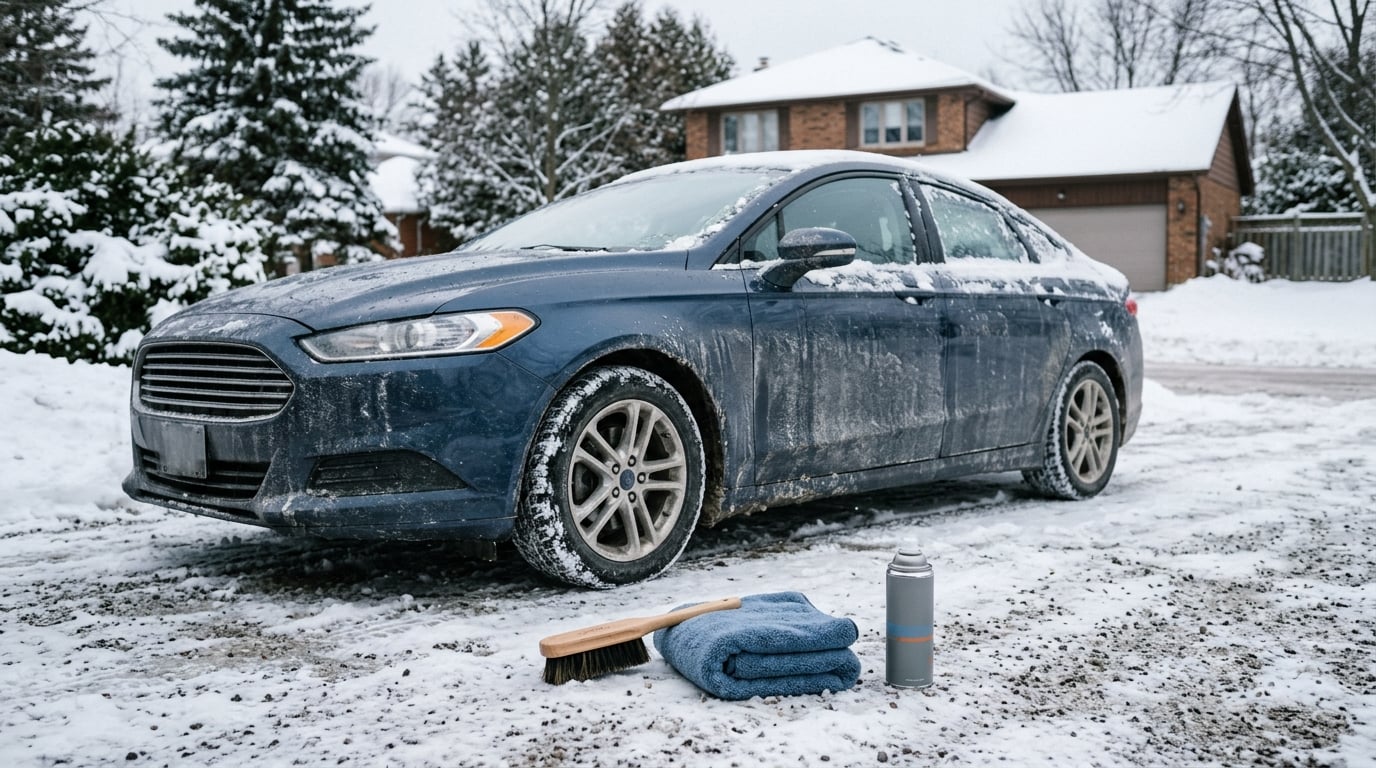
Rust is not a snow problem, it is a salt problem wearing a snow coat. Road salt dissolves into the thin film of water that always sits on a car, and that water becomes an electrolyte that pulls steel apart at the molecular level. Learning how to prevent rust on a car in a snowy climate comes down to three jobs: get the salt off, get the water off, and keep a barrier between bare steel and everything else. Set aside an afternoon before the first freeze to do it properly, then twenty minutes here and there all season.
Most of the work is habit rather than equipment. The owners whose cars stay clean through a salt season are not doing anything clever, they are just removing salt faster than it can do damage.
Table of Contents
- What You Need
- How to Prevent Rust on a Car in a Snowy Climate
- Common Mistakes
- Frequently Asked Questions
- How often should I wash my car in a snowy climate?
- Does washing my car in winter cause more rust?
- What is the best way to protect a car’s underside from road salt?
- Can I stop rust once it has already started on my car?
- Are rust-inhibiting sprays or cavity waxes worth using?
- Should I use a car cover during snowy weather?
- Conclusion
What You Need
The list is short and none of it is specialized. What matters is having it ready before you need it, because the right time to de-salt a car is right after a salted drive, not on a warm Saturday in March.
- Automotive shampoo. Plain car shampoo, not dish soap and not household laundry detergent. Laundry detergent leaves a film that holds dirt, and dish soap strips wax.
- Two buckets and a grit guard. One bucket for soapy water, one for clean rinse water, with grit guards in both. The clean bucket is what stops you dragging grit across the paint while you dry.
- A soft wash mitt and a soft brush. A microfiber mitt for the paint, a soft bristle brush for wheel wells, sills and seams. Never a stiff brush, which scratches the clear coat and creates new places for salt to sit.
- Microfiber drying towels and a blower or compressed air. You need more drying capability than you think. A 20 mph breeze across a wet car will find every seam you skipped.
- Washable underbody spray wand. A long-reach nozzle that reaches the rocker panels, frame rails and suspension from the driveway. This is the single highest-leverage tool on the list.
- Wax, sealant or spray protectant. Any of the three creates the barrier that keeps water and salt off paint. A paste wax lasts longer, spray wax is faster and needs more frequent reapplication.
- Rust inhibitor spray or cavity wax. For the undercarriage, wheel wells, door jambs, frame rails and any spot where the factory sealer has failed.
- A touch-up paint pen and clear coat pen. Every rock chip you seal this week is one fewer rust hole you patch in five years.
- A flashlight, a small mirror and jack stands. For the inspection. You cannot see a floor pan from a parking lot.
- A safe drying area. A garage, a carport, or a clear cold day with low humidity. Drying matters more than most people expect.
Older BMWs and any car with existing surface rust deserve two extras: a small flashlight with a tight beam for crevices, and more time. Existing corrosion changes the job from prevention to containment, and containment means keeping the rust from advancing, not making it disappear.
How to Prevent Rust on a Car in a Snowy Climate
How to prevent rust on a car in a snowy climate before winter
Start in late fall, before the temperature drops, because a wet door jamb in January is a frozen door jamb in February. Park on level ground, jack it up on stands at the four factory jacking points, and look underneath with a flashlight.
You are hunting for three things. First, surface rust, which is a dull orange or brown powder on a steel or cast aluminum surface, often with the paint still intact. Second, coating failure, seen as cracked, hardened or missing factory seam sealer around the frame rails, rocker panels and suspension mounting points. Third, a paint failure on the outside, which shows up as bubbling, lifting or a dull brown stain under a chip.
Tap any suspicious coating with a screwdriver. Firm and continuous is fine, flaking and hollow means it has failed and moisture is already getting in behind it. A bottle of seam sealer and a razor scraper will fix more than you expect in an hour.
Check that the paint is actually still on the car. A wash that hits bare metal with a pressure washer will make a small chip worse in seconds, so seal every chip and stone nick with touch-up paint and a clear coat pen before winter arrives.
You have done this step correctly if every exposed metal edge is covered and no factory seam sealer is flaking anywhere you can see.
Wash road salt off more often
Road salt does not stop working when you park. It stays chemically active in thin moisture films, so the clock starts the moment you get home from a salted road.
The rule I give people is simple: wash within 48 hours of a salted drive, and sooner if you can. If the temperature is going to drop below freezing again before you can get to it, wash at a self-serve bay with warm water, even a quick one, because frozen brine holds itself against the metal until it thaws.
Use lukewarm water rather than cold. Warm water dissolves salt faster and cuts rinse time. Rinse before you soap, always, and pay attention to the four areas most owners skip: the wheel wells, the rocker panels, the front and rear bumpers, and the underside.
For the wheel wells, a soft brush with the soapy solution and a five minute dwell before rinsing will pull salt out of the liner and the lip of the arch. For the underside, a washable wand with plain water, no soap needed, is enough to move the brine off the frame rails and suspension.
Automatic washes are not useless, but understand the trade. A brush wash with fresh water moves a lot of salt. A touch-free wash relies on chemicals and recycled water, and recycled water carries salt from the previous car back onto yours. If you use a touch-free, go through an automatic rinse afterward so the salt has somewhere to go.
You know the salt is gone when the runoff stops leaving a white haze on your driveway during the final rinse and a damp white cloth dragged under the rocker panel comes back clean.
Dry the paint and wheel wells completely
Standing water is half the corrosion equation, and it collects in places people do not think about. Open every door and check the jambs, look under the trunk lid edge, look at the seal at the bottom of each door, and look inside the wheel well behind the liner where the arch meets the body.
Work in a pattern. Blow out the seams and jambs first with compressed air or a blower, then the wheel wells, then the last pass on the flat panels with a dry microfiber towel. Drying a wet car with a towel alone mostly pushes water around and into the trim; the air comes first, the towel second.
Fold the towel rather than dragging it flat. A flat towel picks up grit and grinds it into the clear coat as you move, and those swirl marks hold salt all season.
This step is where a parked car quietly earns its reputation. Anything that sits in one spot with moisture, like a brake line or a suspension arm, will eventually go through, which is why owners ask [why brakes rust when a car sits](https://www.garageboy.com/why-do-brakes-rust-when-a-car-sits/) and get an answer that comes down to the same thing, time plus water plus no coating.
You are finished when a hand run along a jamb or arch seam comes away dry, not cool and damp.
Protect exposed metal with wax, sealant or rust inhibitor
Cleaning removes the salt, and protection is what keeps the next layer of salt from settling in. There are three categories, and they are not interchangeable.
Automotive wax or sealant goes on top of paint. It sheds water, it makes salt easier to rinse off later, and it slows the freeze-thaw cycle that cracks paint adhesion. A paste or liquid wax with a sealant polymer gives roughly three to four months of protection in winter conditions. Spray wax gives two to six weeks and takes five minutes, which is why people who wash weekly use it anyway.
Cavity wax and rust inhibitor sprays go where paint is not, door jambs, frame rails, seam cavities, the backs of body panels, and the pinch weld at the bottom of a door. They are oily or waxy, they displace water, and they are the answer for a car whose factory sealer has cracked.
Dielectric protectants and grease belong on connectors, wiring, clips and bare electrical fittings, not on a brake rotor. Keep them away from anything that generates heat or friction.
Apply wax to cool, dry, freshly washed paint, following the product label for cure time before the car goes back outside. Applying to hot or wet paint is the most common application mistake there is, and the coating will peel within weeks.
Newer cars, especially many Japanese-manufactured ones, come out of the factory with a galvanized or electrogalvanized body panel, an electrophoretic dip coating, and cavity wax applied inside the doors and rockers. That three-layer stack is why a Toyota, Honda or Subaru parked on the same salted street as a European sedan often looks untouched after five winters. The difference is factory process, not owner effort.
On WD-40, the honest answer is that it is a water displacer and a light lubricant, not a corrosion coating. It will slow a light tarnish over a few weeks, but it is not built to hold salt brine against a suspension arm for a whole season. Use it for hinges, latches and fasteners, and use a real rust inhibitor for anything structural.
Protect the underside and keep moisture away
The underside is where the damage actually happens, and it is the part almost every owner skips. Salt brine, mud and slush pack into the frame rails, the rear axle, the brake lines and the fuel lines, and the underbody holds all of it for months.
Wash it first. Every coating goes on over a clean, dry underbody, and putting a film over a brine bath just seals the problem in place.
Here is the honest version of the undercoating argument, because it is the most argued topic in owner forums. A thin, oil or wax-based film that penetrates and leaves the seams able to breathe is protection. A thick, cheap build-up that sits on top of the surface and bridges the seams is a plastic sheet, and it traps whatever moisture is already there. The people who say undercoating causes rust are usually describing the second case, and the people who say it is the best defense are describing the first. Same product family, opposite outcome, decided entirely by application thickness and whether the car was dry underneath first.
There is a second failure mode worth naming. A drip-free oil undercoat that is applied over a wet underbody, or sprayed heavy enough to run down onto the exhaust system, can create its own problems. Coating the exhaust, muffler, catalytic converter, brake lines that move, or rubber bushings is how parts crack or seize. Mask nothing, keep the spray moving, and stay well clear of exhaust heat shields and anything that rubs.
Work from jack stands on level ground, mask the exhaust and brake hoses, apply thin even coats per the product instructions, and let it cure before the car goes back on the road. If you cannot crawl under your own car safely, a shop treatment is the sensible call, and the treatment worth paying for is one that includes cavity wax injection, not just a spray film over the visible underside.
Maintain protection during winter and spring
There is no universal interval, because salt exposure is not universal. A car parked in a garage between home and office in a moderate-salt city needs far less than a work truck that sits on treated roads eight hours a day. Watch conditions, not the calendar.
Use this as a starting point, then adjust.
| Situation | Action | Timing |
|---|---|---|
| Just drove on treated roads | Full hand wash, underside rinse, dry | Within 48 hours |
| Temps drop below freezing again before you can wash | Quick rinse at a warm-water self-serve bay | Same day |
| Salt still visible on the underbody after a storm | Underbody wand rinse, no soap | Within a few days |
| Protective spray wax is wearing thin | Spray wax on dry panels | Every few weeks |
| Before long-term winter storage | Wash, wax, fresh rust inhibitor, inflate or support the tires | Before it goes dormant |
| First warm day above freezing | Full de-salt wash and underbody rinse, then inspect | That day, not a week later |
Two more triggers that catch people by surprise. Owners who move to a snow-belt state from a dry one often find corrosion that was already developing quietly on the way in, so the first full underbody inspection matters more for them than for anyone. And salt tracked inside on boots and mats can soak into the carpet and wet the floor pan from inside, so lift the mats, check for dampness and vacuum the interior dry when you de-salt in spring.
You are on track if, in spring, a flashlight along the frame rails shows bare sealed metal rather than orange powder.
Common Mistakes
Almost every one of these is a habit rather than a lack of equipment.
Washing in freezing conditions
Washing when the panels stay below freezing leaves a film of salt brine behind, and you have just made the car worse. Fix it by waiting for a day above freezing, or use a heated self-serve bay. The preventive habit is checking the panel temperature with the back of your hand before you start, not the air temperature.
Using stiff brushes on the paint
A stiff bristle brush cuts the clear coat, and every scratch is a salt trap. Use a microfiber mitt on paint and reserve a soft brush for wheel wells and seams only. Tip: if grit falls off the mitt while you work, the grit guards or a fresh rinse water are not doing their job.
Drying only the upper body
Water in the jambs, arches and trunk edge is where corrosion concentrates. Break out the blower and check those spots with a hand, every time. A separate small towel for the jambs keeps you from re-wetting the panels you already dried.
Applying coating to hot or wet paint
Wax and sealant applied to a warm or damp panel peels off in weeks. Work in shade on a cool panel, and give the product the cure time printed on the label. The same applies under the car, which is why rinse and dry first, then coat.
Ignoring the underside
A beautiful waxed body with a salty frame rail is a car that will have a rust hole in three winters. Give the underbody one rinse wand pass and one rust inhibitor coat a year, and note the areas the factory never sealed.
Assuming all rust is harmless
Surface rust on a frame rail is mostly cosmetic. Rust on a brake line, a fuel line, a brake hose bracket or a suspension mounting point is a safety question, and corrosion that perforates a floor pan lets water and salt into the cabin. Learn the difference: if the metal is still solid under a flaking coating, treat it. If it perforates, or if it is on a line or a mount, get a proper repair.
Waiting until spring to deal with winter’s damage
By the time you see it in April, the salt damage is finished. Inspect once in the middle of the season, on a dry day, with the car on stands.
Frequently Asked Questions
How often should I wash my car in a snowy climate?
Wash within 48 hours of any drive on salted or de-iced roads, and at least once every two weeks through the season even if the roads look dry. If temperatures will drop below freezing again before you can get to it, do a quick rinse at a warm-water self-serve bay. Frequency should track how much brine the car actually picks up, not the calendar, so a work truck on treated roads needs more than a garage-kept commuter.
Does washing my car in winter cause more rust?
No, the opposite. Washing removes the salt that drives corrosion, and the real risk is washing and then leaving the car wet, frozen, or covered while damp. Washing below freezing leaves a salt film behind, which is the harmful case. Dry the paint, jambs and wheel wells properly, and park the car somewhere it can finish drying, and winter washing lowers your rust risk rather than raising it.
What is the best way to protect a car’s underside from road salt?
Clean the underbody first, then apply a thin, even coat of oil or wax based rust inhibitor, ideally one that penetrates into seams, with cavity wax added to door jambs, frame rails and pinch welds. Mask the exhaust and brake hoses and keep the product off moving parts. If you cannot do it safely on stands, a shop treatment that includes cavity wax injection is worth more than a cheap external spray only.
Can I stop rust once it has already started on my car?
Surface rust on solid metal can usually be arrested. Remove the flaky coating and loose scale, treat the bare metal, and seal it with a rust converter, primer and paint or a cavity wax if it is inside a seam. What you cannot do is reverse corrosion that has already thinned or perforated the metal, so catching it at the powder and bubbling stage is the whole game. Rust on a brake or fuel line is a repair, not a treatment.
Are rust-inhibiting sprays or cavity waxes worth using?
In a salt-belt climate, yes, provided you use them on a clean and dry surface and in a thin coat rather than a thick build-up. Spray inhibitor is the fastest DIY option for an underbody on stands, and cavity wax is the right choice for door jambs, frame rails and the pinch weld at the bottom of a door. A heavy build-up that bridges seams can trap moisture, which is why thickness and dryness decide whether the coating helps or hurts.
Should I use a car cover during snowy weather?
A breathable cover is worth it for a car that sits outside for weeks, mainly because it keeps wet snow and road spray off the paint and out of the jambs. It does nothing for the underbody, which still needs washing and a rust inhibitor coat. Never put a non-breathable plastic cover over a wet car, since it traps moisture against the paint. If the car is stored long term, also handle how to prevent flat spots on tires during storage while you are in there.
Conclusion
Start with the salt. Wash within 48 hours of a salted drive, rinse the underside and wheel wells properly, and get the car genuinely dry, especially in the jambs and arches. Then inspect for existing corrosion, seal every chip and failed seam, and lay down wax on the paint and a thin rust inhibitor coat underneath. That sequence, repeated on a schedule you set by how much brine the car actually picks up, is winter rust prevention that works. Follow your owner manual for drain locations and jacking points, and follow the label on whatever protectant you use, because those instructions cover details this guide cannot.