
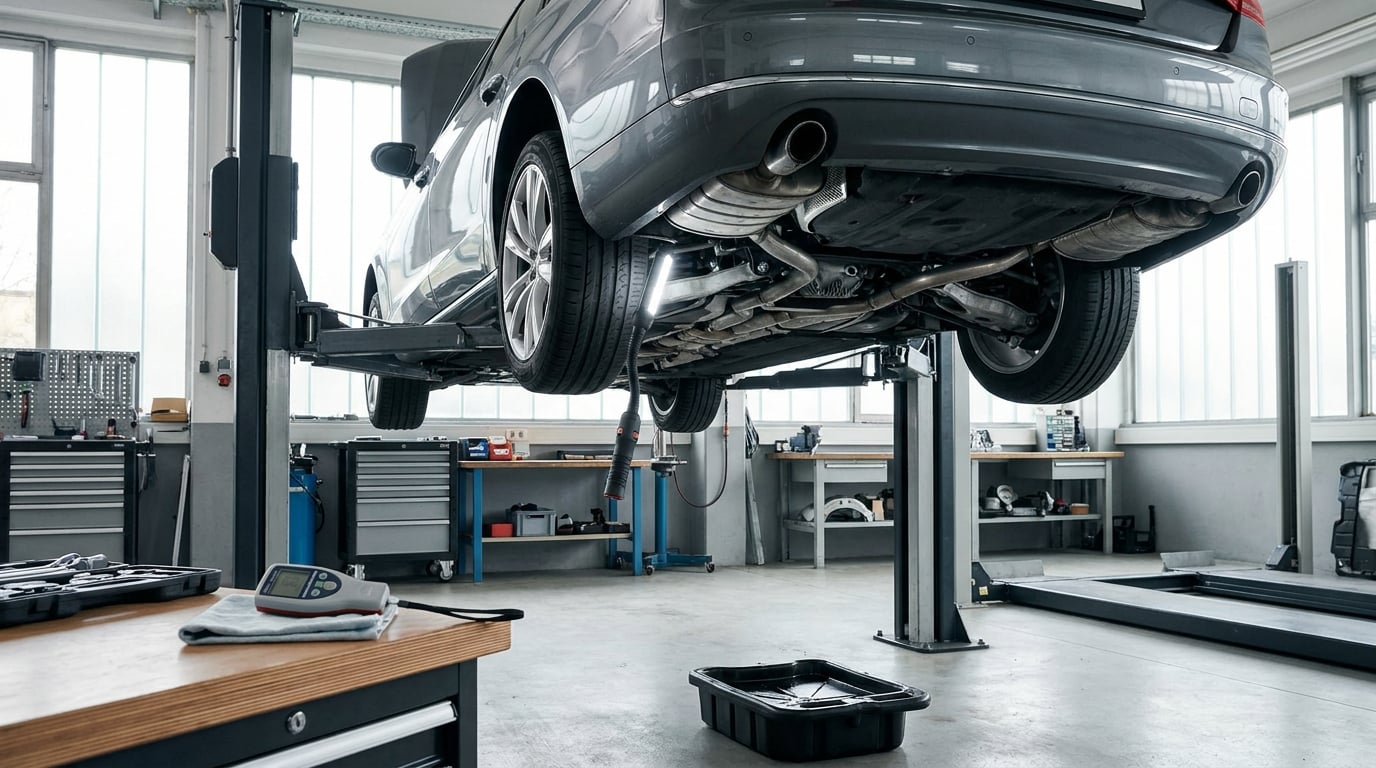
The BMW E60 common problems to check before buying fall into ten areas, and cooling system leaks, oil seepage, transmission faults, and electronics gremlins are the four that end most deals. The E60 ran from 2003 to 2010, so every car on the market is now 15 years old or more, and the failures have become predictable enough to test in a single walk-around.
That predictability is good news. Owners on BimmerPost, 5series.net, and the E60 subreddit talk about the same handful of parts year after year, which means a buyer who knows the list can find a sound car in an afternoon rather than learning the hard way after the sale.
This guide covers cars bought in the US, where most E60s are petrol models. The section on fuel systems and the note about diesel engine codes matter more if you are shopping a 530d or 535d, since the M47 and M57 bring a different set of expensive problems.
Table of Contents
- BMW E60 Common Problems to Check Before Buying at a Glance
- 1. Engine Oil Leaks and Low Oil Levels
- 2. Water Pump, Thermostat, and Cooling-System Leaks
- 3. Oil Sludge, Timing-Chain Noise, and Engine Condition
- 4. Transmission Leaks, Sluggish Shifts, and Converter Problems
- 5. Brake Rotor, Pad, and Caliper Wear
- 6. Suspension Noise and Control-Arm Wear
- 7. Subframe, Mounts, and Structural Accident Damage
- 8. Electrical, Air-Conditioning, and Window Faults
- 9. Fuel-System Leaks, Smell, and Fuel Economy Problems
- 10. Rust, Accident Repair, and Previous Misrepresentation
- Frequently Asked Questions
- Final Verdict
BMW E60 Common Problems to Check Before Buying at a Glance
Here is the fastest way to sort a car before you fall in love with it. Each row gives the symptom you will see, how bad it is if confirmed, and the quickest physical test.
| Problem area | What you will notice | Severity | Fastest check |
|---|---|---|---|
| Oil leaks | Fresh oil under the car or on the engine, low level warning | Major to critical | Look under the car on a level surface before starting it |
| Cooling system | Residue or stains, rising gauge temperature, sweet smell | Critical | Watch the temperature gauge on a full warm-up cycle |
| Engine condition | Blue or white smoke, chain rattle on cold start, rough idle | Critical | Cold start and watch the exhaust and the first 30 seconds |
| Transmission | Pans wet or dripping, delayed engagement, harsh shifts | Critical | Check pan residue, then drive in a straight line and reverse |
| Brakes | Rotor lip, thin pad material, grinding, hot wheel | Major | Wheel-off inspection of rotor and pad thickness |
| Suspension | Clunks, rattles, play in the wheel, uneven tire wear | Major | Rock the car at each corner and check the tire tread |
| Structure and mounts | Cracks in the subframe, torn rubber, wheel alignment off | Critical | Inspect subframe, towers, and frame pockets under a lifted car |
| Electronics and A/C | Flat battery, dead fobs, windows that stop, weak cold air | Minor to major | Test every window, lock, light, and climate control button |
| Fuel system | Strong fuel smell, rich idle, poor economy, tank area dampness | Major to critical | Smell the exhaust, inspect lines and the tank strap area |
| Rust and misrepresentation | Overspray, mismatched panels, mismatched gaps, corrosion at seams | Critical if hidden | Paint thickness reading plus a full panel-gap walk-around |
How to run the BMW E60 common problems checklist during a test drive
Stand at the front of the car before the key goes near the ignition. That gives you a cold engine for the noise check, and a clean look at the ground under the nose for oil, coolant, or fuel dye.
Then take the car out onto a road long enough to reach full operating temperature. The gauge cluster is your cheapest diagnostic tool, and half of the problems on this list announce themselves in the first twenty minutes of a proper drive.
Finally, put the car on a lift at a shop that does pre-purchase inspections. Most of the expensive items here, the subframe, the engine mounts, the transmission pan, the strut towers, are only visible from underneath. Owners treat a full folder of service invoices as the biggest value signal in the whole transaction, so ask for it at the same time you book the inspection.
1. Engine Oil Leaks and Low Oil Levels
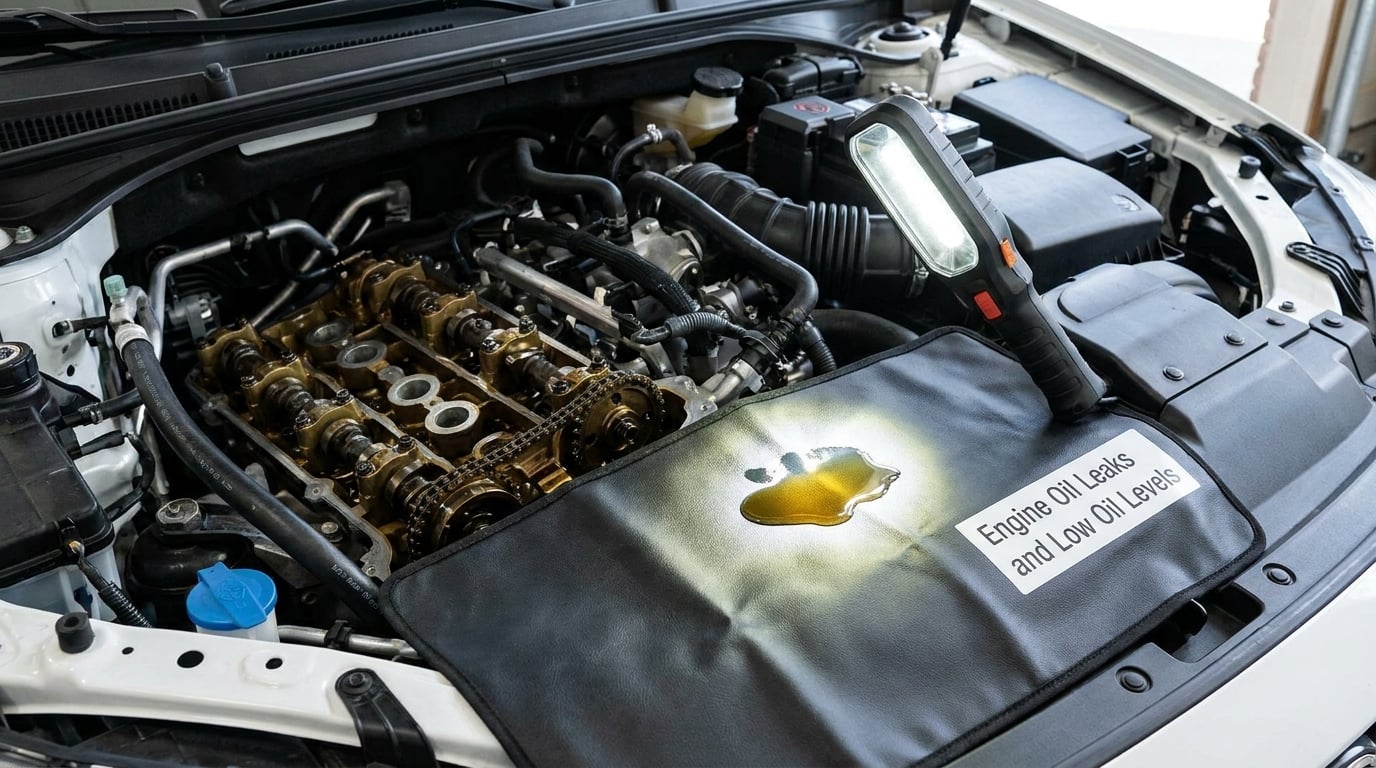
Oil leaks are the most common E60 finding, and the difference between a slow seep and a serious leak is how it looks on a lift, not how it smells in the driveway. Dark oil crusted around a joint is different from a fresh trail on the pan that grows while the engine idles.
Where E60 engines leak oil
The oil filter housing gasket on the N52 and N53 sits right where you can see it, and it is the classic seep on the six-cylinder petrol engines. The valve cover gasket on the same engines shows up as an oily film along the top of the engine under the intake manifold area, often with a faint burning smell on a hot day.
The M54 in the 530i tends to weep at the valve cover and around the oil filter housing too, and its dipstick tube seals are a known source of a trail down the side of the block. On the V8s, the N62 and N63, the oil filter housing gasket and the valve cover gasket both get attention at high mileage, and the N63 has a reputation for oil consumption that we cover in the engine condition section below.
One owner posting on 5series.net about a 2006 525ix with the N52 reported only an oil filter housing gasket leak and a coolant clamp over three months at 100k miles, which is what a well-maintained example looks like. A steady drip that leaves a puddle within a day is a different conversation.
How to tell seepage from a real leak
Ask the seller to park the car on level ground overnight without running the engine, then look underneath before the car is started. Fresh oil on a dry pan means the leak is active. A thin even film of road dust and grime is only residue.
Then check the oil level on a cold engine with the car sitting level, since many E60s use an electronic oil level sensor rather than a traditional dipstick. Our guide to checking oil on a car with no dipstick covers what to ask the seller and what the readout should look like.
Small numbers matter. The rule of thumb I use is that a car needing a top-up between services has a repair waiting, while a car with a clean underside and a level reading at the start and the end of a long drive is fine. Deep breath, engine off, look again.
2. Water Pump, Thermostat, and Cooling-System Leaks
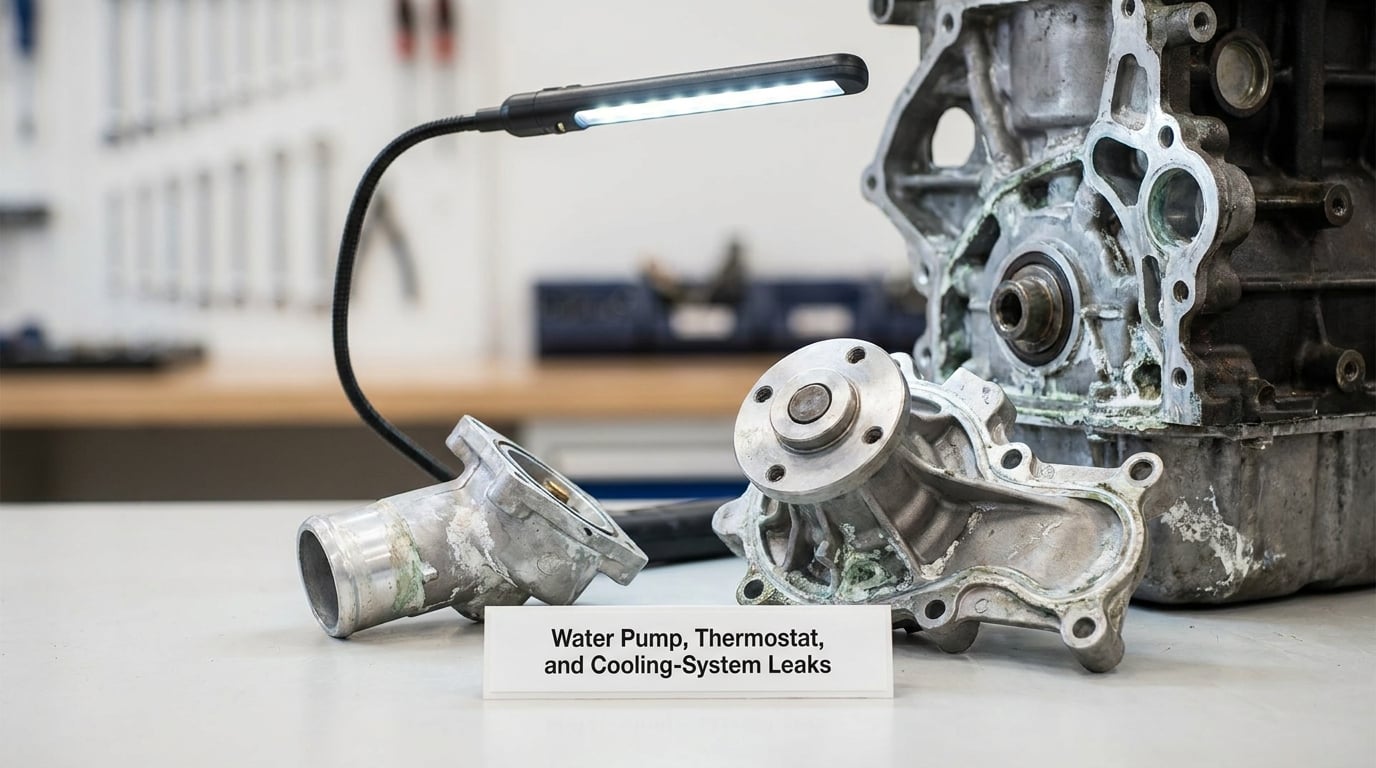
The cooling system is the number one thing to check on an E60 because failure here ends the engine. The mechanical water pump, the electric pump, the thermostat, the expansion tank, and every hose clamp live in one crowded area, and plastic components that were marginal new are now brittle with age.
Where the leaks show up
Look underneath the car for dried white, pink, or blue-green residue on the ground under the front, and look in the engine bay for crusty deposits around the water pump housing and the thermostat housing. Staining that follows a hose or clamp is easier to trace than a stain that sits in a valley and could have come from anywhere.
On the N54 and N55, the plastic expansion tank is a frequent crack point, and a cracked tank usually weeps at the filler neck or the hose connections. The electric coolant pump in later cars can fail silently or fail loudly, and a rattle that comes and goes with engine speed is worth asking about.
The cold-start temperature test
Start the car cold and let it idle. Watch the temperature gauge climb normally to operating temperature without a long warm-up delay and without the fan cutting in constantly. A gauge that climbs fast and then drops, or a needle that stays low while the cabin heats up, points to a thermostat problem.
Ask directly whether the water pump, thermostat, and expansion tank have ever been replaced, and get the date and mileage for the work if so. A 5series.net owner recommends replacing the water pump and thermostat together if it has never been done, noting it is a manageable afternoon job. That is exactly the kind of conversation that should happen before you commit, not after.
Any evidence of overheating, a repaired head gasket, or a car that ran hot in traffic, ends the inspection for me. Head gasket repairs on an N54 are a five-figure project with a low success rate, and a car with no documented repair is worse than one with an expensive but complete one.
3. Oil Sludge, Timing-Chain Noise, and Engine Condition
You can learn a lot from thirty seconds of watching a cold E60 start. White vapor from the exhaust that thins out after thirty seconds is condensation and normal. Blue smoke that continues, or a plume you can see from behind the car, is oil burning and means the engine is consuming it or has a valve cover gasket leak reaching the intake.
Timing chain and Vanos noise
A rattling sound for the first few seconds that fades as the engine warms is a chain or tensioner rattle, and it is the defining concern on the N47 diesel. N47 owners report reaching 170k miles, and the chain history is the single most important question to ask on a 520d.
Ask whether the timing chain has been replaced and whether there is an invoice. On the petrol engines, cold-start clatter can also come from the VANOS solenoids, and a Vanos rattle that never quiets down is a wear item rather than a gasket item, but it is still money.
Signs of a neglected or damaged engine
Pull the oil filler cap. Sludge that looks like thick dark mayonnaise on the underside of the cap, a gritty texture on the oil, or a fuel smell in the oil all point at a neglected service history or an engine that has been run hard and hot. If you are not sure what you are looking at, how to check for engine oil sludge in your BMW walks through the cap, the dipstick, and the filter check step by step.
Listen for a knocking noise under load and watch for flashing check-engine lights. Then ask the seller for every oil change they can produce. Owners on BimmerPost consistently say the cars that stay strong are the ones with annual oil changes, not just interval ones, and a car that shows clear evidence of that record is worth several thousand dollars more than one with a gap.
4. Transmission Leaks, Sluggish Shifts, and Converter Problems
The automatic in most E60s is a ZF 6HP, and it is generally durable, but a car that has missed its fluid service will tell you during the drive. SMG cars, the automated manual with a hydraulic unit, are a separate question, and forum consensus on BimmerPost and the E60 subreddit is blunt: skip them.
Look for the leak before you look for the symptom
Get the car on a lift and examine the transmission pan and the cooler lines at the front of the car. Oily residue on the pan bolts and a drip forming on the floor is normal seepage that many cars live with. A pan that is wet across the whole surface, or fluid that has been sprayed upward onto the exhaust, means the seal has let go.
On a cold start, step inside and let it sit in park for a few minutes, then put it in drive and reverse. A long delay before the car moves in either direction, a hard jolt into drive, or a bang on the first pull is a warning. The fast fluid fill is the harder failure to spot, and a fresh, clean-looking gearbox that was serviced recently is a reason to keep digging rather than a reason to relax.
Harsh shifts and fluid condition
Slippery or foamed fluid after a heat cycle means the cooler is leaking into the case, and burnt fluid that smells sharp means the clutch or the torque converter has been slipping. Neither is a cheap conversation on a car of this age.
On SMG cars, test the shifts carefully on a hill and in slow traffic, since hesitation when the box is warm and about to change gear is the classic symptom. A manual gearbox is simpler, but listen for bearing noise and check that the clutch bites cleanly and evenly.
5. Brake Rotor, Pad, and Caliper Wear
Brakes on a 15-year-old E60 are a wear item, not a deal breaker, until they turn into something worse. What matters is whether the car has been maintained or whether previous owners ran the pads to the metal and let the caliper drag.
What to check with the wheels off
Measure the rotor at its thinnest point. A substantial lip on the outer edge means the rotor has been scored and the caliper is likely sticking, and a thin pad is a brake job you are about to pay for. Look at the piston dust seals for weeping fluid, which is the classic E60 single-piston caliper leak, and it will leave a film on the inside of the wheel rim. Our guide to checking brake calipers for leaks on a BMW shows exactly where that fluid collects.
Rust on the rotor face with grooves worn into it means the caliper has been hanging on. Heavy surface rust on an unused car that clears within a few hundred feet of driving is not a fault. Check the brake fluid in the reservoir for dark, cloudy fluid or a layer of water on top, and see if the pedal feels spongy or the car pulls to one side under braking.
On the parking brake, a car that will not hold on a slope after a warm drive is telling you the caliper is not fully releasing. A dragging brake cooks a rotor and a hub over a few thousand miles, so a hot wheel at a rest stop on the test drive is worth stopping for.
6. Suspension Noise and Control-Arm Wear
Clunks over expansion joints are the E60’s favorite suspension noise, and they come from several places. With the car on a lift, check the control arm bushings and the tension strut mount for cracked or separated rubber, which is the most common repair on these cars and one of the most commonly skipped.
Find the noise, then find the cause
Have someone rock the car at each corner while you sit inside and listen through the body. A clunk over a small bump that repeats at a steady interval is a sway bar link or a sway bar bushing. A rattle that changes with the road surface and gets worse at low speed over washboard sections is often the spring seat or a worn shock.
Then check the steering for looseness. Hold the wheel at the nine and three positions and rock it gently. Any play at the rim means worn tie rods or a failing steering rack, and play under braking points to a worn ball joint. Uneven tire wear across the tread rather than across the face, or feathering on one side, usually points at a worn control arm or a subframe that has shifted.
Ask whether the tires are all four matching, and how old they are. A fresh set of tires on a car with heavy clunking is a way of hiding the noise, and it is a good negotiating point when the arms are clearly worn.
7. Subframe, Mounts, and Structural Accident Damage
This is the section that separates a good E60 from a cheap one, and it is the one that needs a lift. Serious crashes leave evidence in the front subframe and the frame pockets around the strut towers, and evidence means cracks, weld marks, and paint where there should be none.
What to look for from underneath
Ask for a lift and crouch down with a light. Inspect the front subframe at its joints and welds, the area where the control arms bolt in, and the frame pockets beside the strut towers. Cracks, uneven weld beads, or a seam that has been painted over are not factory marks and should end the sale.
Check the engine and transmission mounts with the engine in a cold state. In one gear with the brake off, an assistant should see the engine move a little within its normal travel. More than a small amount of movement, or torn rubber you can see across the mount, means the mounts have been overloaded or the car has been modified. Many E60s have an electronically controlled engine mount that shows its age with a warning rather than a tear, so ask about that light.
Check the alignment before you finish. If a car has been in a serious accident, the geometry is usually never fully returned, and uneven wear across the face of a recent set of tires is the clue. The trunk floor, hood hinges, and door gaps are worth a look too, since crash repairs often get disguised at the edges where the paint meets the glass.
8. Electrical, Air-Conditioning, and Window Faults
Electronics is what owners on the E60 subreddit and BimmerPost call the most problematic part of the car, and the complaints cluster around comfort access fobs that work for a few days and then stop, and head units that go black or lose navigation. None of that is a safety problem, but it is a very strong signal of how the car was treated.
Start with the battery
Ask for the battery’s age and date. A weak battery produces phantom sensor faults all over the cluster before it ever fails to crank, so a thick spread of warning lights on a cold start often means a battery rather than twenty separate faults.
With the car idling, measure the charging voltage at the battery terminals. A reading in the mid to low teens means the alternator is not keeping up, and on this generation that also shows up as flickering interior lights and slow window operation.
Function test everything
Roll both windows up and down several times. On many cars the regulator cable snags after a few cycles and the window stops halfway, which is a common and moderate repair. Test both locks, the mirrors, the seat adjustments, the folding mirror, the lights, and every button on the center console. A system that needs a restart to come back is telling you something.
Turn the air conditioning to maximum cold with the recirculation button and give it a few minutes. A blower that runs but never chills has a refrigerant or evaporator problem, and on a car this age a system that has been opened up and recharged is a purchase detail, not a defect. Then run the heat, since a stuck blend door is a common and irritating fault.
Check the sunroof drains if the car has one, since water that comes in through a blocked drain shows up later as a damp headliner and a wet rear floor.
9. Fuel-System Leaks, Smell, and Fuel Economy Problems
Fuel smells are not subtle. If you notice a strong petrol or diesel odor as soon as the engine starts, or standing near the tank after a fill-up, something in the fuel system is leaking. Treat it as urgent rather than annoying, because fuel vapour near a hot exhaust is a genuine hazard.
Where fuel leaks appear on an E60
The fuel pump sits inside the tank under the rear seat or in the fuel tank access area on some variants, and the tank or sending unit flange is a common seep point. Lift the rear floor mat and look for a damp carpet or a fuel odor there, then look under the car at the tank area for a trail. The filter housing connections and the fuel lines across the frame deserve a look with the same eye you give any wet area.
Check the tank straps for rust and for movement. If the tank has shifted or a strap has been eaten through by corrosion, the pump can be running dry at a level that looks normal on the gauge, and that destroys the pump quickly. The vapor lines and the canister connections at the front of the car are worth a look for cracked or disconnected hoses, which cause a rich-running smell.
For economy, ask the owner to reset the trip computer and watch the readout on a full tank. A car that returns noticeably under what the badge suggests, combined with a rich idle or a rough cold start, points to an injector, a MAF sensor, or a lazy oxygen sensor.
10. Rust, Accident Repair, and Previous Misrepresentation
Corrosion is the most age-related E60 problem, and it is the one most often hidden. The areas to check are the wheel arches, the lower edges of the doors and rockers, the sills, the area around the jack points on the sills, the trunk floor, and the underside of the hood and trunk lid. A garage-kept car in a dry region looks dramatically better than a road-salt survivor, so asking how it has been stored is a fair and useful question.
Read the paint, then read the records
Mismatched panel gaps are the giveaway that most people miss. Compare the gap on the driver-side door with the passenger side, and the same for the hood and trunk, because a car that has had a repainted panel is usually measured slightly wrong. Overspray texture on a door that sits next to a perfectly flat neighbor panel is another sign.
A paint thickness reading across several panels settles the question faster than any conversation. Fresh paint reading noticeably thicker than the rest of the car, especially on a panel nobody would repaint for cosmetics, is worth asking about directly.
Then look at the paperwork with the same attention you give the walk-around. A transmission replaced at 58,000 miles with no explanation is a standard worry among E60 buyers, and a history report is the fastest way to see it. Missing oil change records, a gap of years in the service history, or a list of repairs without invoices are all reasons to assume the car is more expensive to own than the seller says.
Two working keys with working comfort access fobs are part of the same conversation. A single key on a car with comfort access means an expensive key programming job ahead, and owners cite intermittent fob failure as one of the most common electronics complaints on this generation.
Frequently Asked Questions
Is the BMW E60 5-Series reliable?
An E60 can be a very reliable car, but only with records. Owners repeatedly report examples reaching high mileage on a basic schedule of oil changes and a cooling system service, and the M54 petrol engine is often singled out as one of the more dependable units of its era. The weak spots are predictable: cooling system plastics, oil gaskets, transmission fluid service, and electronics. A car with a full service folder and a recent cooling system overhaul is a different proposition from a cheap one with a gap in its history.
Which E60 engine is the most reliable to buy used?
The naturally aspirated six-cylinder petrol engines, the M54 in the 530i and the N52 in the 525i and 530i, are the ones most owners favor for a used car. They are simple, well understood, and the N52 lacks the high-pressure fuel pump and direct injection complexity of the N54. Owners on 5series.net and BimmerPost describe the M54 as one of the most reliable engines of the modern BMW era. Avoid an N47 without documented timing chain work.
Which E60 year should buyers stay away from?
There is no single year to avoid outright, and the failures follow mileage and maintenance more than model year. The practical guidance is to treat early pre-facelift cars built before 2007 with more caution on electronics, since the head unit and module design changed at the facelift, and to treat any high-mileage diesel with an unknown timing chain history as a hard no. Among petrol cars, the N54 is the one to screen most carefully for the cooling system.
Is a pre-purchase inspection worth it on a used E60?
Yes, and it is the single best money you spend in the whole process. Most of the expensive items on this list, the subframe, engine mounts, transmission pan, strut towers, and brake calipers, are only visible from underneath on a lift. An independent inspection by a shop familiar with European cars also tends to catch cooling system residue and evidence of overheating that a private seller has learned to ignore. Book it before you commit, not after.
Should I avoid an E60 with the SMG automatic?
Most owners say yes. The SMG is an automated manual with a hydraulic unit, and its failure modes are abrupt rather than gradual, which makes it a gamble on a car of this age. The conventional ZF 6HP automatic in most E60s is the safer choice, provided the fluid has been serviced on schedule and the car shifts cleanly. If you are tempted by an SMG, have it inspected specifically and negotiate hard, because a hydraulic unit failure can end the car’s life.
Final Verdict
Buy an E60 with a cold-start look, a full warm-up drive, and a lift inspection, in that order. Ask for the service folder before anything else, and treat a documented cooling system overhaul as the biggest reassurance you can get on a car this age.
Then walk away without negotiating if you find evidence of overheating, an unrepaired head gasket, a cracked subframe, active oil or fuel leaks, or transmission slip. Those four findings cover most of what turns a cheap E60 into an expensive one, and there are always other cars.
For everything else, negotiate. A minor oil seep, worn control arms, a tired battery, and a grumpy climate system are ordinary ownership costs on a 2026-era 5 Series, not reasons to pass.