
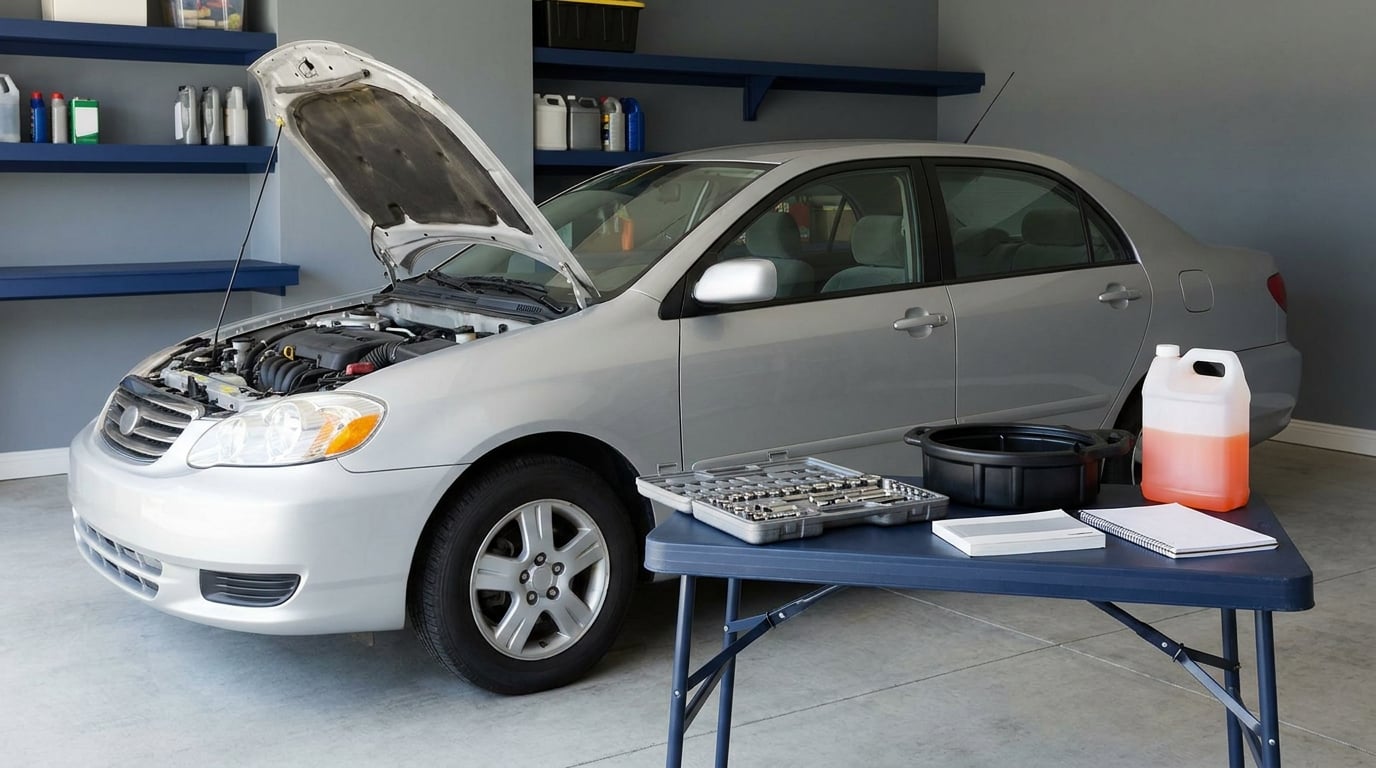
The BMW E46 maintenance schedule explained in plain English comes down to three things: oil on a short interval, a cooling system that never fails, and inspections that track wear rather than just mileage. The factory book counts down to your next Oil Service or Inspection on the cluster. Most owners shorten the oil interval well before the cluster asks.
I have kept records on a 325i and a 330Ci over the years, and the pattern repeats: the cars that survive past 150,000 miles are the ones with an intact cooling system and a service log. Everything else is fixable money.
Table of Contents
- What the BMW E46 Maintenance Schedule Includes
- BMW E46 Maintenance Schedule at a Glance
- What Needs Servicing at 5,000 to 10,000 Miles?
- When Should Brakes, Tires, and Wheel Bearings Be Checked?
- Which BMW E46 Fluids and Filters Need Attention?
- When Are Spark Plugs, Belts, Hoses, and Other Wear Items Due?
- How Do You Handle E46 Maintenance by Age Instead of Mileage?
- How Can You Tell When an E46 Needs Service Before a Failure?
- A Simple BMW E46 Maintenance Checklist
- When Should You Have a BMW E46 Mechanic Inspect It?
- Frequently Asked Questions
- Where to Start With Your E46
What the BMW E46 Maintenance Schedule Includes
The schedule has three layers, and mixing them up is where most owner confusion starts.
Scheduled maintenance is work BMW ties to a mileage or time interval: oil and filter changes, spark plugs, brake fluid, coolant, transmission fluid. The interval is a limit, not a suggestion.
Condition-based inspection is the brake, tire, belt, hose and fluid-level work the cluster calls for at each Inspection. The car is telling you to look, not necessarily to replace.
Optional service covers fluids and components the factory treats as long-life or condition-driven: transmission fluid, rear differential oil, fuel filter, cabin filter, the fuel cap and evaporative emissions checks.
Intervals shift with model year, engine, mileage and how the car is used. The E46 ran from 1998 to 2006, and specs differ across that span. A car that sits in traffic all day in Phoenix burns oil faster than one that cruises. Your owner’s manual is the controlling document; this guide, updated for 2026, explains how to read it and what real owners do with it.
BMW E46 Maintenance Schedule at a Glance
This is the master table. Intervals are approximate US figures from factory schedules and long-term owner practice; verify the exact interval for your model year and engine against your manual.
| Item | Mileage | Time | Who does it |
|---|---|---|---|
| Engine oil and oil filter | Every 5,000-7,500 mi (owners) | Every 6 months | DIY |
| Brake inspection, pads and rotors | Every 15,000-20,000 mi | Every 12 months | Shop |
| Engine air filter | Every 30,000 mi | Every 24 months | DIY |
| Cabin (pollen) filter | Every 20,000-30,000 mi | Every 12 months | DIY |
| Spark plugs | Every 60,000-100,000 mi | Every 6 years | DIY |
| Brake fluid | Every 30,000-40,000 mi | Every 2 years | DIY flush |
| Coolant | Every 90,000-120,000 mi | Every 4 years | Shop |
| Transmission fluid | Every 50,000-60,000 mi | Every 4-5 years | Shop |
| Rear differential oil | Every 50,000-60,000 mi | Every 4-5 years | Shop |
| Fuel filter | Every 60,000-90,000 mi | Every 5 years | DIY |
| Accessory belt and tensioner | Inspect every 15,000 mi | Inspect every 12 months | Shop |
| Cooling system refresh | Preventive at 80,000-100,000 mi | By condition | Shop |
| Spark plug, brake and fuel checks at Inspection I | Every 30,000 mi | Every 24 months | Shop |
| Extended Inspection II items (brake fluid, spark plugs, fuel filter) | Every 60,000 mi | Every 48 months | Shop |
Two numbers in that table cause the most argument. First, oil: BMW’s long-life specification supports longer intervals, but only with oil carrying the right certification. Second, coolant: the calendar interval matters more than the mileage, because coolant degrades on time whether or not the car moves.
What Needs Servicing at 5,000 to 10,000 Miles?
The first oil service is the one that sets the tone for the life of the car. Everything here is basic, and nearly all of it is a garage job on a driveway with a drain pan and a few sockets.
On any car you have just bought, regardless of the odometer, check the oil level cold, read the tire pressure cold, look at the brake pad wear through the wheel spokes, and read every fluid reservoir in the engine bay. Throttle body coolant hoses weeping onto the intake manifold are normal on these cars and are not a reason to panic, but they are a reason to look.
Walk around the car once a month for the first year. Check tire pressure, lights, washer fluid, and look under the car for anything dripping onto the driveway. If you want to know the tools that actually earn their keep, our guide to what tools you need for basic car maintenance covers the short list most owners need.
How Often Should You Change the Engine Oil?
Change it every 5,000 miles or six months, whichever comes first. That is the enthusiast consensus, and it is the interval we recommend on any E46 that is not a museum piece.
BMW’s long-life oil specification was designed around certified oil that holds its additive package for a long interval. If your oil carries LL-01 or LL-01FE certification, a 7,500 to 10,000 mile interval is defensible. If you cannot confirm the certification on the can, do not stretch the interval.
The spec matters more than the viscosity. LL-01 and LL-01FE are not interchangeable labels, and an oil that lacks the certification is not a cheaper version of the right oil; it is a different oil. Wrong spec is the kind of mistake that does not announce itself until years later.
Shorten the interval if the car lives on short trips, sits in idling traffic, runs in high heat, or takes long cold starts. Those conditions are what the CBS sensor is looking at, and they are exactly when oil degrades fastest.
Log the date, the mileage and the odometer reading for every service. A notebook works. Records protect resale value and they tell the next owner the car was cared for.
When Should Brakes, Tires, and Wheel Bearings Be Checked?
Inspect brakes and tires on condition, not on a fixed mileage number, because wear rate depends on driving style and road debris more than distance.
Brake pads on a rear-wheel-drive E46 commonly last 40,000 to 60,000 miles; the front axle on an all-wheel-drive car wears much faster. Thickness is the number that matters, measured at the outer edge of the pad, and rotors need their own minimum thickness checked for lip and scoring.
Vibration under braking usually means a warped rotor. Grinding that does not stop means the pad material or a piece of hardware is against the rotor. Squealing at low speed that disappears when the brakes warm is often a wear indicator, not a failure.
A pull to one side on braking points at a sticking caliper, a worn hose, or a problem in the suspension, not the pads. Fluid color matters too: clean amber is normal, and dark or cloudy fluid has absorbed water and needs a flush.
Tires have a manufacture date stamped on the sidewall, and rubber ages whether you drive or not. Six to ten years is a common replacement window regardless of tread depth. Uneven wear across the tread, or feathering on one edge, usually points at alignment, suspension bushings or a worn wheel bearing rather than the tire itself.
A hum that changes pitch with road speed is often a wheel bearing. Get it checked, because a failing bearing can take the hub with it.
Which BMW E46 Fluids and Filters Need Attention?
Five fluids do almost all the work, and each has a spec worth writing down. Capacities vary by engine, so check your manual for the number rather than guessing.
| Fluid | Specification | Interval |
|---|---|---|
| Engine oil | BMW LL-01 or LL-01FE, ACEA A3/B3 | 5,000 mi / 6 months |
| Coolant | BMW blue coolant, ethylene glycol mix | 4 years / 90,000-120,000 mi |
| Brake fluid | DOT 4 | Every 2 years |
| Manual transmission | BMW MTF, or the manual’s listed gear oil | 60,000 mi |
| Automatic transmission | Fluid specified for the gearbox type | 50,000-60,000 mi |
| Rear differential | SAE 75W-90 gear oil | 50,000-60,000 mi |
| Power steering | Fluid specified in the manual | Check at every service |
Transmission service splits three ways. A manual gearbox is a drain, refill and inspect job, straightforward enough for a competent owner. An automatic on most E46s is the same idea, and a drain-and-fill is the common choice on high-mileage cars rather than a full flush, which needs a machine and removes the friction additives the box depends on.
The SMG automated manual is its own animal. Its fluid and its service procedure differ from both, and shudder on launch is a known characteristic rather than a fault. Owners argue about drain-and-fill versus a full exchange here more than any other E46 topic, so get the gearbox type identified before anyone opens a plug.
Filters follow the same logic. The cabin filter is annual because it is cheap and it dries out. The engine air filter is roughly every two years. The fuel filter on most US E46s sits under the body and is a job worth grouping with a service visit.
When Are Spark Plugs, Belts, Hoses, and Other Wear Items Due?
Replacement intervals and inspection intervals are different things, and E46 owners blur them together.
Inspect belts, hoses and driveshafts at every service. Replace them when the surface shows cracking, glazing, fraying or a soft spot, not because a number came up. The accessory belt and tensioner on these engines live in a dirty, hot pocket next to the coolant pipes, which is why they often go first.
Coolant hoses, the expansion tank, the thermostat housing and the plastic coolant pipes are the wear items to watch most closely, especially on the inline-six engines. Inspection every service; replacement preventive at roughly 80,000 to 100,000 miles regardless of how they look. This is the single most expensive item owners defer, and it is the top-of-mind question in every high-mileage E46 thread.
Spark plugs go at the interval in your manual, commonly 60,000 to 100,000 miles depending on engine. Replace the valve cover gasket and the oil filter housing gasket when you are in there, because the alternative is a second teardown and a second labor charge for the same bay time.
Other aging items: cabin and engine air filters, the fuel cap seal, wiper blades, battery condition, and every rubber hose in the vacuum and crankcase ventilation network.
How Do You Handle E46 Maintenance by Age Instead of Mileage?
A low-mileage E46 is not a maintained E46. Mileage measures use; age measures decay, and decay is what ends these cars.
Rubber ages on a shelf. Brake fluid absorbs moisture whether the car moves or not, which is why a two-year interval beats a mileage interval for a weekend car. Coolant degrades on a calendar, so a car that sat for five years needs it regardless of the odometer.
Batteries fail from sitting. Seals dry out. Belts take a set from tension and heat. Fuel lines corrode from the inside where you cannot see it, and the fuel filter is cheap insurance against a tank full of debris on a car that has been through a long layup.
Cars driven in salt or stored in damp conditions need more, not less. After winter, run a finger along the accessory belt and the lower coolant hoses and look for a chalky bloom of corrosion. If a car has been outside in a wet climate with no maintenance record, treat the entire fluid and filter list as overdue and price it as a single visit.
How Can You Tell When an E46 Needs Service Before a Failure?
Symptoms are clues, and topping off a fluid without finding the cause is how a small leak becomes a seized engine.
Overheating or a low coolant warning is the big one. A low coolant light usually means a leak, not a low reservoir. Common culprits on these cars: the plastic expansion tank, the thermostat housing, the coolant pipes under the intake manifold, and the plastic radiator end tanks. If coolant is disappearing, find it before you refill.
Rough idle, stumble or misfire points at ignition, fuel or vacuum. Old spark plugs, a failing coil, dirty throttle bodies and cracked intake manifold vacuum lines all produce the same symptom, so diagnose rather than swap parts one at a time.
Oil consumption above a quart per 1,000 miles on an inline-six is not normal. Suspect the valve cover gasket, the oil filter housing gasket, the dip tube seal, or a failing PCV valve and a blocked case breather.
Coolant in the oil or oil in the coolant means a head gasket or a cracked head, and the car should stop driving until a shop pressure-tests the system.
Brake noise, vibration or a soft pedal gets diagnosed the same week. A change in steering feel, a clunk over bumps, or a wandering lane points at suspension bushings, ball joints, tie rods or wheel bearings.
Warning lights on the cluster need a code read, not a guess. Throttle body faults, VANOS faults and oxygen sensor codes each have a specific cause, and parts thrown at the problem usually make it worse.
A Simple BMW E46 Maintenance Checklist
The mileage schedule covers the shop work. This covers everything that happens between visits, and it takes ten minutes a month.
Every month: tire pressure cold, all lights and bulbs, washer fluid, oil level, brake feel, and a look underneath for drips. Check the pressure before the car has moved a mile; a hot tire reads low and you will chase a problem that is not there.
Every season: coolant and antifreeze strength before the first freeze, battery terminal condition, wiper blades, washer fluid concentration, and belt condition after a winter of salt and road grime.
Every year: cabin filter, engine air filter, brake fluid if it is due on the two-year clock, tire manufacture dates, a full brake inspection, and a service-light reset if the cluster is counting down.
Whenever it is in the shop: ask for the mileage and date of every item performed, and ask them to look at the belts, hoses and coolant lines while the car is up on a lift. A visual inspection during a service costs little and catches the aging rubber before it fails.
Keep the log somewhere that survives a sale: a folder in the glovebox with every receipt, plus a photographed page if you are lazy with paper. Our take on high mileage oil and whether it works for a BMW covers the one fluid decision most owners get wrong.
When Should You Have a BMW E46 Mechanic Inspect It?
Some E46 work belongs on a shop lift with the right tools, and the line is about access and safety rather than difficulty.
Take it in for anything involving the cooling system teardown, transmission and differential service, brake and suspension components, diagnosis of warning lights or a no-start, subframe and structural repairs, and anything requiring a torque wrench and alignment afterwards. On an S54 or a heavily modified car, rod and piston work is strictly shop territory.
DIY confidently: oil and filter, air and cabin filters, fuel filter on accessible cars, brake fluid flush, spark plugs, and the routine walk-around checks.
Ask any shop to work to BMW specifications for fluid types, torque figures and part quality. If a quote comes back without a fluid spec, ask which fluid they plan to use. The difference between the specified oil and a generic one is real money at 150,000 miles.
One more thing worth knowing: these cars use metric fasteners almost everywhere, and mixing metric and SAE sockets on a brake or subframe bolt is how a job goes sideways. Our metric vs SAE sockets explained guide covers the differences that matter when you are under a car with a 15mm that is not a 15mm.
Frequently Asked Questions
How often should I change the oil in my BMW E46?
Change it every 5,000 miles or six months, whichever comes first. BMW’s long-life specification supports a 7,500 to 10,000 mile interval, but only when the oil carries LL-01 or LL-01FE certification. Shorten that further if the car lives on short trips, heavy idling or extreme heat. Log the date and mileage every time, because an undocumented oil history reads as no history at resale.
What maintenance does an E46 need at 100,000 miles?
At 100,000 miles most E46s need a cooling system refresh, a transmission and rear differential fluid change, fresh brake fluid, new spark plugs if not already done, and the accessory belt and tensioner inspected. Add front control arm bushings and VANOS seals if symptoms point there. Owners treating cooling system condition as a go or no-go item when buying a used car is the most common piece of advice in owner forums.
When should I change the coolant in an E46?
Change it every four years, or at the mileage interval in your manual, whichever comes first. Coolant degrades on a calendar, so a low-mileage car that is five years old still needs it. The bigger question is whether the system is intact. Expansion tanks, thermostat housings, plastic pipes and radiator end tanks are the usual leak points, and replacing one piece while others are still original usually means a second teardown later.
Do I need to service the rear differential on an E46?
Yes. The final drive takes SAE 75W-90 gear oil and is generally serviced every 50,000 to 60,000 miles, with several checks along the way. It is a factory item buried in specification tables, which is why it gets skipped. On a high-mileage car a drain and fill is cheap, and it is a good job to group with a transmission service since the labor is largely open at the same time.
Is a BMW E46 cheap to maintain?
Not cheap in parts, and not especially cheap in labor either, but parts availability is good and most jobs are well documented. Routine service is straightforward and a large share of it is driveway work. What makes a high-mileage E46 expensive is deferred work arriving all at once, not the routine maintenance itself. A car with a full service history and a sound cooling system costs far less to own than a cheaper car with none.
Where to Start With Your E46
Do the oil first, in the correct specification, on a short interval. Then get the cooling system inspected properly and replace the whole thing if it is anywhere near 80,000 miles. After that, work outward through the fluids and filters on the time clock, since calendar intervals catch what mileage intervals miss.
Record everything as you go. The car is old enough that the difference between a documented E46 and an undocumented one is usually the difference between a project and a drive.