
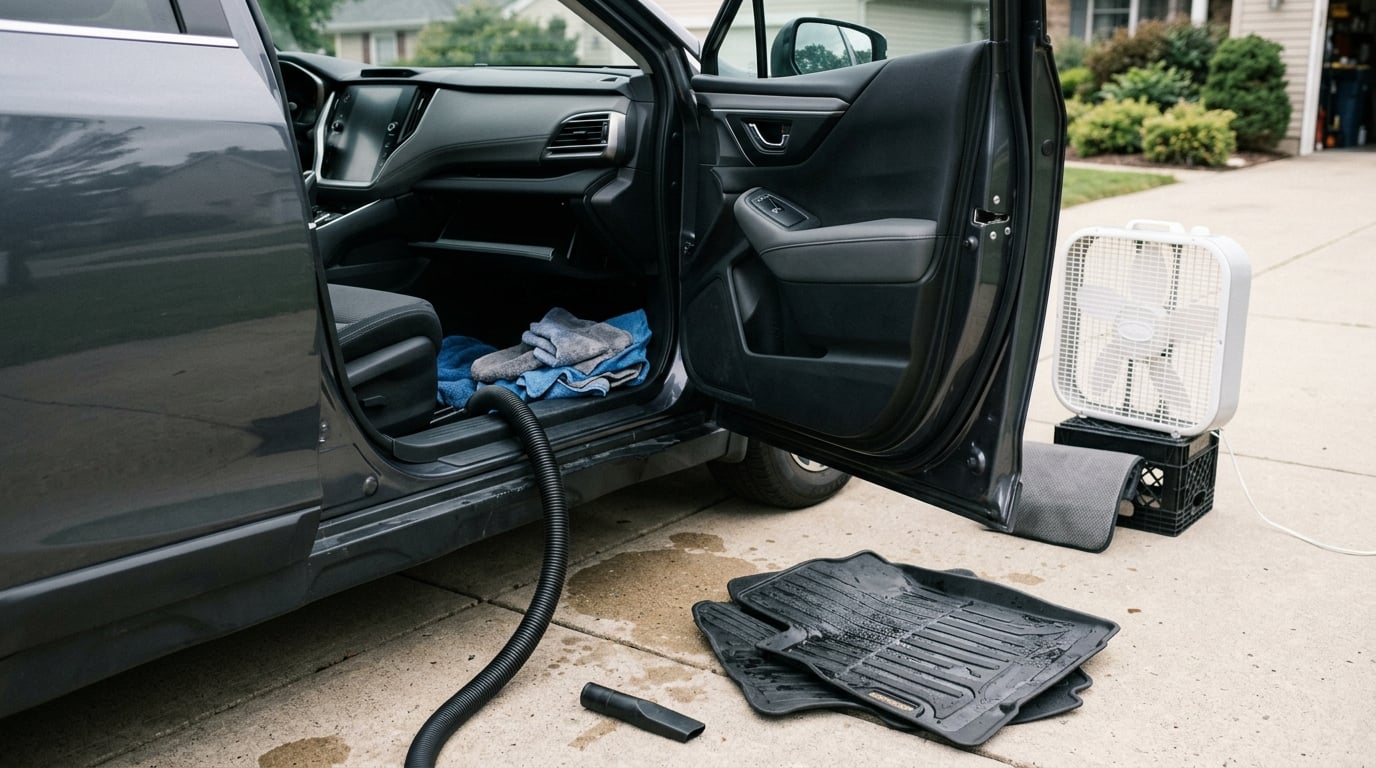
To dry out a wet car carpet fast, pull every mat, blot the water out of the carpet and padding, then run a wet/dry vacuum over the floor and leave the car open to moving air. Most soaked carpets reach “dry enough” in 24 to 48 hours, but only if the water underneath gets out too.
The part most people skip is the layer below the carpet. Foam padding, seat cushions and sound-deadening mat hold water like a sponge, and they will keep a floor damp long after the surface feels dry to your hand.
Check your car before you start. If water came from a collision, a broken window, or a flooded road, treat it as a safety issue first. That is a different job than cleaning.
Table of Contents
What You Need
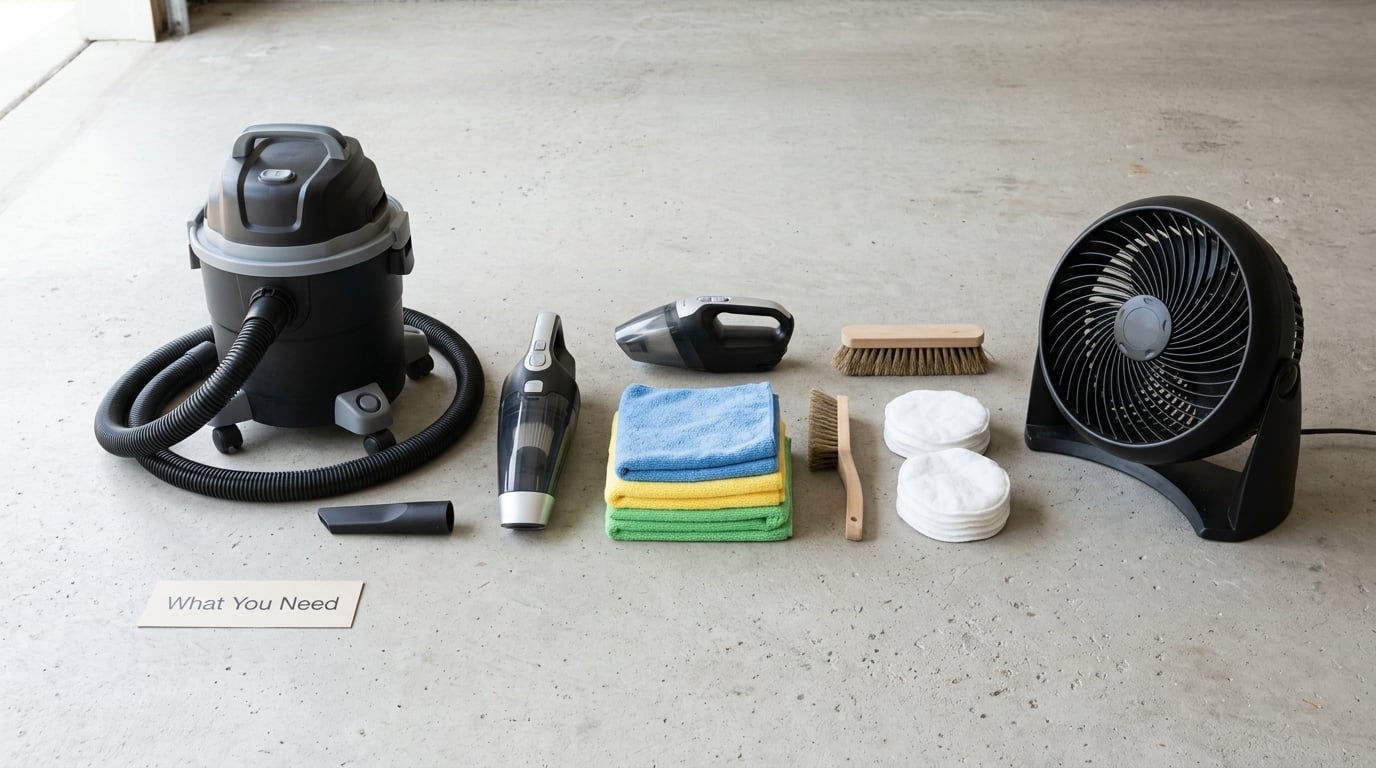
Gather everything before you start, because you will move fast and you do not want to stop halfway through a wet job to find a towel.
- Absorbent towels — old bath or shop towels work better than new ones you care about.
- A wet/dry vacuum — this is the one tool that makes a real difference. A household vacuum cannot handle liquid and will damage its motor.
- A handheld or crevice vacuum — for seams, seat rails and the gap where carpet meets the door sill.
- Absorbent material — old towels, uncolored crystal cat litter, or silica packets placed on the wet floor to pull water out of the air.
- A stiff brush — to lift carpet pile so air can reach the fibers.
- Trim removal tools — plastic pry tools only, for lifting a carpet edge or a sill plate.
- Airflow — a box fan, a blower, or the car heater and fan on high with the windows open.
- An automotive-safe odor treatment — used sparingly, and only once everything is fully dry.
The wet/dry vacuum and the airflow are the two things worth spending money on. The rest you can borrow or improvise.
One warning about heat: skip the hair dryer, the heat gun, and the clothes dryer aimed into the footwell. High heat can shrink carpet, melt plastic trim and buckle the subfloor, and it drives water deeper into the foam where you cannot reach it. Gentle warmth from the cabin heater is fine. Forced hot air is not.
Step-by-Step: How to Dry Out a Wet Car Carpet
1. Stop the Water and Make the Car Safe
Work on a level surface with good ventilation, and switch off the ignition before you open anything up. If the carpet is wet because of rain through an open window or a clogged drain, the leak is still running until you find it.
Work out where the water came from. Rain through a window, a car wash, a spilled drink, a leaking sunroof drain, a blocked air conditioning drain, or a failed door seal all leave different traces. Damp carpet in the passenger footwell with no rain on the outside usually means water is coming in from above, often through a sunroof or windshield seal.
Do not drive the car if moisture is near the pedals, the accelerator arm, wiring, or seat and airbag connectors. Water and current do not mix, and a wet floor can change how a pedal feels under your foot.
2. Remove the Carpet Mat and Expose Trapped Water
Take out the floor mat, the trunk mat, any removable rubber liner and the cargo-area carpet pieces. Mat traps are designed to hold water, so the worst of the flood is usually hiding directly underneath one.
Lay each piece over a door sill or the edge of a bucket and let gravity do the work. If a mat is stiff or crunchy, it is already on its way to mildew.
Next, look at the carpet edges. Lift a sill plate or a trim clip with a plastic pry tool and peel the carpet back a few inches. Never force a plastic clip, because it snaps and then the trim has to come off the expensive way.
With the edge up you can finally see what you are dealing with: standing water pooling in the pan, carpet padding soaked through, or a sheet of sound-deadening foam that is heavy with water. This is the moment to decide how much of a job you have.
3. Extract Water From the Carpet and Padding
This is the step that decides whether the job goes well. Blot the carpet, never scrub it. Press a dry towel down hard and hold it, then lift and swap towels as they turn damp. Rubbing pushes water further into the fibers instead of bringing it out.
Once the surface stops giving up water, run the wet/dry vacuum over the carpet. Work from the dry center outward toward the wet edges, and keep the nozzle moving so the seal does not seal against wet pile. Work along seams and under the carpet edge you lifted, because that is where water hides.
Watch the vacuum. When the stream thins to a trickle, stop. Vacuuming a nearly dry carpet pulls the pile up and leaves suction marks that can take weeks to flatten.
For padding and foam, there is no magic tool. Squeeze them out by weight: roll the carpet edge back, lay absorbent towels on top of the foam, and press down. Do not lift the whole mat, just press, then move the towel to a drier spot and repeat. Owners who pulled their carpets after deep water found the foam still waterlogged weeks later, which is exactly why this part is worth the effort.
Do not soak adjacent trim or the door sill carpet while you work. Those areas are usually dry, and you do not want to trade one wet patch for another.
4. Maximize Airflow and Speed Up Drying
Open all four doors and every window. Put a box fan in the doorway pointing across the cabin and another at the rear if you have one. Cross-ventilation across the whole interior does far more than a fan blowing into one footwell.
Run the cabin heater and blower on high with the temperature turned down. That combination pulls warm, relatively dry air through the cabin and exhausts it out the vents, and it works in cold weather when outside air is too humid to help. Keep the A/C off if you are trying to avoid adding condensation to a cold car.
Absorbent material does the rest. Spread uncolored crystal cat litter, old towels, or silica packets over the damp floor to draw moisture out of the air. Crystal and silica types work better than clay litter, which turns into heavy mud. One owner dried a soaked footwell with crystal litter spread over a plastic mesh layer, which kept the litter off the carpet fibers and made cleanup a matter of shaking it into a bag.
There is a real tradeoff with drying outside. Good weather and moving air speed things up, but road dust, pollen, and a passerby with a phone camera have all ended up in wet carpets. Whatever you choose, close the doors and windows before it rains, and never leave a fan running unattended in a garage.
5. Check the Floor Before Reinstalling the Carpet
This is the step that decides whether the job actually worked, not the last one. A surface that feels dry can be sitting on a soaked foam layer, which is why the carpet feels fine until it starts smelling a week later.
Press your palm firmly into the carpet and hold it for several seconds. Then press the back of your hand to the same spot. If your hand feels cool or damp against your skin, moisture is still moving up through the padding. A dry carpet in a dry room leaves no cool mark on your hand.
Lift the seams and edges and check along the sill plates, the center console, the seat rails and under the carpet at the back of the cabin. A pinch test works well on foam: squeeze a small piece and release it. If it springs back slowly and feels heavy, there is water inside it.
One owner found his carpet bone dry five days after a rainwater flood, yet the windshield kept fogging up on the drive. Interior fogging with dry carpet almost always means moisture is still leaving the floor pan, so treat a foggy windshield as a reason to keep drying rather than a reason to stop.
Get a professional involved if the foam still holds water after two full days of airflow, if there is any smell of sewage or fuel, or if water sits under a module, seat, or airbag connector. Those connectors and control modules at floor level are real, and a shop quoting to pull the carpet is not always upselling.
6. Treat Odor and Protect the Carpet
Wait until the carpet is fully dry before you add anything to it. Chemical treatment of a damp carpet traps the moisture along with the smell, and you end up with the same musty odor in a cleaner-looking carpet.
Start with the vacuum. Run it slowly over the dry carpet to pick up any grit that was dragged into the fibers while the water was there, and empty the canister outside. Then clean any residue according to your vehicle manufacturer’s guidance, since interior trim adhesives and stain resists vary widely by model.
Apply an automotive-safe odor treatment lightly, following the product directions. Test it first in a concealed area under a seat and leave it to dry fully, because some products leave a mark that takes more effort to fix than the smell.
One caution on baking soda. On very wet carpet it absorbs so much water that it turns into a sticky paste, and rinsing that out can leave you worse off than when you started. An owner who spilled a full beer in an E46 made exactly that mistake, then found clay cat litter worked better. Use baking soda on a dry or merely damp carpet, or skip it for something the water cannot turn to glue.
Common Mistakes
Leaving the car in the sun with the doors and windows shut. That traps heat and humidity, and the wet air has nowhere to go. Sun works only with the cabin open and moving air behind it.
Using a hair dryer or heat gun. The fibers melt, the trim warps, and the water gets driven deeper into the foam where it is impossible to reach.
Scrubbing the carpet instead of blotting it. Blot with pressure. Scrubbing drives water deeper and spreads whatever is in it across clean fibers.
Reinstalling damp mats over dry-looking carpet. A wet mat over a slightly damp floor creates a sealed pocket that will go green. Dry every layer before the last layer goes back in.
Ignoring the foam under the carpet. This is the most expensive mistake. Foam sound deadening and seat padding hold water for weeks and will smell long after the carpet itself is dry.
Reaching for random chemicals. Household bleach and ammonia products can damage trim, adhesives, and airbags. Anything you put in a car interior should be labeled for automotive use.
Prevention is the real fix. Clear the sunroof drain holes and check the air conditioning drain tube under the passenger side on a regular basis, since a clogged drain pours water straight onto the carpet. Wash and lubricate the door and window seals, and check for dampness in the footwell after heavy rain. Finding the leak is quicker than drying a car every time it storms.
Frequently Asked Questions
How long does it take for a wet car carpet to dry?
A carpet that has been blotted and vacuumed with good airflow usually feels dry to the touch within 12 to 24 hours. Foam padding and seat cushions take much longer, often two to three days, and can hold water for weeks if the water is not squeezed out. The surface drying fast does not mean the floor is dry, so check the foam and the underside of the carpet before you reassemble anything.
Can I leave a wet car carpet in the sun to dry faster?
Only with the doors and windows open. Sunlight with a sealed cabin traps warm, humid air and makes things worse. If you dry outside, open everything, point a fan across the interior, and keep the car covered from road dust. A clothes dryer or heat gun aimed at the carpet is a different matter, and not a good one, because high heat melts fibers and drives water into the foam.
Will rain ruin a car carpet while it is drying?
A short shower will not ruin a carpet that is already well on its way to dry, but it will reset your clock and put moisture back into the fibers. Close the car before the rain starts, and treat every soaking as a restart of the extraction process rather than something you can ignore. Standing water sitting on damp carpet for hours is the combination that actually causes problems.
Is vinegar or baking soda safe for drying a wet car carpet?
Baking soda is safe on a dry or lightly damp carpet, but on a soaked one it absorbs so much water that it turns into a sticky paste. Rinsing that paste out can leave the carpet wetter than when you started. Vinegar can be used diluted as a cleaner after the carpet is fully dry, but it does not draw water out, and undiluted vinegar can damage some trim adhesives. Dry first, then clean.
Why does my car carpet still smell wet after it dries?
Usually the carpet is not the source. The smell comes from water trapped in the foam padding, the sound-deadening layer, or the seat cushions, all of which sit below the part you can see. A foggy windshield on a dry-looking carpet is another strong sign that moisture is still leaving the floor pan. A persistent sewage or fuel smell, or water near a module or airbag connector, is a reason to have a professional look at it.
Conclusion
The order matters more than the effort. Stop the leak, take out every mat, blot and vacuum the water, open the car to moving air, then press the padding dry and check it with your hand before anything goes back in.
Get to the leak early, remove all the mats, extract the water, and maximize airflow. Inspect the hidden padding before you reinstall anything, and the next time your car carpet is soaked you will know exactly how to dry it out without waiting for a smell to tell you it went wrong.