
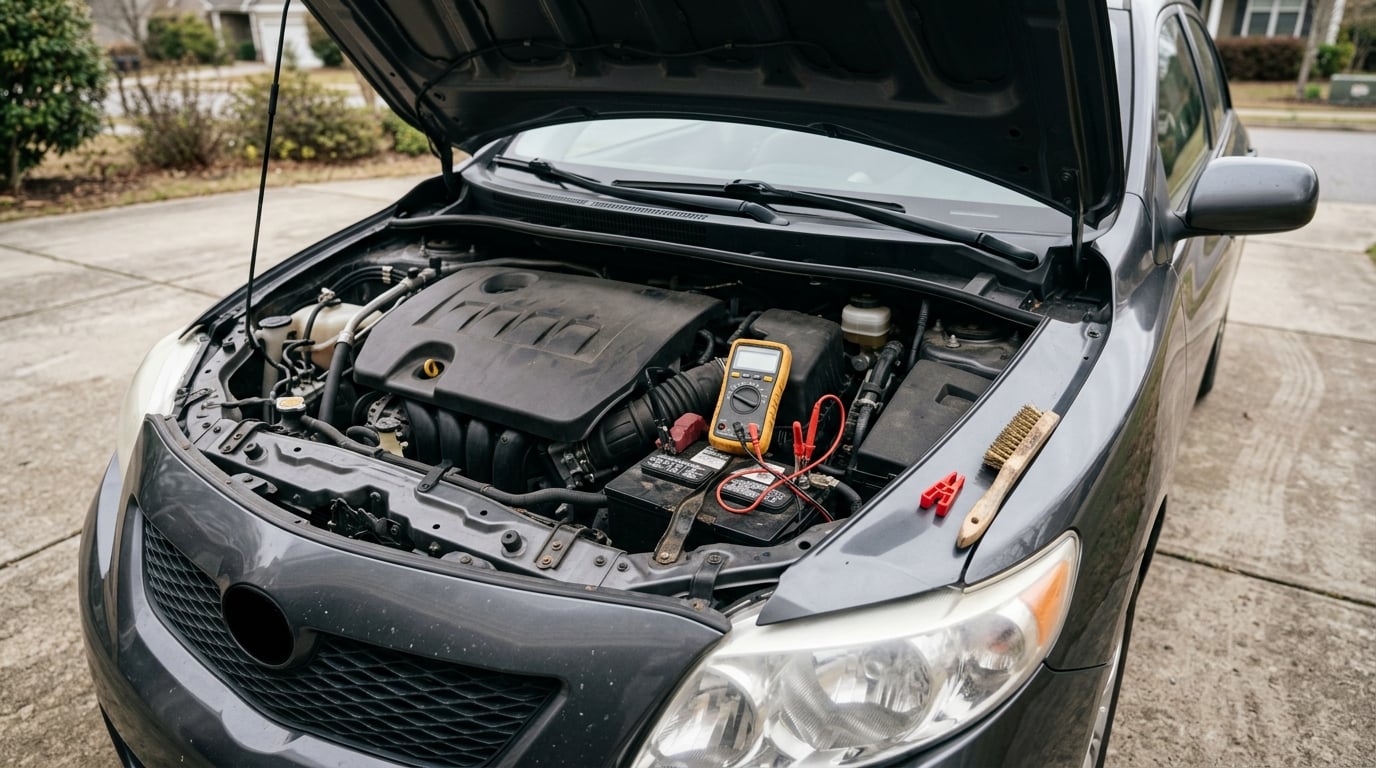
Most of what drains a car battery while parked comes down to three things: parasitic draw, a charging system that never topped it up properly, and a battery that has aged out. Find out which one you have and you stop guessing and start fixing.
Most owners meet this the same way. The car starts fine, sits for three days, and then turns over slowly on the fourth morning. A jump pack gets you going again, a new battery gets you another few weeks, and then it happens all over again. That loop is usually not bad luck. Something is putting current on the battery every hour it is parked, or nothing ever put enough current back into it.
This guide breaks the ten culprits into the order they actually occur: what the symptom looks like, which test proves it, and whether you can fix it in the driveway or you need a shop. It works for any vehicle, though the fuse layouts and module behaviour are specific to your owner’s manual, and the examples here lean heavily on European sedans and wagons with body control modules.
Table of Contents
- What Drains a Car Battery While Parked: Quick Diagnostic Guide
- 1. Parasitic Electrical Drain
- 2. A Trunk, Glove-Compartment, or Interior Lamp That Stays On
- 3. An Aftermarket Accessory Wired to Constant Battery Power
- 4. A Failing Relay That Keeps a Circuit Energized
- 5. A Malfunctioning Body Control Module or Electrical Control Module
- 6. Corroded or Loose Battery Terminals
- 7. A Weak, Old, or Defective Battery
- 8. Frequent Short Trips or Incomplete Charging
- 9. An Alternator or Charging-System Fault
- 10. A Short Circuit in a Damaged Wire, Connector, or Moisture-Affected Harness
- Frequently Asked Questions
- How much battery drain is normal while a car is parked?
- How long can a car battery sit before it dies?
- How do I find what is draining my battery with a multimeter?
- Can an aftermarket stereo or dash camera drain a car battery?
- Why does my battery keep dying even after I replace it?
- Is it safe to leave a car battery uncharged for several weeks?
- What to Do First When a Battery Keeps Going Flat
What Drains a Car Battery While Parked: Quick Diagnostic Guide
Start with how fast the car dies. The speed of the death narrows the list faster than any other clue, because a healthy parked car should hold a charge for weeks.
| Cause | Symptom you will notice | Test that confirms it | Who fixes it |
|---|---|---|---|
| Parasitic draw above normal | Flat after one to three days, fine the day before | Multimeter in series, reading over 50 mA after sleep delay | You, with a fuse puller |
| Cargo or interior lamp stays on | Flat overnight, one bulb visible in the cabin or trunk | Open the trunk, watch the meter reading change | You, usually a relay or switch |
| Aftermarket accessory on constant power | Flat overnight right after an install or alarm fitting | Disconnect the accessory, measure draw again | You, rewire to a switched circuit |
| Stuck or leaking relay | Flat in batches, sometimes with a hum after shutdown | Swap the suspect relay, or measure voltage at its contacts | You or a technician |
| Body control module fault | Flat, lights or locks behaving oddly, warning codes stored | Read trouble codes, then a power-off module test | Technician |
| Corroded or loose terminals | Slow cranking, flickering lights, inconsistent readings | Inspect the post, wiggle the clamp, measure voltage drop | You, ten minutes and a brush |
| Weak or old battery | Slow cranking in the morning, no obvious electrical fault | Resting voltage below 12.4V, failed load or conductance test | You, replace the battery |
| Short trips, no full recharge | Fine on long drives, flat after a week of short ones | Check charging voltage at the battery while the engine runs | Usually you, change your habits |
| Alternator or charging fault | Dim lights at idle, battery warning lamp, odd noises | Measure output voltage at the terminals, engine running | Technician |
| Short in wiring or a wet connector | Flat after rain, a body repair, or a road salt season | Fuse monitoring, visual inspection, continuity testing | Technician |
1. Parasitic Electrical Drain
Parasitic draw is the constant small current your car pulls after you shut the door, and every car has some. The alarm, the key fob receiver, the clock, the engine and body control modules and the relay network all stay awake in sleep mode.
Normal parasitic draw on most vehicles sits under 50 milliamps, which shops write as 0.050 amps. Anything above that with everything switched off is a fault, and it will flatten a healthy battery over a few weeks.
How much parasitic draw is normal?
Under 50 mA is the working rule of thumb, and it leaves enough headroom for an older car. A modern car with a large infotainment system sometimes sits a little higher without being broken, which is why measuring beats guessing.
Multiply the draw by the time parked and you get the useful number. A 50 mA draw is barely worth mentioning, 150 mA will take a healthy battery down in a few weeks, 500 mA will do it in days, and 2 amps will flatten most batteries overnight.
How to trace the draw with a multimeter
You need a multimeter with an amps mode, a fuse puller, and roughly 30 quiet minutes. The car needs to sit untouched for 20 to 30 minutes first so the modules finish their sleep timer, and opening a door restarts that countdown.
- Park the car, switch everything off, and leave it alone for 20 to 30 minutes so the body modules go to sleep.
- Put the vehicle in park, switch off, and open the hood. Wear eye protection and keep metal tools away from both battery posts.
- Disconnect the negative battery cable. Touch the negative clamp to the negative post briefly before touching anything else.
- Set the meter to DC amps or 10 A DC. Connect the red lead to the negative cable end and the black lead to the negative battery post, so the meter sits in series with the whole car.
- Wait a few minutes for the modules to settle, then read the number. Do not sit in the car with the door open, because that alone can add several hundred milliamps.
- If the reading is over 50 mA, pull fuses one at a time and watch the meter. When the number drops sharply, the circuit you just opened is the one drawing current.
That last step is the technique owners on the mechanic advice forums use most, and the cheapest version is simply pulling a different fuse each night and checking whether the car still starts in the morning.
One caution worth knowing. A healthy car can show a cycling pattern where the reading jumps to around 90 mA for a few seconds and then drops back, every ten seconds or so. Owners report that this reads as normal on a quick test and sends them looking for a fault that is not there. Leave the meter connected long enough to see several cycles before you decide.
2. A Trunk, Glove-Compartment, or Interior Lamp That Stays On
Cargo lamps are the classic culprit because a closed trunk or hatch often does not register as open, and the lamp keeps drawing through its relay or the body control module until the battery notices.
Open the trunk with the meter connected and watch the reading. If the current climbs when the lamp comes on, you have found it. The same test works for the glove compartment lamp, the vanity mirror lights, and the map light, which usually run through a dedicated interior lighting fuse.
When the lamp works but will not switch off, the switch itself, the relay, or the module command is usually at fault rather than the bulb. A quick temporary check is to remove the bulb or fuse for that circuit and see whether the drain stops.
3. An Aftermarket Accessory Wired to Constant Battery Power
Anything installed straight to the battery or to a constant live fuse draws forever, because nothing tells it to sleep. Dash cameras, radar detectors, amplifiers, phone chargers, seat heaters, LED interior kits, trailer wiring, and Bluetooth trackers are the usual suspects, and an alarm system fitted by an installer is a very common one.
Standalone GPS trackers and OBD-connected devices are the quietest offenders, because their whole job is to stay awake. A dash cam in parking mode with motion detection can sit at a noticeable draw all night, and hardwired radar detectors do the same.
The test takes two minutes. Disconnect the accessory and re-measure the parasitic draw. If the number falls, you have your answer, and the fix is either to rewire it to a switched circuit so it sleeps with the car, or to swap it for a powered version that unplugs with the ignition.
Timing is the giveaway here. A battery that dies three weeks after an alarm or camera installation is not an old battery problem, it is a wiring problem.
4. A Failing Relay That Keeps a Circuit Energized
Relays fail in two ways. They stick, so a contact welds closed and the circuit stays powered, or they leak internally, so a coil-controlled contact lets current through it with the switch off. Either one leaves a circuit drawing after shutdown.
Common casualties are the horn relay, the cooling fan relays, the starter relay, and lighting relays. A humming sound after shutdown is worth taking seriously, because owners on car forums traced that hum to a draw source rather than the normal alternator whine.
Check with a multimeter set to continuity or voltage across the relay’s contacts with the key off. A circuit that should be dead and still shows voltage points straight at the relay. Swapping in the matching relay from the parts store is a cheap way to confirm it, and the owner’s manual tells you which fuse and box it lives in.
5. A Malfunctioning Body Control Module or Electrical Control Module
The body control module handles the small stuff you never think about: welcome lighting, the trunk release, seat and mirror memory, remote locking, the wipers, and the comfort access timers on many cars. A module with a bad internal driver or a software fault can command those outputs after the car is parked, and the draw follows the command.
The tell is that the symptom is behavioural rather than electrical. Lights flicker or flash after shutdown, the horn chirps on its own, the boot pops open, the seats or mirrors move with nobody in the car, or the comfort light comes on when the key is nowhere near.
Distinguishing a module fault from a stuck relay is straightforward. A relay is a simple on or off device and can be swapped in minutes. A module stores fault codes, so read them with a scan tool first, and then have the technician do a power-off test that shows which output the module is holding active after the car goes to sleep.
Do not start pulling body control modules or repinning connectors yourself. These modules are often welded to the harness, and module replacement is the point where DIY work ends and shop work begins.
6. Corroded or Loose Battery Terminals
A greenish, powdery or white-crusted battery post looks cosmetic and behaves electrical. Corrosion and a loose clamp both add resistance, so the battery can read nearly full at the post while the rest of the car sees a lower voltage.
The symptoms overlap with a dying battery, which is why this one gets misdiagnosed. Slow cranking, headlights that dim when you turn the key, dash lights that flicker at idle, and a voltage reading that changes every time you wiggle the clamp are all signs of poor contact. A battery that seems inconsistent from one test to the next is a contact problem until proven otherwise.
Clean it properly. Disconnect the negative cable first, then the positive, and never let a tool bridge the two posts. Mix baking soda with water to a thick paste, scrub the post and clamp with a wire brush, rinse with clean water, dry thoroughly, and refit. A thin coat of terminal protectant slows the corrosion from coming back. A loose clamp gets tightened now, not after the next cold morning.
7. A Weak, Old, or Defective Battery
A lead-acid battery typically lasts three to five years, and it rarely fails politely. Heat, vibration from the road, repeated deep discharge, and a string of short trips all wear it out faster than calendar age alone suggests, which is why a battery can be three years old and already too weak to hold a charge overnight.
Two quick checks narrow it down. A fully rested battery should read 12.6 volts or higher after sitting for a few hours, and 12.4 volts or lower means it is already partly discharged. A proper load or conductance test at a parts store then tells you the battery’s true remaining capacity rather than its resting surface charge.
How to read the battery date code
Most batteries carry a small sticker or stamped code with a month and year, and the format is usually four numbers. The first two are the month, either as a number or a letter, and the last two are the year. A code reading 9-24 is September 2024, which tells you at a glance whether you are looking at a two-year-old battery that still had life in it or a battery that was already old when it went in.
If the code is worn off, the date of purchase on your receipt works just as well, and an aged battery with a confirmed normal draw is a battery that should be replaced rather than chased.
8. Frequent Short Trips or Incomplete Charging
The alternator tops the battery up while the engine runs, and it needs time to do that. A ten-minute drive uses more charge than the alternator puts back, so a car driven almost entirely on short trips starts every morning closer to flat than it finished the day before.
This produces exactly the same symptom as a leak, which is why it is missed so often. The car starts fine in the morning, drives short distances, and after a week or two will not crank at all. A longer drive with the engine running restores enough charge to make it start, which convinces owners the battery is fine.
Verify it by measuring voltage at the battery terminals with the engine running. A healthy charging system puts out roughly 13.7 to 14.7 volts with the engine running, and it does not matter which engine speed you check at because the regulator should hold it steady. Anything under about 13 volts means the battery is not being replenished, regardless of how long you drive.
The fix for the driving pattern is a longer drive once a week, or a maintainer on a shelf. A car parked for days and short-tripped every other day needs that maintenance more than most.
9. An Alternator or Charging-System Fault
An alternator that undercharges never flattens the battery on its own. What it does is fail to replace what you used, so the battery walks down over days or weeks until it is too low to crank, even though something is sitting on the terminals drawing when the engine is off.
The warning signs are quiet. Headlights that look dimmer at idle than they do revving, a battery or charging warning lamp on the dash, headlights that flicker, and a burning smell that means the unit is hot are all charging system symptoms. A failed rectifier diode also shows up as a radio that loses stations or a phone charger that restarts when the engine runs, because the noise on the charging line is coming through.
Measure at the terminals with the engine running. Under 13 volts is a charging fault, and an alternator that tests fine with a disconnected battery but reads low when the battery is connected usually means a bad diode or a poor cable connection. Jump-starting does nothing for any of this. It gets the car started and hides the symptom until it happens again.
10. A Short Circuit in a Damaged Wire, Connector, or Moisture-Affected Harness
Wiring fails quietly. A chafed wire where a harness rubs against a bracket, a connector that got water in it, a corroded splice from a previous repair, or insulation pinched during bodywork all create a path to ground that never fully goes away.
Common spots are under the front seats where rails slide on the loom, behind the kick panels, through the door jambs, and in the engine bay where heat and water sit. Cars that have been in a collision, had a body shop visit, or survived a winter of road salt are the usual candidates, and owners often notice the battery died soon after that work without connecting the timing.
Start with a visual check along the loom and inside every connector in the area that matches the fuse the draw came from. Then use the fuse-pull method again, or a continuity and insulation resistance check on the suspect circuit. Water in a connector gets dried out and resealed, and a chafed section gets repaired and clipped away from the sharp edge.
Tracing a short through a multi-module wiring network is technician work. If the reading stays high after you have pulled the obvious fuses, or the draw appears only in the rain, hand it to a shop with the ability to trace circuits properly rather than continuing to pull fuses at random.
Frequently Asked Questions
How much battery drain is normal while a car is parked?
Most cars pull under 50 milliamps after shutdown, which is written as 0.050 amps. That covers the alarm, key fob receiver, clock, and body control modules staying in sleep mode. Measure with a multimeter in series after the car has sat untouched for 20 to 30 minutes. Above 50 mA, the draw is a fault and will flatten a healthy battery over days or weeks.
How long can a car battery sit before it dies?
A healthy battery with normal parasitic draw can sit for several weeks and still start on the first turn. In very hot weather it shortens because heat speeds up self-discharge. If the car is dead after a few days, the draw is well above 50 mA. If it dies after a week or two of short trips, the battery is weak or the charging system is undercharging.
How do I find what is draining my battery with a multimeter?
Set the car to sleep for 20 to 30 minutes, disconnect the negative battery cable, and connect the meter in series between the negative post and the cable end. Read the current in amps. If it holds above 0.050 amps, pull fuses one at a time and watch for a sharp drop. The circuit you just opened is the one drawing current. Never sit in the car with the door open while measuring.
Can an aftermarket stereo or dash camera drain a car battery?
Yes, if the device is wired to constant battery power rather than a switched circuit. Dash cameras in parking mode, hardwired radar detectors, amplifiers, phone chargers, LED kits, GPS trackers, and alarm systems are the usual offenders. The test is to disconnect the device and re-measure the draw. If the number drops, rewire it to a switched circuit or use a powered version that unplugs.
Why does my battery keep dying even after I replace it?
A fresh battery only fixes the symptom when the battery itself was the cause. If the draw is still there, the new battery dies on the same schedule as the old one. Common culprits are an accessory installed straight to the battery, a stuck relay, a body control module holding a circuit on, or a short in a damaged wire. Diagnose the draw before spending on another battery.
Is it safe to leave a car battery uncharged for several weeks?
A few weeks is fine for a healthy battery, but the calendar still counts against it, and heat makes it worse. For a car sitting longer than that, put a maintainer on the battery and check it every few weeks. A maintainer replaces the small daily losses, but it will not rescue a real leak. If the car still dies in a week with a charger on it, you have a draw problem to find.
What to Do First When a Battery Keeps Going Flat
Stop jump-starting the car. Every jump start fixes nothing and hides the reading you need to take.
Then work through this order, and stop at the first step that explains the symptom.
- Measure resting voltage. Below 12.4 volts after a few hours of sitting tells you the battery started the day depleted.
- Measure parasitic draw properly. Twenty minutes of sleep, meter in series, and watch the number for several cycles rather than a quick glance.
- Pull out anything added in the last few months. Alarms, dash cameras, stereos, trackers, and trailer wiring go first, then re-measure.
- Check the terminals and the clamp. Corrosion and a loose connection imitate a flat battery better than anything else.
- Test the battery and the charging system. A load or conductance test, plus 13.7 to 14.7 volts at the terminals with the engine running, tells you whether the battery or the alternator is the weak link.
- Isolate the circuit. If the draw is still above 50 mA, start pulling fuses and find the circuit before replacing any parts.
That is the whole answer to what drains a car battery while parked. Most of the ten causes above give themselves away through the symptom and one test, and the ones that stay hidden, an accessory on constant power, a stuck relay, a short in a wire, are the ones the fuse-pull method finds for you.