
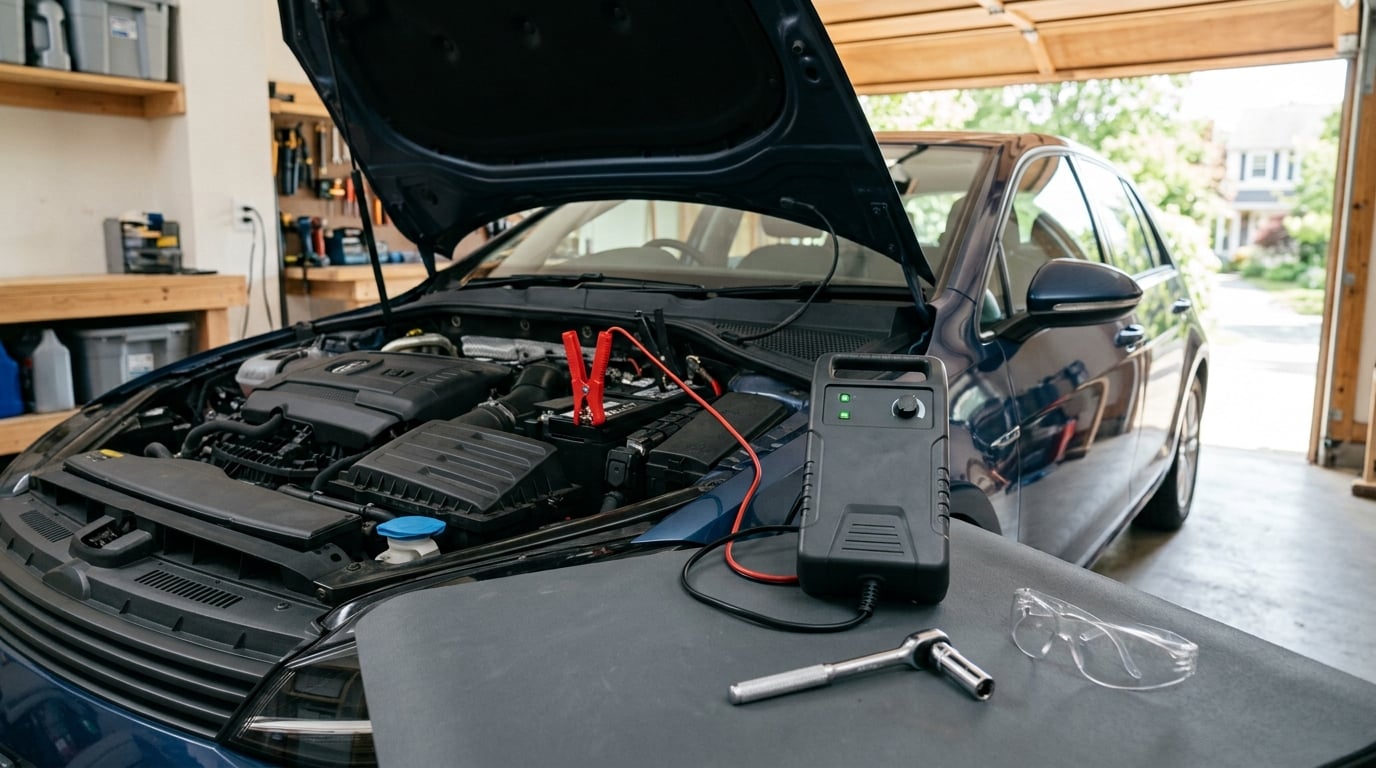
Yes, you can charge a car battery at home. Any 12V smart charger or battery maintainer will do it, and most fully discharged car batteries need 12 to 24 hours on a 2 to 10 amp setting. Connect red clamp to positive first, black to negative second, and let the charger do the rest.
One clarification before we start, because the search results for this question are full of it: this is about the 12V lead-acid battery under your bonnet, not about plugging an electric car into a wallbox at home. Charging a 12V battery is a garage job that takes minutes of your attention and hours of unattended time.
It is worth getting the safety framing right up front, because this is the part that goes wrong. A charging lead-acid battery off-gasses hydrogen, which mixes with air to become flammable at around 4% by volume. Outdoors or in an open garage door, with no flame and no sparks nearby, that is a non-issue. In a closed room, it is not.
The rest of this guide walks through the whole job: what to gather, how to pick a charger that suits your battery chemistry, the connection order, how long to expect it to take, and how to tell whether the battery is actually finished or quietly dying.
Table of Contents
- What You Need
- How to Charge a Car Battery at Home
- Choose the Right Charger for Your Battery
- Prepare the Car and Battery
- Connect the Charger in the Correct Order
- Start Charging at the Correct Rate
- Monitor the Charge and Check for Warning Signs
- Disconnect the Charger Safely
- Check Whether the Battery Is Ready
- Charging a Battery That Will Not Take a Charge
- Charging in Cold Weather
- Why a 20-Minute Drive Does Not Charge Your Battery
- Common Mistakes
- Frequently Asked Questions
- Conclusion
What You Need
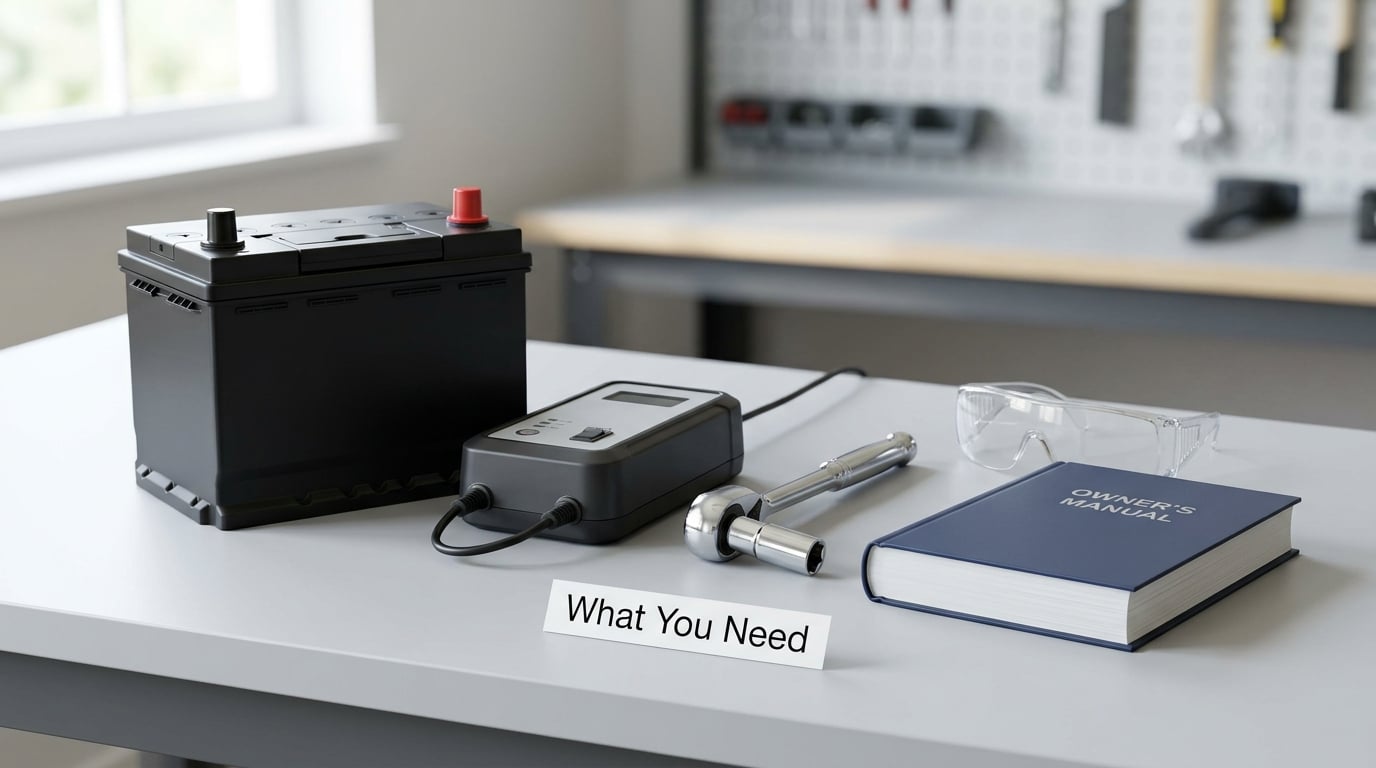
The core list is short. Everything else is optional but useful.
- A 12V battery charger rated for your battery type, or a battery maintainer if the car is simply being stored
- Safety glasses and chemical-resistant gloves
- A rag or paper towels, plus baking soda and water for corrosion cleanup
- A socket wrench or the correct battery terminal tool, if the clamps will not seat by hand
- The vehicle owner’s manual, to confirm the battery type and any manufacturer charge rate
- A multimeter, which turns guesswork into a number
Baking soda neutralises the sulphuric acid in terminal corrosion. A paste of baking soda and water, applied with a rag, turns the fuzzy blue-white crust into something you can wipe off, and it stops the corrosion from eating the metal underneath.
Before anything else, work out what you are dealing with. Nearly every car battery in service today is 12V, and most are one of three lead-acid chemistries: flooded (the classic case with screw-in caps and a vent), AGM (sealed, usually a bit heavier, marked on the label), or gel. The label on the case or the manual tells you which. A lithium-ion start-stop battery in a modern hybrid is a different animal and needs a chemistry-specific charger.
The owner’s manual is worth a genuine look here. Manufacturers sometimes specify a charge rate, a maximum amperage, or a special procedure for their battery, and those instructions beat anything I write. If the manual says 5 amps maximum, set 5 amps.
How to Charge a Car Battery at Home
Choose the Right Charger for Your Battery
Match the charger to the chemistry before you match it to anything else. A flooded battery can take the full 14.4 to 14.6V bulk charge most smart chargers use. A gel battery wants a slightly lower ceiling, around 14.2 to 14.4V, because overcharging boils the gel out of it permanently. AGM also prefers the lower setting, roughly 14.2 to 14.4V.
Many smart chargers have a selector switch for flooded, AGM and gel. If yours does, set it to match. If it does not, check that its manual says it is safe for sealed AGM, and err on the conservative end of the voltage range.
Smart versus manual is a real choice, not marketing language. A smart charger has a micro-processor that watches voltage and current, drops the current as the battery fills, and then switches to a float stage around 13.6 to 13.8V where it can sit for weeks without overcharging. A manual charger pushes a fixed current until you decide to stop, and stopping at the wrong moment is how people cook batteries. For anything you might leave overnight, use a smart charger or a maintainer.
Amperage decides how long you wait, not whether the battery gets charged. The convention is roughly 10% of the battery’s amp-hour rating, so a 45Ah battery takes a 4 to 5 amp setting comfortably. Anything up to about a tenth of capacity is safe; pushing far beyond it just generates heat inside the case, and lead-acid batteries do not like heat.
Here is how the common options compare.
| Method | Typical amperage | Time to a full charge | Best for | Caveat |
|---|---|---|---|---|
| Maintainer (battery tender) | 1 to 2A | Days, in float | Cars parked for weeks over winter | Too slow to rescue a deeply discharged battery |
| Mid-rate smart charger | 4 to 10A | 5 to 20 hours | The normal home repair job | Match the rate to the Ah rating |
| Heavy-duty boost charger | 25 to 50A | 1 to 3 hours | Large commercial or deep-cycle batteries | Too much current for a small car battery |
| Portable jump pack | Burst only, 200 to 400A | Seconds, to crank the engine | Emergency recovery with no second vehicle | Does not recharge the battery meaningfully |
| Jumper cables | Whatever the donor alternator gives | Seconds, to crank | Another car is nearby | Safety depends entirely on connection order |
| Idling the engine | 30 to 80A from the alternator | Does not fully charge | Emergency only | See the myth below, it is not enough |
Prepare the Car and Battery
Park outside or in a garage with the door fully open. Do not charge a battery in a closed room, a basement, or a sealed shed, whatever the internet tells you about “normal” hydrogen levels.
Switch the ignition off, remove the key, kill all accessories, close the windows, and make sure nothing on the vehicle is drawing current. If you are working on a hybrid or a car with an intelligent battery management system, follow the manual’s procedure rather than clamping straight onto the terminals, because the system may be monitoring the terminals.
Let the engine cool. A hot engine bay and a charging battery are a poor combination, and you will be working with your hands close to both.
Look at the battery before you touch it. Stop and take it to a shop if the case is cracked, if it is visibly swollen or domed on top, if there is acid weeping down the sides, if the terminals are snapped off, or if the battery was frozen solid. A frozen battery can crack internally and vent acid when it thaws, and a swollen case can rupture under the pressure of a charge.
Clean the terminals. Disconnect the negative clamp first, then the positive, so a stray wrench bridging the two cannot short the battery. Wire brush the posts, wipe away the corrosion paste, and dry everything before reconnecting anything.
Connect the Charger in the Correct Order
Positive first, then negative. Attach the red clamp to the positive terminal, which is usually marked with a plus sign and often a red plastic cover, and then attach the black clamp to the negative terminal or to a chassis ground point away from the battery.
Some chargers reverse this guidance for batteries that are removed from the vehicle, and some modern units have polarity detection that simply refuses to charge if the clamps are reversed. Both are fine. Read the charger’s instructions and follow them, because the charger’s maker is describing that specific unit. If your charger has an LCD, it usually shows the connection status and the battery voltage once the clamps are seated.
Clamp firmly to the metal post, not to the plastic cover. A clamp that only bites on the rubber boot has a poor connection and will heat up. If there is corrosion and the post will not hold the clamp, a clamp that grips further up the bare lead, or a terminal cleaning tool, will fix it.
Start Charging at the Correct Rate
Set the voltage to 12V if the charger offers a 6V and 12V switch, unless you are charging a 6V battery on purpose. Then set the amperage to about 10% of the battery’s amp-hour rating. If you do not know the rating, a common 45Ah passenger battery is happy at 4 to 5 amps, and a 2 amp setting is always safe, just slower.
Charge time follows from capacity and current. Divide the amp-hour rating by the charge current for a theoretical minimum, then remember that a real charge slows down as the battery fills, so expect the actual time to be roughly double the arithmetic. The common smart-charger stages are bulk, absorption and float, and most of the wall-clock time is spent in the tapering stage.
The table below is a realistic guide for a fully discharged battery at normal temperature. Warmer weather speeds all of it up. Cold weather slows it down noticeably.
| Battery size (Ah) | 2A charger | 5A charger | 10A charger | 50A boost charger |
|---|---|---|---|---|
| 35Ah | 18 to 24 hours | 8 to 10 hours | 4 to 5 hours | Under 1 hour |
| 45Ah | 24 to 30 hours | 10 to 12 hours | 5 to 7 hours | 1 to 2 hours |
| 60Ah | 30 to 40 hours | 14 to 18 hours | 8 to 10 hours | 2 to 3 hours |
| 80Ah | 40 to 50 hours | 20 to 24 hours | 10 to 14 hours | 3 to 4 hours |
Can you leave it unattended? A smart charger, yes. It is designed to run unattended and to hold the battery at float voltage indefinitely. Do not go to sleep next to a manual charger, do not leave it in a hot enclosed space, and keep children away from the leads. A two to three amp maintainer left on a stored car for a month is normal practice, not a gamble.
Monitor the Charge and Check for Warning Signs
Normal behaviour looks like this: the status light comes on when you connect the clamps, the current reading or percentage climbs early, and on a charger with a display the voltage rises from about 12.2V toward 14.4V. A few hours in, the current draw should start falling, and the indicator should move from charging to absorbed to floating or full. Most smart chargers also run a short equalisation or conditioning cycle on deeply discharged batteries, where the light blinks for a while and the voltage may briefly drop. That is not a fault.
Stop and disconnect if the battery gets hot enough to be uncomfortable to touch, if the case bulges, if you hear sustained hissing or popping, if you smell sulphur or a burnt plastic tang, or if you see wet acid weeping from the vents. Those symptoms point to a damaged or deeply sulfated battery, and charging it can release hydrogen faster than a charger expects.
Also disconnect if the charger’s current draw climbs instead of falling, or if it reports full within a few minutes of connecting. A battery that hits full almost instantly is usually reading surface voltage, not real capacity. Owners on r/Cartalk and r/batteries describe this exact pattern: a charger that claims 80% charged after a long session on a battery that still will not turn the engine over.
Disconnect the Charger Safely
Turn the charger off and unplug it from the wall before you touch the clamps. Never pull clamps off a live battery. Removing the negative clamp first while current is still flowing can produce an arc, and a spark next to off-gassing hydrogen is the combination you do not want.
Then disconnect in the reverse of connection: negative clamp first, positive clamp second. Keep the charger leads away from metal and off the ground so they cannot bridge anything when you set them down.
Know when to stop: when the charger reports full and the voltage has settled, or after the time in the table above has elapsed. Leaving a smart charger connected after that costs nothing. Cranking the engine with the charger still attached is a different story, and generally a bad idea, because the voltage spike and the inrush current can confuse the charger and stress the vehicle electronics. Charge first, disconnect, then start it.
Check Whether the Battery Is Ready
A fully charged 12V lead-acid battery rests at about 12.6 to 12.8V with nothing connected. Let the car sit for a few hours, or overnight, before you read anything, and read it at the battery posts rather than at a dashboard gauge, which is calibrated to the running system and will always read higher.
This is how to read the result.
| Resting voltage | What it means | What to do |
|---|---|---|
| 12.6V or higher | Fully charged and rested | Nothing, unless the car will not start and you suspect a different fault |
| 12.4V | Roughly 75% charged | Fine to drive, top it up on a charger before storage |
| 12.2V | Roughly 50% charged | Charge it now, and find out why it sat this low |
| 12.0V | Roughly 25% charged | Charge at 2 to 4 amps and retest after the full cycle |
| 11.8V or lower | Deeply discharged, possibly sulfated | Charge for 24 to 48 hours on a smart charger, then retest |
| Under 11.6V | Near the cutoff, cell damage likely | Expect the charge to take a long time or fail; plan for replacement |
After charging, turn the key. A strong crank and instant start means the battery has real capacity. A slow, lazy crank or no crank at all despite a full-looking charger means the battery is not taking a charge, and the charger reading was surface voltage.
If it will not hold a charge, there are three usual suspects and they are easy to separate. An old battery simply cannot hold charge any more, which is normal past three to five years. A parasitic drain is a circuit that stays awake with the car parked, and you can find it by pulling fuses one at a time and watching what stops. A bad alternator shows up as a battery that stays above 12.8V while the engine runs, or that drains again within a few days of a full charge. Test the alternator output at the battery with the engine running, and if the reading is off, stop replacing batteries and fix that instead.
Here is how to charge a car battery at home without repeating this in a month: find the cause. Most people who jump or charge a flat battery never work out why it went flat, and the same one dies again next week. A ten-minute check for a parasitic drain, or a look at whether the battery is simply old, saves you the repeat job.
Charging a Battery That Will Not Take a Charge
There is one failure mode that confuses everybody eventually: the charger reports full in an hour and the car still will not start. The charger is reading voltage at the posts, and a sulfated or dead-cell battery presents a healthy surface voltage the moment a small current is applied, while having almost no real capacity underneath.
Give it a fair shot first. Drop to 2 amps, which is gentle enough not to stress a weak cell, and leave it for a full 48 hours. Some chargers also have a reconditioning or desulfation mode that pulses a high current through the battery to break up crystalline lead sulphate; run it if your unit has one.
If the charger goes straight to full again, measure the resting voltage after the attempt. Still reading near 12.0V or lower means the battery has lost its capacity for good, and no charger at any price brings that back. Sulfation is the usual culprit on a battery that sat discharged for weeks, and it is a normal end state rather than a fault. On r/BmwTech the recurring question is whether a cheap generic smart charger can revive an old battery, and the honest answer is that it sometimes does, but not reliably enough to plan around.
A trickle charger or maintainer is the wrong tool here, and this comes up on r/MechanicAdvice more than any other charger question. A maintainer is designed to top off a healthy battery at roughly 13.6V float. Point one at a deeply discharged battery and it will either refuse to charge, or it will sit there for days delivering a trickle it was never sized for. Use a real smart charger, and only move the battery onto a maintainer once it is genuinely full.
Charging in Cold Weather
Cold hurts lead-acid twice. A battery that is at 20F has lost much of its charge for the winter, and the chemistry accepts charge more slowly when it is cold, so a charger that would finish in six hours in September can take twenty in January.
Two things help. Let the battery warm up naturally before you start, ideally by bringing the car into a heated garage a few hours in advance, and then charge it. Do not try to speed this up with a heat gun or hot water poured over the case, since the point of a charger is controlled current, not cooking the battery. If the battery actually froze, that is the point to stop and let it thaw on its own, because a frozen battery can crack internally.
Once charged, cold weather is also the moment to think about storage rather than repair. A one or two amp maintainer on a car that sits through a month of cold will hold the battery at float and stop the discharge that ends most of them.
Why a 20-Minute Drive Does Not Charge Your Battery
This one comes up constantly on forums and it is repeated by plenty of well-meaning advice online. It is wrong, and the arithmetic shows why.
A typical car battery holds 45 amp-hours. A running alternator pushes somewhere between 30 and 80 amps into it, but only while the car is moving and only after the engine’s own needs are met, so a realistic net figure is in the 20 to 50 amp range. A deeply discharged battery is missing 30 or more amp-hours. At 30 amps net, 20 minutes gives you about 10 amp-hours, which is a third of what you needed, and a battery that is at a third charge will still crank slowly tomorrow morning.
What the drive does do is give the alternator a chance to bring a partly discharged battery up to a workable state, and it lets the car’s electronics settle. That is genuinely useful after a jump start. It is not a charge, and it is not a substitute for a charger. Mechanics in the r/MechanicAdvice threads make the same point repeatedly, and the same question fills the r/Cartalk forum with cars that start once and then go flat again.
Common Mistakes
Most of these are recoverable. A few are not, so read this part before you start rather than after something has gone wrong.
Reversed polarity. Connecting the red clamp to the negative terminal can melt wiring, blow a fuse, or damage electronics. Buy a charger with reverse-polarity protection, and confirm the polarity is correct before you switch it on. If you have already done it, switch off, disconnect, and check the vehicle before doing anything else.
Charging in an enclosed space. A closed garage, basement or shed concentrates hydrogen, which is lighter than air and collects near the ceiling. Fix it by opening the door fully, moving the car outside, or just waiting until you can work with real airflow.
Too much current. A 50 amp boost charger on a small 35Ah car battery generates heat faster than the battery can take it, and lead-acid hates heat. Stay near 10% of the amp-hour rating.
Metal tools bridging the terminals. A wrench that touches both posts is a dead short and a shower of sparks. Insulated-handled tools, or a plastic socket holder that keeps the handle away from the shell, make this much less likely. The safest habit is to remove the negative clamp first whenever the vehicle is on.
Leaving a non-smart charger connected. A fixed-current charger left on for days boils the water out of a flooded battery, warps its plates, and destroys it. A smart charger with a float stage is the only kind worth leaving connected, and that is the whole point of float and maintenance charging.
Expecting a charger to fix an alternator fault. If the alternator is not holding output, the battery goes flat again no matter how well you charge it. Check alternator output before buying a second battery.
Jump-starting a damaged battery. Never jump start or charge a battery that is swollen, cracked, leaking acid, or has damaged or missing terminals. It can rupture without warning. On r/batteries the fear of exactly this is the most common thread topic, and it is a reasonable fear.
Charging below freezing. A battery that froze in place can be damaged internally. Bring it somewhere above freezing and let it thaw naturally, without a heat gun or hot water, before putting current into it.
Two habits prevent most of the above. Keep the charger and the car out of enclosed spaces, and treat the battery terminals as live even when the car is off.
Frequently Asked Questions
How long does it take to charge a car battery?
A fully discharged 45 amp-hour battery typically needs 10 to 12 hours on a 5 amp smart charger, or 5 to 7 hours on a 10 amp setting. A 2 amp trickle charger takes 24 to 30 hours. Cold weather extends all of these, because a cold lead-acid battery accepts charge more slowly. Most smart chargers are safe to leave on overnight and will hold the battery at float voltage once it is full.
Is it safe to charge a car battery indoors?
Not in a closed room. A charging lead-acid battery releases hydrogen gas, and hydrogen becomes flammable in air at around 4% by volume. Outdoors, or in a garage with the door fully open and good airflow, this is a normal DIY job. In a basement, closed shed or sealed room, hydrogen can collect near the ceiling. Also no smoking, no open flame, and keep sparks away from the battery.
What charger amperage should I use for a car battery?
About 10% of the battery’s amp-hour rating. A 45 amp-hour battery is comfortable at 4 to 5 amps, and 2 amps is always safe, just slower. Stay away from heavy 50 amp boost chargers on a small car battery, since the extra current shows up as heat and heat shortens battery life. Match the voltage to the chemistry too: flooded takes the full 14.4V, while AGM and gel want closer to 14.2V.
Can a normal car battery charger charge an AGM battery?
Yes, as long as the charger is safe for sealed AGM batteries, which most modern smart chargers are. The real risk is voltage, not amperage. AGM and gel cells prefer a bulk ceiling of about 14.2 to 14.4V, while flooded cells take 14.4 to 14.6V, so overcharging an AGM with a flooded setting boils the electrolyte out of it permanently. If your charger has a chemistry selector, set it to AGM.
Why does my car battery keep dying after charging?
Usually one of three things, and they are easy to separate. The battery may simply be old, since lead-acid rarely lasts past three to five years. A parasitic drain keeps waking up circuits while the car sits. Or the alternator is not putting out enough, so the battery drains again within days. If the battery rests above 12.6V after charging but dies quickly, test the alternator output at the battery with the engine running.
Should I remove the battery before charging it?
Usually not. Charging in place is simpler, and it lets you test the charging system right after. A smart charger works fine on a vehicle battery without being removed. Take it out when you need to inspect the case, when the battery is leaking or corroded underneath, when the car is being stored for months, or when your owner’s manual specifies removal. If you do remove it, the negative clamp comes off first and goes back on last.
Conclusion
Charging a car battery at home is straightforward once you have the right charger. Work outdoors or in a well-ventilated garage, check the battery for cracks, leaks or swelling, connect positive first and negative second, and set the current to about a tenth of the amp-hour rating. Then leave a smart charger alone for 12 to 24 hours and confirm the result with a resting voltage of 12.6V or higher.
If it does not hold that charge, stop and diagnose rather than recharging again. An old battery, a parasitic drain and a weak alternator look identical from the driver’s seat, and a multimeter plus a fuse-pull test tells them apart in an afternoon.
Recycle the old battery through a retailer or recycling centre rather than putting it in household waste, and keep the charger leads where nobody walks.