
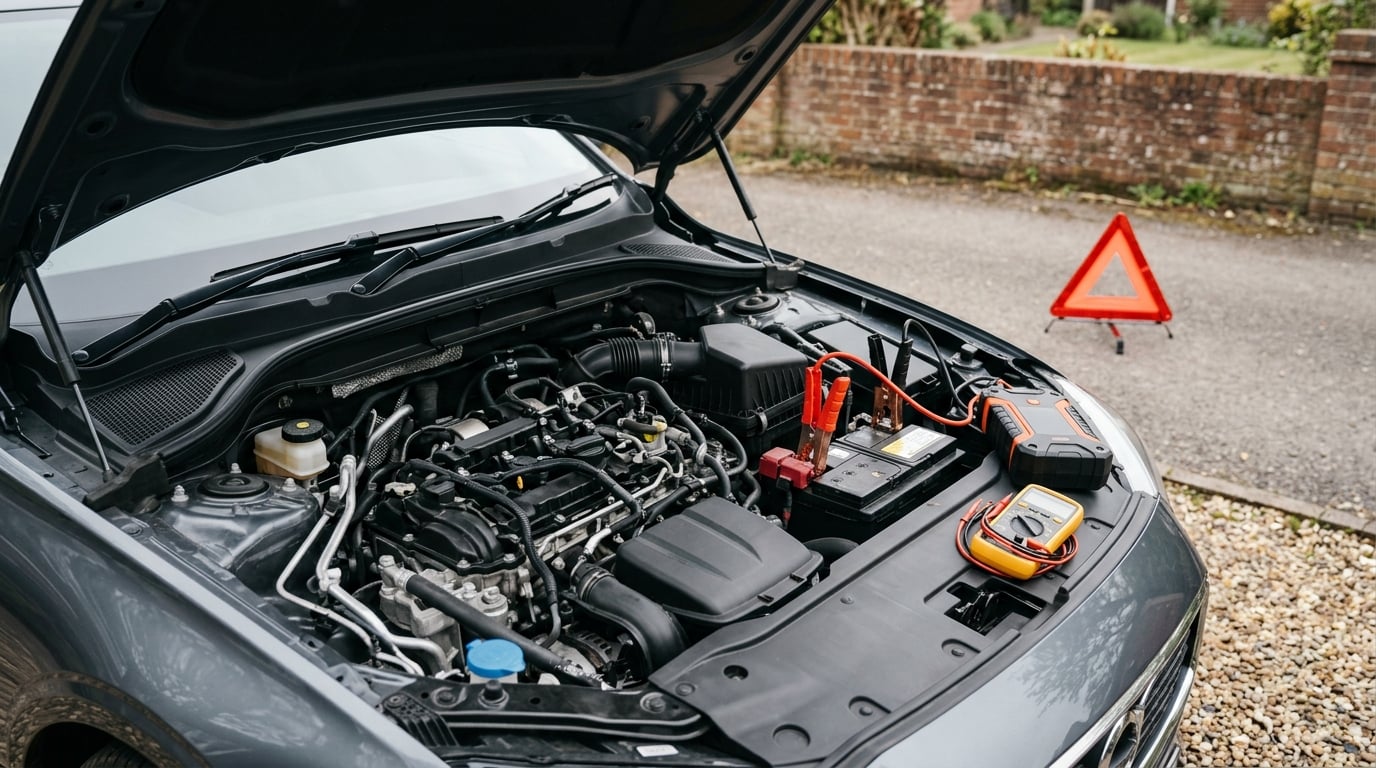
Yes, you can jump start a car with a dead alternator, but it is a temporary fix that gets the vehicle to a safe place or a repair shop. A jump only supplies enough current to crank and start the engine. With a dead alternator, nothing puts energy back into the battery, so the car runs on stored charge alone until it stalls.
This guide covers what you need, the safe connection order, how long you can expect to drive, and how to tell a dead alternator from a dead battery. Ten minutes of reading can save you a second tow.
Table of Contents
- What You Need
- Can You Jump Start a Car with a Dead Alternator?
- Step-by-Step
- Common Mistakes
- When to Call a Mechanic Instead
- Frequently Asked Questions
- Will jump-starting a car charge the battery if the alternator is dead?
- How long can I drive with a dead alternator after jump-starting the car?
- What does it mean if the car starts but the battery warning light stays on?
- Can I use a portable jump starter if the alternator is not charging?
- Is it safe to jump-start a car repeatedly with a bad alternator?
- Can I hit my alternator to make it work?
- Conclusion
What You Need
The gear list is short. Most people already own half of it in the trunk, and the rest is a ten-minute shop trip.
- Jumper cables — a set with at least 4-gauge wire and clamps long enough to reach between both batteries without stretching.
- A portable jump starter — a lithium pack with built-in clamps and a charge indicator. A Jag-Lovers thread on an E-Type reports keeping the car running with a lithium pack, with the caution that the pack should be disconnected soon after the engine starts.
- A donor vehicle — a second car with a healthy battery, if you are not using a jump pack.
- Gloves and eye protection — battery acid and sparks are both real concerns with a discharged battery.
- Basic hand tools — usually a socket or wrench set, only if you need to remove a terminal cover or a battery hold-down bracket.
Battery location varies more than most people expect. On many BMW models the battery sits in the trunk, other cars put it under the rear seat, and plenty of front-engine cars keep it in plain sight under the hood. Check the owner manual before you go looking, especially if the car is a rental or a car you bought used last week.
Your manual also matters for the ground point. Some manufacturers specify an auxiliary grounding stud rather than a body bolt, and using the wrong one can light up warning lamps that have nothing to do with your problem. When in doubt, follow the manual.
Can You Jump Start a Car with a Dead Alternator?
You can, as long as the battery still holds enough charge to turn the starter. The crank draws a heavy burst of current, and the donor battery or jump pack covers that burst. What the donor cannot do is replace the alternator, so the moment the cables come off, your car is running entirely on its own remaining charge.
This is the same mechanic behind the three symptoms r/MechanicAdvice beginners describe: a jump pack that powers on and off, a car that runs for a few minutes and then dies, and a battery that never seems to hold a charge after a drive.
Why the fix is only temporary
- No recharging. The alternator is the component that converts engine rotation back into stored electricity. If it is dead, the battery never gets topped back up.
- Constant drain. Ignition, fuel pumps, steering assist, ECU, lights and every other circuit keep pulling from the battery for as long as the engine runs.
- Quick stalling. The reserve you have at the moment of the jump is all the runtime you get, and it shrinks the moment you turn anything on.
It is also worth separating three different problems that all look identical from the driver’s seat.
A truly dead battery has no reserve left. It will not crank, or it cranks slowly and dies instantly. A damaged alternator can leave a perfectly good battery that simply never gets recharged. A parasitic electrical draw is something else entirely: a module, trunk light, or amplifier staying awake with the car parked, draining the battery overnight until it will not start in the morning. The first two are related; the third is not, and it will drive you crazy if you keep replacing parts that were never the problem.
Do not build a habit out of jump starting. Every cycle takes a deeply discharged battery and puts it through another hard start, and each time the charge you recover is a smaller slice of what you had before. If a shop diagnoses a bad alternator, driving three towns over every morning to jump the car is going to end with a second dead battery and a second bill.
How long you can drive after the jump
Runtime depends almost entirely on how much charge the battery held when you hooked up, then on how many accessories you run. Treat these as planning numbers, not promises, and remember the engine draws its biggest burst of power at the instant you turn the key to start again after a stall.
| Battery state of charge | Expected running time, mostly idle | Expected running time, local driving |
|---|---|---|
| Near full | 20 to 30 minutes | 15 to 25 minutes |
| About three quarters | 10 to 20 minutes | 10 to 15 minutes |
| Around half | 5 to 10 minutes | 5 minutes or less |
| A quarter or less | May crank but not start | No drive time |
One owner on ih8mud drove roughly 20 miles home on a dead alternator in a 2007 V6 Camry and arrived with a battery so depleted it needed a second jump. That was the best case on a mild day with nothing else switched on. An S2Ki thread has the opposite story: a jump that worked fine, followed by a dead car 100 feet down the road.
The spread is the point. Nobody can promise you a distance, so plan for the shortest estimate in the table and get moving.
Step-by-Step
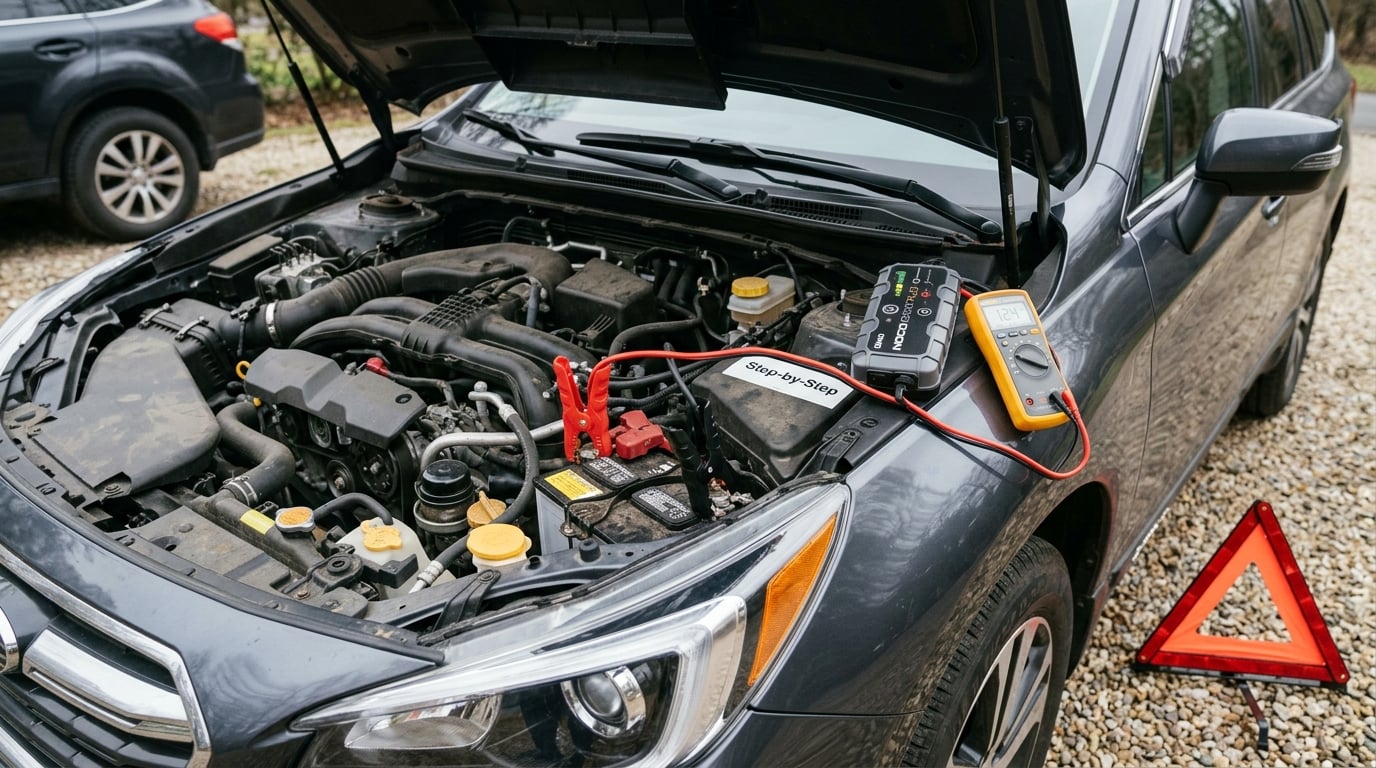
Read the whole sequence once before you touch a cable. It takes about ten minutes from hood up to driving, and the order matters more than any technique.
- Park and prepare. Put both vehicles in park (or in gear with the handbrake set), switch everything off, open the hoods, and put on gloves and eye protection. Do not let anyone touch the keys on either car during the connection.
- Find both batteries and identify terminals. The positive post is marked with a plus sign or a red cover; the negative is marked with a minus sign or a black cover. Some cars hide the negative under a cover or tuck it near a strut tower, so take the extra minute to look.
- Connect positive to positive. Red clamp to the dead car positive post, red clamp to the donor car positive post. No sparks should be generated, but keep the loose ends away from each other anyway.
- Connect negative to negative. Black clamp to the donor negative, then run the second black clamp to a solid, unpainted ground point on the disabled car — a metal strut brace or engine block, several inches away from the battery. Connecting last to a ground instead of the dead battery post gives any spark a safe path away from battery gas.
- Start the donor car, then the disabled car. Let the donor idle and give it a minute. A MaseratiLife thread makes the point about a dead-alternator jump specifically: keeping the donor car running means its own charging system is supporting both cars during the attempt.
- Disconnect immediately, then drive straight to a shop. Take the cables off in the reverse order, negative away from the disabled car first, then drive the shortest practical route to a repair shop. That is the whole recovery; the alternator is not fixed by any of it.
How to Connect Jumper Cables Without Sparks
Attach the negative cable last, and attach it to ground rather than to the battery post. Reversed polarity is the classic mistake and it is the expensive one: it sends current the wrong way through the electronics, and the result can be a fried ECU or a dead battery that was fine yesterday.
Keep both clamps in your hands until you are ready to attach them, and never let the two clamps touch each other. If you hear a hiss, smell acid, or see the cables warm up, stop and look at the connection before you crank anything.
If the engine cranks but will not fire, the jump is not the problem — either the battery cannot hold a charge long enough to ignite, or fuel, spark or compression is at fault. Let the donor sit for another minute and try once more with the cables firmly seated. If a second attempt does nothing, stop. A third and fourth try just drains the battery further, and if the engine fires but immediately stalls, that is a strong signal of a dead alternator or a dead battery rather than a dead spark plug.
What to Do After the Engine Starts
Do not leave the cables attached. Once the engine catches, remove the negative clamp from the disabled car first, then the negative from the donor, then the positive from the donor, then the positive from the disabled car.
With a working alternator, all of this matters less, because the car is putting energy back as fast as it spends it. With a dead alternator, every watt you take is a watt the battery never gets back. Switch off headlights, heated seats, the blower, the radio, the heated steering wheel, seat heaters, defrosters, phone chargers, and anything else you do not need to reach the shop. On a modern car that can be the difference between fifteen minutes of runtime and thirty.
Stay off the highway, take local streets, and do not stop to run errands. If the car is in a parking lot where the engine can idle, idling is the gentlest option for the battery.
Drive it or tow it comes down to a few things. Drive only if the shop is genuinely close, the route is flat and slow, the weather is dry, the battery is fairly young, and the engine started without a long crank. Tow if the shop is more than a few miles away, if the trip involves highway or hills, if the battery is old, if the engine ran rough or smoked, or if the dashboard lights stayed on. No mechanic minds a towed car arriving with a dead battery and an honest phone call.
How to Tell an Alternator Problem from a Battery Problem
Both faults produce a car that will not start, so the useful test is what the car does once it is running, not before.
On a healthy charging system, a multimeter across the battery posts with the engine running reads roughly 13.8 to 14.4 volts. Anything near battery voltage, around 12 volts, means the alternator is not putting out. Drop the hood and listen too: a healthy alternator is quiet, while a whining, grinding, or rattling bearing is a mechanical failure you can hear.
Watch the dash after the jump. A battery or alternator warning light that stays on, headlights that dim when you raise the idle, a blower motor that sounds weak, or power windows that crawl all point at charging. So does a car that dies again two days after a long drive with a fresh battery — that is the classic bad-alternator pattern, and it is the reason a shop should test the charging system before selling you parts.
Watch for the smells too. Burning rubber or a hot-sweet odor means a slipping or overheating serpentine belt, and a rotten-egg smell near the battery means electrolyte boiling off, usually from a battery that is being overcharged. Neither is a situation to keep driving in.
Alternators often die at the far end of a long, normal life rather than all at once. Owners on r/AskMechanics and r/4thGen4Runner report units around 12 years old and roughly 189,000 miles, which is a useful reminder that the failure you are looking at is normal wear, not a manufacturing defect. If the whole charging system is tested as a unit — battery, belt, grounds, regulator, alternator — you get one accurate answer instead of a pile of guesses.
Common Mistakes
Almost every jump-start problem in a parking lot traces back to one of these.
- Reversed cable polarity. The fix is prevention: identify the terminals twice, and never guess. Reversed cables can damage electronics immediately.
- Loose or corroded connections. Green fuzz on a post or a clamp that only half-seats is a bad connection, and it stops current from flowing. Clean the posts with a wire brush and a baking-soda and water paste, dry them, and clamp until they seat.
- Touching the two cables together. The clamps are live the whole time you work. Hang them on the engine bay, not on each other.
- Connecting the negative to the dead battery. It will often work, but a spark at the battery can ignite hydrogen gas. Attach the final negative clamp to a ground point away from the battery instead.
- Revving the donor engine or the disabled car. Hard revs dump huge current into cables and clamps that are not rated for it, and they tell you nothing about whether the charging system is working.
- Trying again and again. A no-start with a dead alternator will not fix itself. After one or two honest attempts, call for a tow.
One last habit: when you remove the cables, the negative on the disabled car comes off first and goes on last. Reversing that order with the engine running can send current back through the electronics.
When to Call a Mechanic Instead
Stop, step away from the car, and call roadside assistance rather than a shop if you notice any of these before you even open the hood.
- A strong fuel smell, or gasoline pooling under the car.
- Smoke, or steam coming from the engine bay.
- A hissing sound from a battery that looks swollen, split, or wet around the posts.
- A burning electrical smell that sharpens the moment you turn the key.
- Visible sparks that keep coming, or a battery terminal that is glowing.
- An engine that overheats within minutes of starting.
- Fluid leaking from the alternator or the battery.
Any of those turn a bad alternator into a safety problem, and no jump start fixes a battery that is already bulging. Set the hazard flashers, move away from traffic, and wait for a tow.
A cheap test is also worth knowing about: push starting only works on a manual transmission, and it needs enough battery charge to fire the engine. A Cartalk thread asks whether a manual car with both a dead battery and a dead alternator can be push started, and the answer is no. You need the alternator repaired or replaced, because the moment the driver releases the clutch the car is on its own charge again.
Frequently Asked Questions
Will jump-starting a car charge the battery if the alternator is dead?
No. The alternator is the only component that puts energy back into the battery while the engine runs, so a dead alternator means no recharging at all. The donor battery or jump pack only supplies the cranking burst needed to start the engine. Once the cables are removed, the car runs on stored charge and will stall when that charge is used up. A charger or a working alternator is the only thing that restores the battery.
How long can I drive with a dead alternator after jump-starting the car?
Usually minutes rather than miles. A battery that was near full might give you 20 to 30 minutes of idling or 15 to 25 minutes of local driving, while a half-charged battery may run 5 to 10 minutes at most. Switch off every accessory you can, stay off the highway, and drive the shortest route to a shop. If the car stalls mid-journey, treat it as a tow from that point on.
What does it mean if the car starts but the battery warning light stays on?
It means the charging system is not doing its job. The engine is running on battery power only, and the light staying on after a successful jump start is one of the clearest signs of a dead or badly undercharging alternator. Turn off headlights, blower, heated seats, radio, and defrosters, keep the trip short, and have the charging system tested before replacing the battery.
Can I use a portable jump starter if the alternator is not charging?
Yes, and it is often the safer choice because there is no second vehicle to position. A lithium pack supplies the cranking current just as a donor battery does, with none of the cable-swap risk. Disconnect it as soon as the engine runs, because leaving a pack connected to a car with no charging system drains both the pack and the car battery. One S2Ki owner learned this the hard way after a jump that ended with a dead car 100 feet down the road.
Is it safe to jump-start a car repeatedly with a bad alternator?
It is not, and it gets worse every time. Each jump starts from a lower charge than the last, and the repeated deep discharge stresses battery plates and can expose electronics to voltage swings that were never designed to be unregulated. Twice is an emergency. A third time means the car needs a tow, not another attempt. Get the charging system tested before you buy a battery, because a new battery in a car with a bad alternator will die the same way.
Can I hit my alternator to make it work?
No. Shocking, banging, or spinning an alternator may unstick a seized brush or diode for a few seconds, but it risks cracking the housing, shearing the pulley, or damaging the voltage regulator you were trying to rescue. If the alternator is not charging, the repair path is testing the belt, grounds, and battery first, then replacing the unit. A temporary fix worth doing is a proper battery charger, not a hammer.
Conclusion
You can jump start a car with a dead alternator, and doing it gets the car running, but it is a recovery move rather than a repair. The alternator is what recharges the battery, so without it the car is burning through its last stored charge from the moment the cables come off.
Start by testing the battery and the whole charging system, not by buying a new battery. A bad alternator will destroy a good one, and that is the expensive mistake people make twice. One jump is fine. Two is pushing it. A third means the car is ready for a tow, and no amount of cranking will change that.