
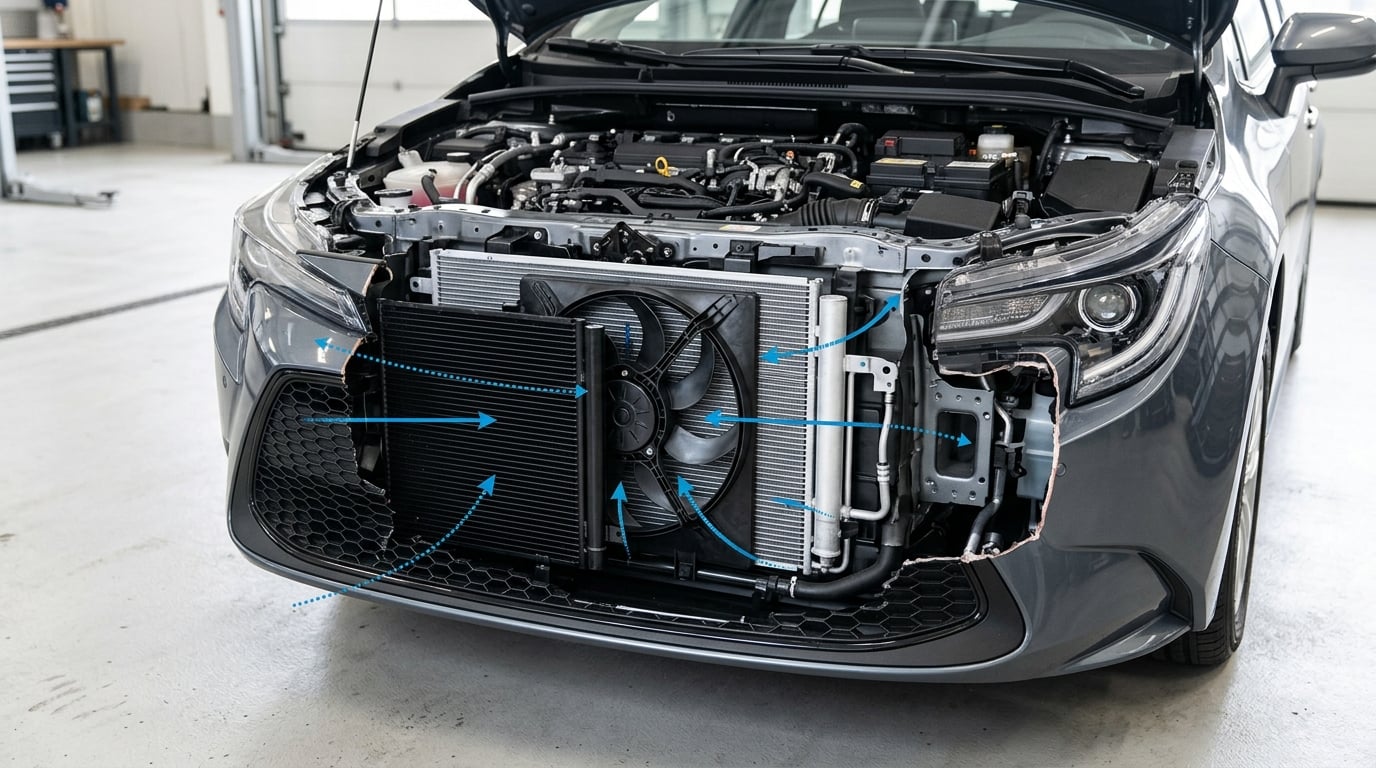
Your air conditioning blows cold only while driving because the system loses the airflow it needs to dump heat once the car stops or slows to a crawl. At road speed, moving air is forced through the condenser at the front of the car. Parked or idling, an electric cooling fan has to supply that airflow on its own, and when the fan, the refrigerant charge or the condenser core is marginal, high-side pressure climbs and the vents go warm.
That speed-dependent pattern is useful, because it rules out a lot. A blower motor does not care how fast you are going, so a weak blower is not the explanation. The fault sits in the part of the system that cools refrigerant, and the cooling only holds up once air starts moving through the fins.
Table of Contents
- Why Does My AC Only Blow Cold When Driving?
- Why Is the Air Warm at Idle and Cold at Road Speed?
- Common Causes and Quick Checks
- Can You Diagnose the Problem Without Opening the AC System?
- Which AC Problems Should Not Be DIY Repairs?
- When Should You Stop Driving and Get Help?
- Frequently Asked Questions
- Why does my car AC work while driving but not while parked?
- Is it normal for the AC to blow warmer air at idle?
- Can a bad condenser fan cause the AC to work only while driving?
- Why is one AC vent colder than the others?
- Does low refrigerant cause air to blow cold only at higher speeds?
- Should I keep driving if the AC stops cooling but the engine temperature stays normal?
- What Should You Check First?
Why Does My AC Only Blow Cold When Driving?
The short answer is that the condenser cannot reject heat properly when the car is stationary. The five causes behind that, in the order they are worth checking:
- The cooling fan does not run, or runs slowly. The condenser fan is the only thing moving air across the A/C condenser while you sit still. No fan means no cooling at idle, and good cooling at speed.
- Low refrigerant charge from a slow leak. A system that is a little low can still pull a workable amount of heat at highway airflow, then fail to hold evaporator temperature during a long idle stop.
- A weak compressor. A compressor that will not reach full pumping speed on its own often keeps up at higher engine RPM and gives up at idle.
- A dirty or blocked condenser core. Bent fins, mud, plastic bags or a bug screen can choke airflow enough that a marginal system tips over.
- A fan relay, fan control module or pressure sensor fault. The command to run the fan or engage the compressor never arrives, or arrives on the wrong schedule.
What all five have in common is the refrigerant high side, or head pressure. High side is the pressure in the lines between the compressor and the condenser, and it rises when the condenser cannot shed heat. Too much heat trapped in that gas means the expansion valve or orifice tube cannot drop the pressure enough, so the evaporator never gets properly cold and the vent air comes out merely cool.
One owner on a Car Talk thread described years of getting the system recharged on a 2008 Lincoln MKZ, with the cooling only holding up at speed. The eventual diagnosis was a slow leak at the condenser, not a failed compressor. That pattern is common enough that a shop pressure test and a leak check belong near the top of the list.
Why Is the Air Warm at Idle and Cold at Road Speed?
Understanding the cycle explains the symptom better than any single part name. The compressor squeezes refrigerant vapor into a hot, high-pressure gas and sends it to the condenser, the heat exchanger mounted in front of the radiator. The condenser drops the temperature, the refrigerant condenses into a high-pressure liquid, and that liquid passes through the expansion device, where the pressure collapses. The cold refrigerant in the evaporator absorbs heat from the cabin, and the blower pushes air across those fins and out the vents.
Every one of those steps depends on heat leaving the condenser quickly. At 50 miles per hour, the vehicle itself becomes a fan, and several times the air volume moves through the fins compared to a standstill. Pull into a parking lot and that free airflow stops completely. Now the condenser has one heat exchanger worth of moving air available, and if the electric fan is slow, missing or fighting through packed fins, the head pressure climbs within a few minutes.
Engine speed matters as much as road speed. The compressor is driven off the crankshaft through a pulley, so it pumps more refrigerant per minute at 2,500 RPM than at 700 RPM. Heat also has somewhere to go at idle: the radiator and condenser sit in the same hot engine bay air, and at idle there is no stream of fresh ambient air to carry that heat away. The cabin sees the result as a vent temperature that climbs while you are stopped and drops the moment you accelerate.
What Changes When the Engine Speeds Up?
Four things change together, and it helps to keep them straight. Compressor output rises with RPM. Condenser airflow rises sharply with road speed. The radiator and engine coolant temperatures settle into their normal range once the engine is under load. And the demand on the system changes, because the cabin load at a stoplight is not the same as the load on an open highway.
That last point is worth a sentence. Many drivers describe the opposite expectation: cold on the highway, warm in city traffic. Both reports can be true for the same car. Stop-and-go traffic means repeated idle and low-speed crawling, exactly the conditions where a weak fan and a marginal charge cannot cope. On an open highway the same system looks perfectly healthy.
Fan strategy also varies by vehicle, and that changes what you should expect to see. Some cars run the condenser fan continuously with the A/C on. Some cycle it on a timer. Some use a fan control module to blend fan speed with engine and refrigerant temperature. Mazda6 owners on mazda6club.com report a familiar model-specific pattern: the passenger-side radiator fan not coming on with the A/C the way it should. Owners on ariyaforums.com describe different behavior again on the Nissan Ariya, where the electric compressor system responds differently at idle.
One thread on r/AskAMechanic turned on a detail that comes up often: the recirculate button was left on, and outside air at idle adds load the system may not be able to carry. It is worth switching between fresh and recirculated air as part of your checks, though on most cars it is a contributing factor rather than the cause.
Common Causes and Quick Checks
This table maps what you notice in the cabin to the most likely cause and the first thing to look at.
| What you notice | Most likely cause | First check |
|---|---|---|
| Warm at idle, cold above 30 mph, no fan noise when the A/C starts | Condenser fan or radiator fan not switching on | Engine idling, A/C on, watch whether the fan behind the grille starts |
| Cooling fades after a long idle stop, recovers on the highway | Low refrigerant charge from a slow leak | Look for a visible leak or oil residue at the condenser lines, and note whether it improves when the fan runs at speed |
| Engine is louder when the A/C is on, cooling is weak everywhere | Weak compressor | Whether the A/C works at all when the car is warm after a long drive, not just at startup |
| Reduced airflow and warm air together, in all weather | Dirty condenser core or restricted cabin air filter | Look through the grille at the fins for debris, and check the cabin filter behind the glovebox |
| One vent is cold and the others are warm | Blend door actuator or stuck blend door | Switch from face vents to floor vents to defroster and see whether the cold air follows the mode setting |
| One temperature from every vent no matter what you select | Blower resistor, control module or a closed blend door | Whether the fan changes speed when you move the blower control |
| Cooling works but the temperature gauge climbs in traffic | Fan problem affecting engine cooling, not just the A/C | Watch the coolant temperature gauge and the fan behavior in the same test drive |
Two misconceptions come up repeatedly and cost owners money. A clogged cabin air filter restricts the air the blower moves through the evaporator, which can reduce cooling, but it does not change the temperature between a stop and a highway. And a failing blower motor produces noise, rattle or no airflow at all rather than air that is the wrong temperature. A 2008 Lincoln MKZ owner on a Car Talk thread was advised to watch both the condenser and the electric fan with gauges on the system, because symptom descriptions alone sent the diagnosis in circles.
Overcharge deserves a mention too. A system that has been topped up repeatedly can pick up non-condensable gases from a worn compressor, and those gases do not condense. They sit in the high side, raise head pressure and weaken cooling, sometimes enough that airflow at speed becomes the only thing holding the vent temperature down.
Can You Diagnose the Problem Without Opening the AC System?
Yes, most of the diagnostic value comes from comparing the same car in two conditions, and all of the following are owner-level checks with the car parked on level ground. Checked against the guidance on the forum threads for this symptom, the order matters: verify fan operation before you spend money on refrigerant.
- Measure the vent temperature parked. With the engine warmed to normal operating temperature, set the A/C to cold, the fan to medium, and recirculate on. Leave the car idling for ten minutes, then hold a thermometer at the center vent. Write the number down rather than guessing from your hand.
- Watch the fan, not just the vents. With the engine running and the A/C on, look through the grille for the condenser fan. It should start within a few seconds of pressing the A/C button. A puller fan behind the radiator and a pusher fan in front of it are both normal arrangements, so learn which one your car uses. Keep hands, tools and loose clothing well clear of the shroud and blades.
- Look at the condenser core. From the front of the car with the engine off, check for leaves, mud, a bag caught against the fins and fins that are visibly bent. Night driving with a flashlight aimed into the grille shows gaps and blockages well.
- Compare the same measurement at speed. On a quiet road, hold the thermometer at the same vent at 45 to 55 miles per hour after ten minutes. If the parked reading is 70 degrees or warmer and the moving reading is in the mid 50s, the system is losing cooling when airflow drops.
- Check the air path, not just the refrigerant side. Try every blower speed, then switch between face, floor and defroster vents. Air that follows the mode setting points to an air distribution problem. Air that is weak at every speed points to the blower, the filter or a blocked evaporator.
- Watch the engine while you are at it. Note the coolant level with the engine cold, and note whether the temperature gauge or any warning lamp reacts during the idle test. That one observation is what separates a cooling-only fault from a fan failure that also affects the engine.
Two more things that cost nothing. Turn the A/C off and on while idling to hear the compressor clutch or electric compressor engage and disengage, and check whether the car has an unusual smell at startup. A sweet or oily odor from the vents is refrigerant or compressor oil in the evaporator area, and that is a stop-and-fix item rather than a driving-with-it item.
Which AC Problems Should Not Be DIY Repairs?
Owner checks stop at the outside of the car. Once you are into refrigerant, pressure or electrical diagnosis, the job belongs to a qualified auto technician, and the owner’s manual for your vehicle is the reference for the procedure.
- Refrigerant work of any kind. Adding refrigerant without a leak test, with the wrong weight of the wrong refrigerant, can make the problem worse. Modern vehicles use R-134a or R-1234yf, and the two are not interchangeable. Low-side and high-side readings need proper gauges and a recovery machine.
- Anything on the high-pressure side. The condenser lines are hot and stay pressurized after the engine shuts off. Opening a fitting or loosening a line is how people get hurt.
- Electrical diagnosis. Fan relays, fan control modules, compressor control valves and pressure sensors are part of the system the technician reads with a scan tool and a gauge set.
- Compressor and clutch work. A failing compressor means a leak has already developed, and replacing it without finding the leak means the new one is on the same path.
- Heater core and blending work. Hot coolant circuits and blend door actuators sit deep in the dash, and mistakes there can mean no cabin heat in cold weather.
- Hot engine cooling systems. If the temperature gauge is already climbing, do not open a radiator or reservoir cap. That is a cooling-system fault and a hot-engine work problem, not an A/C one.
The community consensus on the Car Talk thread for this exact symptom was consistent: use proper gauges rather than a DIY recharge can, and find the leak with a sniffer or UV dye instead of recharging every season. The forum’s owners also recommend a second opinion before accepting a compressor quote, since a number of people in those threads were quoted for a compressor when the actual fault was a relay or a fan control module. Getting a small relay diagnosed is a very different job from replacing a compressor.
When Should You Stop Driving and Get Help?
A weak cabin A/C on its own is a comfort problem. A cooling fan failure is not, because on most cars the same fan moves air through the radiator. Here are the signals that mean you should not keep driving the car.
- The coolant temperature gauge climbs or stays pinned higher than it normally would, especially in slow traffic.
- A coolant temperature warning lamp comes on, or a check-engine light appears alongside the A/C symptoms.
- You see or smell steam from under the hood, or hear a fan running loudly and continuously at a stop.
- There is a sweet smell in the cabin, hissing from the engine bay, or oily residue around the condenser lines. That points to refrigerant escaping into the evaporator area.
- A fan blade is bent, cracked or missing, or you can see a damaged shroud. Debris hitting the radiator at speed can destroy the engine cooling system.
- Oil temperature alerts, or a burning smell that comes and goes with the A/C switch.
- Heat is affecting you. If the cabin will not cool and you feel overheated, dizzy or sluggish, stop in a safe place. Heat impairs reaction time and judgment, and a fogged or glare-bright windshield is a visibility and braking risk before it is a comfort one.
If the engine temperature stays steady, the coolant level is right and there are no warning lights, driving to a shop in cool morning conditions is generally fine. Keep the A/C off on the way in if the fan is the suspected problem, since the compressor load adds heat the engine has to shed.
Frequently Asked Questions
Why does my car AC work while driving but not while parked?
Parked, the condenser has no airflow except what the electric cooling fan provides. If that fan is slow, missing, or pushing air through a blocked core, refrigerant high-side pressure rises and the evaporator cannot get cold, so the vents blow warm. At road speed the moving air does the fan’s job, which is why the same car cools fine on the highway. Check whether the condenser fan starts when you press the A/C button before assuming a refrigerant problem.
Is it normal for the AC to blow warmer air at idle?
A little. Cooling capacity drops at standstill for every car because condenser airflow drops with road speed, and hot engine bay air has less to carry heat away. What is not normal is warm air that turns properly cold within a few minutes of driving. That difference between idle and road speed is the useful signal, since it points at airflow, charge or compressor performance rather than the cabin air path.
Can a bad condenser fan cause the AC to work only while driving?
Yes, and it is the most common cause of this symptom. With the fan dead or slow, head pressure climbs within minutes of idling and the air goes warm. Accelerate and the airflow takes over, so the system appears healthy. On many cars the same fan cools the radiator, so a stuck fan can also bring the coolant temperature up in traffic. A second opinion is worth getting if you are quoted a compressor instead of a fan, relay or fan control module.
Why is one AC vent colder than the others?
That points to air distribution rather than the cooling system itself. A blend door actuator or a blend door that has stuck open or closed sends more or less air across the evaporator, so different outlets deliver different temperatures. Switch between face, floor and defroster settings and see whether the cold air follows the mode you select. If it does, the cooling system is probably fine and the blend door is the fault.
Does low refrigerant cause air to blow cold only at higher speeds?
Sometimes. A slightly undercharged system can still pull enough heat at highway airflow to keep the evaporator cold, then lose that margin at idle. Frequently the cause is a slow leak rather than a lost charge, and one owner on a Car Talk thread was recharged every year for years before the leak at the condenser was found. Refilling without locating the leak only restores the symptom temporarily, and a technician should pressure test and check the refrigerant weight by specification.
Should I keep driving if the AC stops cooling but the engine temperature stays normal?
If the temperature gauge stays steady, the coolant level is correct and no warning light comes on, driving to a shop is generally fine. Choose cooler times of day, keep the A/C off if the fan is the suspect part, and avoid heavy traffic where airflow is lowest. Stop and call for help instead if the temperature gauge climbs, you see steam, smell something sweet or burning, or the heat is affecting your concentration.
What Should You Check First?
Work through it in this order, and the answer usually appears in the first three steps.
- Compare parked and moving behavior. Measure the center vent temperature at idle for ten minutes, then again at 45 to 55 miles per hour. If the difference is large, the fault is in condenser airflow or refrigerant performance, not in the cabin.
- Verify the fan. Engine running, A/C on, watch through the grille. A fan that never starts, starts late or sounds rough explains most of these cases on its own.
- Check the mode and recirculate setting. If the cold air follows the vent you select, you are looking at a blend door problem rather than a cooling problem.
- Look for airflow obstruction. Debris and bent fins in front of the condenser, or a clogged cabin air filter, are visible and cheap to address before anything gets opened.
- Watch the engine for warnings. If the temperature gauge moves or a warning lamp appears, stop diagnosing the A/C and treat it as an engine cooling fault.
- Hand it to a technician if it persists. Pressure readings, a leak test, a control module scan and refrigerant weight by specification are the professional steps, and this guide is current for 2026.
Start with the fan, because it is the cheapest thing to confirm and the most common thing to be wrong. The habit that helps most is measuring the same vent in the same conditions twice, so the diagnosis rests on two numbers instead of an impression.