
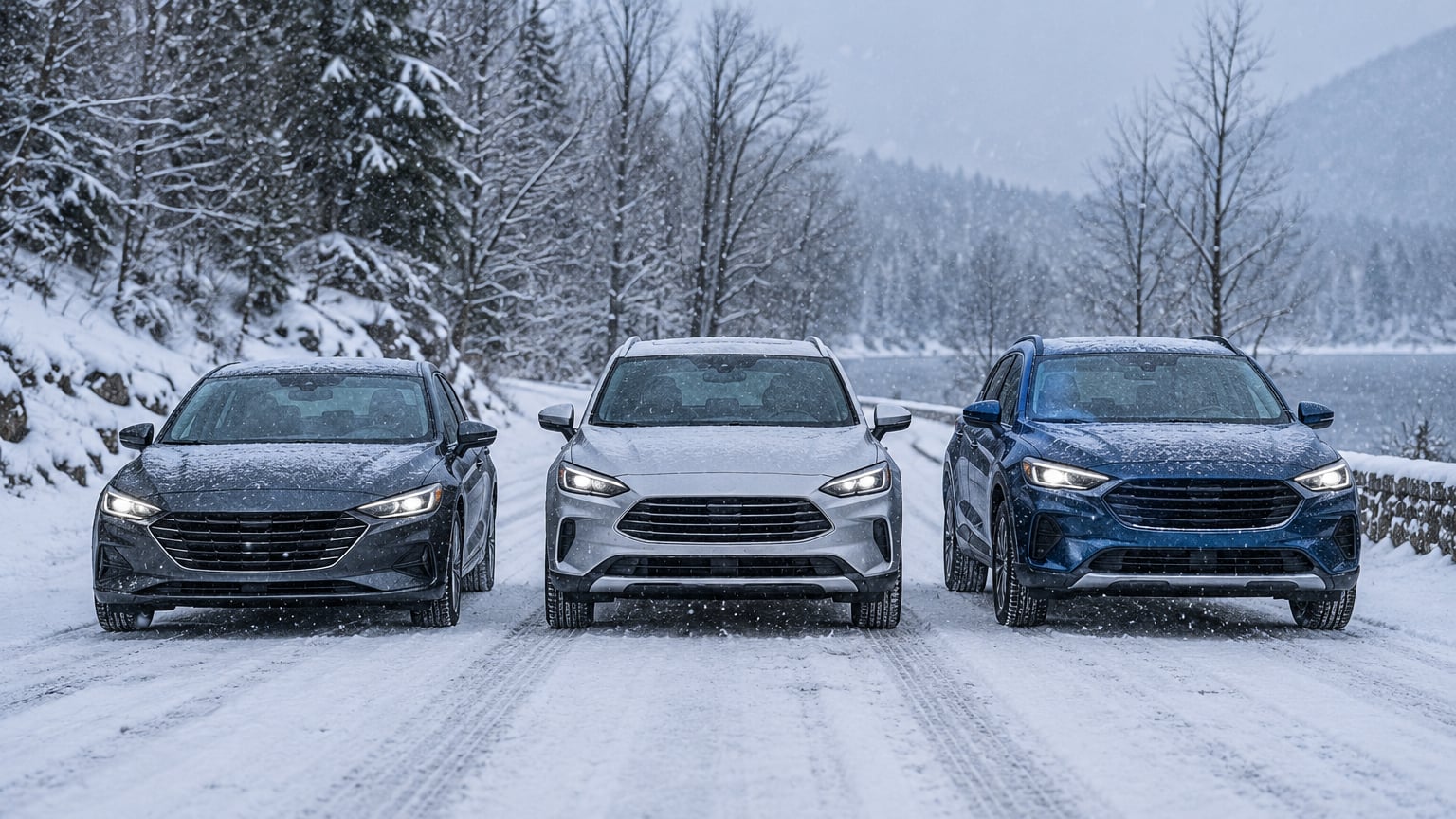
If you want the short version of fwd vs rwd vs awd in snow: all-wheel drive gives the best acceleration and climbing ability, front-wheel drive handles flat and moderate snow well because the heavy engine sits over the driven wheels, and rear-wheel drive struggles most from a stop without good tires. The layout decides how easily you get moving. Your tires decide how fast you stop and how well you turn.
That second sentence is where a lot of winter arguments go wrong. People treat drivetrain and tires like substitutes when they solve different problems. A drivetrain moves the car. Tires grip the road. No drivetrain, including a 500-horsepower one, shortens your stopping distance on ice.
The layout question still matters, and in 2026 it matters more than it used to. Electric vehicles put instant torque through the driven wheels, which changes how gentle you have to be. Mild-winter regions have more drivers choosing the do-nothing option. And buyers keep getting told that all-wheel drive makes winter tires optional, which is the single most expensive misconception in this whole topic.
I have driven all three layouts through the same winters, from flat city streets to mountain grades that get plowed once a day. The honest ranking changes depending on what you are asking the car to do, which is why this is a comparison with a table rather than a winner’s circle.
Table of Contents
- FWD vs RWD vs AWD in Snow at a Glance
- What Does Drivetrain Mean in Snow?
- Which Drivetrain Has Better Snow Traction?
- How Do FWD, RWD, and AWD Handle Winter Driving?
- Does AWD Make a BMW Safer in Snow?
- What About Tires, Braking, and Ice?
- FWD vs RWD vs AWD: Cost and Practicality
- Which Should You Choose?
- Frequently Asked Questions
- Bottom Line
FWD vs RWD vs AWD in Snow at a Glance
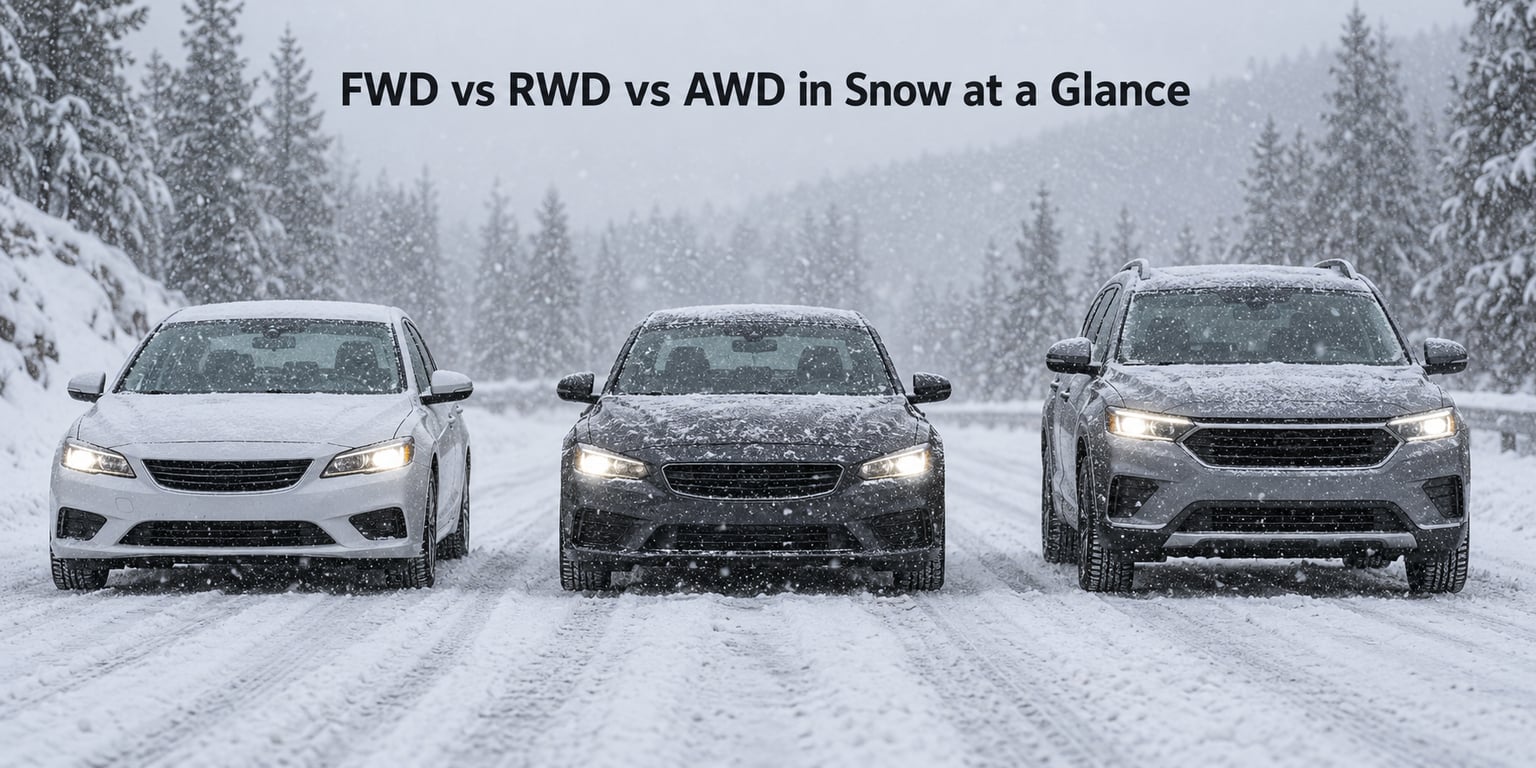
| Snow criterion | Front-wheel drive | Rear-wheel drive | All-wheel drive |
|---|---|---|---|
| Accelerating from a stop on packed snow | Good, engine weight helps | Weak, rear axle is light and spins | Best, torque splits front to rear |
| Climbing a steep snowy hill | Fair to good | Poor without a limited-slip diff | Best, keeps momentum up grade |
| Braking on ice | No advantage | No advantage | No advantage |
| Cornering on ice | Stable, mild understeer | Rotation prone, needs throttle control | Stable, mild understeer |
| Low-speed crawling in deep snow | Fair, depends on clearance | Poor, momentum dies and it bogs | Best |
| Predictability when you get going wrong | High, tends to push wide | Lower, rear steps out | High on power, still needs brakes |
| Efficiency penalty | Smallest | Small | Largest, more mass and losses |
| Purchase cost premium | Baseline | Baseline to slight | Noticeable on most vehicles |
| Extra maintenance items | None beyond a transaxle | Diff fluid if limited-slip | Transfer case, coupling, rear diff fluid |
| Best conditions | Flat to moderate snow, city and suburbs | Groomed roads with winter tires | Hills, rural roads, ski trips, unplowed streets |
Read the braking and cornering rows again. They are identical across all three columns, and that is not a formatting shortcut. A car’s ability to slow down and change direction comes from the four tires touching the ground, regardless of which ones receive power.
What Does Drivetrain Mean in Snow?
FWD, RWD and AWD in plain language
Front-wheel drive sends engine power to the two front wheels. Rear-wheel drive sends it to the two rear wheels. All-wheel drive sends some to all four, usually by splitting torque between a front and a rear axle.
Most front-wheel-drive cars are transverse-engine layouts, meaning the engine sits sideways above the front axle. That packaging stacks the heaviest part of the car directly over the wheels doing the driving, which is why front-wheel drive has a natural grip advantage that has nothing to do with cleverness.
Rear-wheel drive is usually a longitudinal layout with the engine behind the front axle and the gearbox in the middle. The driven wheels carry less of the car’s weight, so they have less normal force pressing them into the snow.
Why AWD and 4WD are not the same thing
Four-wheel drive usually means a low-range gearbox, a transfer case, and a truck-style chassis built to crawl or tow. All-wheel drive means road-oriented full-time or on-demand power to four wheels, sometimes with no low range at all.
In deep mud, deep snow, or a steep rocky climb, 4WD wins because low range multiplies torque at the wheels. On a snowy highway, the two are closer, and a good AWD system with proper winter tires will outrun most 4WD trucks on all-season tires.
Grip is a tire problem, traction is a drivetrain problem
Traction is grip multiplied by the weight on the driven wheels. Grip comes from rubber compound, tread depth, tread pattern, contact pressure, and surface temperature. You can only change the drivetrain when you buy the car.
A useful test: imagine dragging a boat. The drivetrain decides how hard the rope pulls. The tires are the hull. A weak engine in an efficient hull still floats. A powerful engine on a hull full of holes does not, and it does not matter how many propellers it has.
Which Drivetrain Has Better Snow Traction?
AWD: torque splitting and the hill-climb advantage
All-wheel drive keeps a wheel turning in every direction, so it can always find something to grip. A torque-sending system biases power rearward on climb, which is exactly what a steep grade needs. Symmetrical systems split roughly evenly and are simpler, so they give up a little on steep grades and gain consistency.
The result is the best acceleration from a stop and the best ability to keep climbing. On deep snow where you have to move slowly and steadily, that is a real advantage, not marketing.
FWD: weight over the driven wheels
Front-wheel drive wins in light to moderate snow because the engine’s weight presses the front tires down. More weight on driven wheels means more force available before the tires break loose. That is why a front-drive car often pulls away cleanly at an intersection while a rear-drive car next to it just sits and spins.
Its weakness shows up in deep unplowed snow. A front-drive car that bogs down has almost no way to rock itself free, and it carries less weight over the wheels than the axle is being asked to do.
RWD: a light driven axle and an open differential
With an open differential, a spinning wheel sends its speed to the other wheel and limits torque to both. Rear-wheel drive from a stop with an open diff on snow means the lightly loaded, spinning rear wheel sets the pace for the whole axle.
A limited-slip differential is the fix, and it is the most underrated traction upgrade in this entire topic. A Crown Victoria with a limited-slip diff and winter tires was described as pretty much unstoppable in bad weather by owners on the ClubLexus forum, and plenty of drivers in Ohio and Boston run rear-wheel-drive cars through real winters with nothing more than good rubber.
What the instrumented snow tests actually showed
One of the few controlled same-vehicle comparisons published ran a single electric sedan at minus 7 C on Michelin Pilot Sport AS4 tires at 42 psi, switching between torque modes on the same course. Front-wheel drive managed the run in 101.3 seconds. Rear-wheel drive did it in 99.1. All-wheel drive with an even split did 94.
Two things stand out. The gap between all-wheel drive and either two-wheel-drive mode was real but modest, around 7 percent. The gap between front-wheel drive and rear-wheel drive was negligible, which tells you that on a moderate course with all-season rubber, layout barely matters.
Change the tires instead of the torque mode and the ranking reshuffles. A crossover on all-seasons was slower in snow than a car on rear-wheel drive wearing proper winter rubber. That is the comparison shoppers should be running, and almost nobody runs it.
One caveat belongs with those lap times. A fixed course on a groomed surface is not a stand-in for a steep city street in a storm, and one vehicle is not a sample of every drivetrain design. Read the numbers as evidence that the layout gap is real but modest, not as a spec sheet.
Which AWD system works best in snow?
Three designs cover most of what you will meet, and they behave differently on a climb.
- Symmetrical AWD splits torque near evenly between axles all the time. Subaru is the familiar example. It is simple, predictable, and has no thinking delay, which is why owners describe it as excellent in light snow. The trade-off is that it gives up some of the rearward bias a steep grade wants.
- Torque-sending AWD can drive more power rearward on demand or by default. It climbs better and pulls out of soft snow more readily, at the cost of a more complex front or rear drive unit.
- Disconnecting 4WD runs in two-wheel drive most of the time and drops a rear axle in when a front wheel starts to slip. It is the cheapest to operate and the least helpful once you are already moving on snow, since it reacts to a problem rather than preventing one.
For a driver who will not name the system, the practical test is a hill. If the vehicle climbs a steep snowy grade in one smooth pull without spinning, the system is doing its job. If it bogs and beeps, it is not.
How Do FWD, RWD, and AWD Handle Winter Driving?
How to drive FWD in snow
Give it more throttle than feels reasonable, not less. A front-wheel-drive car bogs down when you ease off, so a steady, deliberate press of the accelerator keeps the front tires working instead of spinning up in a heartbeat.
It will push wide if you arrive too fast, so plan your line earlier and accept a wider arc. Its predictability understeer is the reason it is the default choice for so many drivers in snow country.
How to drive RWD in snow
Rear-wheel drive demands the most throttle discipline of the three. Smoothness beats power: a stab at the pedal lights up the rears, and once they break loose the car rotates. Lift, wait for grip, then feed in throttle again.
Climb hills in a straight line with steady momentum, use low gears to stay above the wheelspin threshold, and leave real space behind. Our guide to snow driving techniques for rear wheel drive cars goes into the clutch-up and handbrake-start tricks in detail.
How to drive AWD in snow
All-wheel drive forgives a lot of throttle abuse, which is both its gift and its problem. Still leave space. The rear axle can carry you onto an ice field you could not stop on, and the drivetrain will not save you there.
On climbs, let the system do its job rather than stabbing the pedal. If your vehicle has a hill descent or snow mode, use it, because those modes usually soften throttle and shift torque rearward where the grade demands it.
The misconception: more driven wheels does not mean a safer winter drive
Owners noticed this pattern on the forum threads long before it appeared in a guide. A good all-wheel-drive system puts both rear-wheel drive and front-wheel drive to shame at getting moving, and the car feels far more stable while doing it. The corollary is what gets people hurt.
Drivers who selected all-wheel drive partly to avoid the awkwardness of swapping tires twice a year, then drive as if their tires never mattered. One Reddit consensus line about this topic said nothing has changed the physics: all-wheel drive is better than front-wheel drive, which is better than rear-wheel drive, in wet and cold weather. Better at going. Not better at stopping.
Five techniques that work in any layout
Whatever you drive, these five habits do more for you than any drivetrain choice.
- Look further ahead. On snow you need stopping distance you cannot currently use. The gap that looks enormous at 30 mph is gone by the time you react.
- Roll into speed. Momentum is traction you already have. Build it on the straight and coast rather than braking and accelerating on every change.
- Feather, do not stab. A smooth partial throttle keeps a tire near its peak slip ratio. A stab overshoots it and starts a wheelspin event with nothing useful in it.
- Steer with the throttle. On a low-grip turn, a touch of extra throttle at the right moment can rotate the car in a way that no steering input will.
- Brake early, in one straight application. On ice, threshold braking beats repeated stabbing, and a straight line keeps all four tires working instead of two.
Those five, applied consistently, put a mediocre car with the right tires ahead of a great car with the wrong ones more often than buyers expect.
Does AWD Make a BMW Safer in Snow?
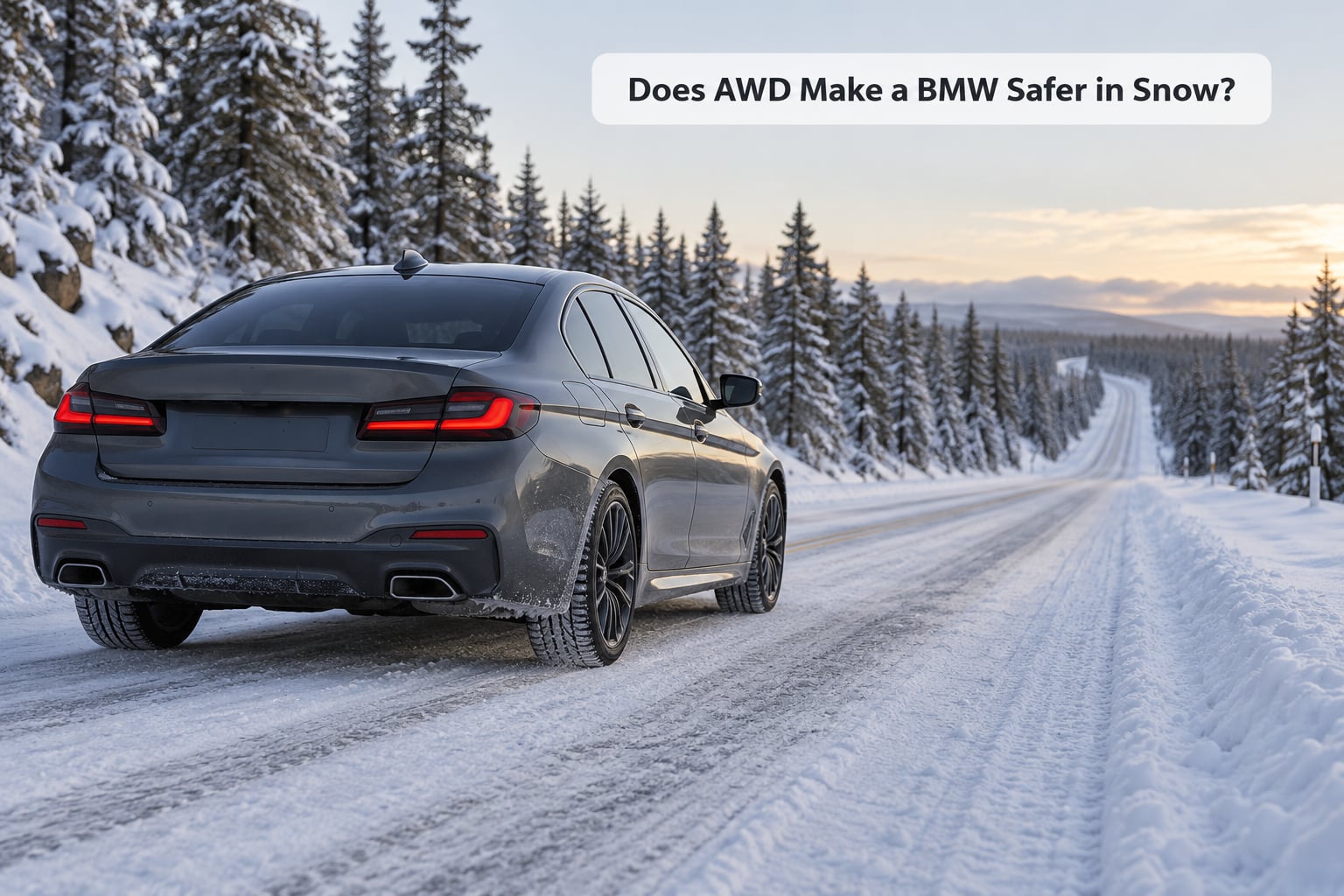
Only partly. xDrive and similar systems in BMWs do what all-wheel drive does everywhere: they improve acceleration, hill climbing, and the odds of getting moving. The useful question for a BMW owner is narrower than the marketing suggests, and it comes down to whether your roads are steep.
On flat and moderate city snow, an xDrive sedan on good all-season tires is close to a front-wheel-drive sedan on good all-season tires, and both are beaten by either car on winter tires. The extra driven axle buys you the ability to climb and to back out of a situation rather than the ability to avoid one.
Vehicle mass is the other honest limit. A rear-drive sedan on winter tires, with its lower mass and balanced layout, stops and turns more predictably than a heavier xDrive version doing the same job. The same owner debate about which is safer comes up constantly in driver forums, and the practical split is usually by terrain rather than by badge.
Stability control and the electronic aids around it do more day-to-day work than the drivetrain. If a BMW owner wants the biggest winter safety gain per dollar, brakes and tires beat a drivetrain upgrade.
What About Tires, Braking, and Ice?
Winter tires exist because of the compound. Summer rubber hardens in cold temperatures and loses the ability to conform to a surface, and all-season tires sit somewhere in between depending on their rating. A tire marked with the three-peak mountain snowflake symbol is certified for severe snow conditions, which is the closest thing to an objective answer in this debate.
Our comparison of snow tires versus all-season tires walks through the tread, compound, and cost differences if you want the detail. The short version: on packed snow below freezing, winter rubber is worth more than any drivetrain letter.
Here is the nuance that most guides leave out. Winter tires do not fix hard-packed ice. On genuinely frozen surfaces, the contact patch is limited by friction that no compound fully overcomes, and a good all-wheel-drive system helps you avoid stopping on it, not survive it. One forum thread made exactly this point about winter tires and hard-frozen slick ice, and it is the single most useful caveat on this whole topic.
Braking distance follows from the same physics. Anti-lock brakes, brake condition, and tire compound set how fast you stop. AWD only contributes one thing here, which is that a driver who has not had wheelspin may be traveling more calmly.
For electric vehicles, add two winter items to the list. Instant torque makes smooth throttle inputs the entire game, because the torque arrives before you finish deciding to ask for it. And one-pedal regeneration can upset weight transfer on ice, so lifting early and letting the car coast is often the safer way down a slippery hill.
FWD vs RWD vs AWD: Cost and Practicality
All-wheel drive costs more to buy in most segments and costs a little more to run. Exact figures vary by vehicle, trim, and market, so treat anything you hear as specific to one car. What holds up across markets is the direction of each line item.
The extra drivetrain hardware adds mass, and mass shows up as fuel consumption on every drive, not just in winter. All-wheel drive systems also add service items: transfer case fluid, front and rear differential fluid, and on some designs a coupling or drive unit that can wear. Front-wheel drive cars often have no separate rear differential at all.
Tire wear is the sleeper cost. Front-wheel drive and all-wheel drive put drive forces through steering wheels, so front tires typically wear faster than on an equally driven rear-wheel-drive car.
Then there is the tire swap question, which is really the whole argument. In a place that gets consistent snow, a rear-wheel-drive car on winter tires is a defensible, cheaper package than an all-wheel-drive car on all-seasons. In a place that gets occasional snow, swapping twice a year is a nuisance, and all-wheel drive becomes the compromise that requires no decision.
Which Should You Choose?
Choose by terrain and by how much tire attention you are willing to give the car, not by the badge on the trim.
- Flat to moderate snow, city and suburban roads: Front-wheel drive with winter tires is the strongest value combination. You get clean launches from stops and predictable, mild understeer.
- Groomed winter roads, driver who cares about handling: Rear-wheel drive with winter tires and a limited-slip differential. It is the most enjoyable of the three in the cold and needs the most discipline.
- Hills, rural roads, mountain passes, unplowed side streets: All-wheel drive with winter tires. This is where the extra driven axle earns its keep.
- Occasional snow, no willingness to swap tires: All-wheel drive on decent all-seasons and the understanding that it is a mitigation, not a solution.
- Hard ice as the normal condition: No drivetrain choice saves you. Slow down, increase following distance, and accept that the road wins.
Before buying any of them, a used all-wheel-drive car deserves a proper look: check the fluid condition on every diff and transfer case, look for a cold start that shudders or clunks, and on a car with a rear disconnect make sure it re-engages. If you plan to drive on unmaintained side streets, know how to get unstuck from snow before you need it.
Frequently Asked Questions
Is AWD always better than FWD or RWD in snow?
No. All-wheel drive is best at accelerating from a stop and climbing steep grades, and it gives you the best chance of moving when you are stuck. It changes nothing about braking or cornering grip. With winter tires on all three, the layout gap narrows to a few percent on moderate courses. On flat city snow, a front-wheel-drive car on winter tires keeps up fine.
Does AWD help a car stop faster on ice?
Not even slightly. Stopping distance is decided by tire compound, tread, contact pressure, brake condition, and the anti-lock brake system. Which wheels receive engine power is irrelevant once the brake pedal is pressed. A rear-wheel-drive car on proper winter tires will stop in less distance than an all-wheel-drive car on all-seasons. Speed and distance come before technology here.
Is rear-wheel drive dangerous in snow?
It is the hardest of the three to launch from a stop, because the driven rear axle carries less weight and an open differential limits torque when one wheel spins. It is not inherently dangerous when the car wears winter tires and the driver uses smooth throttle and low gears to climb. Drivers in Ohio and Boston run rear-wheel-drive cars through real winters without trouble.
Is 4WD better than AWD for winter driving?
For deep mud, deep snow, or rocky climbs, yes, because low range multiplies torque at the wheels. On snowy roads, the two are closer, and a good all-wheel-drive system with winter tires will usually outrun a 4WD truck on worn all-seasons. Four-wheel drive asks more of the vehicle in fuel economy, weight, and tire wear, so it only makes sense if you use the low range.
Which drivetrain is easiest to use on snowy hills?
All-wheel drive, clearly. It keeps torque flowing to whichever wheels have grip, and most systems bias power rearward on a climb so the vehicle keeps moving. Front-wheel drive is a close second on gentle grades. Rear-wheel drive is the hardest and needs a steady line, low gears, and steady momentum rather than throttle stabs.
Do winter tires matter more than AWD?
Yes, in most real conditions. Drivetrain gets you going; tires stop and turn the car. A rear-wheel-drive car on winter tires will outperform an all-wheel-drive car on all-seasons in snow. The one caveat is hard-packed black ice, where winter rubber cannot create friction that does not exist. Every drivetrain should still be paired with tires rated for the conditions.
Bottom Line
Pick the drivetrain that matches your terrain, then spend your money on tires. Front-wheel drive with winter tires for flat and moderate snow, all-wheel drive with winter tires if your roads are steep or unplowed, and rear-wheel drive with winter tires and a limited-slip differential if you want the handling and will manage the throttle.
Do these three things before the first storm: buy winter-rated tires or good all-seasons, get your brakes checked while they are still cheap to fix, and double your following distance. Then choose the layout. That order solves fwd vs rwd vs awd in snow better than any badge.