
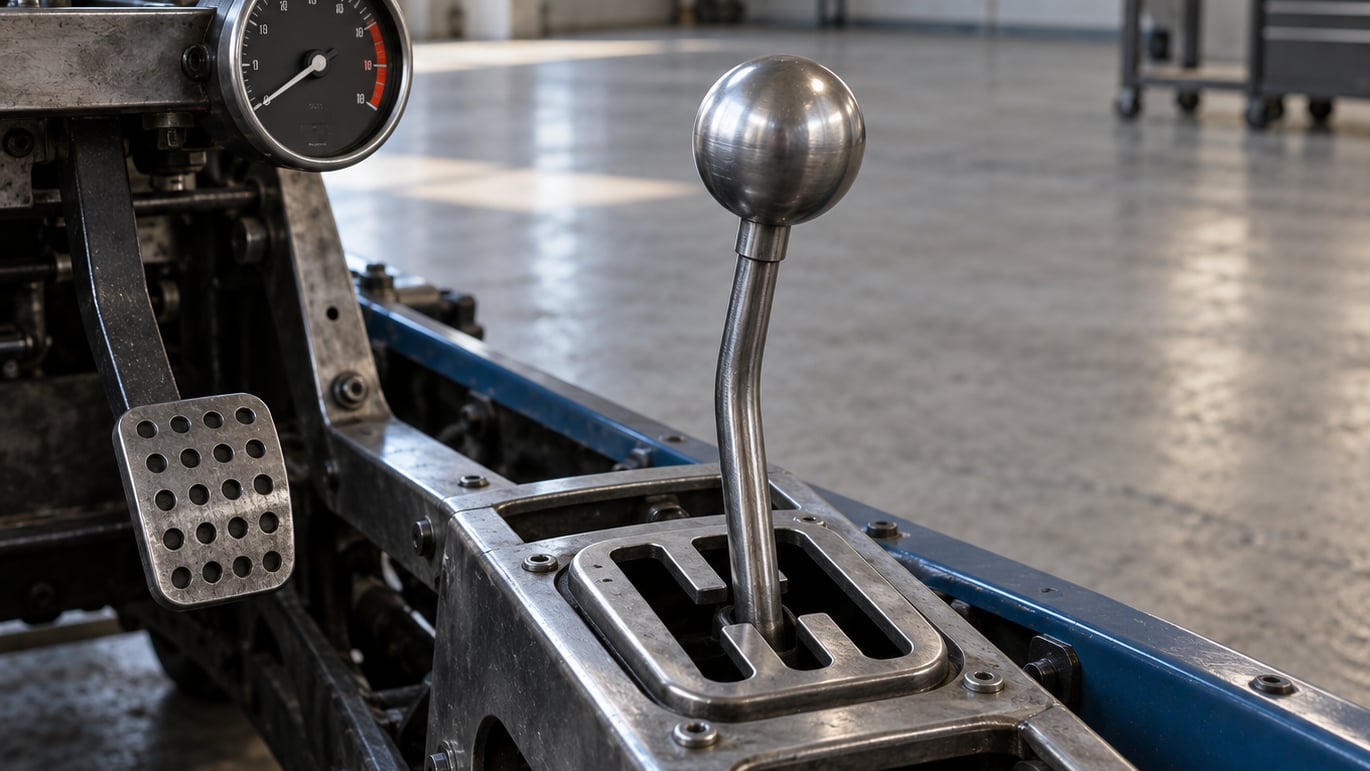
To double clutch a manual transmission, you press the clutch twice during one gear change: once to reach neutral, again to reach the next gear, matching engine speed in between so the gearbox goes in without a jolt. It takes about two weeks of short daily practice to make the sequence feel automatic. Most drivers only need it for downshifts, corner entries, and trucks with unsynchronized gearboxes.
The reason it works is mechanical. When the clutch is out and the lever sits in neutral, the gearbox input shaft is free to spin with the wheels instead of with the engine, so a blip of throttle raises the speed the next gear expects. Close it out at the right revs and the synchronizer ring has almost nothing left to do.
If your clutch bite point is still shaky, fix that first. Our guide to driving a manual transmission smoothly covers finding the bite and moving off without stalling, which is the base this technique sits on.
Table of Contents
- What You Need
- Step-by-Step: How to Double Clutch a Manual Transmission
- Step 1: Get Into Position and Bring the Car to a Controlled Stop
- Step 2: Release the Clutch Slowly Into the First Gear
- Step 3: Apply Light Throttle and Unload the Clutch
- Step 4: Press the Clutch Fully and Select the Next Gear
- Step 5: Match the Clutch to the New Gear
- Step 6: Complete the Shift and Reapply Throttle Gradually
- Common Mistakes and How to Fix Them
- Practice Progression That Actually Builds Skill
- Frequently Asked Questions
- Does double clutching save synchros and your transmission?
- Is double clutching bad for your transmission?
- Can a manual transmission have a dual-clutch?
- What is the difference between double clutching, rev matching, and heel-toe?
- When is double clutching actually worth using?
- How should a beginner practice double clutching safely?
- Start With One Gear Down
What You Need
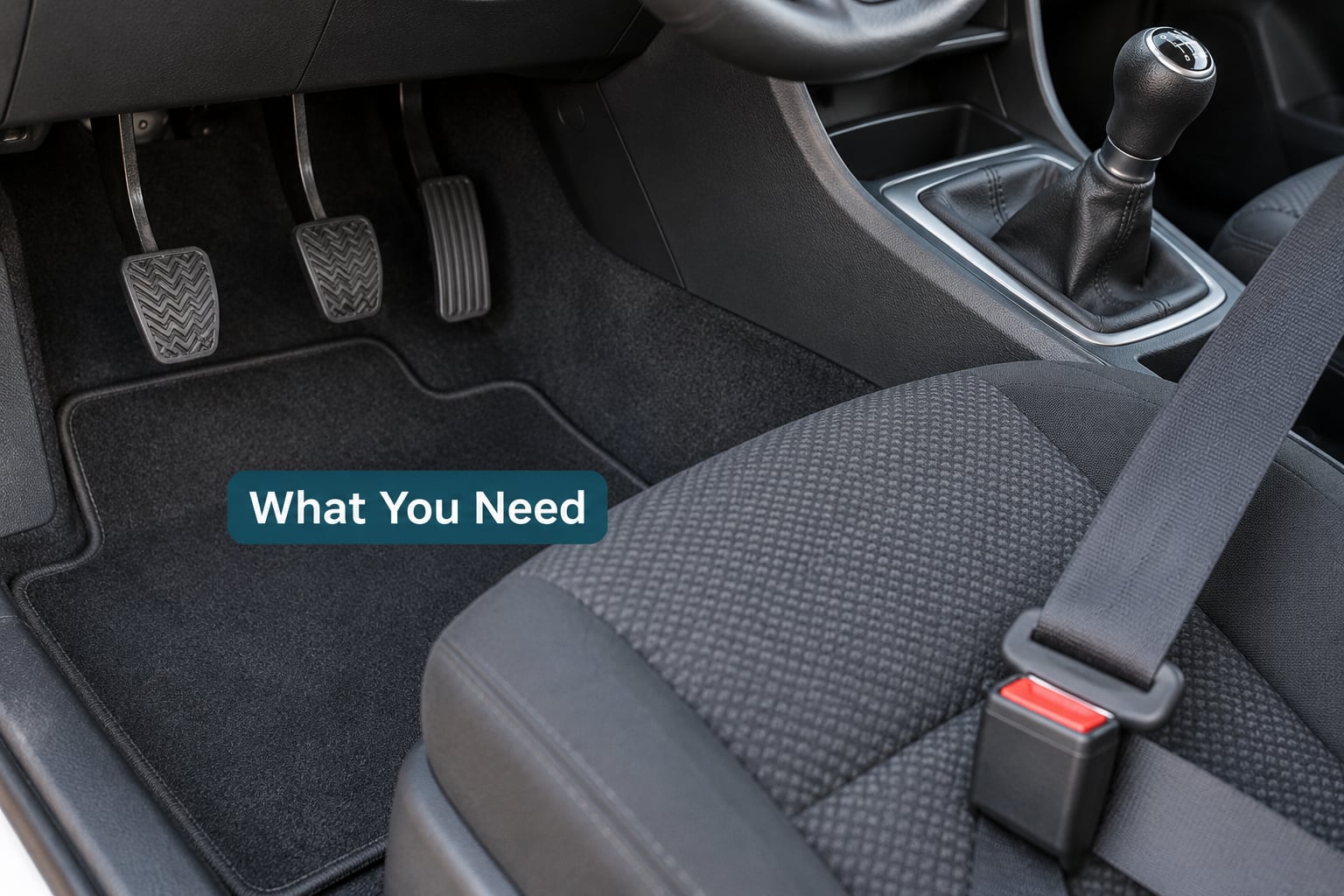
You need a car with a manual transmission, a flat empty area, and about 20 minutes. Nothing else — no tools, no products.
Choose a level parking lot or a quiet straight road with no traffic. Double clutching splits your attention, so you want clear space ahead while you are concentrating on your feet.
Sit properly first. Your back against the seat, the seatbelt fastened and snug, and your driving leg able to reach the pedals without overstretching. The clutch foot stays on the clutch pedal, not resting on the floor or the heel of your other foot, because the blip of throttle comes a fraction of a second later and you cannot afford to hunt for it.
Check three things on the car before you start. The clutch pedal should return cleanly with no soft or sticking feel, the lever should move freely between gates, and the fluid is up to temperature — cold transmission fluid is thick and the same blip will not spin the input shaft as fast. Warm the car up with a few minutes of easy driving before the first attempt.
Keep the handbrake within reach for the first few attempts. Getting the throttle balance wrong at a stop is how beginners stall, and a stall at 5 mph in an empty lot is a much better teacher than one at an intersection.
Step-by-Step: How to Double Clutch a Manual Transmission
Step 1: Get Into Position and Bring the Car to a Controlled Stop
Select first gear, come to a full stop, and press the clutch all the way to the floor. For an upshift, keep rolling speed in the current gear instead of stopping — you are only changing the throttle and clutch timing, not the road speed.
Before the car stops moving, decide the target gear and settle the throttle you plan to hold. Deciding mid-shift is where most beginner attempts fall apart, because the feet and hand have to arrive at the gearbox at the same time.
Step 2: Release the Clutch Slowly Into the First Gear
With first gear selected and the clutch held down, raise your foot slowly until the car starts to pull. Hold it there — that spot is the bite point — and give just enough gas to keep the engine from bogging.
If the engine dips toward stall, add a little more throttle rather than dumping the clutch. For a stationary double clutch, keep the clutch pedal pressed the whole time you do this instead; the double clutch matters in motion, not while you are sitting still.
Step 3: Apply Light Throttle and Unload the Clutch
Once the car is rolling, feed in a small amount of throttle and fully release the clutch so the driveline unloads. That extra revs the input shaft through neutral, which is the whole trick of the technique.
You are not flooring it. A firm blip that lifts the needle a few hundred RPM is plenty, and on many cars that is just a quick stab. Hold the throttle steady through the next step rather than pumping it, because varying revs mid-shift is the single most common reason the next gear refuses to go in.
Step 4: Press the Clutch Fully and Select the Next Gear
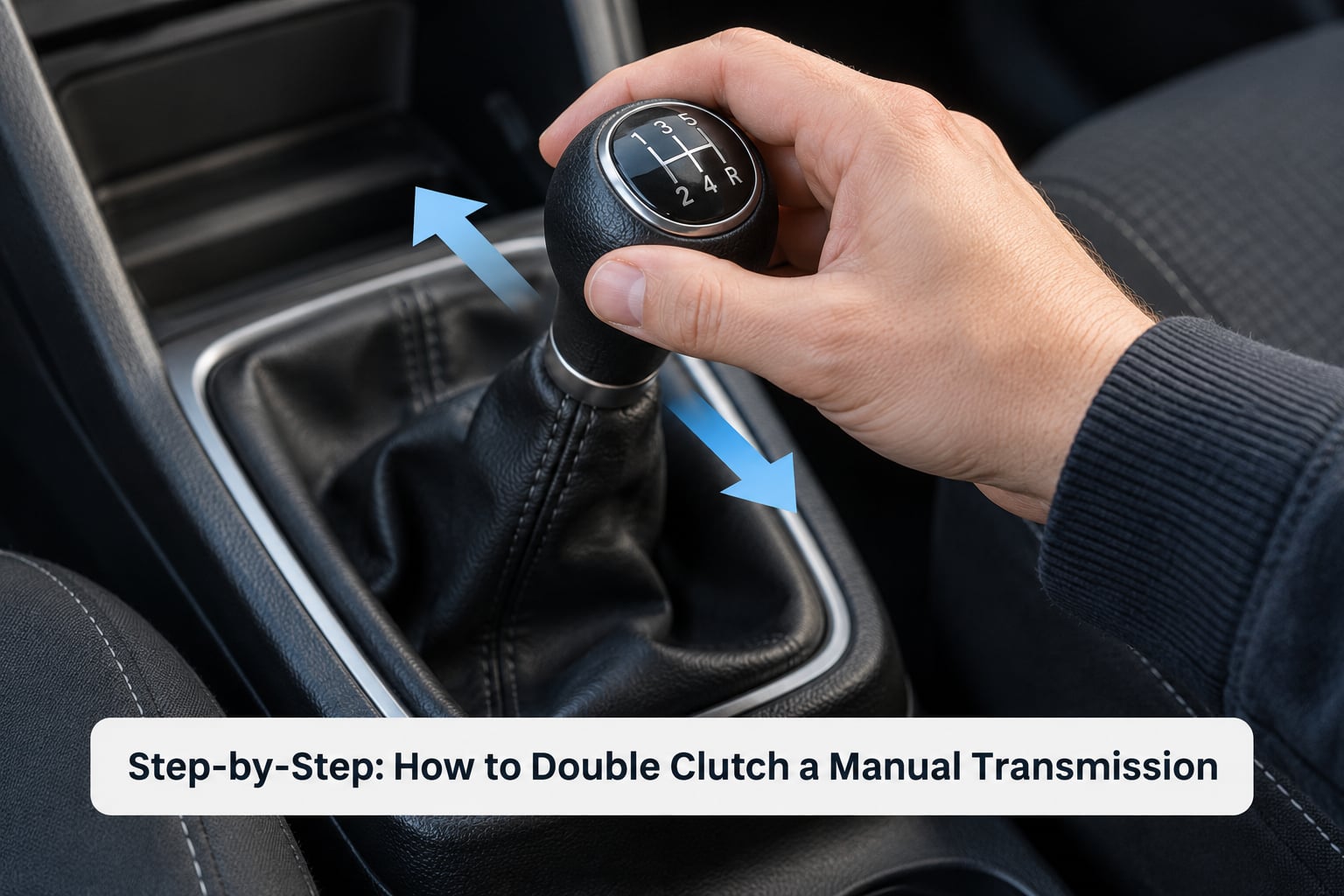
Press the clutch back down to the floor and move the lever decisively to the next gate. Quick and firm beats gentle — a hesitant lever parks halfway in neutral and you end up pressing and releasing the clutch a third time.
For an upshift the lever travels one gate toward you. For a downshift it moves toward the front of the car, and a two-gear downshift like 5th to 3rd means two distinct movements with a pause for the throttle blip between them. On trucks you may also need to move the range selector out of a lower split or overdrive position before the gear will seat.
Step 5: Match the Clutch to the New Gear
This is the heart of how to double clutch a manual transmission correctly: match the revs to what the new gear wants. Start easing the clutch up and listen or watch for the revs to stop dropping as the input and output shafts come to the same speed.
When the revs stop falling, the two speeds are matched and the gear will slide home without a fight. Push the lever gently through the gate at that moment. If you feel resistance, hold the clutch down, add or trim the throttle, and try again — a non-synchronized gearbox will simply refuse the gear, which is normal and harmless.
A rough rule for road speeds: for a one-gear downshift, blip until the engine sits roughly 1000 RPM higher than before. For 5th to 3rd, match the revs you would have in 3rd at that road speed, which is closer to double the original revs. Ignore the tacho during the blip itself and focus on the drop in revs as you release the clutch.
Step 6: Complete the Shift and Reapply Throttle Gradually
Once the lever clicks into the gate, feed the clutch fully home and bring the throttle back to a normal driving level. The shift is done — the whole sequence should take about a second and a half at normal road speed.
On an upshift, the sequence starts differently: you lift off the gas first, press the clutch, briefly release it in neutral so the engine drops to the revs the next gear wants, then push the lever into the higher gate and re-engage. The pedal goes down twice either way. If the revs came out too low going in, the downshift after a corner is where you will feel the wrongness — expect a jolt, and go back to matching rather than pressing harder.
Common Mistakes and How to Fix Them
The fix is almost always slower feet, not faster hands.
Dipping the clutch too late. Pressing the clutch only after the gear is already moving invites a grind on synchros and bogs the engine on the way in. Press it fully first, every time, then move the lever. Nothing bad happens if you press the clutch while the engine is still revving down.
Adding too much throttle. A hard blip overshoots the target revs, and an overshot downshift bangs the gear in with a jolt that hurts the gearbox more than the shift you were trying to smooth. Start with less than you think you need and add a little at a time until the revs stop dropping as the clutch comes up.
Rushing the gear lever. Pushing the lever firmly but quickly into a gear that is not yet matched is the classic cause of grinding. Move the lever decisively to neutral and hold it there, then nudge the target gear rather than shoving it. The gearbox will go in when the speeds match, and resisting it is the correct response.
Staring at the tachometer. Tach watching splits your attention exactly when you need it on the road. Learn the feel instead: revs stop falling as the clutch comes up, and the lever wants to move. Check the needle once you are driving straight and empty, not mid-corner.
Using it when a single shift would do. Double clutching every shift on a healthy modern synchromesh gearbox adds work and takes attention away from the road for no mechanical benefit. Use it for downshifts, deliberate corner entries, cold starts, and trucks. Straight upshifts at a steady throttle are fine with one clutch press.
Skipping warm-up and maintenance checks. Thick cold fluid and a worn cable make the same blip behave differently, which is where most people conclude the technique does not work. If the clutch or cable is past its service life, replacing it beats adjusting technique — and while you are in there, it is worth knowing that the lifetime fill myth does not exist, so change the fluid on schedule.
Practice Progression That Actually Builds Skill
Week one, stay in a parking lot. Pick a set speed, downshift one gear, and repeat until the revs stop dropping at the right moment. Ten minutes daily beats an hour on Saturday.
Week two, move to a quiet straight road. Do single-gear downshifts at steady speed, then add braking so you are coordinating the brake, the clutch, and the throttle.
Week three, add corners. Practice the full brake, clutch, blip, gear, clutch sequence as you enter a bend. This is where heel-and-toe helps — pivoting on the ball of the clutch foot so the heel can press the brake keeps your right foot free to blip the throttle. Our manual transmission basics guide has the footwork drills for that.
Frequently Asked Questions
Does double clutching save synchros and your transmission?
On an unsynchronized gearbox, absolutely — it is the only way to shift. On a modern synchromesh manual, the synchronizer rings do the matching for you, and double clutching mainly spares them on heavy downshifts, cold starts, and cars with worn synchros. Mechanic advice generally treats it as good habit rather than necessity.
Is double clutching bad for your transmission?
No, not when it is done correctly. Matching the revs before engaging the gear means the dog teeth meet at nearly the same speed, so nothing grinds and the synchronizer ring barely has to work. It only causes damage when you force a gear in against a mismatch, which is a fault in the technique, not in the technique itself.
Can a manual transmission have a dual-clutch?
Yes. A dual-clutch transmission, often called DCT, is a fully automated gearbox with two clutches and no clutch pedal. It is a different thing entirely from the double-clutching technique, which is a driver skill done by hand on a single-clutch manual car. Some performance cars offer a manual mode on a DCT, where you use the paddles instead of a clutch.
What is the difference between double clutching, rev matching, and heel-toe?
Double clutching is pressing the clutch twice with a neutral pause in between. Rev matching is the throttle blip that happens during that pause. Heel-and-toe is the foot position that lets you press the brake and blip the throttle at the same time. You often use all three together for a fast downshift, and each solves a different part of the problem.
When is double clutching actually worth using?
It is required on commercial truck transmissions without synchronizers, and it is tested as part of CDL training. In a passenger car it earns its keep on downshifts, deliberate corner entries, cold mornings when the fluid is stiff, and any gearbox starting to grind. On steady upshifts in a healthy modern manual, one clutch press is all you need.
How should a beginner practice double clutching safely?
Start in an empty parking lot with the seatbelt on and the handbrake within reach, at walking pace. Do one-gear downshifts at a steady known speed until you can feel the revs stop dropping. Then move to a quiet straight road, then add braking. Keep practice sessions to about 20 minutes and stop while it still feels easy.
Start With One Gear Down
Pick a flat car on a quiet street, get up to about 25 mph in 3rd, and downshift to 2nd while matching the revs. Do that five times in a row without a jolt, then do it in 4th to 3rd. Once a single downshift feels automatic, add the blip to every corner entry.
Take your time with the clutch pedal on the way back up. Slower is smoother, and smooth is the entire point.