
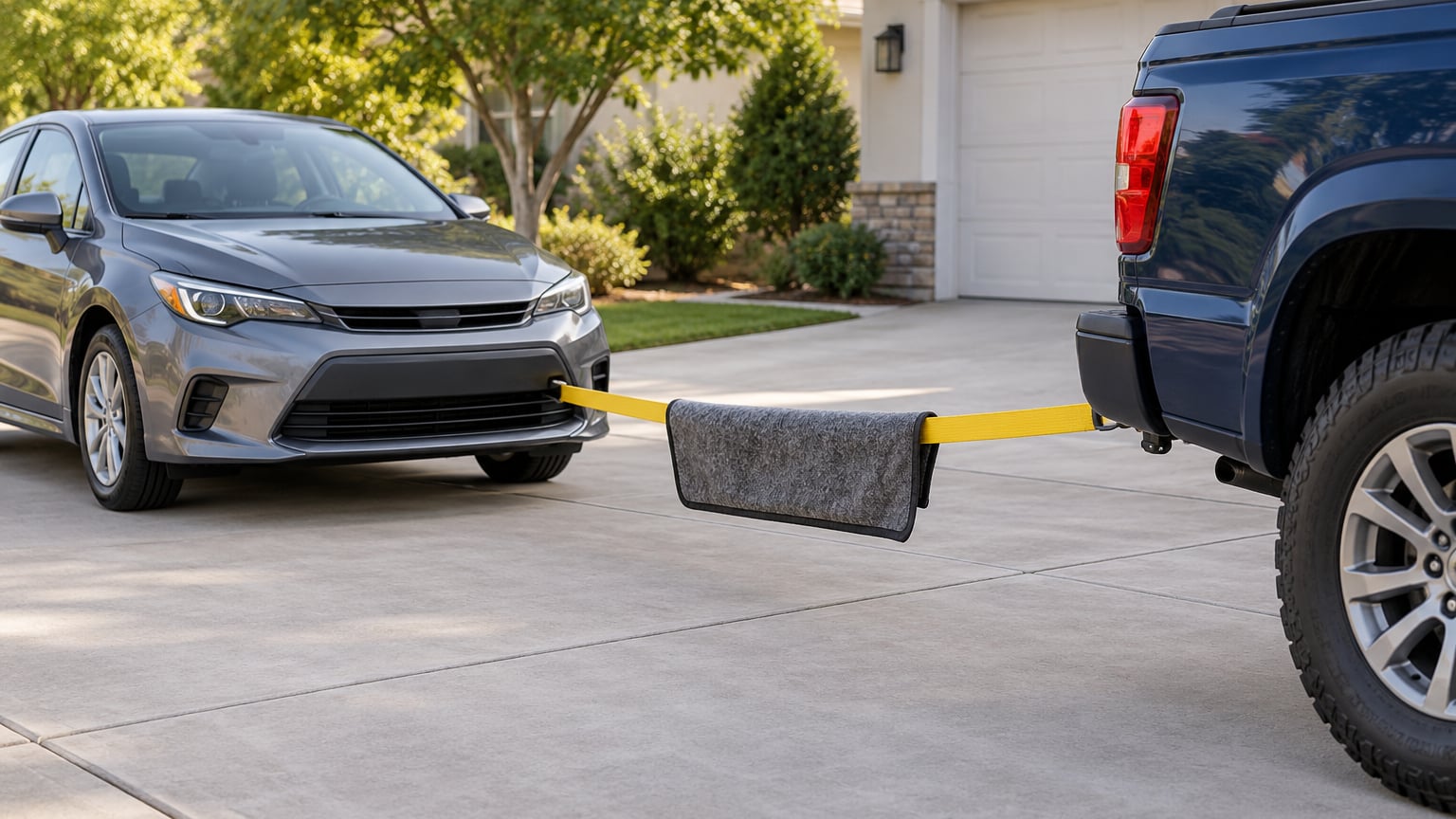
Yes, but only for a short distance on private property: connect a rated tow strap to the designated tow points on both cars, keep light tension in the line the whole way, and creep along under 25 mph. A strap is a recovery tool, not a replacement for a trailer or a flatbed, and most of the damage people see comes from skipping the rated attachment points.
If a car is stuck in a driveway, in mud, or off the shoulder and you have a lead vehicle heavy enough to pull it plus a strap rated above its weight, you can do this in your own driveway in about 15 minutes with a second person.
This guide covers how to tow a car with a tow strap from gear selection through the slow, careful part of actually moving it.
Table of Contents
What You Need
You need four things before the strap comes out of the trunk: a strap rated for the weight you’re pulling, a rated attachment point on each vehicle, a way to protect the paint where the strap touches, and a way to talk to the other driver.
Start with the strap itself. Two numbers matter, and they are not the same number.
- Working load limit (WLL) is the weight the strap is rated to pull in normal use. For most passenger cars, choose a strap whose WLL is above the weight of the vehicle being moved.
- Minimum breaking strength (MBS) is the load that parts or destroys the strap. It is much higher than the WLL. Judge the strap by the WLL, not by the MBS.
A good rule of thumb: stay under 80 percent of the tow vehicle’s rated capacity, and never use a strap whose WLL is below the weight of the car you are pulling. A strap with no rating printed on the label is a decoration, not equipment.
Strap type matters too, because drivers routinely confuse them.
- Static tow strap. Very little stretch. This is the right one for moving a stuck car a short distance.
- Tow rope (braided polyester). Moderate stretch, smooth tension. Fine for low-speed dragging.
- Kinetic recovery rope. A lot of stretch on a surge. Built for pulling out of mud or sand only.
- Ratchet strap. No stretch, and not a towing device at all. It secures a load to a deck.
Ratchet straps come up constantly in searches, and they are the wrong tool here. A ratchet strap is a cargo restraint, not a towing device. Kinetic rope is a recovery rope designed to absorb a snatch load, and using it to drag a car down a road is not what it is for.
The rest of the kit:
- Rated hardware. Two D-shackles or soft shackles of matching rating, plus a hitch pin to retain the loop through a receiver hitch. A shackle with a threaded pin you have to finger-tight is not safe under load.
- Protection. A heavy blanket, old jacket, or neoprene-covered sleeve to drape over the strap where it crosses a painted bumper or body edge.
- Gloves. Polyester rope burns hands at the tension this job produces.
- A high-visibility flag or cloth tied on the strap so following traffic sees a line in the road.
- Comms. A phone, two radios, or an agreed horn pattern between drivers.
- Wheel chocks for the towed car, and a basic tool kit.
Finally, check the owner’s manual for both vehicles and your local rules before you hook up. Many jurisdictions limit rope or strap length, require a warning flag, or restrict towing on public roads outside a licensed operator’s setup. Rules vary by state and country, so verify yours rather than assuming.
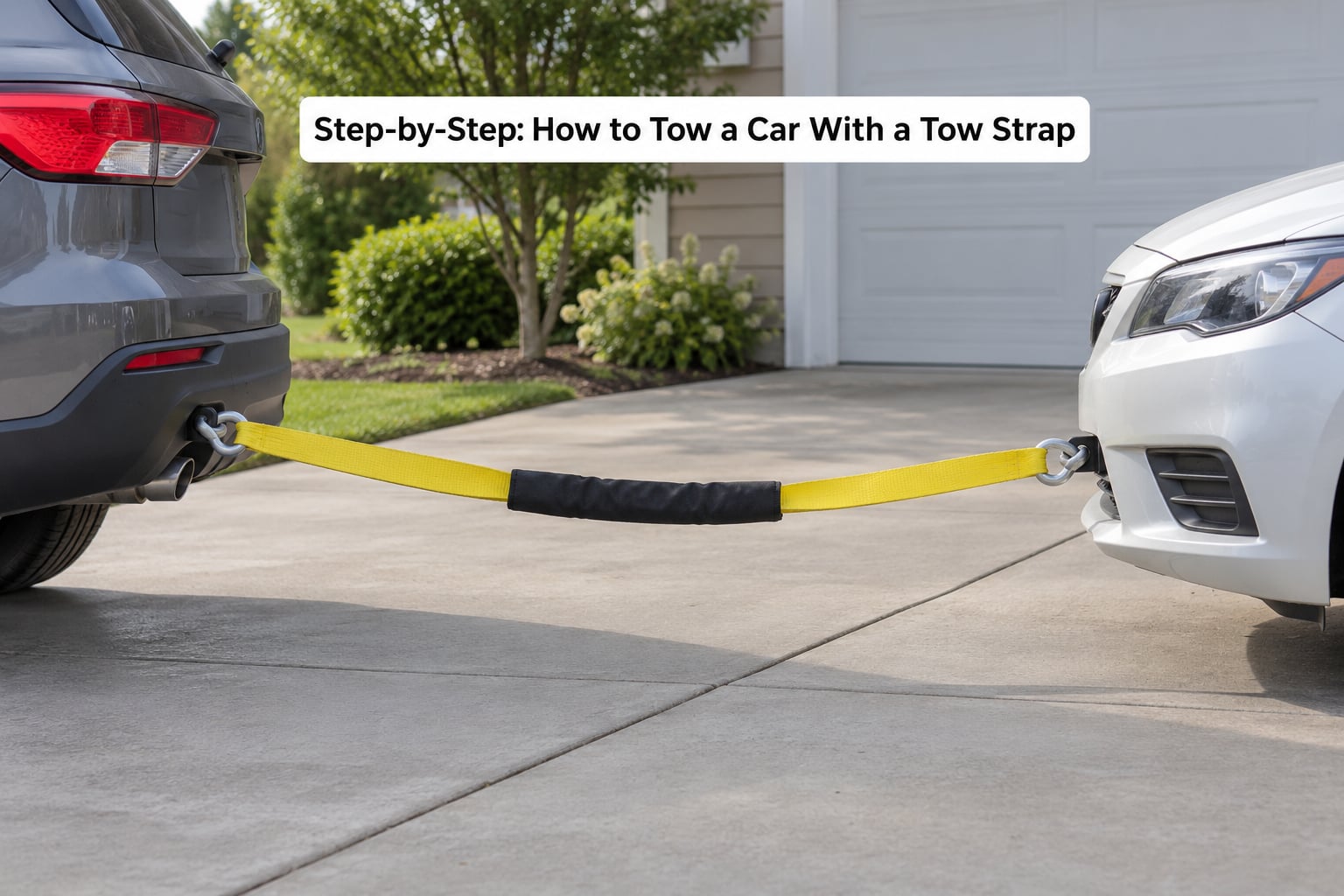
Step-by-Step: How to Tow a Car With a Tow Strap
- Inspect and prepare. Check the strap end to end for cuts, fraying, or damaged stitching, and throw it away if the webbing looks fuzzy or the stitching is broken.
- Confirm the lead vehicle can pull the weight. A heavy SUV or truck moves a stranded car; a compact hatchback does not.
- Park both vehicles with the parking brake off, in park or neutral. For a car with no engine running, confirm the transmission is in neutral and the ignition is on so the steering lock releases.
- Identify the rated tow points on each car. Look for the factory tow eye, recovery eye, or frame rail loops in the manual. Do not improvise an anchor.
- Clear the path and the line. Walk the route between the cars. Nothing stands in front of, behind, or beside the strap’s line, including people holding a camera.
- Connect the strap straight, one run only. Loop it through each tow point, secure with a rated shackle and hitch pin, drape protection over the strap where it touches paint, and check it is not twisted.
- Take up slack and agree on signals. The lead driver creeps forward until the strap is snug with no sag. Agree who moves first and agree a stop signal.
- Move slowly in a straight line. Stay under 25 mph, keep 15 to 20 feet of spacing, make smooth steering inputs, and stop the moment the strap frays, goes slack, or shifts.
How to Attach and Tension a Tow Strap Without Slips
Slips happen because of the connection, not the pulling. Keep it straight: a single straight run of strap is stronger than a doubled U-shape, and experienced users avoid doubling because it only shortens the gap between the two cars.
Work on the towed car first with both vehicles parked and the parking brake set. Thread the strap through the tow eye, add the shackle, and push the hitch pin fully through with its retainer clip fitted. A pin you can back out with a fingernail will come out under load.
Protect the paint on the side facing the strap. A folded blanket or a sleeved section of strap takes the abrasion and kills most of the paint damage people complain about afterwards. Gloves on your hands before you pull the strap tight, not after.
Then move to the lead vehicle, hook up the other end the same way, and have one person stand clear of the line as a spotter while the lead driver takes up slack. Tension comes on slowly: a quarter of the throttle’s worth of creep, then stop, check the shackles, check the pins, check that nobody is standing near the strap.
The most common tension complaint is that the strap keeps going slack on every stop and start. That is normal with a non-ratchet strap and it is exactly why you stay slow. Keep a little tension by feathering the throttle on any downhill grade, and never slam off the brakes.
How to Tow the Car Safely
The movement phase is where most strap tows go wrong, and almost all of it comes down to speed, spacing, and sudden inputs.
Keep 15 to 20 feet between the vehicles. Far enough that the strap does not pile up, close enough that it stays taut. Run under 25 mph, and treat that as a ceiling rather than a target.
Make everything smooth. No hard steering, no sudden acceleration, no stomping on the brakes. Slow down well before you turn and take the corner wide; sharp inputs put a lateral snap load through the strap that a straight pull never does.
Watch the line constantly. If the strap goes loose, frays, shifts, or starts rubbing on the exhaust, pull over and fix it. Stop in a straight, flat place, not on a grade, because the towed car will roll into the strap the moment tension comes off it.
Expect the towed car to feel wrong. With the engine off there is no power steering and no power brakes, so the wheel is heavy and the pedal travel is long. Leave far more room than normal. Do not expect the towed car’s lights or brake lights to work either, which is part of why a flag on the strap and a slow speed matter.
If the strap breaks, do not chase it and do not stand behind the line. Both drivers brake smoothly, pull onto the shoulder or a safe spot as far off the roadway as possible, and get clear of the strap’s path.
Common Mistakes
Where to Attach the Strap on Each Car
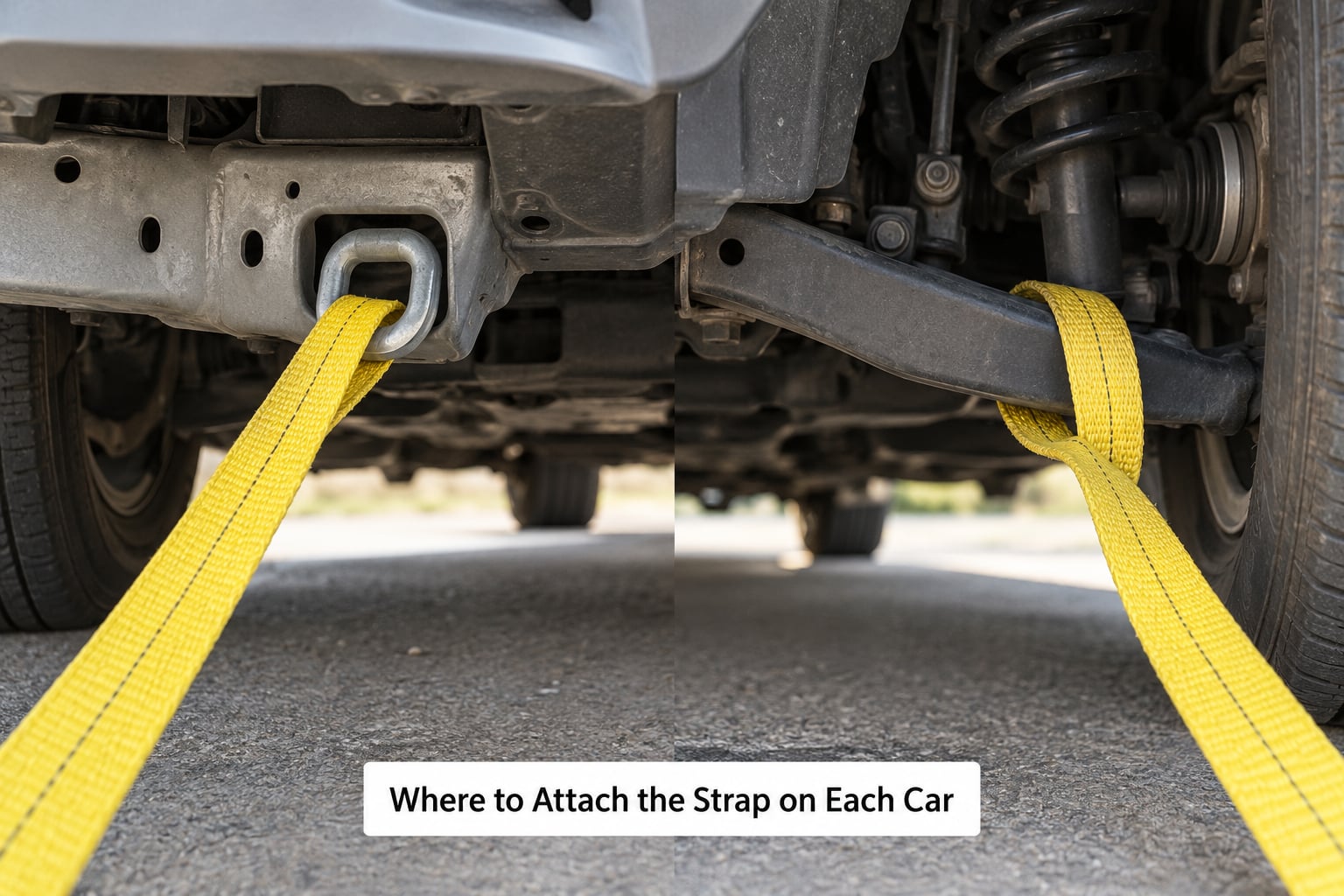
Attach to the factory tow eye or recovery point, or to a frame rail loop the manufacturer specifies. Everything else is a gamble with someone’s steering and suspension.
Never attach to a bumper cover or bumper bar, a lower control arm, a ball joint, a tie rod, a leaf spring, an axle, a driveshaft, the exhaust, the radiator, or the air conditioning lines. Every one of those is a component, not an anchor, and pulling on it bends metal or puts a snatch load straight into a wheel bearing.
Looping a strap around an axle or through wheel spokes is the most common thing you will see on forums, and it is how cars end up with bent control arms and cracked bumpers. Recovery forums keep repeating the same warning: if there is no rated point, the answer is not a workaround.
If you cannot find a tow point, check whether it is hidden behind a bumper cover or an underbody shield, and check the manual’s recovery section. Many modern unibody cars have an eye tucked into the frame rail behind a plastic shield that pops out with a couple of fasteners.
The other classic mistake is moving too fast. A tow that feels fine at walking pace does not feel fine at 40 mph, and a strap that has been fine for a mile can part under a sudden downhill surge. Pull the strap to a stop, keep both drivers in communication, and never tow a car on public roads without checking whether your local rules even allow it.
When to Stop and Call a Tow Truck Instead
Some jobs are not DIY jobs, and calling early costs less than the damage does.
- The car has no rated tow point on either end. If the only anchors you can find are suspension parts, stop.
- The distance is more than about 15 miles. Straps are for repositioning a car, not moving it across town.
- A wheel is off, a tyre is flat and locked, or the car is on its side. Dragging a locked wheel destroys the tyre and the driveline.
- It is public road recovery. Roadside tows need lighting, signage, and often a licensed operator. That is a tow truck’s job.
- The tow vehicle is not heavy enough or is rated below the car you are pulling.
- Any AWD or 4WD car with a completed or unknown service history. Confirm the neutral and transfer case procedure in the manual first, and expect a donor-vehicle tow if you cannot.
For anything longer than a driveway, the right tool is a tow bar, a tow dolly, or a flatbed. A dolly lifts two wheels and rolls on the towed car’s own tyres; a flatbed carries the whole car and is the only safe option for long trips or a car that cannot roll.
Frequently Asked Questions
Can I tow a car with a tow strap?
Yes, for short distances on private property, using designated tow or recovery points on both cars, light tension in the line, and speeds under 25 mph. A tow strap is a recovery tool, not a road-towing setup. Keep it to roughly 15 miles or less, verify your local rules, and call a flatbed for anything longer.
How far and how fast can you tow with a tow strap?
Treat 25 mph as a ceiling and 15 to 20 feet as the spacing between the two cars. Distance should stay under about 15 miles, and on a driveway a few hundred feet is the normal case. The longer and faster you go, the more shock load hits the strap at every stop, start, and pothole.
Is it safe to tow a car with ratchet straps?
No. A ratchet strap is a cargo restraint for securing loads to a deck or trailer, and it is not built for the shock load of a moving car. Use a rated static tow strap or a braided tow rope connected through rated shackles and a retained hitch pin, and never wrap anything around a bumper or suspension arm.
Do I need a person in the car being towed?
Only if the car still rolls and steers, and it is far safer with someone in it who can steer and signal. If the engine is off, expect no power steering and no power brakes, so the driver will fight the wheel. Do not plan a long tow with a non-running car; call a flatbed instead.
Where do you attach a tow strap on a car with no hitch?
In the factory tow eye or recovery eye, which on many cars is a loop in the frame rail hidden behind a bumper cover or underbody shield. Check the owner manual for the recovery point location. Never use a bumper cover, control arm, ball joint, tie rod, leaf spring, axle, driveshaft, or exhaust as an anchor.
What is the 80% rule for towing?
It means staying under about 80 percent of a vehicle’s rated towing capacity rather than running it at the maximum number on the label. For a tow strap specifically, judge the strap by its working load limit and make sure it exceeds the weight of the car you are pulling. Never judge a strap by its breaking strength.
Conclusion
If you remember nothing else: stop the car, decide whether a tow is even the right answer, use a strap rated above the weight you are pulling, connect it only to rated tow points, protect the paint, and stay under 25 mph with light tension in the line.
Keep it in the driveway or the yard where you can see both vehicles and nobody is standing near the line. If the car has no approved recovery point, if the trip is longer than about 15 miles, or if you would be doing it on public roads, call roadside assistance or a flatbed operator instead.
That is how to tow a car with a tow strap without wrecking the suspension, the paint, or somebody standing next to it.