
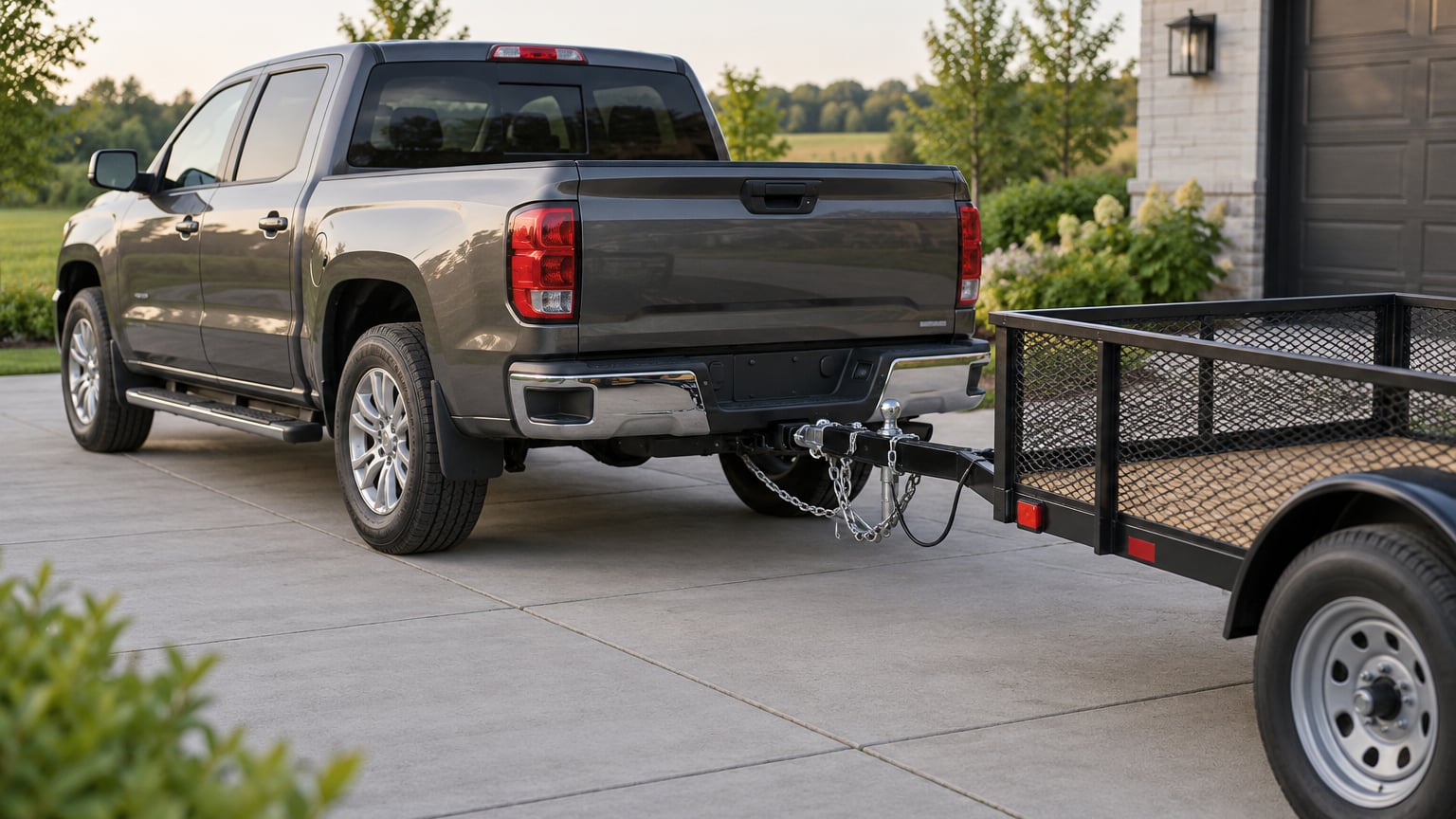
Towing a trailer safely for beginners comes down to four things: know your vehicle’s weight limits, connect the hitch and safety gear correctly, load the trailer so the weight sits over the axle, then drive slower and more gently than you normally would. A trailer changes your stopping distance, your turning radius and how your vehicle handles crosswinds, all at once.
Most first-timers get into trouble for the same reason. They treat towing like ordinary driving with a heavier load, then find out at the first downhill off-ramp that the trailer feels like it has opinions of its own. The good news is that the whole process is learnable in an afternoon of practice, and almost every mishap traces back to something you can check before you pull out of the driveway.
This guide walks through the process in order, from rating your vehicle and trailer to hooking up, loading, checking systems, driving and parking. Keep your owner’s manual open while you read; the numbers in your door jamb and your hitch’s label outrank anything written on the internet, including this page.
Table of Contents
- What You Need
- How to Tow a Trailer Safely for Beginners: Step-by-Step
- 1. Confirm the Towing Setup Is Rated for the Job
- 2. Inspect the Trailer Before Loading
- 3. Connect the Trailer to the Vehicle
- 4. Load the Trailer for Balanced Handling
- 5. Perform a Stationary Systems Check
- 6. Pull Away Slowly and Build Speed Gradually
- 7. Manage Braking, Turns, Hills, and Reversing
- 8. Park, Couple, and Shut Down Safely
- Common Mistakes
- Overloading the vehicle
- Not enough tongue weight
- Routing safety chains straight instead of crossed
- Forgetting the breakaway cable
- Leaving chains, straps or loose cable around the tires
- Tailgating and sudden braking
- Sharp steering inputs at speed
- Using the tailgate or truck bed as a work surface while connected
- Ignoring sway or tire problems
- Frequently Asked Questions
- Final Checklist Before Your First Tow
What You Need
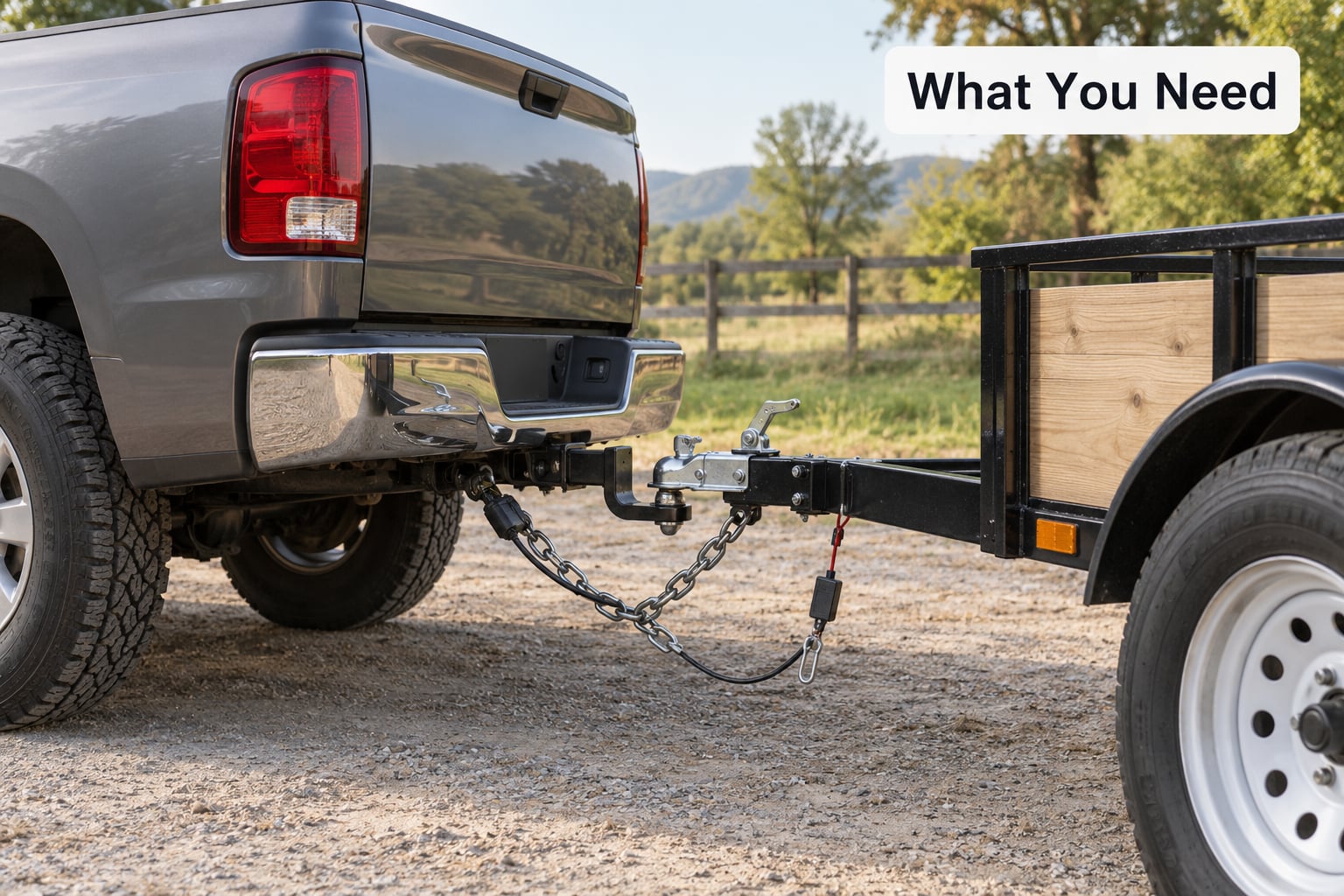
Before the first tow you need two things that already exist: a tow vehicle rated for the job and a trailer whose loaded weight stays under that rating. Everything else on this list is either paperwork or safety gear that costs very little compared with the damage a failed connection can do.
- A tow vehicle with the right rating. Your owner’s manual lists the maximum trailer weight, the maximum tongue weight, the payload capacity and the gross combined weight rating. Those four numbers decide whether a tow is legal and safe.
- A trailer and hitch that match. The hitch class and ball size have to match the coupler on the trailer tongue, and the hitch’s own weight rating must exceed the loaded trailer weight.
- Registration and insurance. A trailer generally needs its own plate and registration in most states, and a separate policy endorsement so the trailer and its contents are covered rather than treated as an afterthought.
- Safety chains, rated for the trailer’s gross weight. Transport chains crossed under the tongue, plus adequate slack.
- A breakaway cable on any trailer equipped with electric brakes, and a working breakaway battery.
- A 7-way electrical plug that matches your vehicle’s socket, plus the trailer’s brake controller if it has brakes.
- Extended tow mirrors wide enough to see past the trailer’s edges on both sides.
- A tarp and rated ratchet straps to protect and tie down the cargo.
- Wheel chocks so the trailer cannot roll while you are uncoupling or walking around it.
- A roadside kit sized for two vehicles: spare tires for both truck and trailer, the correct jack for the trailer, lug wrench, tire inflator, bungee cords, wire, duct tape, a flashlight, gloves, and a small bottle of wheel bearing grease.
One more item is worth adding if you can find one: a spare tire for the trailer. A flat on a trailer with no spare usually ends in a roadside service call, and those are expensive on a highway.
How to Tow a Trailer Safely for Beginners: Step-by-Step
1. Confirm the Towing Setup Is Rated for the Job
Open the owner’s manual and find four ratings before you touch the trailer. The first is towing capacity, the heaviest trailer the vehicle is rated to pull. The second is payload capacity, which is the maximum weight of passengers and cargo, including the hitch itself, that you can put in the truck bed or behind the rear axle.
Third is maximum tongue weight, which is the downward force the trailer applies at the hitch. Most ball-mount setups land between 10% and 15% of the loaded trailer weight, and exceeding that figure on a short wheelbase vehicle can lift the rear tires off the pavement and cost you steering response. The fourth is gross combined weight rating, the ceiling for the truck and trailer together once loaded.
Then add the trailer’s unloaded weight, its GVWR from the VIN plate, and everything you plan to put on it. Add a couple hundred pounds for people, fuel and gear you had not counted. Truck forums are full of people who did the math with dry weight only, loaded to the axle, and then discovered the payload math no longer worked.
For ball-mounted trailers, keep the loaded total at or below about 80% of your stated capacity, or 85% if your vehicle is a truck built on a body-on-frame chassis. That margin exists for tires, grades, wind and heat, none of which appear on the door sticker. Cross the number with the hitch label and the coupler rating before you do anything else.
2. Inspect the Trailer Before Loading
Walk the trailer from front to back before anything goes on it. On the tongue, check that the coupler opens and closes freely, the lock latch and pin engage, the safety chains are not rusted through, and the jack moves smoothly. On the axle, check tire tread depth, sidewalls for cuts or bulges, and lug nuts for looseness by sound, since metal can look tight and still be loose.
Look at the frame for straight, unbent steel and at the deck or floor for rot, especially along the edges where moisture collects. Confirm that breakaway cables exist, that tie-down points are welded solid, and that the floor is rated for the load. For an enclosed trailer, check door latches, hinges and the condition of the interior walls.
Finish with the lights. Turn on the running lights, brake lights, turn signals and hazard flashers from the vehicle’s controls and walk behind the trailer to confirm each one works. This same test before and after a long trip is how most electrical faults get caught early. You have found the problems while the trailer is still in a driveway, which is the only place you want to find them.
3. Connect the Trailer to the Vehicle
Put the vehicle in park, set the parking brake and chock the trailer wheels before you lift the coupler. For a ball mount, lower the trailer tongue onto the ball using the jack or a hand winch, push the coupler back until it seats fully over the ball, then close the latch and drop the pin through it. Give the coupler a firm upward tug. If it lifts, back off and check that the ball is not worn or the wrong size rather than forcing it.
Cross the safety chains under the tongue rather than running them parallel to each other, then hook them to the vehicle’s rated anchor points. Leave enough slack to let the vehicle move forward and backward a few inches without tightening them, because a chain that snaps taut during a sharp turn can pull the coupler off the ball.
Connect the electrical plug and give it a tug at the plug body to confirm the locking clip seated. Route the breakaway cable to the vehicle’s anchor point separately from the chains, with just enough slack to keep it from snagging. With a fifth wheel or gooseneck, the sequence is the same idea: pin and safety latch fully locked, fifth-wheel kingpin pulled up hard against the jaws, and the factory slack chains crossed and hooked up.
Lower the trailer jack only once the tongue weight is on the vehicle. If you drop it too early, the front of the trailer can settle and pull the coupler out of position.
4. Load the Trailer for Balanced Handling
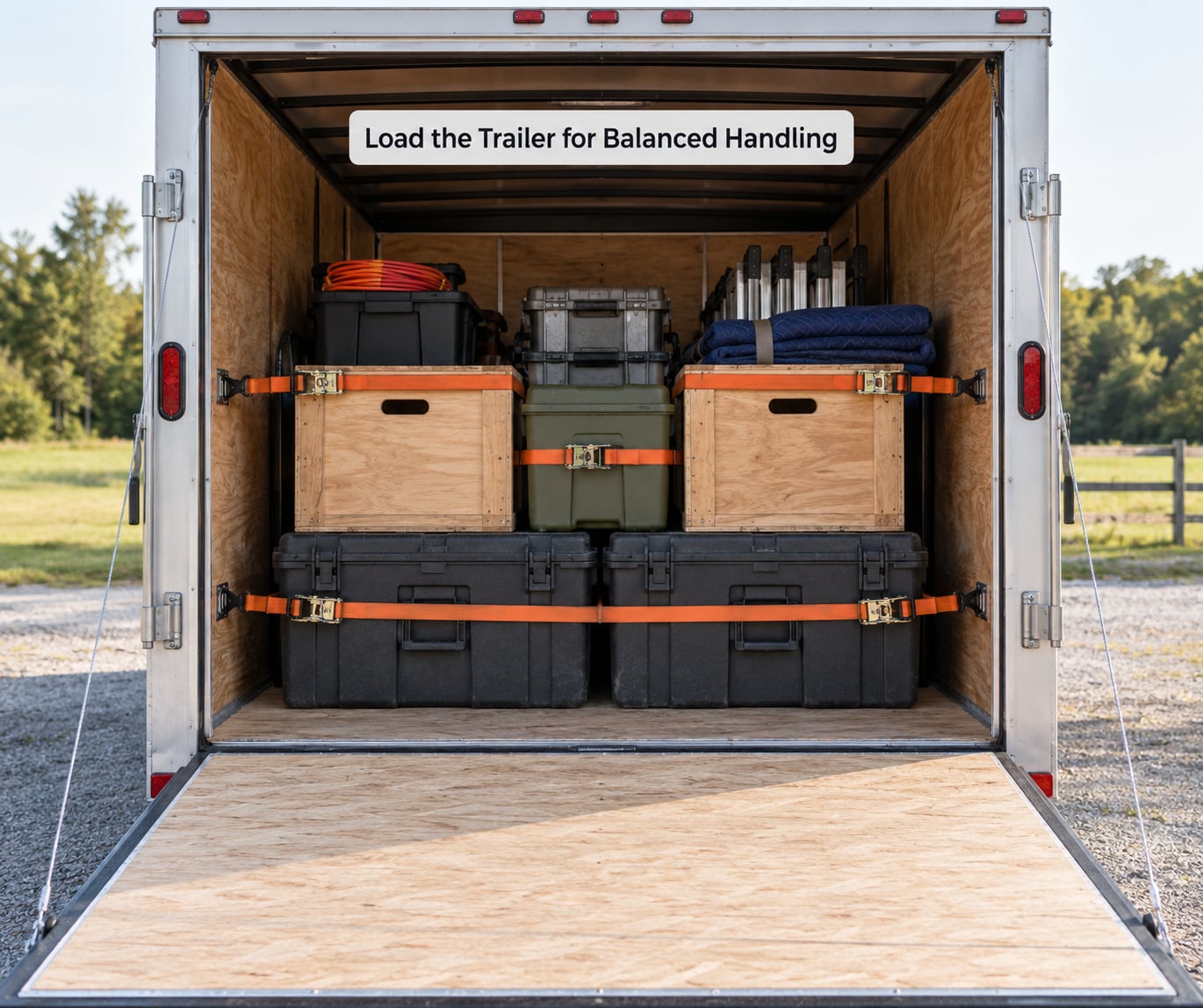
Heavy items go on the floor, low and centered, with about 60% of the load mass forward of the axle and no more than 40% behind it. Stack the tallest, heaviest pieces against the front wall, where a sudden stop pushes the load back into the trailer rather than into the back wall. Never let the load shift rearward past the center; rear-heavy trailers are the single most common cause of sway.
Strap every item with rated ratchet straps to actual tie-down points, not to each other. A load that looks tidy and rides unfastened is waiting for the first emergency stop to become a projectile. Leave no loose loops of chain or strap near the tires, where they can slap the fender or catch something.
The 60/40 rule matters because it is the practical stand-in for tongue weight. Heavier loads near the tongue pull the trailer’s axle back under control and keep the trailer tracking straight, while too much weight out back makes it want to wander. If you can weigh the loaded trailer, aim for 10% to 15% of that weight on the hitch ball.
5. Perform a Stationary Systems Check
With the trailer connected and loaded, everything you can test without moving gets tested now. Ask a second person to stand behind the trailer and work the brake lights, both turn signals and the hazard flashers while you confirm each one lights. Then have them stand at the side of the truck and confirm your turn signal, brake lights and hazards come on at the same moment, which catches mismatched wiring and bad grounds that only show up as confusing flicker.
If the trailer has electric brakes, set the brake controller, back the truck into open space and let the manual apply braking on command. Verify the breakaway cable is attached and that the breakaway switch on the trailer would pull free and trigger the brakes. If your controller has a diagnostic readout, confirm it shows a closed circuit rather than a trailer-disconnect code.
Set your mirrors before you move. Extend the tow mirrors, tilt them so you can see the trailer edges and the road beside the rear quarters, and check that you can see down the lane next to the trailer without leaning. Put the parking brake on, then try to pull the truck forward gently against it. If the vehicle creeps, the parking brake or trailer brake is not holding and you have a problem to solve before speed.
6. Pull Away Slowly and Build Speed Gradually
Set the parking brake, select first gear and use the lowest gear that keeps the engine out of lugging territory, or a low towing range if your transmission has one. With an automatic, switch to drive and add power until the trailer starts to roll, then hold a steady, feather-light throttle. Never floor it to get moving; a hard launch shoves load into the trailer’s front wall and can start sway immediately.
Your stopping distance roughly doubles once the trailer is moving, so following distance has to change too. The habit worth building now is counting four seconds of empty road between your bumper and the vehicle ahead, and stretching that to six or more in rain, at night or on a bad surface. Our guide to driving safely in heavy rain covers the visibility side of that calculation.
Lane changes need about double the normal distance. Merge at a steady, moderate speed, check the mirrors and the trailer’s clearance line over several seconds, then let the trailer track before touching the wheel again. Pass slower vehicles only on wide, legal stretches, and never pass a truck near a hill crest where the driver beside you has no view of you.
7. Manage Braking, Turns, Hills, and Reversing
Brake earlier and more gently than you would on an empty road. Trailers with their own brakes do most of the stopping work once the controller is set correctly, and those brakes often engage with a slight delay while pressure builds in the system, so the whole rig still wants more room than instinct suggests. Descending, this lag is where brake fade and trailer jackknife come from, which is worth reading about in more detail on what brake fade is and how to avoid it.
On grades, drop to a lower gear before the descent starts rather than braking the whole way down. Holding speed in low range puts the load on the engine instead of the brakes. Never ride the brakes for miles, and if the brake pedal starts feeling spongy or hot-smelling, pull over and let things cool before continuing.
Turns need room. Inside turns clip the trailer, and outside turns swing the trailer outward into the next lane, which is why you take corners slower than the road feels like it needs. Watch your speed where a crosswind or a passing semi hits the trailer’s broad side; a hand on the wheel and a light touch on the brake controller helps more than gripping the wheel.
Backing up means the trailer follows the vehicle rather than the other way around. Put your left hand on the bottom of the steering wheel and pull that hand toward you to send the trailer left, or push away for right, and hold the position after you reach the spot. Move in short bursts. Below about 45 degrees you will start pulling the vehicle toward the curb and then straighten out, which is the moment jackknife appears. A spotter standing clear of both vehicles and visible in the mirror is worth more than any amount of confidence.
8. Park, Couple, and Shut Down Safely
Pick a level site you can back into without reversing the trailer downhill, and pull straight and fully into it. Apply the parking brake, then leave the engine in park or in first gear so the vehicle cannot roll while you work behind it.
Lower the trailer jack only onto solid ground or onto a board, and only when the trailer’s weight is still on the vehicle. Chock both trailer wheels before disconnecting anything. Then unhook the breakaway cable, pull the electrical plug, release the safety chains, and finally open the coupler latch and lift the tongue with the jack or winch. Pull forward slowly until the coupler clears the ball.
Do it in that order every time and the coupler will never come off a moving vehicle. If the trailer is going to sit for more than a moment, chock it, disconnect the tow vehicle, and walk back to confirm the trailer is not resting on anything but the chocks.
Common Mistakes
Almost every towing accident on record traces to a short list of repeated errors, and nearly all of them are avoidable at the driveway.
Overloading the vehicle
Adding a trailer, passengers and cargo can push you past the payload limit even when the trailer itself is under the tow rating. The check to make is the payload figure, not the towing figure.
Not enough tongue weight
A trailer carrying too little weight on the ball becomes unstable and sways. Keeping roughly 10% to 15% of the loaded weight on the hitch gives the trailer something to steer with.
Routing safety chains straight instead of crossed
Chains attached in parallel can come loose. Crossed chains form a cradle under the tongue and hold the trailer even if the coupler fails.
Forgetting the breakaway cable
It is a small loop near the tongue that most people never touch. Pull it free and the trailer brakes fire automatically if the coupler ever separates from the ball.
Leaving chains, straps or loose cable around the tires
Anything that can reach a spinning tire will destroy it, usually at highway speed. Strap ends, bungee cords and chain slack all belong well clear of the fenders.
Tailgating and sudden braking
Stopping distance grows enormously behind a loaded trailer. Start braking earlier in every situation rather than testing the limit once.
Sharp steering inputs at speed
Yanking the wheel sets the trailer swinging. Small, smooth corrections are what keeps a heavy load tracking behind you.
Using the tailgate or truck bed as a work surface while connected
Loads sitting above the cab raise the center of gravity and add wind resistance, and that is unsafe at any trailer weight. Secure cargo within the bed rails and keep it low.
Ignoring sway or tire problems
If the trailer starts to fishtail, do not brake hard or turn into it. Lift off the gas, hold the wheel straight, and apply the manual trailer brake gently. A tire that is visibly cracked, worn to the cords or older than about six years is a replacement, not something to monitor.
Frequently Asked Questions
What is the 80% rule for towing?
The 80% rule means keeping the loaded trailer weight at or below 80% of your vehicle’s stated maximum tow rating, which leaves a margin for grades, wind, heat and tire condition. Some experienced towers use 85% for trucks built on a body-on-frame chassis, where the margin can be tighter. The rule is a guideline of caution, not a rule of law; your owner’s manual and your actual payload calculation decide what is safe.
What is the 60/40 rule for trailers?
The 60/40 rule means placing roughly 60% of the loaded trailer’s weight ahead of the axle and no more than 40% behind it. This keeps the trailer balanced over its axles and keeps enough weight on the tongue for stable tracking. Loading too far back puts the trailer behind itself, reduces tongue weight and is one of the leading causes of sway.
What should I do when towing a trailer for the first time?
Spend the first two or three hours in an empty parking lot before touching public roads. Mark a cone course, drive straight and slow, practice stopping to a controlled stop, then practice turning in both directions and backing into a marked space. Most beginners say this is the single most valuable preparation they did. Only leave the lot once you can back into a straight line without thinking about it.
How do you park with a trailer?
Back into a level spot while the site is still mostly empty, pull straight and fully forward, then set the parking brake and leave the transmission in park or first gear. Chock the trailer wheels before you disconnect anything. Unhook in this order: breakaway cable, electrical plug, safety chains, then the coupler. Never drop the tongue onto the ground while the trailer is still attached to the vehicle.
Does pulling a trailer hurt my transmission?
It puts more torque and heat into the transmission and the cooling system, especially on grades and in high ambient temperatures. Hot, loaded pulls at sustained high speed are the harshest case, and ignoring shifting delays can shorten fluid life. A lower gear, a reasonable speed and a full transmission fluid level at proper temperature do more for longevity than anything else you can do.
Final Checklist Before Your First Tow
Run this before you pull out of the driveway. It takes about ten minutes and it catches the overwhelming majority of beginner problems.
- Ratings checked: loaded trailer weight, payload, tongue weight and hitch class all line up with the owner’s manual.
- Trailer inspected: tires, lug nuts, frame, coupler, chains and breakaway cable all sound and secure.
- Connected: coupler latched and pinned, chains crossed under the tongue with slack, plug seated, breakaway cable attached.
- Loaded: heavy items low, centered and forward of the axle, everything strapped to a tie-down point.
- Systems tested: brake lights, turn signals, hazards and trailer brakes all confirmed working, mirrors adjusted.
- Drove: left the lot at walking pace, kept four to six seconds of distance, used a lower gear on grades.
- Stopped: parked level, parking brake set, wheels chocked, disconnected in the correct order.
If you take one thing from this guide, take the practice session. An hour in an empty lot with a few cones teaches more about trailer handling than a hundred hours of reading, and it costs nothing but time. Start there, stay inside the rated numbers, and add distance and speed only once the low-speed maneuvers feel ordinary. Once that habit is built, learning to brake smoothly and deliberately is the next skill worth developing.