
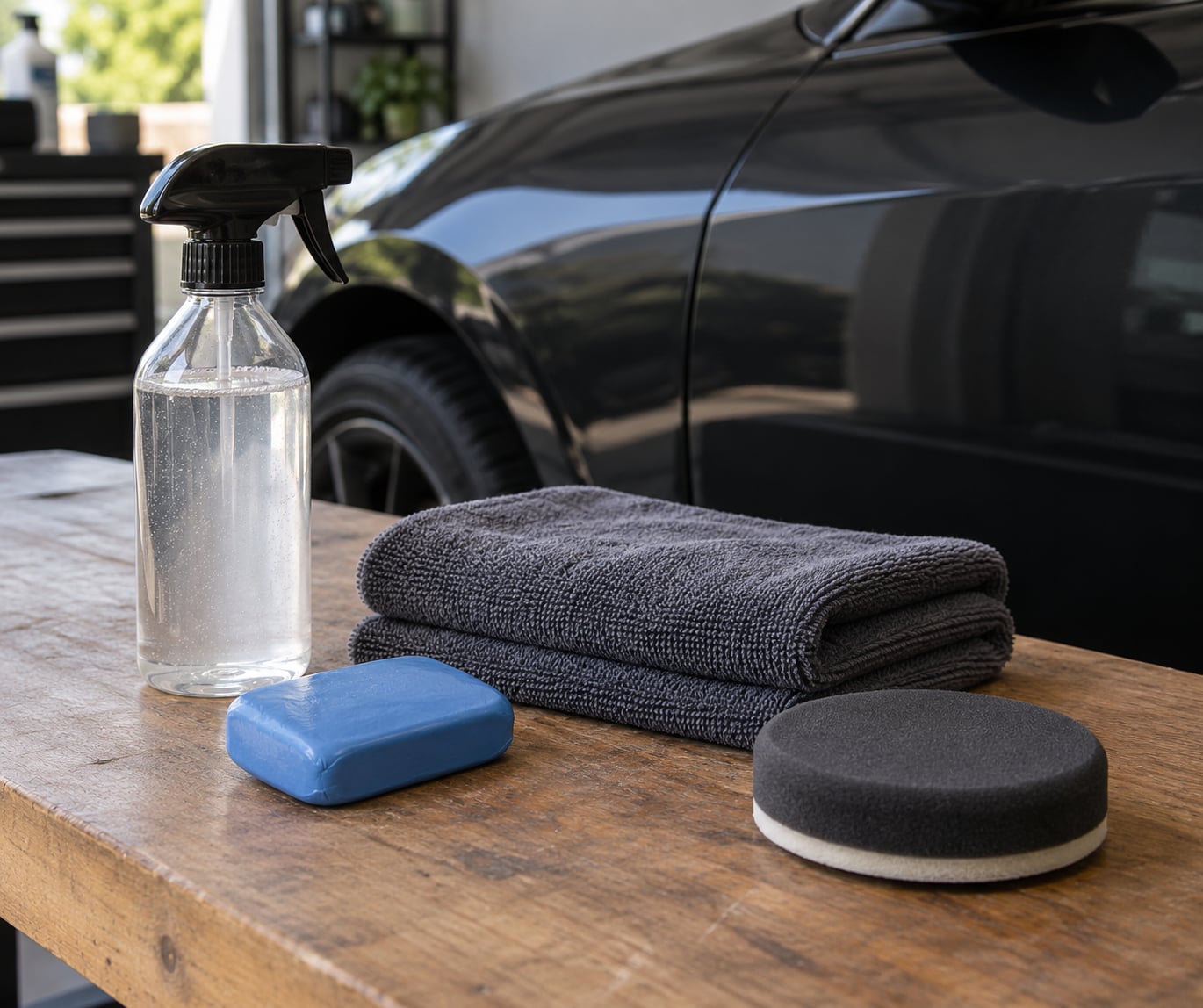
Most white rings on a car’s paint are mineral deposits left behind when water evaporates before it can be rinsed away, and they lift off a clear-coated panel with a lubricated clay bar. This guide walks through how to remove water spots from car paint in the order that costs the least risk: wash and dry first, then clay, then polish only what clay leaves behind.
The whole job takes 30 minutes for fresh spots on one panel. Set aside a couple of hours if you are dealing with a whole car of hard-water scale, and remember that spots living in direct sun or on a hot hood will bake in faster than you think.
Table of Contents
- Quick answer: the five steps
- What You Need to Remove Water Spots from Car Paint
- The essentials
- Optional, only if spots persist after clay
- Finish-specific alternatives
- Step-by-Step: Removing Water Spots Without Damaging the Finish
- 1. Identify the Paint and Check for a Two-Step Finish
- 2. Wash and Dry the Affected Panel
- 3. How to Remove Water Spots from Car Paint with a Clay Bar
- 4. Polish Away Spots That a Clay Bar Does Not Remove
- 5. Treat Glass and Plastic Separately
- Common Mistakes in the Sequence
- How to Prevent Water Spots from Returning
- Common Mistakes Worth Avoiding
- Products that damage clear coat
- Habits that quietly make things worse
- Why spots come straight back
- Frequently Asked Questions
- Are water spots on car paint permanent?
- What is the safest product to remove water spots from a car?
- Can I use vinegar to remove water spots from car paint?
- Will a clay bar remove water spots from glass and plastic?
- Should I polish a car to get rid of water spots?
- How do I stop water spots from coming back after washing my car?
- Conclusion
Quick answer: the five steps
- Confirm the car has clear coat, then find shade and let the panel cool to the touch.
- Wash with pH-balanced car shampoo and dry fully with clean microfiber towels.
- Run a clean clay bar over the damp, lubricated panel in straight overlapping passes.
- Wipe away any residue, re-wet, and check whether the panel feels smooth with your fingertips.
- Protect the corrected area with wax, sealant or ceramic coating so water sheets off next time.
That sequence works for the majority of spots. Everything below covers the cases it does not: single-stage paint, glass and plastic trim, and marks that clay cannot shift because they are etched into the clear coat.
What You Need to Remove Water Spots from Car Paint
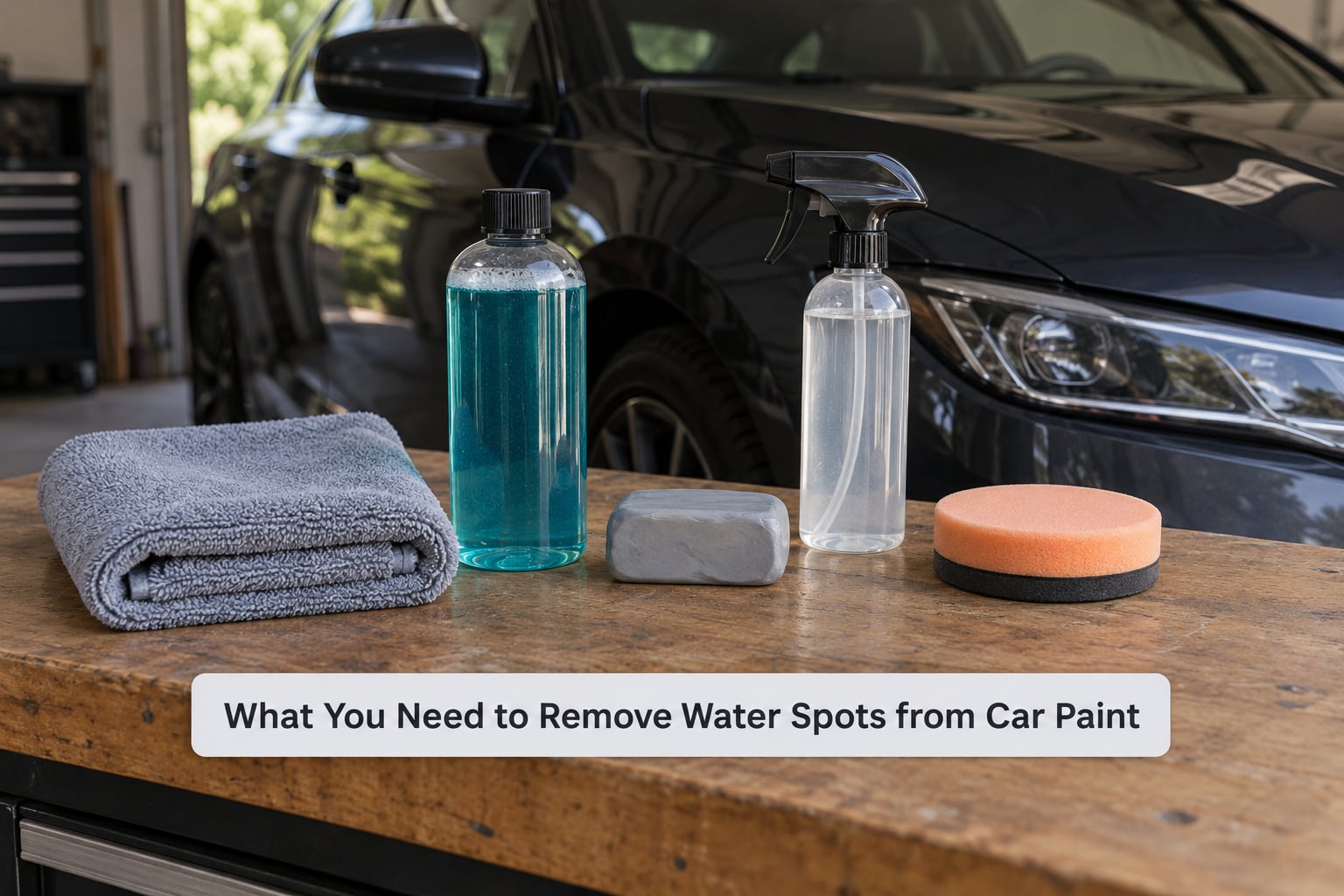
Gather everything before you start, because interrupting a clay session to hunt for a lubricant is how people end up dragging a dry bar across paint.
The essentials
- A pH-balanced automotive shampoo. Household dish soap strips wax and sealant in a single wash and leaves a film that traps more dirt than it removes.
- Two clean microfiber wash mitts or towels, plus two more for drying. Grit trapped in a single rag is how a spot-removal job turns into a swirl-mark job.
- A detailing clay bar or clay mitt. This is the tool that actually lifts bonded mineral scale off clear coat.
- Clay lubricant or a slick soap-water mix. The lubricant has to stay wet between the bar and the paint for the whole panel.
- Spray bottles. One for water, one for your choice of chemical remover.
Optional, only if spots persist after clay
- A dedicated acidic water spot remover or a finishing polish, plus a soft foam pad or microfiber hand applicator.
- A dual-action polisher for larger panels, if you are comfortable with one. A random orbital on a dark car can make the problem look worse, not better.
- A clean, soft brush for plastic trim, and glass cleaner reserved strictly for glass.
Finish-specific alternatives
Single-stage paint from older vehicles has no clear coat to protect, so skip acidic chemistry and go straight to a mild polish. Glass and plastic need their own products, and I cover both in step 5.
If your washing technique is the problem, how to wash a car without scratching the paint is worth reading before you pick up the clay.
Step-by-Step: Removing Water Spots Without Damaging the Finish
1. Identify the Paint and Check for a Two-Step Finish
Almost every car built since the late 1980s uses a two-stage finish: pigmented base coat sealed under a clear coat. You can confirm yours by finding the paint code on the driver’s door jamb placard, inside the fuel filler door, or on the paint information sticker in the service book, then looking up the finish type for that code.
Older single-stage and older repaints are a different animal. They have no clear layer, so any chemical that dissolves mineral deposits is working directly on colour. On single-stage paint, use a mild polish and skip acidic spot removers and clay work on delicate vintage finishes.
Whatever the finish, keep glass cleaner, degreaser and acidic household products off automotive paint. Read how to touch up paint chips on a car if the panel you are working on has deeper damage to consider.
2. Wash and Dry the Affected Panel
Never clay a dirty panel. Loose grit under a clay bar is exactly how micro-scratches happen, and clay will happily drag it across the clear coat in long lines.
Rinse the panel thoroughly, then wash with pH-balanced shampoo and a clean mitt using straight back-and-forth strokes. Rinse again before drying, or you are drying grit into the finish.
Dry with a large drying towel first, then a second towel for the last pass. Move the car into shade before you start if you can, and let the panel cool to the touch. Working a warm panel speeds up evaporation, and evaporation is what created the spots in the first place.
3. How to Remove Water Spots from Car Paint with a Clay Bar
A clay bar is the strongest DIY option for spots that sit on top of the clear coat, and it costs almost nothing in risk when you keep it lubricated.
- Rewet the washed panel. Squeeze the clay bar in your palm to soften it and flatten it against your hand.
- Spray a generous amount of clay lubricant over roughly a two-foot section at a time.
- Slide the bar across the panel in straight, overlapping passes. No circular motion, no pressure, no scrubbing.
- If the lubricant turns to a milky paste, stop and re-wet before continuing. That paste is paint residue.
- Rinse and dry the section, then re-clay if the surface still feels gritty.
Test the result with clean fingertips. Run a fingertip lightly across the corrected area and compare it to a section you did not touch. Bonded mineral scale feels like fine sandpaper; a properly decontaminated panel feels smooth, almost like glass.
A clay bar will not remove spots that have chemically etched the clear coat. Those feel permanently dull and slightly rough no matter how many passes you make. That is your signal to move on, not to add pressure.
4. Polish Away Spots That a Clay Bar Does Not Remove
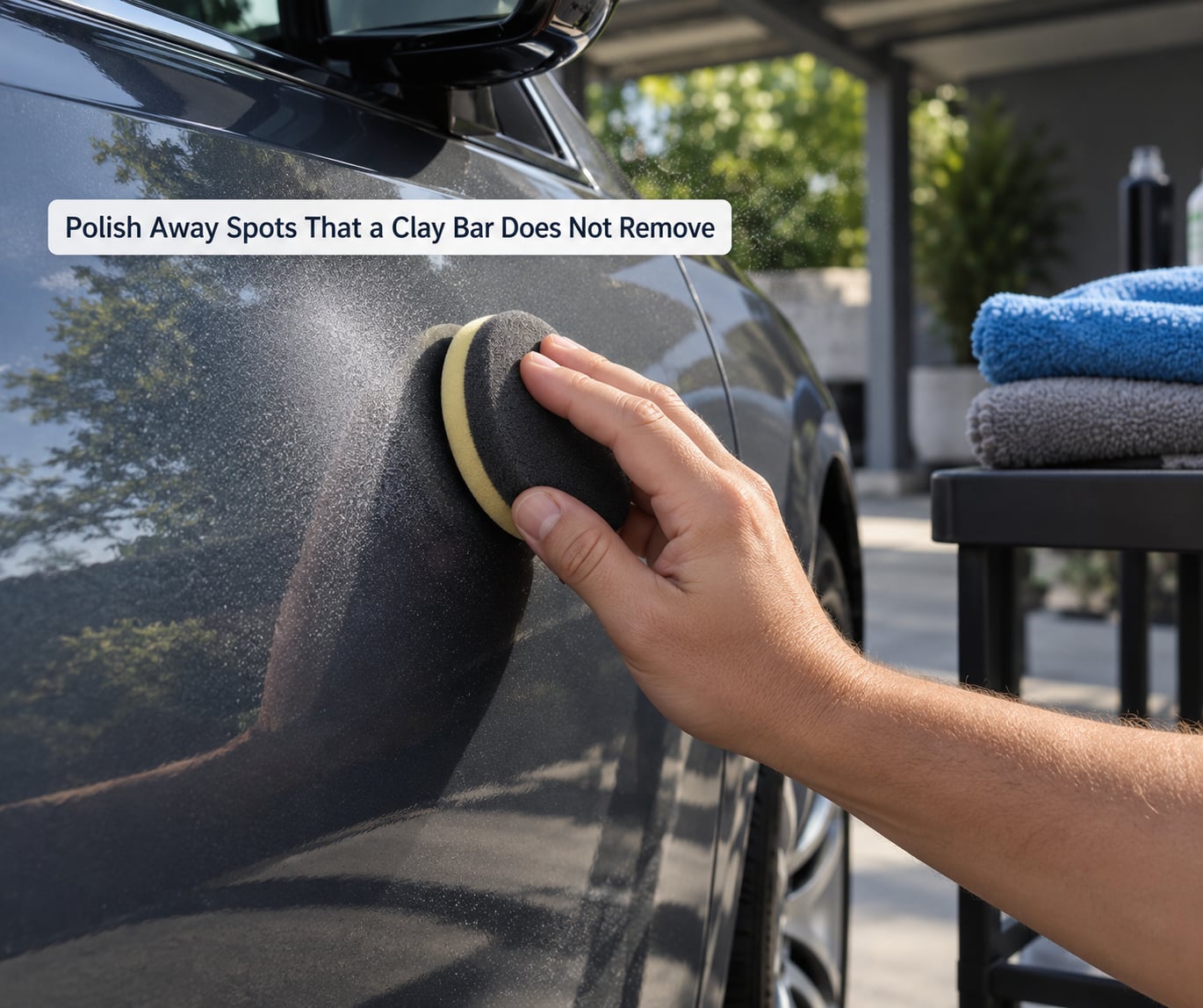
A light polish is the only DIY fix for etched spots, because the deposit is now part of the surface rather than sitting on it.
- Work a small section at a time in shade, on a panel that is cool enough to hold your hand on it.
- Apply a pea-sized amount of finishing polish to a soft foam pad. More product makes it harder to see what the pad is doing.
- Work in small overlapping straight passes at low speed or by hand until the haze clears.
- Keep a spray bottle of water in the other hand and re-wet the pad often. Water spots forming under the pad while you polish creates exactly the mark you are trying to remove.
- Wipe off the residue with a clean microfiber towel before it cures, following the product label for cure time.
Match the polish to the finish. A modern clear coat tolerates a dedicated finishing polish well, while single-stage paint needs something gentler. Check the label for the finishes it is approved for, and skip any polish containing abrasive powders you cannot identify.
If a spot still shows after a full pass with a light polish, the etch has gone deeper than the clear coat thickness can spare. Sanding and recoating or a professional paint correction is the only remaining option, and that is where I stop.
5. Treat Glass and Plastic Separately
Glass and trim are not automotive paint, so they take different chemistry. Glass has no clear coat at all, and etch spots on glass can often be lifted with an acidic glass cleaner or a melamine sponge used with light pressure.
Plastic trim behaves differently again. Panes of gloss black on the B-pillar and around windows are usually painted or chromed plastic with their own clear layer, so test a small hidden corner first. Many of these spots wipe away with a damp microfiber and a little APC diluted to roughly one part in ten, while truly etched gloss black needs a plastic-safe polish.
Skip the vinegar-on-paint advice most of the internet repeats. A diluted white vinegar solution works well on fresh surface-level rings on glass and on some sealed panels, but it dulls wax and sealant and is never a good idea on bare single-stage paint. Use it only where you have confirmed the surface will tolerate it.
If the windshield is the problem rather than the body, removing ice from a windshield without scratching covers the same glass surface in winter conditions.
Common Mistakes in the Sequence
Each of these is easy to make and awkward to undo, so they are worth naming before you pick up a tool.
- Claying a panel that is still dirty. The most common cause of swirl marks. Wash and rinse twice if you are unsure.
- Letting an acidic remover dry on the paint. Dried acid concentrates and burns a dull spot into the clear coat. Keep the panel wet and rinse if you lose track of time.
- Polishing a hot hood. Heat drives the water out from under the pad and you will be sealing fresh spots into the finish.
- Skipping the protection step. An unprotected panel beads water in tight beads instead of sheets, so every wash re-deposits minerals in the same places.
How to Prevent Water Spots from Returning
Prevention is mostly about how water leaves the car, not about stronger products.
- Rinse with plenty of water, and give the lower doors and rocker panels an extra rinse since they collect the most runoff.
- Dry immediately with a large towel while the panel is still wet. A blower or a compressed-air rinse before towel-drying pushes water out from behind trim where it hides and dries later.
- Wash in the shade, and never on a hot panel. In hot climates, wash in the early morning or after sunset.
- Use deionized or distilled water for a final rinse when spots keep coming back. It carries almost no dissolved minerals, so nothing is left to deposit as it dries.
- Add a wax, sealant or ceramic coating after you finish correcting. Coating reduces new deposits; it does not make aggressive spot removal safe later.
If your parking spot sits under a sprinkler, removing the head or adding a car cover solves the problem at the source. No product on the shelf will outrun water hitting the car every night.
Common Mistakes Worth Avoiding
Most of the bad advice about this topic falls into one of three buckets, and all three can end with a repaint.
Products that damage clear coat
WD-40 does not remove water spots. It is a petroleum solvent and water displacer. It may make a deposit look different for a day, and it leaves an oily film that traps fresh dust. On ceramic-coated or waxed paint it can also break down the protection you paid for.
CLR and similar acidic descalers belong on wheels and glass, not paint. Undiluted, they will etch clear coat in minutes. If a detailer or forum recommends wheel acid on paint, that means a specific dilution with gloves and a short dwell time, applied to a cool rinsed panel and neutralised immediately. For most people, a purpose-made automotive spot remover is a far safer way to do the same job.
Never use household bleach, oven cleaner, or abrasive powders such as Comet. Bleach attacks clear coat and rubber trim, and Comet is sand with a label on it. Those are the two ingredients you would be rolling across a black door panel.
Habits that quietly make things worse
Existing wax and sealant can stop a remover from reaching the deposit underneath. If a dedicated remover seems to do nothing, you are probably looking at protection rather than paint. Strip or, better, work the deposit through with clay first, and re-protect afterwards.
Overworking one small area is the other big one. Repeated passes with a stiff pad on a section you keep checking will haze the clear coat long before it removes anything.
Why spots come straight back
Removing a spot but never addressing the source just resets the clock. Detailers on the forums describe the same pattern: a two-bucket wash with pH-neutral soap still produced spots because the car was parked under a sprinkler and the wash itself never dried it. If the marks appear within a day, look at where the water comes from before you buy anything else.
Frequently Asked Questions
Are water spots on car paint permanent?
It depends how long they sat there. While mineral deposits still sit on top of the clear coat, they wipe or clay off and nothing is permanently lost. Once the minerals chemically etch into the clear coat itself, no cleaner, remover or vinegar will shift them. Only a light polish, or professional paint correction for deeper damage, will make the surface clear again. Fresh spots found the same week are almost always removable.
What is the safest product to remove water spots from a car?
A lubricated detailing clay bar is the safest first choice, because it physically lifts the deposit without reacting with the clear coat. Dedicated acidic water spot removers are the safer chemical option, but only when the panel is cool, rinsed, kept wet, and the product is approved for automotive paint. Skip acidic chemistry entirely on single-stage paint, and test any chemical in a hidden corner first.
Can I use vinegar to remove water spots from car paint?
A diluted white vinegar solution, roughly one part vinegar to one part water, will lift fresh surface-level rings from glass and some sealed panels. It is not a good idea on bare or single-stage paint, and it will strip or dull wax and sealant. Vinegar also does nothing at all against etched spots. For paint, use a purpose-made automotive remover instead of a household acid.
Will a clay bar remove water spots from glass and plastic?
A clay bar is designed for clear-coated paint, and using it on glass or on plastic trim risks scratching both without doing much for etched marks. On glass, use an acidic glass cleaner or a melamine sponge with light pressure. On plastic and painted trim, try a damp microfiber with a little diluted all-purpose cleaner first, then a plastic-safe polish if the mark has etched in.
Should I polish a car to get rid of water spots?
Only when the spot is etched into the clear coat and a clay bar will not move it. Polishing before you have tried clay removes clear coat unnecessarily to shift a deposit that was sitting on the surface. When you do polish, use a finishing polish approved for your finish, small overlapping passes, and keep the panel wet and cool throughout, since water spots forming under the pad undo the whole job.
How do I stop water spots from coming back after washing my car?
Dry the car immediately with a large microfiber towel, blow water out from behind trim first, and wash in shade on a cool panel so water is not evaporating as it sits. Rinsing with deionized or distilled water helps in hard-water areas. Then protect the paint with wax, sealant or ceramic coating so water sheets off instead of beading. If spots return overnight, the source is the sprinkler or car wash, not the paint.
Conclusion
Start with the least aggressive step that can work: confirm the finish, wash and fully dry the panel, then run a clean clay bar over it with proper lubrication. That handles most water spots without taking any clear coat off. Polish only the marks that clay leaves behind, keep the panel wet while you do it, and treat glass and plastic with their own products. Finish by protecting the paint so the next wash does not start the problem over.
This method is current as of 2026 and follows the sequence detailers describe on car care forums: wash, then remover, then clay, then polish, then protection.