
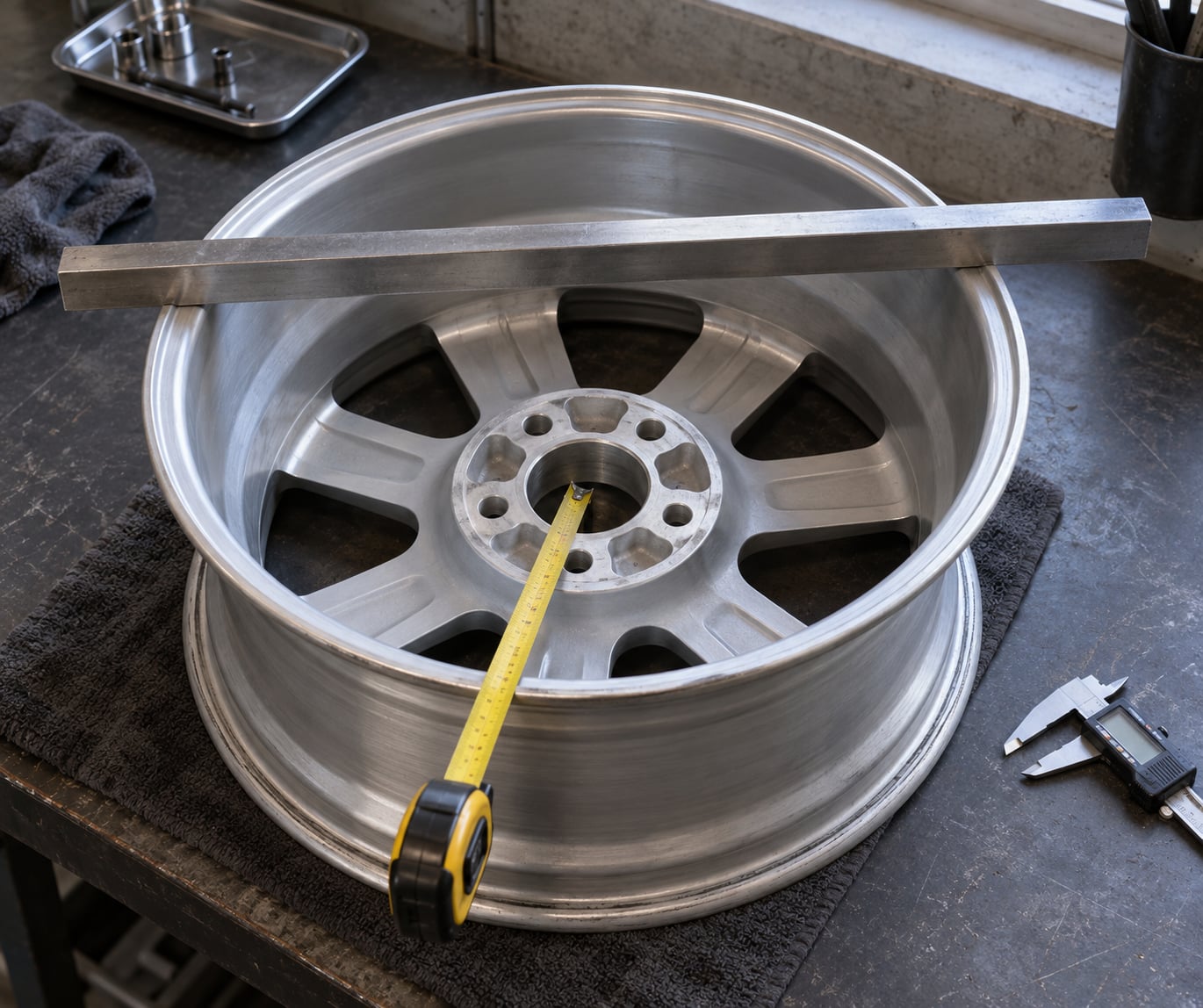
To measure wheel backspacing, lay a straight edge flat across the inside lip of the wheel and measure the distance in inches from that straight edge to the wheel’s hub mounting pad. The wheel comes off the car, the tire can stay on, and the whole job takes about five minutes with a straight edge and a tape measure.
Most people get close, then argue with a 1/8 inch error and end up with a wheel that tucks in or pokes out. Getting the reference surfaces right the first time is what matters, and the difference between backspacing and wheel offset is where nearly all that argument starts. Sorting out both takes less time than one trip to the tire shop.
Table of Contents
What You Need
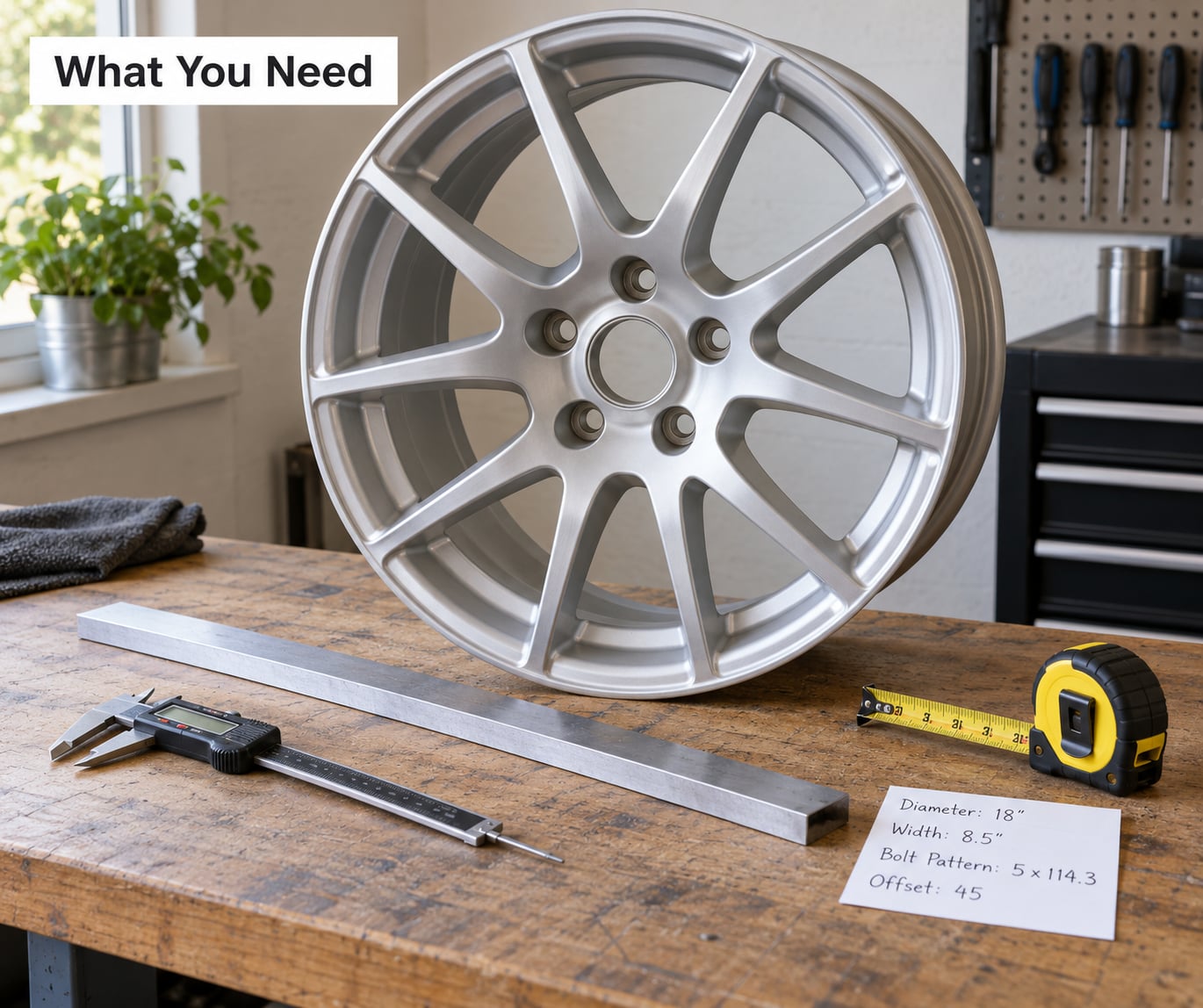
You do not need anything expensive. A good straight edge and a tape measure get you a usable number, and a caliper makes the wheel width measurement exact rather than approximate.
- A straight edge — a yardstick, a machinist’s rule or a 4-foot level with the vial removed all work. It has to be flat and at least as wide as the wheel.
- A tape measure or ruler — a flexible tape is easier inside a wheel barrel; a ruler is more accurate on short runs.
- A digital caliper — optional for backspacing itself, but worth having to measure the wheel width from flange to flange.
- A flat, level surface — a bench top or clean garage floor with the wheel resting on the flange, not on a soft mat.
- Your wheel’s stamped markings — usually cast into the back of the spokes or the inner barrel. Look for the diameter, width and bolt pattern.
- Your car’s factory offset — found on the driver’s door jamb sticker, in the owner’s manual specification list, or from a VIN decode.
The door jamb sticker is the fastest check and most people never find it because it is on the driver’s side edge of the door frame, not on the jamb itself. If the sticker is gone or the number is worn, the specification list in the manual will have it.
How to Measure Wheel Backspacing Step by Step
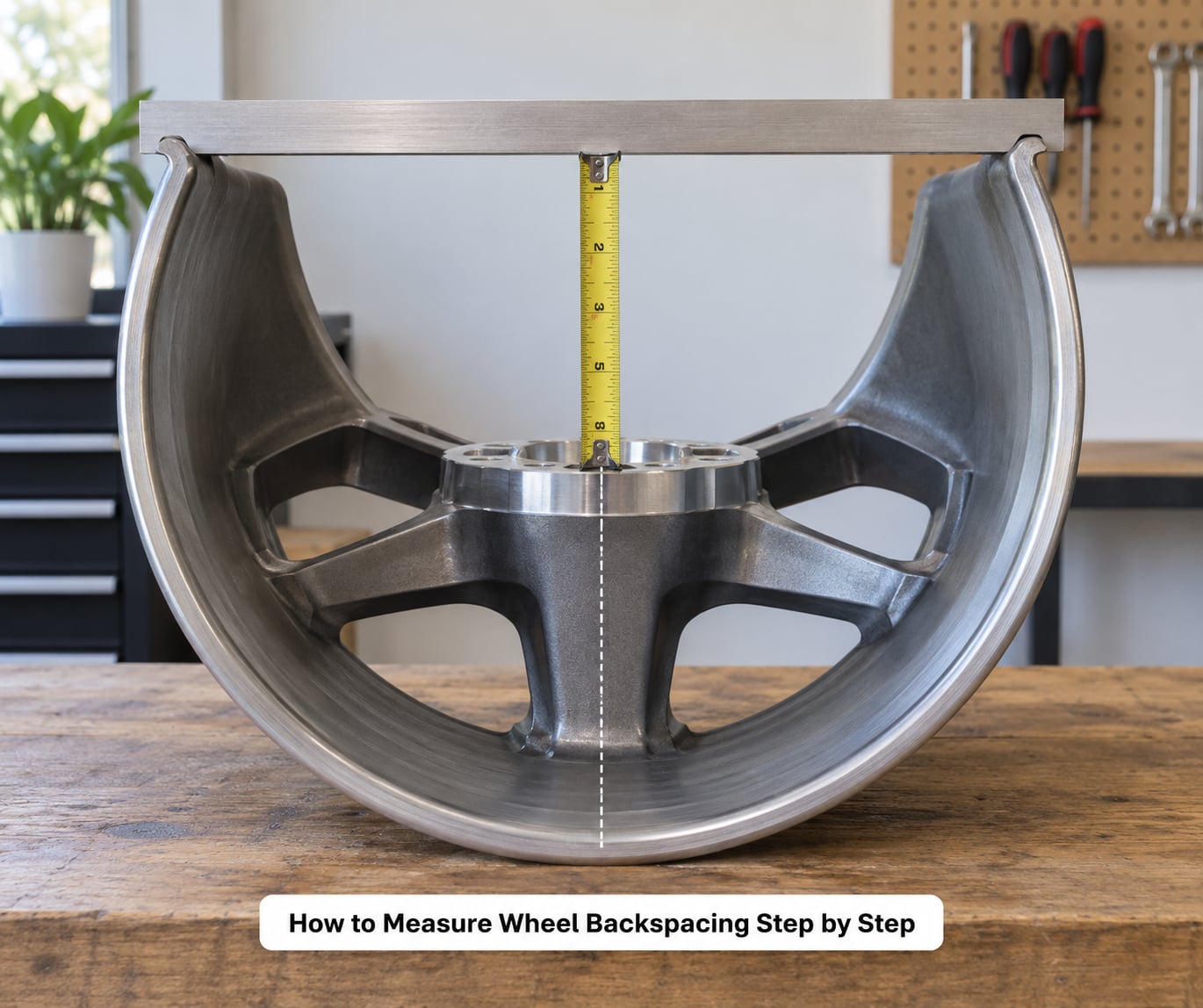
Backspacing is the distance from the mounting pad to the inner edge of the wheel, measured straight across, and it is expressed in inches. Everything else about this measurement follows from those three ideas.
Clean the wheel and identify the mounting face
Brake dust and road grime build up on the mounting pad and inner lip, and a quarter-inch of crust under the straight edge is the difference between a good reading and a useless one. Wipe both surfaces down with a damp rag and let them dry.
The mounting face, also called the mounting pad, is the flat metal surface on the back of the wheel that sits against your hub. It is the only flat reference on the wheel, and it is the surface you measure to. The inner lip is the outer edge of the wheel on the side that faces the engine.
If your setup uses spacers or adapters, be clear with yourself about what you are measuring. A measurement taken across the spacer is the spacer’s dimension, not the wheel’s. Put the wheel on the car or on the bench the way it will actually be installed.
Measure the inside-to-outside width
Set the wheel on a flat surface resting on its mounting pad, then measure across the widest part of the rim, from the inner lip to the outer lip. Do this in a few spots and take the largest reading, because rim barrels are not always perfectly round.
Use the metal flange, not the tire sidewall. A mounted tire bulges past the rim in both directions and adds roughly an inch of width that has nothing to do with the wheel. That extra inch is exactly what makes tire-mounted measurements confusing.
A caliper with jaws wide enough to span the flange will do this in one step. If the caliper is too narrow for the barrel, use a straight edge and a tape measure and move it around the circumference.
Locate the wheel centerline
The wheel centerline is the midpoint of the total width, so half your flange-to-flange measurement. If the wheel measures 8.6 inches across, the centerline sits 4.3 inches from either lip.
You can find it physically by laying the straight edge on its edge across the face of the wheel, or simply mark it on your paper next to the overall width. The math is easier if you write the half-width down before you start the offset calculation.
Measure the mounting-face offset
Lay the wheel face down on the bench so the mounting pad sits flat and the outer lip points up. Rest the straight edge flat across the inner lip so it touches metal at both edges and does not rock.
Now measure from the underside of the straight edge straight down to the mounting pad. That perpendicular distance, in inches, is your backspacing. Keep the tape measure vertical and square to the bench; leaning it over by a few degrees will read long.
Most wheels are sold with a backspace figure rounded to the nearest quarter inch, while the real number is usually somewhere in sixteenths. An 18-inch wheel is commonly listed at 4.5 inches and may actually measure 4.438 or 4.5 exactly.
Calculate and verify backspacing
Backspacing in inches is not offset in millimeters, and the conversion is worth doing because offset is the number every wheel seller and fitter actually works from. If you are still fuzzy on what that number means, what wheel offset is and why it matters covers the reasoning behind it. The formula is:
ET = (half of overall width minus backspacing) × 25.4
Multiply the inch result by 25.4 to convert to millimeters. A positive number means the mounting pad sits outboard of the wheel centerline, a negative number means it sits inboard, and zero means the pad is exactly at the centerline.
| Overall width | Backspacing | Calculated offset |
|---|---|---|
| 7.0 in | 3.5 in | 0 mm (zero offset) |
| 7.0 in | 4.25 in | about -19 mm |
| 7.0 in | 4.5 in | about -25 mm |
| 7.5 in | 4.5 in | about -19 mm |
| 8.5 in | 4.0 in | about +6 mm |
| 8.5 in | 4.5 in | about -6 mm |
| 8.5 in | 5.5 in | about -32 mm |
| 10.0 in | 4.5 in | about +13 mm |
| 10.0 in | 5.5 in | about -13 mm |
Worked BMW example: a common 18×8 ET34 wheel measures about 8.6 inches across the flange. Half of that is 4.3 inches, and subtracting the measured 2-15/16 inch backspacing gives about 1.36 inches, which converts to roughly +34 mm. That matches the stamped ET34, which is how you know the measurement was right.
If your calculation lands within a millimeter or two of the stamped ET value, you measured correctly. If it is off by more, you probably measured across the tire bulge or used the outer lip instead of the inner one. Take a second measurement and confirm the straight edge was fully seated before trusting the result.
The thing to check after the math is clearance. Compare your calculated offset with the factory figure from the door jamb, then look at what changes: a lower offset number pulls the wheel inward toward the suspension, while a higher offset number pushes it outward toward the fender lip. The same wheel at the same width with a more positive offset will reduce the gap you have at full lock.
Common Mistakes
Measuring across the tire instead of the rim. A mounted sidewall bulges past both lips and inflates the width. If you want to leave the tire on, measure from the outer edge of the tire to the mounting pad on one side only, but treat that as tire clearance rather than backspacing.
Using the wrong lip as the reference. The straight edge belongs on the lip that faces the engine bay, opposite the outer face of the wheel. Measuring to the outer lip gives you the same number twice the wheel width off.
Treating backspacing and offset as the same thing. They measure from different reference points in different units. Backspace runs from the mounting pad to the inner lip in inches; offset runs from the mounting pad to the centerline in millimeters. Comparing an inch figure to a millimeter figure without converting is the single most common error.
Letting the straight edge rock. If the straight edge bridges the lip on one side and lifts on the other, your reading is wrong by as much as the tilt. Press it down at both ends and check it visually before you measure.
Ignoring spacers and adapters. Spacer thickness adds directly to the offset of the assembly. Measure the bare wheel for comparison purposes, but calculate the offset of the complete setup.
Forgetting bolt pattern and hub bore. Correct backspacing does not help if the pattern or bore is wrong. Read the stamped bolt pattern and compare it with your hubs; if you are unsure how many studs you should be counting, how to measure bolt pattern on wheels walks through four ways to get it. Then confirm the center bore matches or that the correct centric rings are included.
Skipping brake clearance. Wider wheels with less offset put the outer lip closer to the caliper. Check that the barrel clears the caliper body at full suspension compression, not just while parked.
One tolerance note worth remembering: 1/16 inch is about 1.6 mm, and that is enough to matter on a car with tight fender clearance. 1/8 inch or more will usually mean a rubbing tire on one side. Read your measurement to the nearest 1/16 inch and stop there.
If you have already picked the wheels and the numbers worry you, how to avoid wheel rubbing after a wheel upgrade covers the checks worth doing before the tires go on.
Frequently Asked Questions
Do I need to remove the tire to measure backspacing?
No. Lay the wheel face down on a flat bench, rest a straight edge across the inner rim lip, and measure down to the hub mounting pad. The tire stays on the whole time. What you must not do is measure across the tire, because the sidewall bulge adds roughly an inch of width that has nothing to do with the wheel.
Is backspacing the same as wheel offset?
No, and mixing them up causes most fitment mistakes. Backspacing is measured in inches from the hub mounting pad to the inner edge of the wheel. Offset is measured in millimeters from the mounting pad to the wheel centerline. Convert with ET = (half of overall width minus backspacing) multiplied by 25.4.
What is 4.5 inch backspacing in offset?
It depends on overall width, which is the whole point of the conversion. On a 7.0 inch wide wheel, 4.5 inches of backspacing works out to about -25 mm. On an 8.5 inch wide wheel, the same 4.5 inch figure comes out to about -6 mm. Same backspace, very different offset, because the centerline moved.
How accurate does a backspacing measurement need to be?
Read to the nearest 1/16 inch, which is about 1.6 mm, and stop there. That is accurate enough to compare wheels and calculate offset reliably. An eighth inch of error can put a tire against the fender lip on a lowered car, so take a second measurement and confirm the straight edge was seated flat on both lips.
Where is the offset stamped on a wheel?
Cast into the back of the wheel, usually on the inner barrel between the spokes or on the spoke faces themselves. Cast wheels show it clearly; forged and painted wheels may need a flashlight or a rub of the finger across the surface to find. Look for ET followed by a number, plus width, diameter and bolt pattern.
How do I find my car’s factory wheel offset?
Check the driver’s door jamb sticker first, where the tire and rim specification is usually printed. If that sticker is missing or faded, the specification list in the owner’s manual will have the factory offset in millimeters. A VIN decode gives the same figure, and the measurement on your current wheel is a useful cross-check.
Final Checklist
Start with the number, not the wheel. Measure the overall width across the metal flange, write it down, and halve it for the centerline.
Then measure backspacing with a straight edge seated flat on the inner lip, reading down to the hub mounting pad in inches. Run the conversion formula, compare the result with the stamped ET value on the wheel, and note the difference if there is one.
Confirm the bolt pattern and center bore before anything else, since neither can be corrected by changing offset. Compare your calculated offset with the factory figure from the door jamb sticker, and allow for the wider tire size you plan to run rather than the one you have now.
Before you cut anything or order anything, check the gap at full lock and at full compression, not just while the car is sitting still. If your figures land within a millimeter of what you expected and you have clear room at the fender lip, you have what you need.