
Yes, a high-mileage BMW E90 is still worth buying in most cases, and this BMW E90 high mileage reliability guide explains what actually decides the outcome. A 2005-2013 3 Series that has covered 150,000 to 250,000 miles can be a dependable daily driver, but only when the service history is documented, the cooling system is intact, and the previous repairs were done properly. Mileage on its own tells you very little.
That is the honest version of the answer, and it is the version the owner forums keep coming back to. Enthusiasts on E90Post and BimmerPost routinely point out that a car with 150,000 documented miles is a safer purchase than a cheap example with 90,000 miles and no records at all. One owner of a naturally aspirated car describes an engine at 160,000 miles as solid, then adds the warning that matters: do not ignore a leaking gasket for a year and expect the engine to survive it.
What follows covers how mileage bands change the expected condition, which engines hold up best, what the cooling system does at age, what to budget for, and how to inspect a car before you commit. Where the numbers come from owner reports, I say so rather than presenting them as factory figures.
Table of Contents
- Is a High-Mileage BMW E90 Reliable?
- How Does BMW E90 High Mileage Reliability Vary by Mileage and Model?
- What Engine Problems Do High-Mileage E90 Models Have?
- Is the BMW E90 Cooling System Reliable at High Mileage?
- What Maintenance Intervals Should a High-Mileage E90 Follow?
- What Brakes, Tires, and Suspension Need Attention?
- Which E90 Electronics and Sensors Usually Fail?
- What Should You Check During a High-Mileage E90 Test Drive?
- How Can You Check a High-Mileage E90’s Service History?
- What Warning Signs Mean You Should Avoid an E90?
- Is It Worth Buying a High-Mileage BMW E90?
- Frequently Asked Questions
- What Should You Do First?
Is a High-Mileage BMW E90 Reliable?
A high-mileage E90 is reliable when it has been maintained on schedule and the expensive deferred work was never skipped. It becomes a money pit when the cheap maintenance was done and the water pump, thermostat, gasket work, and transmission service were postponed year after year.
The platform is mechanically stronger than its age suggests. The body is galvanised at key structural areas, the steering and suspension are serviceable with common tools, and most wear items are consumable rather than catastrophic. The parts are widely available, the DIY skill curve is manageable, and the enthusiast community documents most repairs in detail.
Where the E90 earns its reputation for trouble is age-related wear concentrated in a handful of systems: cooling, gaskets, suspension bushings, and electronics. On specific engines, the timing chain and rod bearings get added to that list. None of these is a mystery failure, and almost all of them are visible during a careful inspection.
So the verdict is conditional rather than flattering. A documented, garage-kept example with a clean cooling system and no oil leaks is a genuinely good buy. A car that has been run hot, towed, and neglected will consume its first-year budget in the first month.
How Does BMW E90 High Mileage Reliability Vary by Mileage and Model?
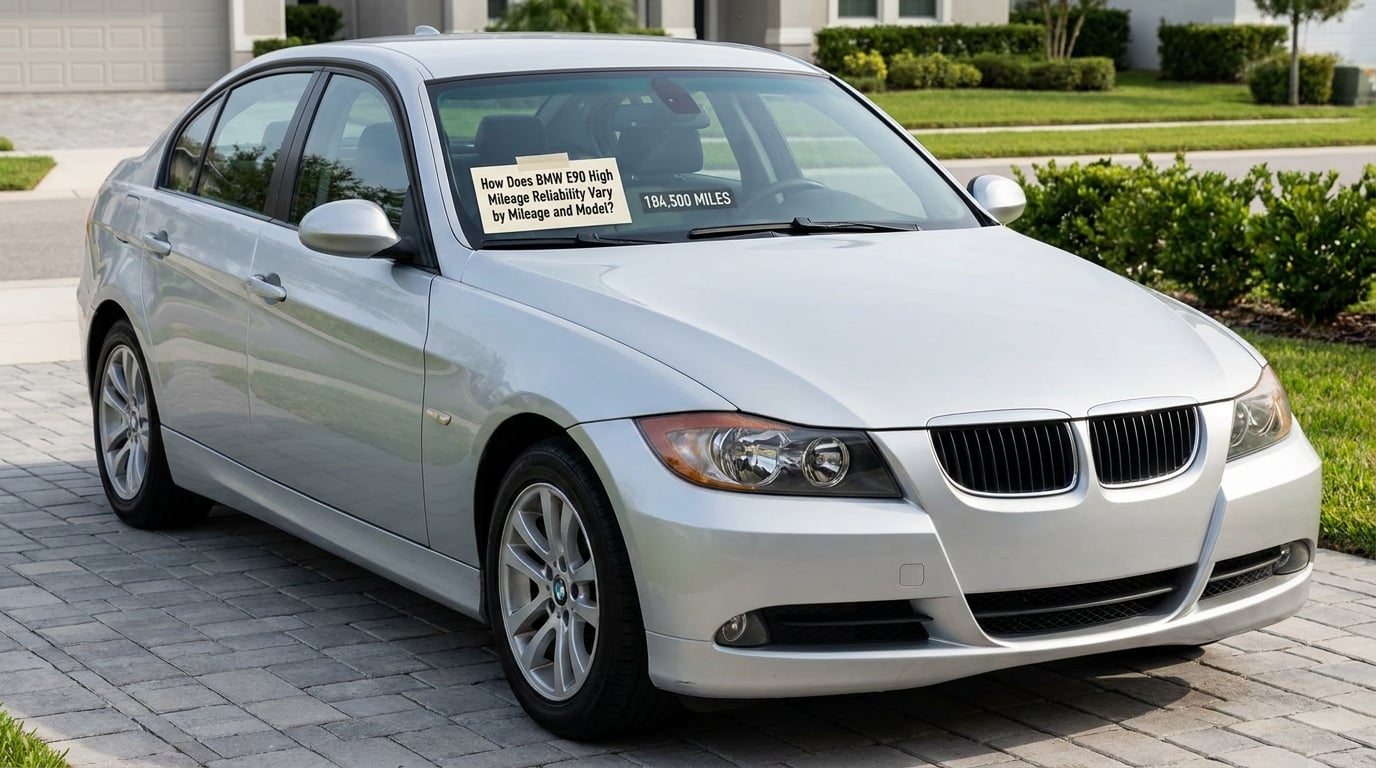
At 100,000 miles the E90 is still in the part of its life where most wear items are ahead of you rather than behind you. By 150,000 miles, the original cooling system parts and suspension bushings are commonly at the end of their useful life. At 200,000 miles and beyond, you should assume a cooling system refresh and some driveline work is coming, and the question becomes whether the previous owner paid for any of it.
| Mileage band | What to expect | What to inspect closely |
|---|---|---|
| Under 100,000 | Mostly original, wear items still approaching end of life | Service records, tires by date, any deferred work |
| 100,000 to 150,000 | Cooling system components ageing, bushings and shocks worn, brakes near replacement | Water pump history, oil leaks, suspension play, brake fluid age |
| 150,000 to 200,000 | Assume cooling system, plugs, coils, and some rear suspension work is due | Thermostat, expansion tank, oil filter housing gasket, sway bar links, control arm bushings |
| 200,000 plus | Survivor cars usually have a documented major repair history; gaps are the red flag | Everything above, plus transmission service records, rear differential oil, driveshaft flex disc |
A lower-mileage car can be the worse purchase. A short ownership history means more changes of hands, and each change is a chance for deferred maintenance, a collision, or a mileage rollback. Forum threads about imported cars with very high kilometer readings converted to miles are a recurring source of buyer regret on the enthusiast boards.
Storage matters as much as mileage. A car that sat in salt-heavy winters without washing underneath will show subframe and wheel-arch corrosion at a younger age than a car driven in a dry climate. Towing damage shows up as steering bushing wear, bent wheels, and driveline play that does not match the mileage.
Model-year variation matters too, but less than the engine choice. An E90 with the naturally aspirated straight-six and an E90 with the turbocharged inline-six can both be excellent, yet they age in completely different ways. The engine decides.
What Engine Problems Do High-Mileage E90 Models Have?
Engine problems on a high-mileage E90 fall into three groups: oil leaks that eventually matter, timing components that stretch on specific engines, and fuel or emissions systems that carbon up and misfire. Direct injection engines are the ones where intake and exhaust carbon is the dominant issue at mileage.
Which E90 engine is the most reliable at high mileage?
The naturally aspirated straight-six, known as the N52 in the 328i and 328is, is the engine most owners regard as the strongest choice for high mileage. It has no turbo, no direct injection, and no high-pressure fuel system to fail. On the opposite end of the list, the V8 in the M3 carries a documented rod bearing concern on early production cars, which is why a documented bearing replacement changes how the car should be valued.
| Engine | Typical application | High-mileage verdict | Watch for |
|---|---|---|---|
| N46 | Early 318i | Durable, simple, low output | Water pump, oil filter housing gasket |
| N47 | 318d diesel | Fine apart from the timing chain | Timing chain stretch, injectors, turbo, DPF, swirl flaps |
| N52 | 328i, 328is | Best choice for high mileage, simple and non-direct-injection | Water pump, thermostat, alternator, oil filter housing gasket |
| N54 | 335i early | Strong if maintained, less forgiving if not | Oil filter housing gasket, oil filter housing cracks, intake manifold, vacuum leaks, carbon, direct-injection misfire |
| N55 | 335i later, 335is | Improved, still direct injection | Charge pipe, spark plugs and coils, carbon, water pump |
| B47 | 328d diesel | Better emissions hardware than the N47 | DPF, turbo, timing chain, dual-mass flywheel |
| S65 | E9x M3 V8 | Outstanding when maintained, costly when not | Rod bearings, throttle actuators, VANOS solenoid, oil filter housing gasket, VANOS-related noises |
Diesels need their own conversation. The N47 timing chain, the dual-mass flywheel, the turbocharger, and the diesel particulate filter all cost more to repair than the equivalent gasoline item, and the DPF is expensive to replace if it is damaged. For a high-mileage car used as a daily driver in the U.S., a gasoline engine is usually the calmer choice.
Turbocharged gasoline engines are fine at mileage, but the direct-injection fuel system needs the right fuel and a clean intake. Owners consistently report that cars maintained with good fuel and an induction service at the scheduled interval run well; cars that skipped it tend to show misfires, throttle actuator faults, and rough idle by 150,000 miles.
On a test drive, listen for a rattle that appears on cold start and fades after a few seconds, which can point to timing chain tensioner or VANOS noise. Watch the oil pressure reading, and ask the seller when the oil filter housing gasket was last replaced. If oil is fresh, dark, and smells burnt, the engine has been run with low oil.
Is the BMW E90 Cooling System Reliable at High Mileage?
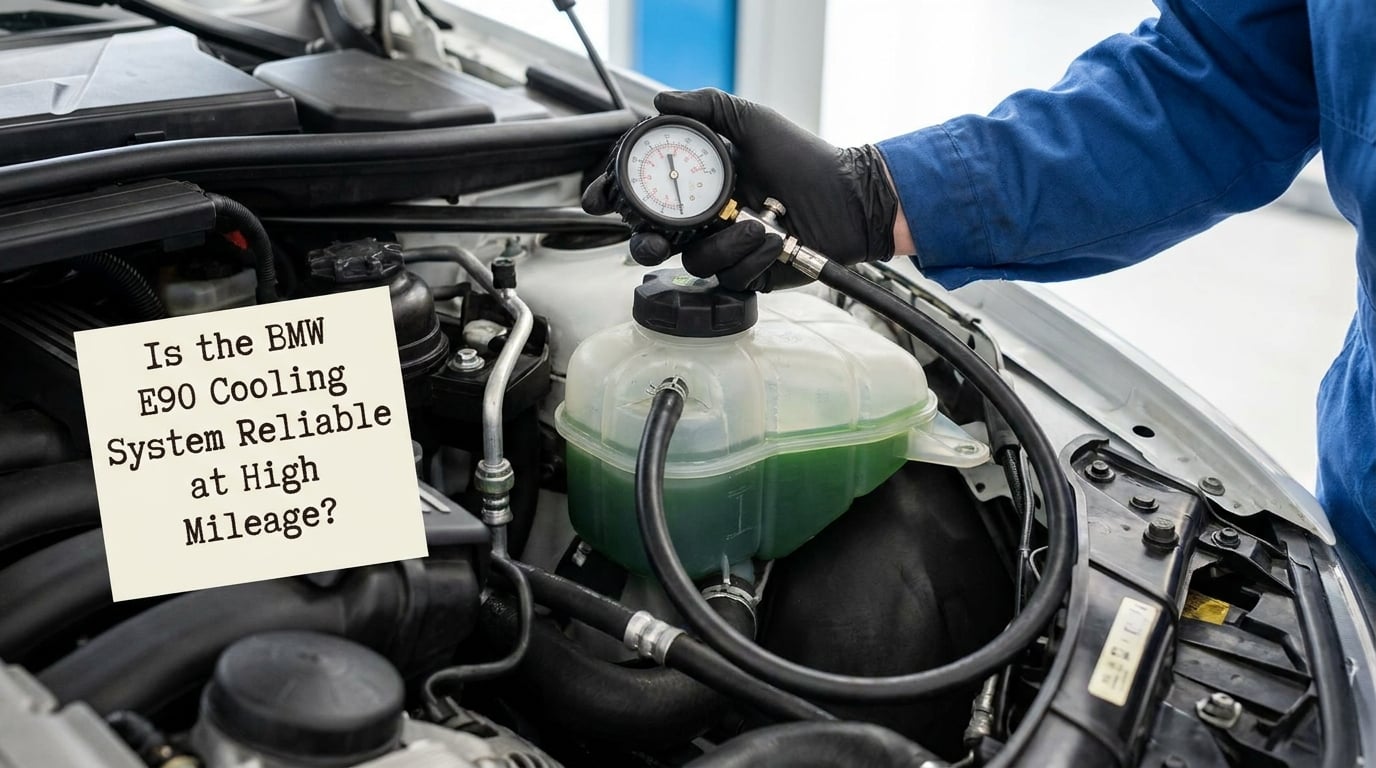
On a high-mileage E90, the cooling system is the single most important thing to inspect. Most E90s use an electric water pump driven by the engine, and the thermostat, plastic coolant pipes, and expansion tank are all age-related parts. Because the water pump is electric, a failure can leave you with little or no circulation warning until the temperature climbs quickly.
Here is the order I would check it in.
- Coolant level and condition. The reservoir should sit between the marks when the engine is cold. Low coolant, coolant that is oily, or residue around the cap all point to an internal leak that has been topped up repeatedly.
- Visible leaks and stains. Green or blue staining on the radiator, plastic pipes, or the front of the engine block means a weep that will get worse, not better.
- Thermostat behavior. Watch the temperature gauge through a full warm-up and twenty minutes of driving. A needle that climbs slowly past normal and stays there, or a fan that runs constantly, suggests a thermostat stuck open or a coolant flow problem.
- Water pump history. Ask whether it has ever been replaced and whether there is a receipt. On a car with a full cooling system, the pump may be original and near the end of its service life.
- Expansion tank and radiator condition. These are plastic and brittle with age. A cracked tank found during a pressure test is a cheap repair now and an expensive roadside one later.
- Evidence of previous overheating. Look for residue in the coolant filler neck, discoloration of the cap, a warped plastic manifold, or a history of head gasket work.
If the car has been driven with an overheated engine, treat the whole car differently. Warped heads, a replaced head gasket, and a damaged engine block are all repair bills that dwarf a pump and thermostat. The guide to topping off coolant correctly is worth reading if you plan to keep an E90, because low coolant is how most cooling failures start.
My rule of thumb: if the cooling system has no documentation, budget the full refresh as if it is coming due, then subtract the parts you can find in good condition yourself.
What Maintenance Intervals Should a High-Mileage E90 Follow?
Once you own a high-mileage E90, treat the service schedule as a checklist to be caught up on rather than a schedule to be waited out. Most cars that are behind have been behind on fluids, not on hardware. The table below is a general guide; the owner’s manual and BMW’s own specifications take precedence over anything here.
| Item | Typical interval | Why it matters at mileage |
|---|---|---|
| Engine oil and filter | Every 7,500 to 10,000 miles | The cheapest engine protection you can buy; the filter housing gasket is often changed with it |
| Coolant flush and refill | Two years or roughly 40,000 miles | Old coolant degrades and stops protecting the aluminum head and block |
| Brake fluid | Every two years | Absorbs moisture, and the pedal feel changes when it degrades |
| Transmission fluid and filter | Every 60,000 to 80,000 miles on an automatic | The most neglected service on these cars, and the one with the most expensive consequences |
| Rear differential oil | Every 50,000 to 60,000 miles | Frequently never done, even on cars with otherwise full records |
| Driveshaft flex disc | Inspect at 60,000 miles, replace if torn | A shredded flex disc ruins the center bearing and driveshaft |
| Spark plugs and coils | Plugs around 60,000 miles, again near 100,000 to 120,000 | Cheap insurance against misfires on direct-injection engines |
| Air, cabin, and fuel filters | Every 15,000 to 30,000 miles | A neglected cabin filter makes the blower noisy and the ventilation slow |
| Serpentine belt, tensioner, hoses | Inspect from 60,000 miles | Cheap parts that strand the car if they let go |
| Battery and charging system | Test from four to five years old | A tired battery causes warning lights and no-start complaints that look like far bigger faults |
| Fuel lines and tank straps | Inspect with every major service | Age-hardened lines are a real failure point on cars of this age |
On the automatic transmission, most owners treat the mechatronic adapter seal, the shift solenoids, and the flex disc as one combined job in the 80,000 to 100,000 mile range, with the rear differential oil done alongside. Individual long-term owner logs report fluid changes and a mechatronic seal replacement well past 200,000 miles on a 6HP21, so this gearbox is not a short-life part when it is serviced and the fluid runs cool.
For a daily driver, oil and filter changes every 7,500 to 10,000 miles make more sense than the maximum interval, especially on a turbocharged engine that sees short trips. If you are shopping for one of these cars, what high-mileage oil actually does is worth a read before you pick a viscosity.
What Brakes, Tires, and Suspension Need Attention?
Brakes and suspension are where high-mileage E90s are most predictable. They wear with use, they are visible, and they are not catastrophic if handled. The mistake is buying a car where the pads are at the metal and the fluid is nine years old, and then treating the sale as a bargain.
What to measure and inspect:
- Pad and rotor thickness. Look through the wheel spokes at the rotor edge and compare it with the minimum thickness cast into the hat. Pads sitting on a thin rotor are a full brake job, not a pad swap.
- Brake fluid condition and age. Dark fluid, a spongy pedal, or a car that has been sitting still for a year all point to fluid that needs replacing before anything else. If a low brake fluid warning appears, check the level and the wear on the sensor before assuming a leak.
- Tire age and tread. Tires have a manufacture date stamped on the sidewall. A car with 200,000 miles running on six-year-old tires is a safety problem regardless of remaining tread.
- Wheel bearings. A hum that rises with road speed and changes with a slight turn is a classic sign.
- Control arm bushings and sway bar end links. These are cheap parts that make the biggest difference in how the car feels. Play in the steering, a knock over bumps, or a rattling front end points here.
- Shock absorbers and strut mounts. Weeping dampers, a car that bounces after a bump, and a clunk when turning both mean the front strut assemblies are due.
- Even wear patterns. Uneven inner-edge wear often points to worn bushings rather than an alignment problem.
Rear wheel bearings and the rear control arm bushings are also common at this mileage, and both are audible over rough roads. A car that has been repaired with cheap bushings tends to need them again sooner.
Which E90 Electronics and Sensors Usually Fail?
Electrical faults are the most frustrating category on a car of this age, because many of them are cheap parts with expensive access. The useful distinction is between a fault that annoys you and a fault that affects safety or drivability.
Common age-related electrical items include window regulators, which fail when the motor burns out and often leave the glass in the door; door lock actuators; seat heater circuits, where a failed heating element reads as a circuit fault; battery-related faults caused by a weak battery or an alternator on its way out; and various sensors feeding the engine management, steering, and parking systems.
On the safety side, watch for warning lights that stay on, headlights or brake lights that work intermittently, and a horn or power window circuit that blows fuses repeatedly. On the drivability side, an intermittent no-start with no warning light on the cluster often traces to a tired battery or a dirty battery terminal rather than a failing module.
A pre-purchase scan matters here. A diagnostic tool with no codes stored tells you a lot more than a test drive, because it also tells you whether codes have been recently cleared. A car that was throwing codes last week and shows a clean scan today is a car to ask hard questions about.
Cosmetic faults such as a dead pixel, a failed lens, or a cracked mirror housing do not affect the decision, though they are a useful negotiating lever.
What Should You Check During a High-Mileage E90 Test Drive?
Arrive early, on a cold engine, and see the car before the seller warms it up. Most of the useful evidence is available in the first ten minutes.
- Documents first. Ask for the service records, the title, the registration, and a vehicle history report before the drive. Read them in the parking lot if you can.
- Cold start. Listen for rattles that fade, hesitations, and a stumble off idle. Note anything that stays on the dashboard after start-up.
- Idle quality. A smooth idle that revs cleanly is what you want. Rough idle, misfires, or a hunting idle on a direct-injection engine means induction service or a vacuum leak.
- Warm-up and temperature. Watch the gauge from cold through full operating temperature, then through twenty minutes of driving. Any climb past normal or a fan that never stops is a cooling system red flag.
- Transmission behavior. Listen for a slip or flare on acceleration, and feel for a harsh engagement in any gear. On an automatic, check that all ratios engage and that the fluid is not pink or gritty.
- Brake feel. Firm pedal, no pulsing, no pull to one side, and no grinding under braking.
- Steering. Test at low speed on a straight road and during a turn. Free play, a knock, or a wandering front end points to bushings or tie rod ends.
- Suspension noise. Slow down over a rough surface and listen for rattles from the front. Then drive over a speed bump slowly and listen behind you.
- Underbody. With the car on a lift, look for fresh fluid, weeping differentials, exhaust leaks, and rust on the subframe and wheel arches.
- Scan tool. Have an independent shop read stored and pending codes. Ask them to check the cooling system for trapped air and pressure-test the system if it is even slightly suspect.
Finish with a drive that includes a highway merge and a full-throttle pull. Any hesitation under load on a turbo engine is worth more attention than a noise at idle.
How Can You Check a High-Mileage E90’s Service History?
A complete service history is worth more than a lower odometer, and that is the single most repeated point in owner discussions about these cars. A well-maintained 50,000-mile car and a documented 90,000-mile car are usually the same car six months apart.
What to request, in order of usefulness:
- All invoices and receipts for the life of the car, including the ones from before the current owner. BimmerPost and E90Post regulars both describe buying cars with paper trails and being glad of it.
- A vehicle history report that shows mileage readings over time, service events, title status, and any reported damage. Consistent readings across years matter more than the highest number reported.
- Work orders and parts invoices for the major jobs: the cooling system, the transmission service, the timing chain or chain tensioner, the differential oil, and any head or engine work.
- The previous owner’s own notes if they kept them. A spreadsheet or a notebook listing dates and odometer readings is gold.
Watch the shape of the history. Regular entries at believable intervals are a good sign. Gaps in the middle, several services in one year, or an odometer that dropped between readings all deserve a question. On imported cars, check whether the recorded kilometer history was ever converted, and whether there is a second set of readings from another market.
One more detail: ask whether the car has ever been used as a track or tow car, and check for a removed center console or hard driving marks on the pedals. Consistent wear on the interior is a small thing that tells you how the car was used.
What Warning Signs Mean You Should Avoid an E90?
Some findings are worth walking away from. If you see several of these together, the car is telling you it has been worked hard and repaired cheaply.
- Evidence of overheating: residue in the filler neck, a warped intake manifold, a replaced head gasket without explanation, or a history of the car losing coolant repeatedly.
- Thick, dark oil that smells burnt or an oil filler neck that is foamy. That pattern points to coolant getting into the oil and is a serious concern.
- Fresh fluid under the car at the oil pan, transmission, or differential, especially with no service to explain it.
- A binding or pulsating brake pedal, or a brake pedal that drops toward the floor under load.
- Unstable steering, severe pull, or play in the wheel that is not explained by worn tires.
- Structural corrosion on the subframe, spring perches, or wheel arches, especially on a car from a salt-heavy climate.
- Warning lights that stay on after start-up, or a check engine light with the code already cleared and no idea what it was.
- Documented accident repair with no records, panel gaps that do not line up, or mismatched paint depth across panels.
- A rebuilt or salvaged title on a car in this age bracket. Repair quality after a major collision is a gamble, and a rebuilt title is the single biggest warning sign on the list.
- A mismatch between the asking condition and the service record. Showroom-clean exterior with a thin paper trail, or a stamped service book with inconsistent dates, both deserve a walk-away.
Is It Worth Buying a High-Mileage BMW E90?
It is worth it when the inspection comes back clean or nearly clean, the history is documented, and you are the kind of owner who will do the work. It is not worth it when you need it to be cheap, when you expect a new-car warranty, or when the seller cannot or will not produce records.
Here is the framework I use.
- Start from the inspection, not the listing. Have the car on a lift and get codes read before you negotiate. A small inspection fee saves far more than it costs.
- Weight the repair history heavily. A cooling system done once at 90,000 miles is a positive. A cooling system that has been topped up repeatedly is a negative, regardless of the odometer.
- Prefer original-equipment parts. A car built with quality replacement parts is usually in better mechanical shape than one assembled with the cheapest option available at the time.
- Count the modifications. Lowered, aftermarket wheels, tinted windows, and non-stock exhausts are not disqualifying on their own, but they signal an owner who may not have used the specified fluids or intervals.
- Check the rust, not just the paint. Structural corrosion under the arches and subframe is the one thing that can make an otherwise great car unsafe.
- Verify the title. A clean title in the original name is a baseline expectation for these cars, not a bonus.
- Budget for age, honestly. Assume a real maintenance fund for a car of this mileage, and think of it as the cost of the car rather than an unexpected failure.
And if you already own one, the keep-or-sell question has a simple test. If the car is safe, the cooling system is sound, the transmission shifts cleanly, and you can pay for the routine work, an E90 at 200,000 miles is still a good daily driver with a driving character nothing else at that money matches. Sellers who regret the decision usually skipped inspection or bought on appearance alone.
One comparison worth naming: a low-mileage E90 with unknown history is usually a worse buy than a documented high-mileage one, but a well-serviced newer 3 Series may be a calmer ownership experience than a neglected E90 at any mileage. If your goal is low fuss rather than a specific car, weigh the newer platform seriously.
Frequently Asked Questions
What mileage is too high for a BMW E90?
There is no single cutoff, because a documented 200,000-mile car can be in better shape than an undocumented 90,000-mile one. Treat 250,000 miles and above as a specialist purchase that needs a lift inspection and a scan before any money changes hands. Below 150,000 miles, mileage is usually the least interesting fact about the car. Service records, cooling system condition, and accident history tell you far more than the odometer does.
Is 150,000 miles bad for an E90?
No, 150,000 miles is mid-life for the platform and many owners run well past it. At that point expect to budget for a cooling system service, suspension bushings, shocks, brake fluid, and a transmission fluid change. Naturally aspirated engines usually need less at this stage than turbocharged or diesel ones. The deciding factor is whether the previous owners deferred the expensive work.
Which BMW E90 engine is the most reliable?
The naturally aspirated straight-six sold in the 328i and 328is is the most reliable choice for high-mileage use. It has no turbocharger, no direct injection, and no high-pressure fuel system, which removes three common failure areas. Direct-injection turbo engines run well when maintained but need induction service and the right fuel. Diesels carry higher repair cost for the timing chain, flywheel, turbo, and particulate filter.
Is the BMW E90 expensive to maintain at 200,000 miles?
Costs rise with age, but the E90 is not unusually expensive to maintain. Consumables like brakes, tires, plugs, coils, and bushings are inexpensive and widely available. The expensive items are the electric water pump, thermostat, plastic coolant pipes, transmission service, and any engine gasket work. Doing the cooling system and transmission service on schedule prevents most of the large bills, so the real cost is skipping maintenance rather than owning the car.
Should I buy a high-mileage E90 with a rebuilt title?
I would not, unless the rebuild was fully documented and the car is priced accordingly. A rebuilt title means the vehicle was declared a total loss, and the quality of that repair varies from excellent to barely roadworthy. Structural damage, corrosion, and poor panel alignment are the usual result. Expect to spend meaningfully more on inspection and repairs, and consider that insurance and resale may also be affected.
How much should a pre-purchase inspection cost?
A pre-purchase inspection from an independent shop typically runs in the low hundreds, and a mobile mechanic who will travel to the car charges a similar amount. For a car in this price bracket, that is the highest-return spending you will do. Choose a shop that will put the car on a lift, read stored and pending codes, and pressure-test the cooling system, and give them permission to call you before authorizing any extra work.
What Should You Do First?
Identify the exact engine and drivetrain in the car you are looking at, because that single fact changes the parts list, the fuel choice, and the risks. Then verify the service records and run a vehicle history report to confirm the odometer readings tell the same story over time.
Next, arrange a cold pre-purchase inspection that includes a lift, a diagnostic scan, and a cooling system check. Inspect the cooling system yourself in detail, look for fresh fluid and structural corrosion underneath, and check that the brakes, tires, and suspension are sound rather than merely present.
Finally, negotiate from the documented repair needs instead of the seller’s asking number. A high-mileage E90 with records and a healthy cooling system is a buy. The same car with a rebuilt title, no history, and a cold-start rattle is not, and this BMW E90 high mileage reliability guide comes down to that distinction more than any other.