
How to buy a used enthusiast car without getting burned is a process question, not a shopping one: run the same inspection in the same order every time. Verify the VIN and title first, walk the body and frame while the car is cold, scan for fault codes, road test on a fixed route, pay an independent shop for a pre-purchase inspection, then negotiate only from what you documented.
Allow three to four hours per car you seriously consider, plus the travel. The order matters more than the length of time, because each step feeds the next and a skipped early step makes the later ones unreliable.
Two rules carry most of the protection. Never put money down before documents are verified and an independent inspection is done, and walk away the moment a seller blocks the VIN, the title, or the car being lifted on a lift.
Table of Contents
- What You Need
- How to Buy a Used Enthusiast Car Without Getting Burned
- Step 1: Confirm the Car’s Identity and Legal History
- Step 2: Review the Records Before You Inspect
- Step 3: Inspect a Used Enthusiast Car from Cold
- Step 4: Get an Independent Pre-Purchase Inspection
- Step 5: Test Drive for Driving Faults
- Step 6: Price the Repair Risk and Total Ownership Cost
- Step 7: Negotiate From the Inspection Findings
- Common Mistakes
- Frequently Asked Questions
- Do I really need a mechanic to inspect a used enthusiast car before I buy it?
- Which service records matter most on an old enthusiast car?
- How do aftermarket modifications affect resale value?
- What do I do when a seller refuses a pre-purchase inspection?
- How can I tell if a used car has been in a serious accident?
What You Need
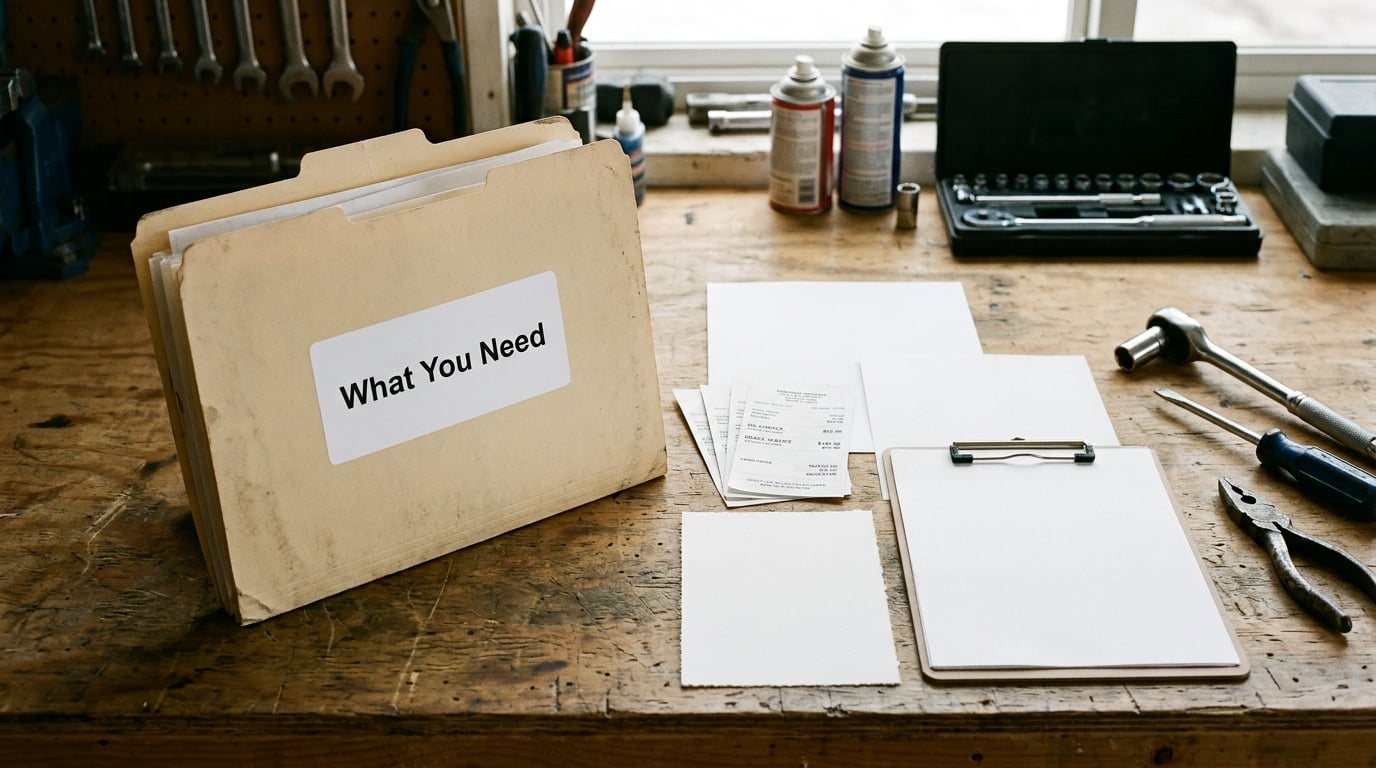
Gather these before you drive anywhere, because half of them are easier to request in writing than in person.
Documents to ask the seller for and review on your own screen: a clean title in the seller’s name, the bill of sale, the last two years of service records with itemised receipts, every recall and campaign letter for the VIN, a written mod list, and a vehicle history report you purchase yourself rather than one the seller sends.
Tools and gear for the walkaround: a phone with a flashlight, a tire tread depth gauge, a small inspection mirror, a pen magnet for lost hardware, a brake rotor measuring tool or a feeler gauge, an OBD-II scanner, a paint thickness gauge if you are checking for repainted panels, and clean rags. A jack and jack stands are helpful but not essential since most inspection happens with the car on a lift.
Information to confirm before the visit: the VIN on the listing, the odometer reading, whether the car is a daily driver or a weekend toy, whether it has been tracked or autocrossed, and whether it has been winter driven or salted. Enthusiast sellers will usually answer these plainly when asked in writing, and hesitation in the reply is itself useful information.
Budget preparation: decide the maximum you will pay before the visit, then set a second number for immediate work. Consumables on a performance car are not a rounding error. Tires, brake pads and rotors, fluids, and a set of spark plugs or a drive belt can land in the low thousands within the first year, and that reserve should exist before you commit to a car rather than after.
How to Buy a Used Enthusiast Car Without Getting Burned
The seven steps below run in order, and each one gates the next. Verify the car is what it claims to be and legal to own, read the records, inspect it cold, have somebody else inspect it, drive it properly, cost out the ownership, then talk money.
Step 1: Confirm the Car’s Identity and Legal History
Match the VIN yourself, in three places, before anything else happens. Read the VIN plate on the dashboard through the windscreen, read the stamped VIN on the driver’s door jamb, and compare both to the VIN on the title and on the bill of sale. A mismatch of a single character means the car is not the car in the paperwork, and you walk.
Then read the title itself rather than trusting the word clean. A title notation such as rebuilt, salvage, or flood means the insurance company wrote the car off at some point, and repairing it does not erase that note. Check that the name matches the seller’s government ID, that the VIN on the title matches the car, and that any lien listed has been released with the lender’s stamp or electronic release on file.
Run a vehicle history report on the VIN and read the mileage entries against the dash. A jump upward and then back down is a rollback. Also check that the number of registered owners matches the story the seller tells, and pull the recall and campaign records for the specific VIN. Open recalls on a car the previous owners ignored are a mechanic’s bill sitting on the driveway waiting for you.
Step 2: Review the Records Before You Inspect
Service records tell you what the owner paid attention to, and the gaps tell you more than the entries do. Look for the maintenance items that matter on a high-revving or heavily loaded car: the cooling system flushes, the belt or chain service at the manufacturer’s interval, the brake fluid changes, the transmission fluid changes on an automatic, and the valve adjustment on engines that need it.
Sort records into three piles. Documented work with itemised invoices is real. Work claimed but unsupported by a single invoice is a guess. Anything inside the maintenance interval with nothing at all is a line item for your budget, not a reason to reject the car outright.
Send your questions in writing and let the answers sit for a day. Ask what was repaired, not just what was serviced. Ask whether the car has ever been tracked, and if so, ask what safety equipment was fitted and whether the cage or hoop hardware was ever installed. Ask about accidents, about how many sets of tyres the car has needed, and about any work the owner considers a waste of money. Sellers who keep enthusiast forums in good standing tend to answer in detail, and that experience on the specific car is worth paying for.
Step 3: Inspect a Used Enthusiast Car from Cold
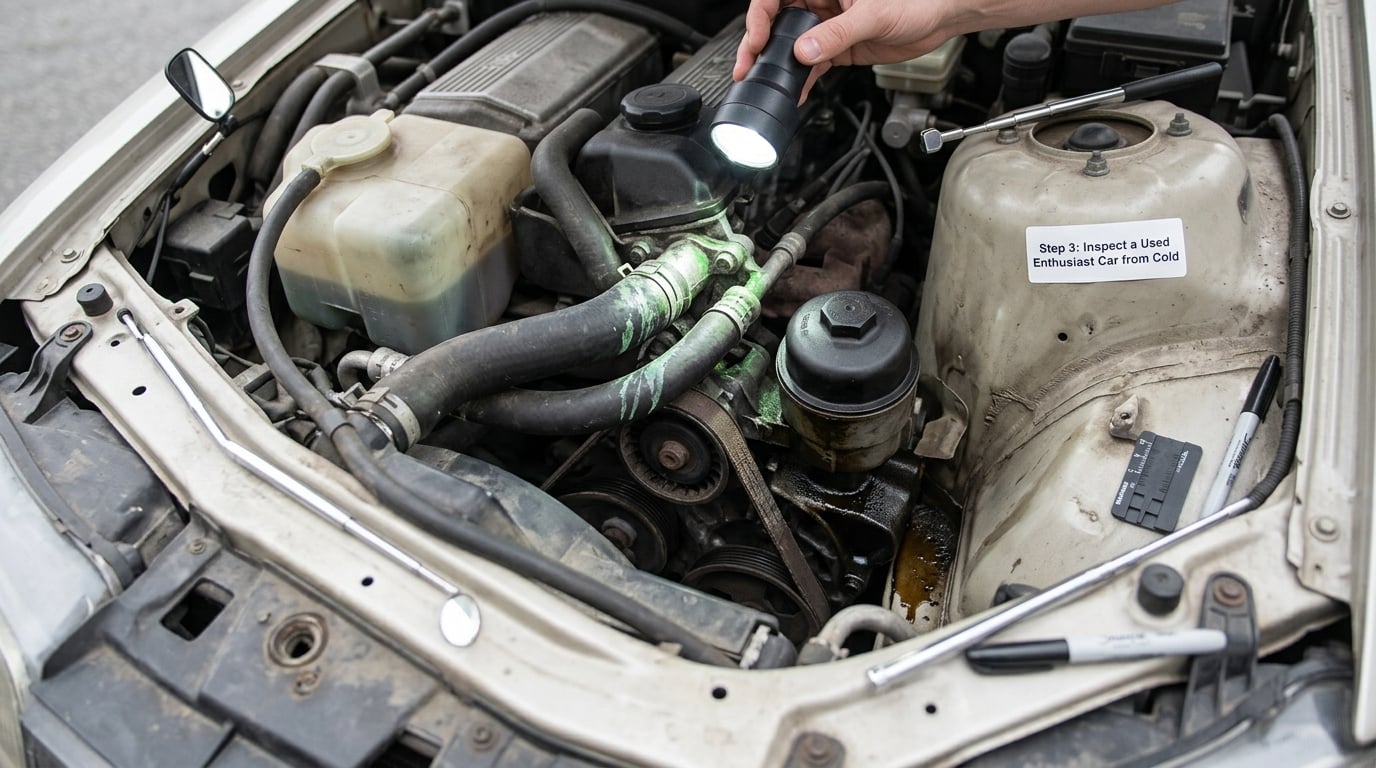
A cold engine bay shows you what a warm one hides. Ask the seller not to start the car before you arrive, and inspect the underside first while everything is still cool and quiet.
Start underneath. Put the phone light on the frame rails, the floor pans, the rocker panels, and the subframe mounting points. Rust is not evenly distributed on these cars, so check the specific places that fail: frame rails below the footwells, the areas around the rear subframe mounts, the trunk floor around the spare tyre well or battery tray, and the jack points. Run a magnet over the rails to spot fresh welds, then knock on metal and listen for a dull tone rather than a ring. A chassis repair that has not been done properly is the single most expensive thing you can buy by accident, and it regularly costs more than the car is worth.
Look for evidence of a collision next. Uneven panel gaps, paint that is thicker than the surrounding panels, a hood or door that does not line up, and mismatched fasteners all point the same way. Paint thickness readings vary across a single panel on an older car, so treat one reading as data and a pattern across four doors as evidence.
Check the cooling system and every fluid. Fresh coolant in an engine that should have aged, a pressure-test cap, or a plastic radiator tank stained green at the seams all point to previous overheating, and overheating warps cylinder heads. Look for oil seepage at the valve cover, the front of the crank, and the oil filter housing, and check the dipstick colour in the morning cold state. Scan for fault codes before the seller clears them, and look at the readiness monitors since a recent battery change can reset them.
Now the tires and brakes. Read the four-digit date codes on every tire and put the tires in a list sorted oldest to newest. A ten-year-old tire with decent tread is a safety problem and a near-term cost, and a car with four different brands of tire tells you the previous owners never ran a matched set. On the brakes, measure rotor thickness at the outer edge with a tool, compare inner to outer wear, and look for pad dust on the wheel faces. Uneven wear usually points to a sticking caliper or a worn suspension component rather than normal use. If the wheels come off, check the caliper slide pins and the boot condition, and be ready for a lug nut that fights you, which is its own fix job, and the tools for that are worth carrying.
Read the interior for how the car was lived in. Heavy wear on the driver’s seat bolster with a pristine passenger side means hard use, and a rubber steering wheel worn smooth on one side only means the same. Mismatched tire wear, dark spots on the wheels, and scrape marks on the subframe or driveshaft tunnel suggest the car was used hard, and that is not automatically disqualifying, but you should price it as a car that has already consumed a set of tires and pads.
Step 4: Get an Independent Pre-Purchase Inspection
Pay an independent shop or a mobile mechanic to inspect the car, and arrange it yourself rather than through the seller. Tell the shop the model, the year, and what you already know, and ask them to raise an oil pressure test, a cooling system pressure test, a compression and leak-down test, a scan of every module, and a check of the underbody on a lift. On manual cars ask them to check clutch bite and throw-out bearing play, and on older automatics ask for a fluid condition check.
Tell the shop to call you before they start destructive work and to tell you about anything they find that changes the price. A good inspection runs a few hundred dollars for a common enthusiast car, and it is the cheapest information you will ever buy. A shop that has never seen the model before is fine for a general check, but a model-specific shop will spot things a general one walks past.
Pay the bill whether you buy the car or not. You are buying a report, and the report is worth something even when you walk. It also removes the pressure to decide on the spot in the seller’s driveway.
Step 5: Test Drive for Driving Faults
Drive the car on a fixed route with a cold start and a full warm-up, because most faults show up only when the engine reaches operating temperature. A short hop around the block tells you almost nothing.
Work through the sequence deliberately. From cold, listen to the start: a slow crank, a rattle that stops at idle, or a tappet noise that fades once oil pressure comes up. Check the clutch bite point and the smoothness of engagement, or for an automatic, the shift quality and any shudder. Take the car to operating temperature and watch the temperature gauge and the coolant level in the recovery tank. Then drive at steady highway speed in one gear for ten minutes and listen for a driveline hum or differential whine that rises with speed.
Test the brakes under load with three firm stops from highway speed, then again from city speed. Pulsation, a soft pedal, or a pedal that sinks means a problem worth pricing. Afterwards, immediately check for hot spots at the wheels and dark spots on the ground. Watch the suspension through a series of sharp transitions for knocks and any looseness in the steering at low speed.
Stop and go home if you hit any of these: overheating, an oil pressure warning, a brake pedal that drops, a fuel smell, smoke from any pipe, a grinding or clunk on startup, or a noise that rises with engine speed. If the seller pressures you to keep driving through a warning light, that is information about the car too.
Step 6: Price the Repair Risk and Total Ownership Cost
Add up everything the car will need in the first twelve months, using the inspection report and your own findings as the source. Immediate repairs come from the defects you documented. Then add consumables: a full set of tires, pads and rotors front and rear, an engine service with filters and fluids, a brake fluid change, and any belt or plug interval the records do not cover.
On top of that, run the ownership costs a performance car actually carries. Insurance for a spirited driver on an older performance car costs more than the same coverage on a sedan, and it varies a lot by state and by use. Add registration and any inspection requirement in your state, plus fuel and the cost of a second set of tires if the car lives outside the winters you drive in.
Check the parts market before you commit. A car with a healthy enthusiast community has cheap parts, good documentation, and plenty of shops that know it, and that is worth real money at resale. A discontinued model with thin aftermarket support is a collection in the driveway. Also consider the tools and consumables the car assumes you already own, and any upgrade you know you will do within a year. Add the purchase price to the first-year total and compare it to your budget honestly.
Step 7: Negotiate From the Inspection Findings
Negotiate last, with a number and a reason, and never while standing in the seller’s driveway with your own money on the table. Build your offer from four inputs: the documented defects and their repair estimates, the missing records and the risk they imply, comparable listings for the same model in the same condition, and your first-year ownership cost.
Keep the repair estimates as a separate line rather than netting them against the price silently. A car that needs cooling system work, a set of tires, and a brake job is a car you will pay to own, and a seller who argues about the tires loses the argument about the bent radiator support. Also use the comparables, because a seller pricing against the cleanest example on the market rather than the average one is worth correcting with evidence.
Stay away from emotional bidding, and away from any attempt to win the seller over personally. Make your offer once, explain it in one sentence, and be willing to leave. Walk away without negotiation when the seller refuses the VIN verification, hides the title, blocks the lift, dismisses the independent inspection, pressures you for a deposit before you have seen the car, or will not state whether the car has been in an accident.
Follow forum accounts on this one. Owners consistently treat a missing inspection as worse than a known fault, because a known fault has a number attached and an uninspected car does not. Sellers who are genuine enthusiasts also consistently offer receipts and a mod list when asked in writing beforehand, so a refusal stands out.
Common Mistakes
Buying on looks or power output. A fresh respray and a nice exhaust hide a cooling system problem and a chassis repair. Fix: run the inspection order regardless of how the car presents, and let the report outrank the impression.
Skipping the independent inspection to save a few hundred dollars. The inspection is a small fraction of the repair risk it rules out. Fix: budget it as a cost of buying the car and schedule it yourself.
Treating a clean title as proof of clean history. A title only shows ownership and that no insurer branded the car. Fix: verify the VIN on the title, then run a history report and recall check on that VIN.
Ignoring tire age and brake condition. Old rubber and thin rotors are the two cheapest failures to prevent and the two most common reasons an otherwise good car goes into a shop. Fix: read every tire date code, measure rotor thickness, and put the replacement in your first-year budget.
Overlooking parts availability. Fix: check whether the model has active enthusiast forums, a healthy aftermarket, and shops that specialise in it before you commit, and price thin support into your long-term plan.
Paying a deposit before verification. Fix: no money moves until the VIN, the title, the records, and the inspection are all in hand, and any deposit is written as refundable pending inspection on a signed document.
Negotiating before knowing the repair risk. Without a report you are arguing about the wrong number. Fix: complete the inspection first, then open with the documented findings.
Budgeting only the purchase price. Fix: add a first-year reserve for tires, brakes, fluids, and the service intervals the records do not cover before you commit.
Confusing high mileage with neglect. A documented high-mileage car with a full service trail is a different proposition from a low-mileage car with gaps, and owners consistently treat the documented one as the safer enthusiast buy. Fix: read the record trail, not the odometer, and price the gaps explicitly.
Falling in love before inspecting. Emotion is the most expensive input in this purchase. Fix: decide your walk-away conditions in writing before the first viewing, and do not renegotiate them in the driveway.
Frequently Asked Questions
Do I really need a mechanic to inspect a used enthusiast car before I buy it?
For most cars, no. Your own cold-start check and road test catch worn tires, thin rotors, leaks, and obvious warning lights. On an older performance car, though, a leak-down test, an oil pressure test, and a lift inspection catch things a driveway cannot, and they are cheap next to the repair. Pay for one, and schedule it yourself rather than letting the seller pick the shop.
Which service records matter most on an old enthusiast car?
Cooling system work, the timing belt or chain service at the manufacturer’s interval, brake fluid changes, and oil services with invoices attached. Those four areas are where skipped maintenance turns into a head gasket, a belt failure, or a seized caliper. A trail of dated invoices matters more than a thick folder of unitemised statements, and consistent gaps are more informative than a single missing entry.
How do aftermarket modifications affect resale value?
Mods cut value in two ways: they narrow the buyer pool, and they raise the risk the next owner sees something you did not document. Common tasteful items like a catback exhaust or a short shifter usually cost a little value. Drilled rotors, a welded diff, or a cut and rewired harness cost more, and cheap safety hardware is the worst of all. Keep a written list and all receipts.
What do I do when a seller refuses a pre-purchase inspection?
Leave. There is no legitimate reason to refuse a lift or an independent shop once the seller knows who is performing the work. Sellers refuse for one of three reasons: the car is not what it was described as, the seller cannot afford the failures, or the seller knows the car has more miles than advertised. Any of those is a reason to stop, not a reason to raise your own offer.
How can I tell if a used car has been in a serious accident?
Start with the vehicle history report, then confirm on the car itself. Paint thickness readings that vary widely across one panel, mismatched panel gaps, overspray on adjacent trim, a trunk floor or firewall with fresh seam sealer, and a subframe or radiator support with newer paint than the body around it all point to structural work. Fresh welds found with a magnet on the frame rails are the clearest signal.
Start with the paperwork, because it costs you nothing and ends most bad purchases before they start. Pull the history report on the VIN, ask for the records and the mod list in writing, and see who answers. If the car survives the VIN, the title, and a cold inspection, the independent report is what tells you whether the price is fair. Getting the sequence right is most of what it takes to buy a used enthusiast car without getting burned.
If you are new to a platform, our guide to what DOT 5 brake fluid is used for explains why fluid age matters so much on a car that stops hard and often, and what a torque angle gauge is for shows how to check the fasteners you would have removed. If a wheel fights you on inspection, our walkthrough on removing a stripped lug nut without damage keeps the damage off the brake rotor.