
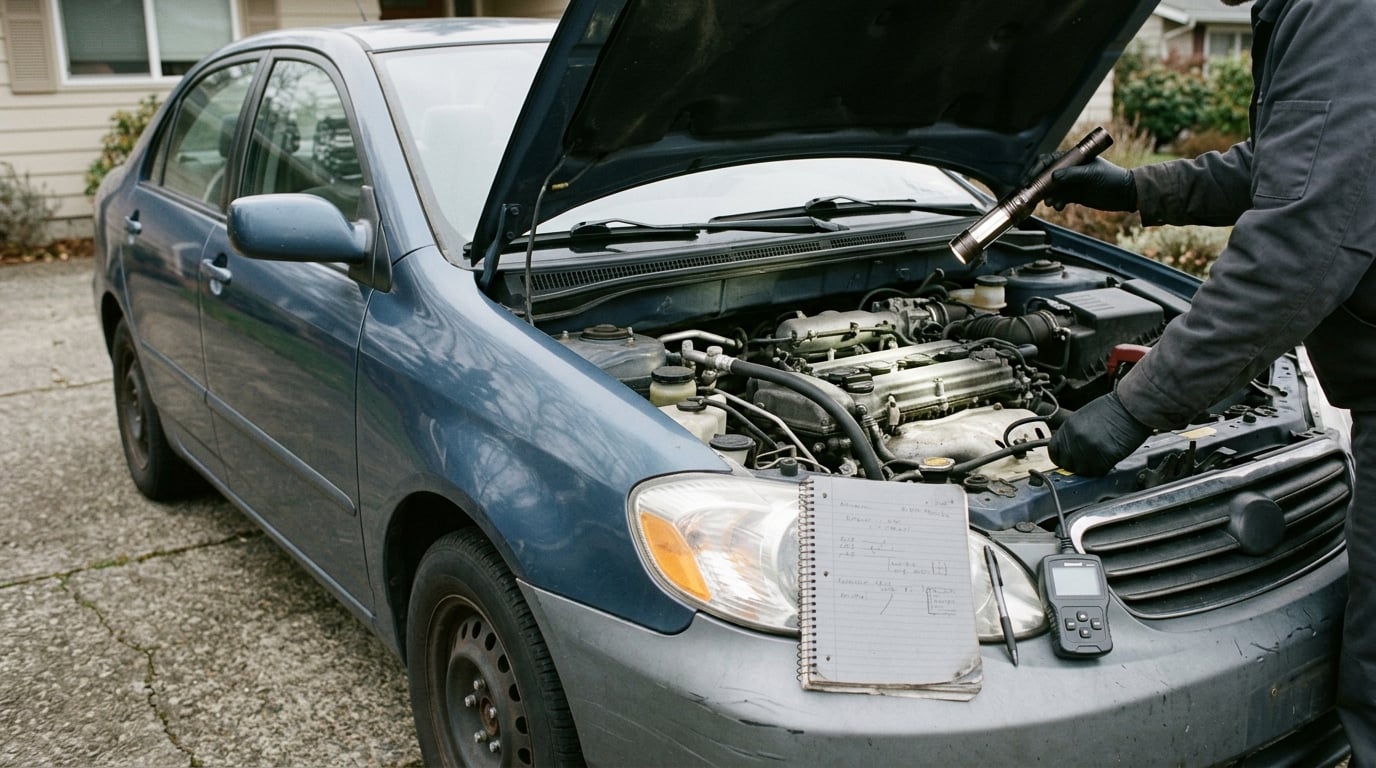
A used BMW deserves more than a 15-minute test drive around the block. This bmw pre purchase inspection checklist walks through the twelve checks that catch the most expensive problems, in the order you should do them: verify the VIN and records, walk the body, check the fluids BMW is known to leak, listen to a cold start, drive it properly, then re-scan for fault codes. Budget about an hour for the hands-on work and leave the diagnostic scan to a shop that can lift the car.
Why bother? Because a used BMW is a complex machine with a thin margin for hidden faults, and a buyer without BMW-specific experience cannot read condition off a five-minute drive. Inspection data compiled on used 4 Series cars found oil leaks in 50% of them, low coolant or cooling system issues in 33%, and tire condition problems in 27%. The same data set turned up recently cleared fault codes in 17% of cars, and a repainted or replaced panel in 73%.
The list below is meant to be usable on a phone in a parking lot. Work it in order, and you will know by the end whether you are looking at a car worth negotiating over or a car to politely decline.
Table of Contents
- BMW Pre Purchase Inspection Checklist at a Glance
- 1. Confirm the VIN, Mileage, and Vehicle Identity
- 2. Review the Service History and Recalls
- 3. Inspect Engine Bay Fluids and Components
- 4. Check the Oil Life and Engine Condition
- 5. Test the Brakes and Parking Brake
- 6. Inspect Tires, Wheels, and Suspension
- 7. Test Steering, Wheel Alignment, and Handling
- 8. Check Body, Glass, and Paint Condition
- 9. Test the Cooling and Climate Systems
- 10. Inspect the Interior, Electronics, and Controls
- 11. Complete a Road Test
- 12. Get an Independent Pre-Purchase Inspection
- Frequently Asked Questions
- How long should a BMW pre purchase inspection take?
- Do I need to lift the car during a BMW inspection?
- What BMW problems should make me walk away?
- Is it safe to buy an older BMW without a complete service history?
- Should I pay for a BMW dealership inspection before buying privately?
- Can I inspect a BMW myself before scheduling a mechanic?
- Conclusion: Inspect Before You Buy
BMW Pre Purchase Inspection Checklist at a Glance
The table below is the whole inspection on one page. Each row names what to examine, the warning signs that matter, and whether a finding should kill the deal or simply move the price.
| Step | What to examine | Key warning signs | Effect on the deal |
|---|---|---|---|
| 1. VIN and identity | Windshield VIN, door-jamb label, title, registration, dash and door-jamb mileage | Mismatched numbers, mileage lower than records, salvage or rebuilt title | Walk away |
| 2. Service history | Maintenance intervals, dealer stamps, oil and brake fluid records, open recalls, coverage | Cosmetic-only stamps, long gaps, no fluid services on a high-mileage car | Walk away or heavy discount |
| 3. Engine bay fluids | Oil level and color, coolant, brake fluid, belts, battery, air intake, visible leaks | Fresh residue, milky deposits, wet plugs, spotless bay on an old car | Negotiate or walk |
| 4. Oil life and engine condition | Dashboard service indicators, exhaust smoke at cold start, oil consumption record | Excessive white smoke, thick oil, warning light that returns quickly | Get a quote before signing |
| 5. Brakes and parking brake | Pedal feel, stopping straight, noise, pulsation, rotor and pad condition, fluid | Spongy pedal, pull to one side, grinding, thin rotors | Negotiate the full brake job |
| 6. Tires, wheels, suspension | Tread depth, DOT date codes, wear pattern, wheel damage, ride height, bushings | Feathered edges, cords showing, cracked bushings, uneven stance | Negotiate; walk if structural |
| 7. Steering and alignment | Wheel centering, free play, pull, clunks, body roll, rubbing | Steering wheel off-center, excessive play, constant small corrections | Negotiate an alignment |
| 8. Body, glass, paint | Panel gaps, paint depth, overspray, weld points, underbody, glass, drains | Blown panel, filler under paint, sanding marks, disturbed undercoating | Get a paint gauge reading |
| 9. Cooling and climate | Coolant level and condition, fans, heater output, air conditioning, defrost | Low coolant, residue on the cap, weak heat, fan never runs | Get a pressure test |
| 10. Interior and electronics | Seats and trim wear, odors, water intrusion, gauges, switches, iDrive, cameras, battery | Damp carpets, headliner sag, warning messages, dead buttons | Negotiate; watch for wiring work |
| 11. Road test | Cold start, idle, lock-to-lock steering, acceleration, braking, highway, warning lights | Rattle on start or shutdown, shudder, hot coolant gauge, overheat | Walk if it overheats or knocks |
| 12. Independent inspection | Full-module scan with printed report, lift on the lift, written findings | Seller refuses, shop cannot lift the car, no written report | Do not sign without it |
One clarification before you start: a BMW dealer pre-delivery-style inspection and an independent pre-purchase inspection are not the same product. A dealer PDI is a short condition check performed by the seller’s own staff on a car they are about to sell, and it covers the basics: exterior, interior, fluids, a short drive, tires. An independent PPI is a full diagnostic and mechanical inspection done by a shop with no stake in the sale, and it is the one that reads codes module by module and puts the car on a lift.
1. Confirm the VIN, Mileage, and Vehicle Identity
Start with the numbers, because everything else is worthless if the car is not what it claims to be. Read the VIN on the windshield, on the door-jamb label, on the title, and on the registration, then confirm all four match character for character. A single swapped digit usually means a different car, a different history, or worse.
Compare two odometer readings: the dash display and the sticker or stamp inside the driver’s door jamb. If the dash reads lower than the jamb label, assume it was rolled back. Pair the check with a vehicle history report for the VIN and read the title status line first, not the accident line, because salvage and rebuilt titles carry the most weight.
Look for a recall and campaign work history on the same report, and match the report’s mileage against the seller’s paperwork. A car whose paperwork says 92,000 miles and whose report says 71,000 has an identity problem no inspection can repair.
2. Review the Service History and Recalls
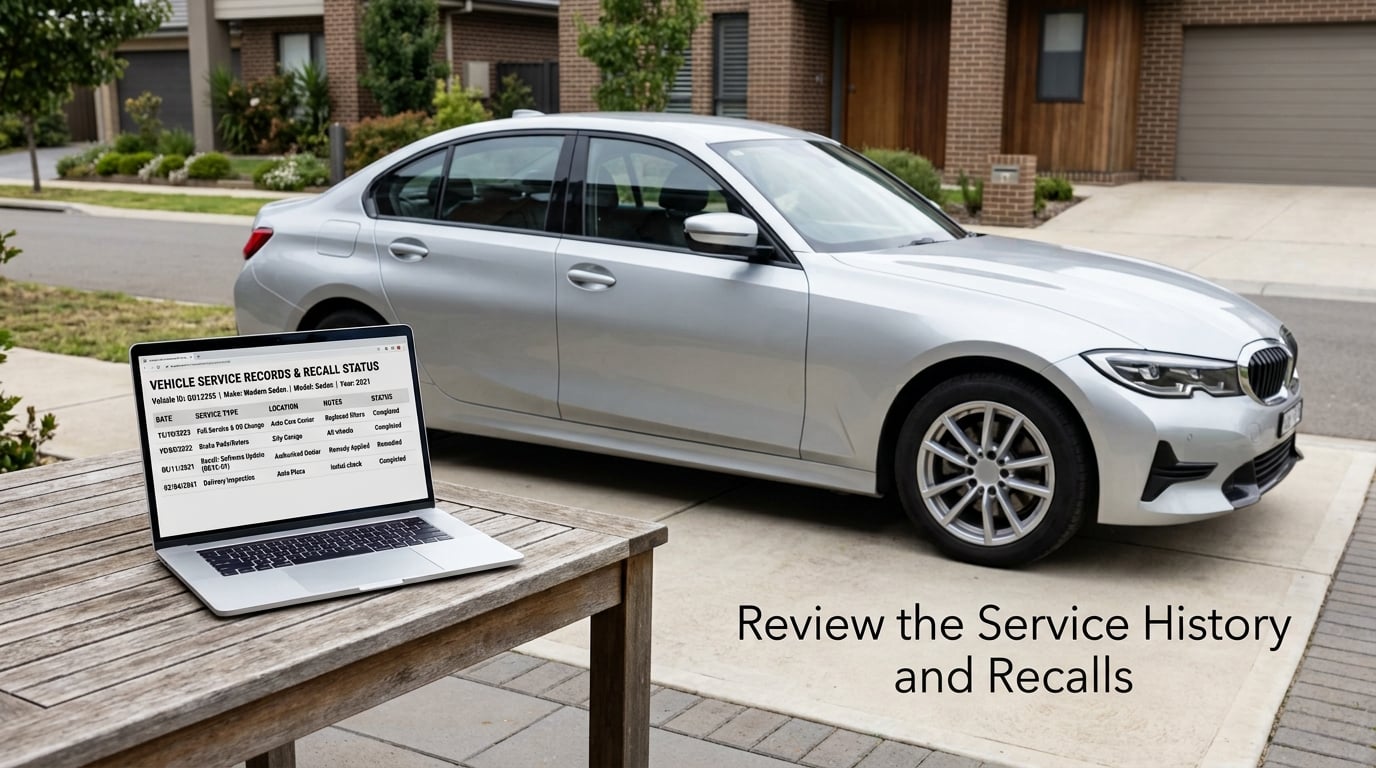
A complete BMW service history is the single most useful thing a seller can hand you, and the most commonly faked document in the used car market. BMW service is interval-based: oil roughly every 5,000 miles, brake fluid every two to three years, and cabin filter work in between. Cross-check the dates rather than reading the stamps and hoping.
How to verify the service history before the pre purchase inspection
Dealer stamps in the glovebox book are the real signal. Look for the same dealer name across consecutive services, matching mileage intervals of roughly 5,000 to 7,000 miles, and work that matches the car’s age. A book with tidy stamps every few months but no brake fluid service on a car past 60,000 miles is a presentation, not a record.
Then check the condition-based service indicators in the dash against the mileage. If the car reports overdue inspections that the paper history never mentions, the paper history is not complete. That gap is worth a phone call to the dealer named in the stamps, and many will confirm or deny service for a fee small enough to be worth paying.
What a dealer PDI adds, and what it does not
You can request a pre-delivery-style inspection from a BMW dealer even when you are not buying from them, and it is a useful cross-check on the paperwork. Ask specifically for the written report, the fault code list, and confirmation of whether the car was lifted. Dealers are also the only route to a model-specific recall or technical campaign check tied to your VIN, which is worth doing on older turbocharged and V8 cars.
Certified Pre-Owned badges carry a warranty, and that warranty is the part to read closely. Typical coverage focuses on the powertrain and factory defects, and commonly excludes wear items, tires, brakes, and anything caused by aftermarket work. CPO status is useful, but it is not a substitute for an independent look under the car.
3. Inspect Engine Bay Fluids and Components
BMW engines are commonly reported to leak from a short, specific list of places, and those are the spots to photograph. The oil filter housing gasket, the gasket where the oil filter sits inside the valve cover, and the plastic coolant fittings around the water pump and thermostat housing show up again and again in owner reports. Forum discussion on X3 buying advice and on bimmerpost threads keeps coming back to the same root cause: plastic housings and seals that weep under heat cycles.
Pull the oil dipstick, wipe it, read it, and put it back. Dark oil with a burnt smell is one story. Thick, milky, or fuel-diluted oil is a different story entirely. Note the level against the min and max marks and whether the engine sits level, because a low reading on a car that has been parked can hide a slow leak.
Read the coolant level in the expansion tank cold, then look at the cap and the tank neck for dried residue. Green crust around the cap or a level that drops between visits means the system is losing coolant, and the only way to find out why is a pressure test. Check the brake fluid color too: clear or amber is normal, brown or cloudy means it has aged past its service interval.
Look at the belts, the battery, and the air intake ducting for cracks, corrosion, or a clamp that has worked loose. Then add up what you see. A sparkling, freshly pressure-washed engine bay on an older car is itself a warning sign, as multiple owners have pointed out, because clean engines hide the residue that tells you where the oil went.
4. Check the Oil Life and Engine Condition
Dashboard service indicators tell you about time and distance, not condition. The oil life message calculates from factory intervals and driving pattern, and it knows nothing about how hard the car was driven or whether someone reset it at every oil change. Treat it as a clock, not a diagnosis.
Listen instead. A cold start is the most informative two minutes of the whole inspection, so ask the seller not to warm the car before you arrive. Listen for a rattle that appears at start-up and fades at idle, which owners on E90 forums frequently describe as a normal trait rather than a failure, and listen for anything that does not fade, which is not. Note any smoke from the exhaust: a brief white puff on cold start is normal on many BMWs, a steady cloud is not.
When a compression or leak-down test is justified
Pay for a compression test or a leak-down test when the engine runs rough, when the check engine light has a history, when the seller reports high oil use, or when the car sat for a long period. The numbers are less important than the pattern: even, comparable readings across all cylinders is the result you want, and one cylinder sitting well below the others sends you straight to a head or valve diagnosis.
On naturally aspirated engines, ask what the car has burned. On turbocharged and older V8 cars, ask whether it has been tuned. A BMW with a remap, an intake or exhaust change, or a downpipe is a different car from the one the warranty assumed, and the seller should say so without being asked.
5. Test the Brakes and Parking Brake
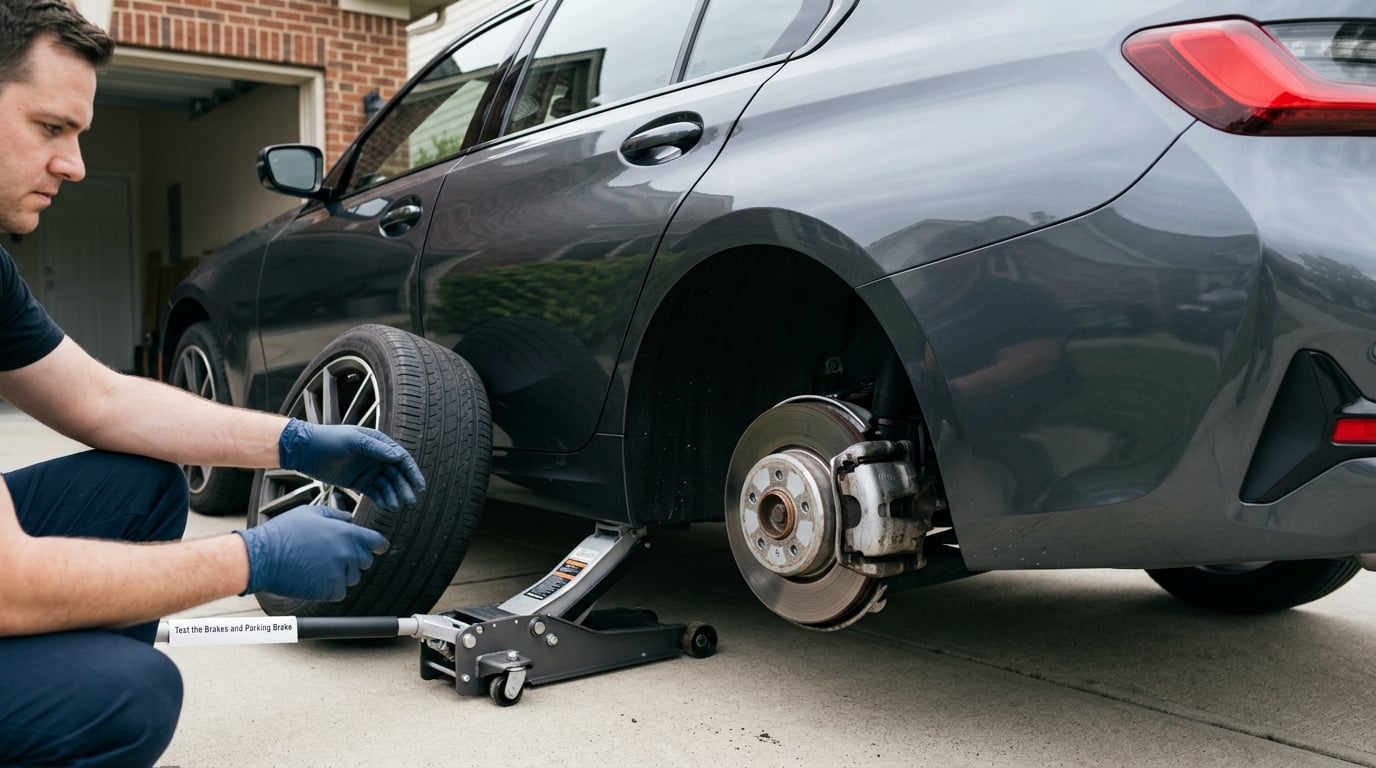
Brakes are the easiest system on the car to evaluate and the one most often ignored. Firm up braking from around 40 mph on a straight, level road: the pedal should stay solid under pressure and the car should track straight without pulling toward one side. A pedal that sinks toward the floor means air or moisture in the hydraulic system, and a pulse through the pedal means warped or thin rotors.
At low speed, listen. Grinding means pads are finished. A metallic squeal that shows up once per revolution usually means a surface rust or a stuck caliper, and a rhythmic clunk on braking can come from the parking brake cable or a caliper bolt. Any noise that changes when you turn the wheel points at the steering joints instead.
With the car safely supported, look at rotor thickness, pad material remaining, and whether the rotor is scored deeply rather than just lightly grooved. Outer pad wear faster than inner, or faster on one wheel than the other, points at a caliper that is sticking or a problem with the wheel bearing. Finally, set the parking brake on a mild slope and confirm the car holds and releases cleanly.
6. Inspect Tires, Wheels, and Suspension
Tires are the cheapest thing on the car to fix and the fastest way to reveal neglect. Read the DOT date code on the sidewall: a tire more than about six years old is past the point where the rubber should be trusted regardless of remaining tread. Check that all four tires and any spare are the same size, and never accept a mix of tire brands if you can help it.
Wear pattern tells the story. Feathering across the tread means the wheels need alignment. Heavy wear on the outer edge of one tire points at a worn shock absorber or a worn control arm bushing. Cupping in repeating blocks usually means a wheel imbalance, and uneven wear on one side of the car often traces back to a subframe problem on older models, a known concern among E90 owners who check the front subframe mounts closely.
Then check ride height at each corner with the car on level ground, look for tires rubbing the body liner while turning, and walk around the car pressing the bumper to load the suspension. Any clunk from that press deserves an explanation.
Air suspension and adaptive models
If the car has air struts, watch the compressor. It should not run continuously, and you should not hear it cycling for a few minutes after the car is parked. Check for a sagging corner that sits lower when the car is cold, and ask whether the struts or the compressor have ever been replaced. On adaptive M cars, make sure the active suspension electronics report no faults and that all four dampers behave consistently over a rough road.
7. Test Steering, Wheel Alignment, and Handling
With the car parked and the wheels straight, the steering wheel should sit centered. If the rim is visibly off-center while the front wheels point straight, alignment was corrected to compensate for a pull, and that pull is still there.
On the move, drive lock to lock in a quiet parking area and note any free play, slop, or grinding in the steering column. Turn the wheel slowly and feel for abrupt notches; on some models those notches come from active steering valves that can stick and leak. Check for a constant small correction on a straight road, clunks over expansion joints, or a car that leans hard into a turn, all signs that the front suspension or bushings are tired.
Pull to one side under braking is a different problem from pull under acceleration, and telling the two apart helps the shop. If a tire rubs at full lock, you have an alignment or steering issue rather than a brake fault.
8. Check Body, Glass, and Paint Condition
Stand in good light and look along each panel rather than straight at it. The goal is matching gaps: an uneven gap between the hood and fender, a door that sits proud, or a trunk lid with a different shadow line all point to bodywork. A paint thickness gauge reading of roughly 150 microns or more on a panel that should be near 100 tells you the panel has been resprayed, and you should ask why.
Check the window trim, bumpers, and plastic pieces for scratches around clip locations, and look for missing trim fasteners. Owners on bimmerpost forums treat these as a specific tell for trim that was removed to hide a fault, such as a charge pipe or a component behind the engine cover, so it is worth a careful pass with a flashlight.
On a lift, inspect the structural areas and the underbody coating. Uniform factory undercoating is even and continuous. Sanded, sprayed, or bare metal spots suggest a repair that was not documented. Check for weld points at the frame rails, and inspect the sunroof drain channels and the carpet edges for dampness or a musty smell, which is how water ingress usually announces itself.
If the car has been sitting for months, learn what long storage does to a car before you judge it, and use our how to store a car for six months checklist as a reference for what to look for in seals, fluids, and battery condition.
9. Test the Cooling and Climate Systems
Cooling faults are the second most common complaint in inspection data after oil leaks, so give the system real time. Turn the key to on, leave it there, and listen for the electric fan to come on within a couple of minutes. On many models the fan only runs with the air conditioning on, so switch that on too and confirm it spins and that you hear air moving at the vents.
Then drive with the heat on maximum and check that the air gets hot within a few minutes. Weak heat with a normal gauge points to a coolant flow problem, which is exactly the failure a pressure test is designed to find. Check the climate control display, both zones if the car has them, and the defroster vents, which often blow weakly when the evaporator is partially blocked.
Overheating signs during the road test end the inspection. Watch the coolant temperature gauge rather than the warning light, because the light comes late. If the car is stone cold and the gauge sits unusually high, or if the level drops during the drive, stop and have it pressure tested before you negotiate anything.
10. Inspect the Interior, Electronics, and Controls
Interior condition is the cheapest way to guess the car’s history. Look at the driver’s seat bolster and the outer edge of the seat base for wear that a careful owner would have expected to be visible. Check the headliner for sagging around the sunroof, which is a water trail more often than a wear issue, and look under the rugs and the trunk liner for dampness or a musty smell.
Work every switch: windows, locks, mirrors, seats, sunroof, lights, hazards, and the horn. A dead window regulator or a failed door switch is cheap, but a scan tool showing a short in a seat or door circuit suggests someone has already been inside the wiring, and that becomes a bigger conversation.
Cycle through the menus, test the iDrive screen and controls, and confirm that any camera feed appears promptly and clearly. Check every stored service entry against the paperwork you were given, because a wiped condition or maintenance history tells you the previous owner was managing something. Finally, confirm the battery age label, test that the charging system holds voltage with the engine off and climbs with the engine running, and count any warning messages still sitting in the display.
11. Complete a Road Test
Drive for 20 to 30 minutes if you can, and vary the conditions. Start with a cold idle, then reverse and check the camera. Run lock-to-lock steering in a parking lot, ease into speed to feel the transmission, accelerate hard to wide-open throttle once from about 30 mph, and do one firm stop from around 40 mph to feel the pedal. Then get on a road with a speed limit near 60 mph and hold it for several minutes.
The highway leg is where heat problems show up. Watch the coolant gauge, listen for new noises at steady speed, and note any vibration that appears and disappears with speed. On a six-speed manual, listen for a grind on slow downshifts, a noisy throw, and clutch slip. On the 8HP automatic, listen for a shudder on hard acceleration and pauses between gears; either one means the mechatronic unit or clutches deserve a look before you buy.
Straight-line stability matters too. A car that wanders, needs constant small inputs, or drifts toward one side on a level road is telling you about alignment, bushings, or in severe cases a bent suspension part from an unreported impact. At the end of the drive, park it, and let the car sit for a few minutes so the full temperature cycle is complete before the shop scans it.
12. Get an Independent Pre-Purchase Inspection
Book an independent BMW-capable shop for anything you are not certain about, and treat that shop as the last step in this checklist rather than the first. A state safety inspection is a snapshot of a handful of items and does not approach a pre-purchase inspection. What you want is a technician who can lift the car, read every module, run a cooling pressure test, and put brakes, tires, and bushings on paper.
Give the shop permission in writing to raise the car on a lift and to charge nothing beyond the inspection fee unless you call first. Ask for a printed report that separates safety items now, maintenance items now, and maintenance items later, and ask for photos of anything the technician judges to be a deal-breaker. If a shop will not lift the car, or hands you a verbal summary with nothing in writing, keep shopping.
On cost, there is no single national number. Fees vary by region, by how complex the car is, and by whether a mobile inspector comes to the seller or you drive to the shop, so ask each one for a flat figure up front. Owners on r/BMW are near-universal on the value side of this, describing a full independent inspection as worth every penny, and they treat a dealer’s recommended shop as a conflict of interest rather than a shortcut. Ask the seller for permission before you book, because a refusal to allow an independent inspection is itself an answer.
Private-party sellers are usually more flexible about this than dealers, and a reasonable seller will let the car go to a shop. Sellers who push to close the deal before an inspection, or who offer a partial refund instead, are telling you what they would rather you did not find.
Frequently Asked Questions
How long should a BMW pre purchase inspection take?
Allow one hour for the hands-on portion and two to three for a full independent shop inspection, which includes lifting the car, a module-by-module scan, a cooling pressure test, and a written report. A dealer pre-delivery-style inspection is much shorter, usually 30 to 60 minutes, and covers a lighter checklist. Book the independent inspection when the car is cold, so you can see the cold start and any overnight leaks.
Do I need to lift the car during a BMW inspection?
You should, and that is the single biggest difference between a real inspection and a state safety check. Lifting the car lets the technician inspect the subframe, control arm bushings, exhaust, underbody coating, and the underside of the engine bay where BMW oil leaks collect. Ask the shop in advance for permission to put your car on the lift, and confirm it appears on the written report.
What BMW problems should make me walk away?
Walk away from salvage or rebuilt title evidence, structural or frame damage, a cooling system that is already losing coolant, heavy rather than light oil seepage, active or recently cleared fault codes from a full scan, and signs of undisclosed track use on an M car. Forum consensus is clear that a failing cooling system is a walk rather than a negotiation, because the repair grows quickly once the engine is involved.
Is it safe to buy an older BMW without a complete service history?
It is possible, but it changes the price and the risk you accept. Without records you should assume the deferred maintenance is all still outstanding, budget for brake fluid, coolant, and a full service immediately, and lean much harder on the independent inspection. A high-mileage car with clean, verifiable dealer records is usually a better bet than a lower-mileage car with a cosmetically assembled history.
Should I pay for a BMW dealership inspection before buying privately?
It can be useful as a second opinion, especially for a model-specific recall and technical campaign check tied to the VIN. A dealer inspection is performed by the seller’s side, covers a lighter checklist, and usually does not include a full module scan or written findings list. Use it to cross-check records, not as a replacement for an independent shop doing the real work.
Can I inspect a BMW myself before scheduling a mechanic?
Yes, and you should, because the stationary checks catch the obvious problems before you spend anything. The walk-around, the fluid inspection, the cold start, the electronics test, and the road test need no tools beyond a flashlight, a tire gauge, and a phone. What you cannot do yourself is read codes module by module, raise the car, or pressure test the cooling system, which is exactly where a shop earns its fee.
Conclusion: Inspect Before You Buy
Start with identity and records. Match the VIN across the windshield, door jamb, and title, then read the service history closely enough to spot a gap. From there, do the walk-around in good light, check the fluids and the engine bay cold, listen to the start, and take a proper road test that includes a firm stop and a sustained highway stretch.
Then book the independent inspection and make your decision on the written report. A bmw pre purchase inspection checklist is only worth the time you put into it, and the sequence that catches the most problems is the simple one: verify, walk, drive, scan, then decide.