

To read a used car maintenance history, work through it chronologically: confirm every document carries the same 17-digit VIN as the car in front of you, line the records up in date order, and check that the odometer reading on each one is higher than the last. Then compare the work listed against the manufacturer’s maintenance schedule, chase down any gaps, and verify the biggest claims with the shop that supposedly did the work. It takes about 30 minutes with a folder and a spreadsheet, and it is the cheapest inspection you will ever buy.
The reason this matters is simple. A vehicle history report only captures work that got reported, and plenty of maintenance never gets reported. A car with a spotless report may simply have never been to a franchise dealer. A car with a thin paper trail may have been maintained carefully by someone who kept receipts in a glovebox. The records tell you a story; your job is to read it and know which parts are missing.
Here is what the research on this topic turns up again and again: owners on r/whatcarshouldIbuy consistently say that full dealer records with the VIN on every invoice meaningfully change their willingness to buy, sometimes accepting higher mileage for the documentation. Buyers on r/UsedCars report that franchise dealer work shows up in CARFAX while independent shop and quick-lube work does not. Both groups draw the same conclusion. A clean report often means no dealer visits, not no maintenance.
Table of Contents
- What You Need
- How to Read a Used Car Maintenance History Step by Step
- Confirm the Records Match the Exact Vehicle
- Build a Simple Maintenance Timeline
- Check Whether Required Service Intervals Appear
- Look for Gaps, Duplicates, and Impossible Entries
- Match the Paperwork to a Second Mileage Source
- Verify Major Repairs and Maintenance Claims
- Turn the Records Into Purchase Questions
- Common Mistakes
- Frequently Asked Questions
- What if a used car has no maintenance records?
- How far apart should maintenance records be?
- Does a dealer service history mean the car was well maintained?
- Why do the mileage numbers in maintenance records matter?
- Should I trust an online vehicle history report by itself?
- When should I walk away from a used car because of missing records?
- Conclusion
What You Need
Gather this before you read a single line of the file. Most people start with the report and end up reverse-engineering what they should have collected first.
- The vehicle identifiers. The 17-digit VIN from the dash, the door jamb sticker and the title. Write all of them down and make sure they match each other.
- A vehicle history report. CARFAX and AutoCheck are the two big reporting networks. A dealership will usually run one, but for a private-party sale you are the one paying for it.
- Every paper record the seller has. Dealer invoices, quick-lube receipts, state inspection certificates, tire and brake invoices, owner notebooks, warranty claim paperwork, and any recall completion notices.
- The manufacturer’s maintenance schedule for that exact model year and engine. Without it you cannot tell whether a record set is actually complete.
- A second mileage source. The current odometer reading, the door-jamb mileage sticker, and any inspection or emissions records you can pull for the car.
- A spreadsheet or notebook. Columns for date, mileage, service performed, provider, and supporting evidence. Paper is fine, but be consistent.
- A phone. Several steps below involve calling the service department named on an invoice. If you would rather handle basic upkeep yourself later, our guide to what tools you need for basic car maintenance covers the starter set.
How to Read a Used Car Maintenance History Step by Step
Seven steps, in this order. Skipping ahead to the conclusion before confirming the VIN is how buyers end up analyzing paperwork that belongs to a different car.
Confirm the Records Match the Exact Vehicle
Start by proving the records belong to the car you are buying. Read the VIN off the dashboard plate, off the driver’s door jamb sticker, and off the title, then compare each one against every invoice and report in the file, character by character.
They should be identical every time. A mismatch is not a typo to shrug off. It means a document was pulled from another car’s file, a sticker was swapped, or something was reprinted.
Also compare the year, make, model and trim on the paperwork with the car itself. A 2019 invoice for a trim level that did not exist that year, or a service record for a diesel engine in a gasoline car, tells you the file is assembled rather than genuine. Pay attention to the mileage too: the number on the oldest document should be lower than the number on the newest one, and both should sit near the current reading.
Build a Simple Maintenance Timeline
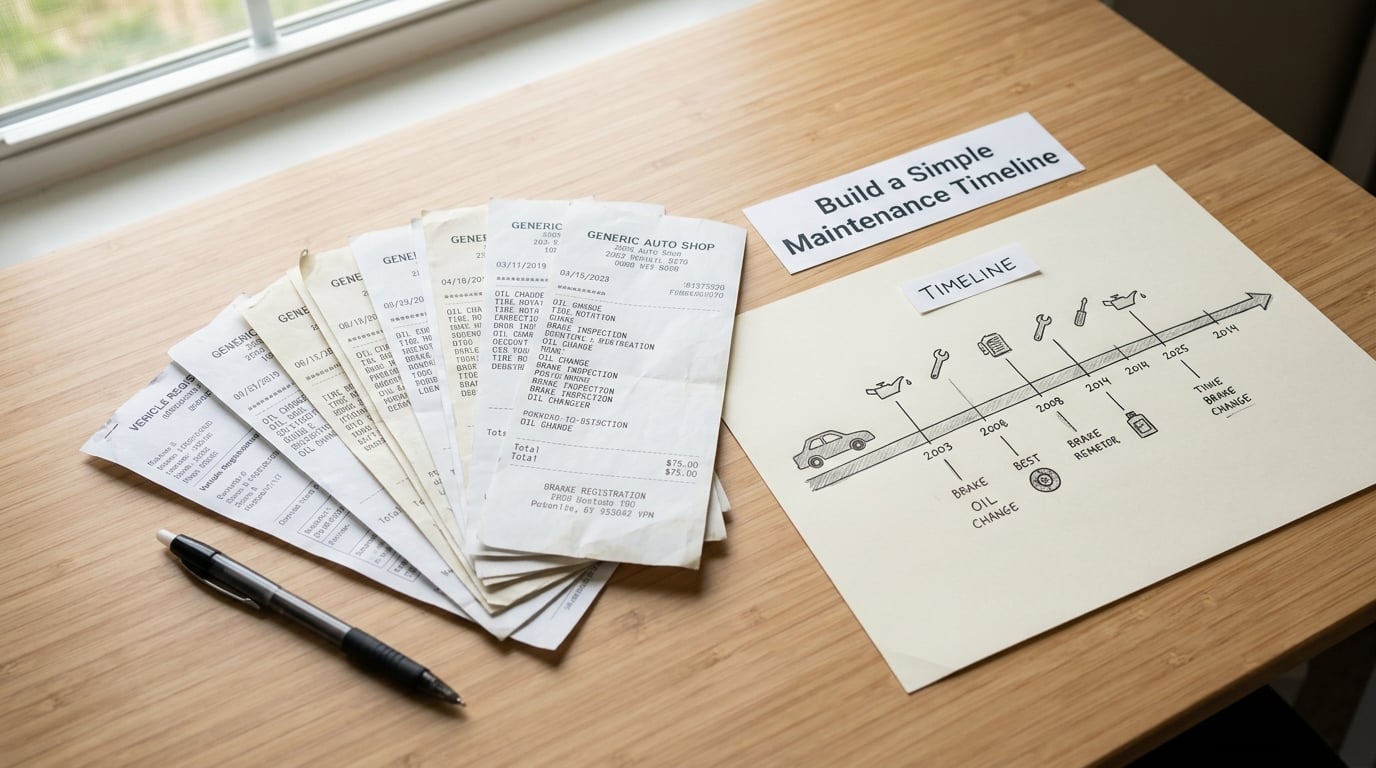
Put the records in date order. Not the order they appear in the report, not the order the seller stacked them in the folder. Actual chronological order, oldest first.
A spreadsheet with five columns is all you need: date, odometer reading, service performed, provider, and whether supporting evidence exists. That last column is the one people skip and the one that matters most. An entry marked dealer invoice is evidence. An entry that exists only as a line in a report is a claim.
Once it is laid out, the shape of the car’s life becomes obvious at a glance. Ownership changes, moves across states, long stretches of nothing. You cannot see any of that in a stack of un-sorted receipts.
Check Whether Required Service Intervals Appear
Now compare the timeline against the manufacturer’s maintenance schedule for that model year. Look for the recurring items: oil and filter changes, tire rotations, brake inspections, fluid checks and flushes, air and cabin filters, spark plugs on the schedule, transmission service on models that call for it, and any inspection your state requires.
Do not demand exact dates. Schedules are usually written in miles, months, or both, and a car driven a little short of an interval between two services is not a problem. What you are looking for is whether the big-ticket and wear items appear at roughly the right mileage and never vanish for years at a time.
Two things deserve extra scrutiny. First, a car with one owner and a full folder may have been maintained on a severe service schedule, which many manufacturers specify for towing, heavy load, extended idling or repeated short trips. Second, an oil record that lists a viscosity but not a specification tells you very little; if you want to know what the oil label actually means, how to read oil bottle labels and certifications covers the parts that matter.
Look for Gaps, Duplicates, and Impossible Entries
Read down the timeline looking for things that should not be there. This is where the file usually tells on itself.
| What you see | What it usually means | How serious |
|---|---|---|
| A multi-year stretch with no records | Owner changed, records stayed behind, or the car was neglected. Sometimes the previous shop was a franchise that does not report. | High if it covers the first years; medium if it is recent and the car is otherwise sound |
| Mileage on one document lower than the previous one | Odometer rollback, a typo, or a document from another vehicle | Very high. Stop and resolve it before anything else |
| Three oil changes in the same month | Duplicate entries, one service counted several times, or restamped stickers | Medium to high, depending on what else looks off |
| Services that repeat at implausibly short intervals | Entries filled in afterward rather than recorded at the time, sometimes to pad the file | High |
| Every entry is an oil change and nothing else | Not necessarily neglect, but brakes, tires, battery and cooling work should appear somewhere on an older car | Medium |
| Vague descriptions such as maintenance or service | No parts list, no mileage detail, nothing to verify | Low on its own, worse in a long file of vague entries |
| Entries in different ink, different printers, different fonts | Scans from a shared folder, or photocopies of copies losing detail | Medium. Old photocopies are common, so weigh the rest of the file |
Forum buyers treat an unexplained multi-year gap as a genuine deal breaker, and they treat a file containing nothing but oil changes the same way. A report that only ever shows quick-lube visits is telling you the owner never went to a dealer, which is a habit, not a verdict.
Match the Paperwork to a Second Mileage Source
Read the current odometer, then check the door-jamb sticker, then pull whatever state inspection or emissions records you can for the car. Those are three independent readings of the same number.
No single source is definitive on its own. The door-jamb sticker is a snapshot from an unknown date, and inspection records reflect what a reader saw at the time. But disagreement between sources is a signal. If the report shows 96,000 miles and the car has 121,000 on the cluster, somebody is lying or misreading something, and both readings need to be explained.
Physical wear is the fourth check. A driver seat with a worn outer edge and a shiny steering wheel rim suggests real highway miles. Light pedal wear on a supposedly low-mileage city car can mean a different story, because short trips wear different parts.
That distinction matters more than buyers expect. Low annual mileage is ambiguous rather than reassuring, and forum regulars argue about this constantly. Short-trip city driving never reaches operating temperature, so an engine with 40,000 mostly-town miles can be harder on its oil and cooling system than one with 90,000 highway miles.
Verify Major Repairs and Maintenance Claims
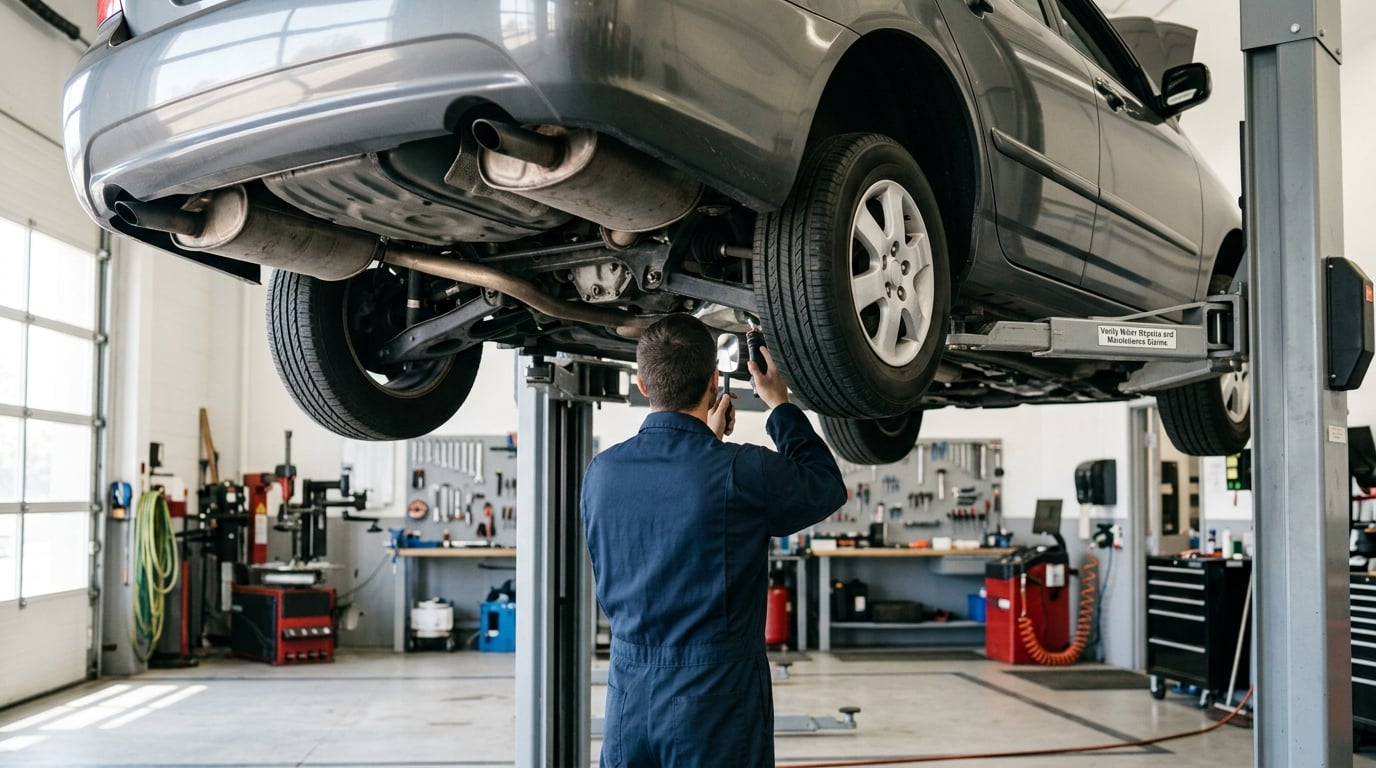
Pick the three most expensive claims in the file and verify them. Brake and suspension work, cooling system work, transmission service, battery replacement, tires, and collision or body repair are the ones worth the effort.
Call the service department named on the invoice. Give them the date, the last four of the VIN and the odometer reading, and ask whether the vehicle came in for that work and roughly what the invoice covered. Shops are not obliged to share another person’s records without permission, so expect a yes or a no. A no is informative.
Ask the seller for itemized invoices rather than the summary receipt. Itemized invoices list parts, labor hours, fluid types and the specific complaint that brought the car in. A summary line reading brakes, serviced is a marketing document.
Watch your own hands here. Checking a brake rotor for thickness, looking at tire tread wear across all four, and reading fluid levels are inspection tasks. Jacking the car, removing a wheel, or working around airbags, cooling systems under pressure, or high-voltage hybrid components are not. If a records question leads you toward pulling a suspension component apart, book a licensed shop or an independent inspector instead. Our torque spec chart guide covers why fasteners matter once a wheel comes off.
Turn the Records Into Purchase Questions
Every unresolved item becomes a specific question, not a vague feeling. Vague feelings get ignored; specific questions get answers.
Instead of asking whether the car has been well maintained, ask what the mileage was at the last oil change, or whether the dealer that performed the transmission service can confirm it, or why there is nothing documented between a given date and a given mileage. Write the questions down during the test drive and go back to them with the car on cold ground, which is when most sellers are more forthcoming.
Then decide. A missing inspection with a plausible explanation is one thing. A mileage that cannot be reconciled, a file that cannot be verified with a single shop, or a seller who refuses an independent inspection is a different thing. Sellers who allow a pre-purchase inspection are telling you something too, and it is worth more than a folder of receipts.
Common Mistakes
Treating a full-service history as proof of good care. A thick folder tells you the car was in a shop, not that the right work was done at the right time. Fix: read the line items. If everything says oil change and nothing mentions brakes or tires, the file is thin regardless of its size.
Accepting a report without checking the VIN. A report for the right car is the foundation of everything else, and it takes ten seconds to verify. Fix: read the VIN off the dash, off the jamb sticker and off every document before you read a single service entry.
Ignoring the small records. State inspection certificates and tire invoices are easy to overlook because they look unimportant. They are also independent, dated and hard to fake. Fix: put them in the timeline like any other entry.
Reading a rolled-over odometer as low mileage. A cluster showing 99999 and a fresh tire receipt does not mean the car is young. Fix: cross-check the door jamb and state records, and treat any unexplained discrepancy as disqualifying until it is resolved.
Relying on digital records alone. A report shows what was reported. Quick-lube visits, independent shops, and owner-performed work routinely never reach the reporting network, and buyers on r/UsedCars say this all the time. Fix: ask for the paper file, the service book, and the inspection certificates in addition to the report.
Skipping the independent inspection. Records describe work someone says they did. They do not tell you the car is dry at the firewall or that the transmission shifts oddly when warm. Fix: commission a pre-purchase inspection before you commit, not after.
One last tip. Read the file the night before, not in the parking lot. A record you have had time to sit with tends to raise a question you would otherwise skip, and the seller notices the difference.
Frequently Asked Questions
What if a used car has no maintenance records?
No records usually means one of three things: the car was maintained well by an owner who did not keep paperwork, the work was done at a shop that does not report, or the car was genuinely neglected. You cannot tell which from the file alone. Look at physical evidence instead, including tire tread, brake hardware, fluid condition, pedal wear and the underside, and treat the absence of records as a pricing factor and a reason to inspect more carefully, not an automatic rejection.
How far apart should maintenance records be?
Close enough that the odometer readings progress logically and cover the life of the car. Most cars should show oil changes every few thousand miles to roughly ten thousand, depending on the engine and the schedule. A one-year gap is common and often harmless. A multi-year gap with no explanation, or an entry where the mileage does not advance at all, deserves a question.
Does a dealer service history mean the car was well maintained?
It is the most verifiable kind of history you can get, because franchise work is itemized, dated, tied to a VIN and usually reported to the history network. It is still not a mechanical inspection. Dealers service the cars they sell, but a well-documented car can still need work, and a car with no dealer visits may have been maintained privately and more carefully. Read the line items and then inspect.
Why do the mileage numbers in maintenance records matter?
Because they are the only consistency check in the file. Each record carries an odometer reading, so a sorted timeline should show mileage rising steadily from the oldest document to the newest. Any reading that goes backwards, stalls for years, or contradicts the cluster and the door-jamb sticker points to a rollback, a mismatched document, or a problem worth walking away from.
Should I trust an online vehicle history report by itself?
No. A report is a starting point. It shows reported accidents, ownership counts, title events, odometer readings and dealer service, but it misses quick-lube visits, independent shop work, owner-performed maintenance and often any record from a non-franchise business. Use it to check for red flags and mileage consistency, then back it up with the paper records and an independent pre-purchase inspection.
When should I walk away from a used car because of missing records?
Walk away when the gaps hide the expensive items rather than the cheap ones. A missing oil change is a small concern. Missing brake, cooling, transmission or collision history across several years is not. Also walk when mileage cannot be reconciled between sources, when the seller refuses to let you verify with a shop or have the car inspected, or when a salvage or rebuilt title appears on the report regardless of how good the maintenance file looks.
Conclusion
Reading a used car maintenance history comes down to four things in order: confirm the VIN, collect every record you can get, sort them into a timeline with the mileage, and investigate the gaps before you commit to anything. A clean file is nice. A file that is verifiably clean is what actually protects you.
So start with the VIN. Write it down, compare it to the dash and the door jamb, then ask for the paper file, the inspection certificates and the shop you would want to call. If any of that comes back thin, price it in or walk. The records are not the whole inspection, but they tell you whether the inspection is likely to turn up anything you would not want to pay for.