
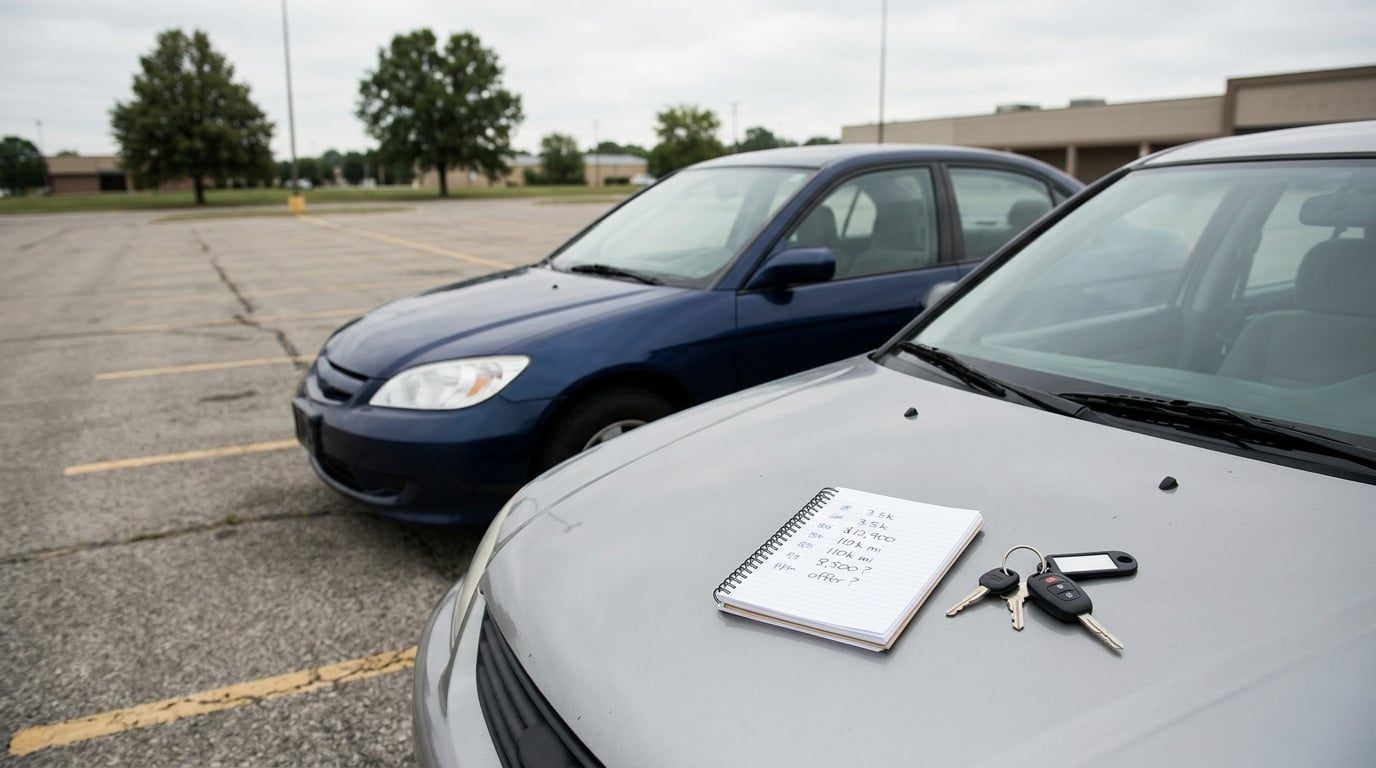
Most buyers can take 3 to 8 percent off a clean, market-priced used car, and considerably more when the vehicle has accident history or documented repair needs. The number that matters is the out-the-door price, the total with every fee, tax, and charge already added, not the figure painted on the window. This guide walks through how to negotiate a used car price in seven steps, with the exact words to say at each one.
Used cars feel different from new ones, so buyers either freeze up or swing too hard. New-car folklore says offer 10 percent off sticker and the sale manager shrugs; used-car folklore says the price is the price, and you should just accept it. Both are wrong. There is no magic percentage, and the room moves with the car’s condition, the seller’s inventory, and the evidence you bring to the table.
Here is the short version:
- Know the number before you go. Research comparable cars, pull the vehicle history report, and get financing arranged so none of it becomes a negotiation later.
- Pay for the inspection yourself. An independent pre-purchase inspection turns hunches into a written estimate with prices attached.
- Settle the vehicle price first, in isolation. Trade-in, financing, and add-ons all come afterward, one at a time.
- Convert the deal to one out-the-door number. If it is not written on a buyer’s order, it does not exist.
- Be genuinely willing to leave. A walk-away point is the only leverage that costs you nothing to hold.
Table of Contents
- What You Need to Negotiate a Used Car Price
- Step-by-Step: Negotiating a Used Car Price
- Common Mistakes When Negotiating a Used Car Price
- Frequently Asked Questions
- Can I negotiate the price when financing through the dealer?
- How low should I make my first used-car offer?
- Should I negotiate before or after a pre-purchase inspection?
- Can my trade-in lower the price of the car I am buying?
- Is it reasonable to ask a dealer to reduce the price after an inspection?
- Should I give a deposit to lock in a used-car price?
- Conclusion: Make Your Next Move With Confidence
What You Need to Negotiate a Used Car Price
Negotiation is a preparation problem, not a personality problem. Almost every weak offer I have seen started with a buyer who had not done the homework, and almost every strong one started with a buyer who knew the number before the salesperson finished the greeting.
Bring these five things to the conversation:
- A walk-away price you wrote down. One number, on paper, including taxes, title, registration, and the work the car will need in the next year.
- Comparable listings. The same year, trim, mileage range, and options from Kelly Blue Book, Edmunds, CarGurus, Autotrader, and Cars.com. Three to five real listings beat a single guide value, and local listings beat national ones.
- A vehicle history report pulled from the VIN through Carfax, AutoCheck, or an approved NMVTIS source. Look for accident entries, service gaps, title problems, and odometer flags.
- An inspection booking. The name and number of an independent shop, and a plan for a mobile inspection if the seller will not drive the car to it.
- Financing, already arranged. A credit approval from your bank or credit union takes an afternoon and turns a soft question into a fact.
Two smaller items matter more than people expect. A pocket-sized notebook for writing down every number the seller says, because verbal numbers drift. And a rough idea of what you will do with the car in the garage, since a set of new tires or a service interval changes what a fair price looks like. If you plan to work on the vehicle yourself, our guide to what a torque angle gauge is used for explains one tool that comes up on nearly any brake or suspension job.
Step-by-Step: Negotiating a Used Car Price
1. Set Your Maximum Price Before You Negotiate
Split your budget into two numbers before you start. The first is the maximum purchase price for the car itself. The second is the all-in number, which adds sales tax, title and registration, insurance, and the maintenance you can expect in the first 12 months.
Buyers who get into trouble conflate these. They agree to a satisfying out-the-door figure and then discover the tax and fees add four or five percent on top of what they planned to spend. Negotiate the first number, but make your real limit the second.
Include a fluids-and-filters line in that maintenance budget, along with anything the inspection turns up later. If you will be doing work on the car, our piece on how to dispose of used motor oil covers doing it properly so the job stays cheap and legal.
Then write the walk-away price down and put it somewhere you cannot edit mid-conversation. A number on paper is the difference between a decision and a mood.
2. Research the Car’s Real Market Value
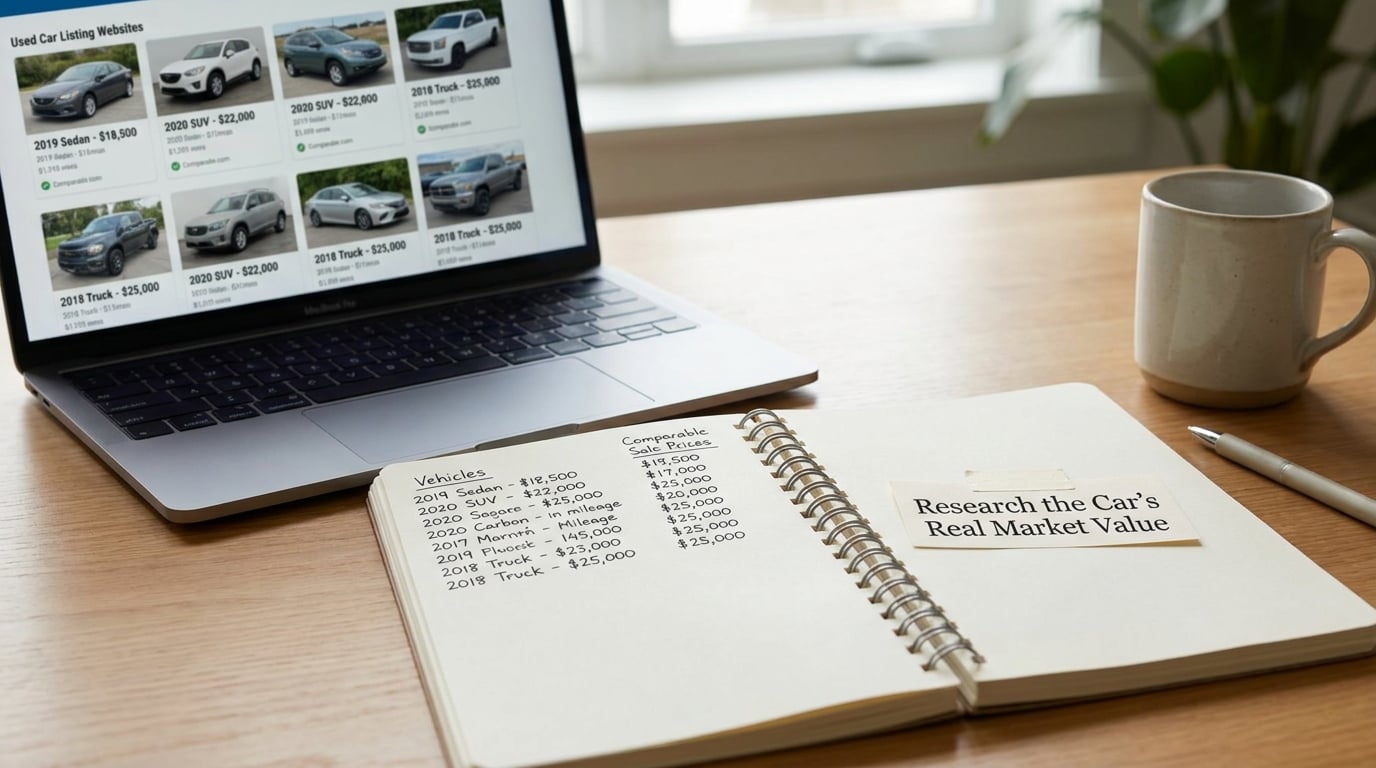
Asking price is a wish, not a value. Your job is to find what the same car actually sells for, and the differences between listings are where the real work is.
Match on year, trim, drivetrain, mileage band, and options. Then normalize the gaps. A car with 20,000 fewer miles, a clean history, and one previous owner is worth more than the same badge with a stack of service records missing. Paint damage, a missing feature, or a tire set at the end of its life is worth less. Apply those adjustments to the comps and you get a defensible range instead of a single meaningless number.
Location matters too. A vehicle priced in a high-cost metro area is not the same market as one three states away, and shipping or flying to collect it changes the math. If you are willing to travel, add that trip cost to your all-in number before you decide the price is wrong.
3. Gather Vehicle Facts and Build an Offer Range
Ask for the VIN and pull the history report yourself rather than trusting a summary in the listing. Then collect the rest: title status, number of owners, service records, accident disclosures, open recalls, and the date the car was listed for sale.
Every documented item becomes a line in your offer. Service gaps and skipped timing intervals are real money. Accident repairs without a full repair record are a bigger number, because you are buying uncertainty. An unrepaired safety recall is not a discount at all, it is a reason to leave.
With that evidence in hand, set three figures: a low opening offer, a realistic target, and your walk-away number. For a car priced at market with clean records, open around 7 to 10 percent below asking and expect to land in the 3 to 8 percent range. Forum regulars on r/carquestions often open more conservatively, nearer 2 to 3 percent, and that works too because used margins are thinner than new ones.
A lowball is not a bold opening offer. A lowball is a number with no reason attached, low enough that the seller stops treating you as a serious buyer.
4. Arrange an Independent Inspection
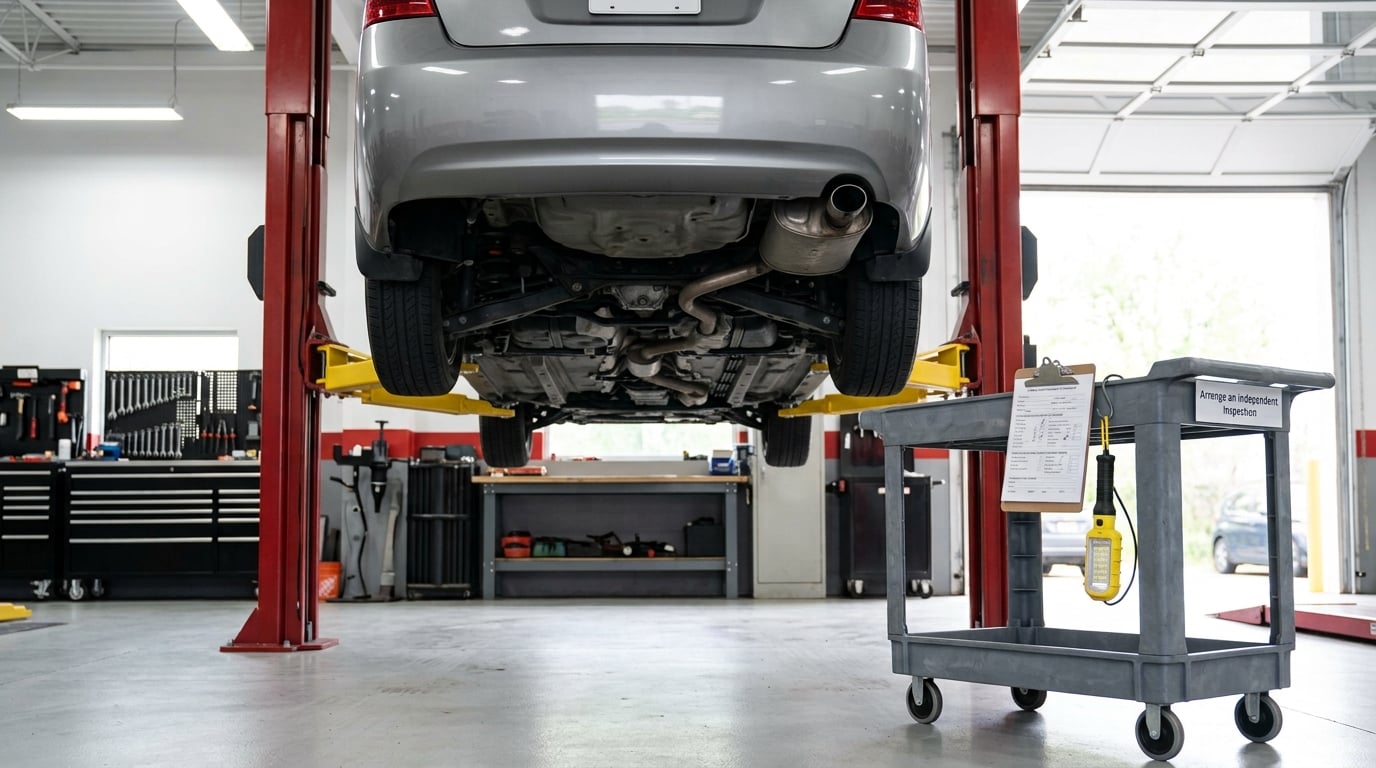
Ask the seller for the car for an hour or two and pay for the inspection yourself. A mobile mechanic will come to a private listing, a driveway, or the lot, which removes the most common excuse for skipping it.
Use a shop the seller does not control, and ask for a written estimate rather than a verbal summary. When you sit down to negotiate, a line item on a shop’s letterhead is worth hundreds of dollars of argument. A cooling system that needs work, worn brake rotors, or a set of tires at the end of their life are all straightforward price adjustments.
Two things to keep in mind. The inspection is not a substitute for a test drive, because a car that starts, steers, and stops can still be a car you will not enjoy owning. And a refusal to allow an independent inspection is itself a finding, whether or not the seller gives a reason for it.
5. How to Negotiate a Used Car Price Below Your Maximum
Make the offer as a statement of fact, not a request. Something like this works: based on the local comps I pulled, similar cars with this mileage are going for 14,200 to 14,600, and the history report and inspection add roughly 600 in work, so I am at 13,400 today and I can close this afternoon.
Three rules make that land. Anchor below your own ceiling, not near it, because your ceiling is information you are protecting. Give the reasons in the same breath as the number, so the number is a conclusion rather than an insult. Then stop talking. Silence after an offer is uncomfortable for both people and it is where the real move happens.
Keep repair estimates in their own column. If the mechanic says the brakes need 900 dollars, that is a reduction in what the car is worth, not a negotiating tactic to be added on top of a lowball.
Whatever you agree, convert the whole deal to a single out-the-door number and check the math yourself:
| Line item | Typical range | Who controls it |
|---|---|---|
| Selling price of the vehicle | Your negotiated number | Negotiable |
| Documentation fee | A few hundred dollars, varies by state | Often fixed, sometimes waived |
| Dealer prep or market adjustment fee | A few hundred dollars | Push back, sometimes negotiable |
| Sales tax | Set by your state | Not negotiable |
| Title and registration | Set by your state | Not negotiable |
| Add-ons and protection products | Zero if you decline them | Decline every one |
| Final out-the-door number | The only figure that matters | Write it on the buyer’s order |
That last row is the whole ballgame. A discount that quietly reappears as a fee has not happened.
6. Respond to the Seller’s Counteroffer
When an offer comes back, resist the urge to meet it in the middle by reflex. Ask what they will do on a specific number, and let silence do the work. If they ask for a manager, that usually means the first price was never the last one; managers hold a pre-approved floor that salespeople are not allowed to cross. It is often theater, sometimes it is real, and you cannot tell which, so treat the manager’s number as the seller’s real number.
| What you will hear | What you say back |
|---|---|
| “Let me check with my manager.” | “Please do. I am at 14,900 out the door today, and if that does not work I will keep looking.” |
| “That price is already discounted.” | “I see the discount. The comps in my area are lower, and the inspection estimate covers the difference.” |
| “What is your budget?” | “What is your best out-the-door number for this car today?” |
| “I can approve that only if you trade today.” | “Then I will price this car on its own, and we can look at my trade separately.” |
| “Let me improve the rate for you.” | “I already have approval at a lower rate, so let us put that on the out-the-door number instead.” |
Make at most two additional moves, each smaller than the last, and each tied to a reason. Then decide whether the remaining gap is worth another round or whether the car is simply not that car for you. A deposit can hold a deal while you arrange a loan, but keep it small and written, and never before an inspection.
7. Close the Deal or Walk Away
Put the agreed out-the-door number in writing on the buyer’s order before any other conversation begins. That document should show the selling price, each fee, tax, title, and registration, with anything you declined struck through rather than quietly removed. The purchase agreement is the version that governs once you are signing.
For a private sale, the same principle applies with a bill of sale: VIN, odometer reading, agreed price, and a clear statement that the car is sold as is. Verify the VIN on the car matches the VIN on the title, confirm the title is clean of liens, and check the seller is the titled owner or has a power of attorney. States have their own odometer disclosure and title transfer rules, so check yours before signing.
Then pay the way you agreed, take every document, and confirm the plates and registration process. Walk away if the car does not match the agreement, if the paperwork gets vague, or if the seller invents new pressure at the last minute. Those are not small details, and no car is worth a title problem.
Common Mistakes When Negotiating a Used Car Price
Most lost money in this process is not lost to a clever dealer. It is lost to habits that feel reasonable in the moment.
- Answering “what is your budget?” The question is an opening move, and the number you give becomes the seller’s target. Redirect every time with a request for their best out-the-door figure.
- Negotiating before researching. Without comps you are guessing, and a guess is easy to dismiss. Ten minutes of listings changes your posture entirely.
- Talking about the monthly payment first. A payment conversation hides the price and lets longer terms and higher rates substitute for a real discount. The TalkBass forum consensus is blunt about this: negotiate the price of the car, not the payment.
- Mixing the trade-in into the price. A soft trade-in number is the easiest place for a discount to hide. Negotiate the price first, and get competing trade quotes from two national buyers before you mention your car at all.
- Skipping the inspection to save a day. A few hundred dollars spent at a shop regularly finds several times that much, and it is the only finding a seller cannot argue with.
- Letting the day decide. End-of-month inventory pressure is real, and so is the feeling that you must close today. That is exactly the feeling a seller is counting on.
- Deciding you must have this car. The alternative to a bad deal is another weekend of searching, and the search is almost always cheaper than the deal you are trying to rescue.
One more deserves its own mention: assuming there is nothing to negotiate. Curbside Classic hobbyists recommend simply asking whether the seller is flexible before investing an afternoon in a haggle. Fresh listings, rare trims, and sellers who have already priced against the market rarely move. A question costs you one sentence and saves you a wasted trip.
Frequently Asked Questions
Can I negotiate the price when financing through the dealer?
Yes, and the price comes first. Get pre-approved through a credit union or your bank before you go in, then tell the dealer you already have a rate in hand and want the vehicle price settled on its own. If the dealer beats your rate, the savings belongs in the out-the-door number, not the monthly payment. Watch the loan term as well, since a lower rate stretched across a longer loan can cost more in total.
How low should I make my first used-car offer?
Open about 7 to 10 percent below the asking price when the car is priced at market and the history report is clean. When accident repairs, service gaps, or heavy mileage are documented, price those at real repair cost and take them off your target first. Forum regulars on r/carquestions often open closer to 2 to 3 percent off, since used margins are thin. Anchoring a little low costs nothing when the reasons are documented.
Should I negotiate before or after a pre-purchase inspection?
Get the inspection before making a firm offer. The written estimate turns vague concerns into priced items, and a shop’s number is much harder to argue with than your own guess. Ask the seller for the car for an hour or two and pay for the inspection yourself. A refusal to allow an independent inspection is itself a useful finding about what the car may be hiding.
Can my trade-in lower the price of the car I am buying?
Sometimes, but keep the two conversations separate. Negotiate the purchase price as though you are not trading anything, then treat the trade-in as its own deal with a written offer from a competing buyer. Mixing them lets the seller hide a discount inside a soft trade-in number and slows the price discussion down. Get instant trade quotes from two national chains before you walk in, and decline if their number falls short.
Is it reasonable to ask a dealer to reduce the price after an inspection?
Yes, as long as you bring a finding and a number. Hand over the written estimate and ask what the dealer will do about it instead of guessing at a discount yourself. Cosmetic issues, brake and rotor work, tires, and an upcoming service are all fair to price. Structural rust, accident damage to a unibody rail, or a drivetrain concern are different conversations and may end the deal. Any agreed credit belongs on the buyer’s order.
Should I give a deposit to lock in a used-car price?
Only in writing, and only after the car checks out. A small deposit that holds the vehicle for 24 hours is reasonable while you arrange a loan or a transfer. Avoid handing over a large cash deposit before the inspection and before the title status is verified. Make the deposit refundable if the mechanic finds something serious, and confirm the agreed out-the-door number in the same document.
Conclusion: Make Your Next Move With Confidence
Learning how to negotiate a used car price comes down to four things: know the market before you speak, let a history report and an inspection turn problems into numbers, settle the vehicle price on its own, and put the total out-the-door figure in writing.
Start with the research today. Pull the listings, order the report, book the shop, and get financing approved. Then make one reason-based offer below your ceiling, and be honest about the number that ends the conversation.