
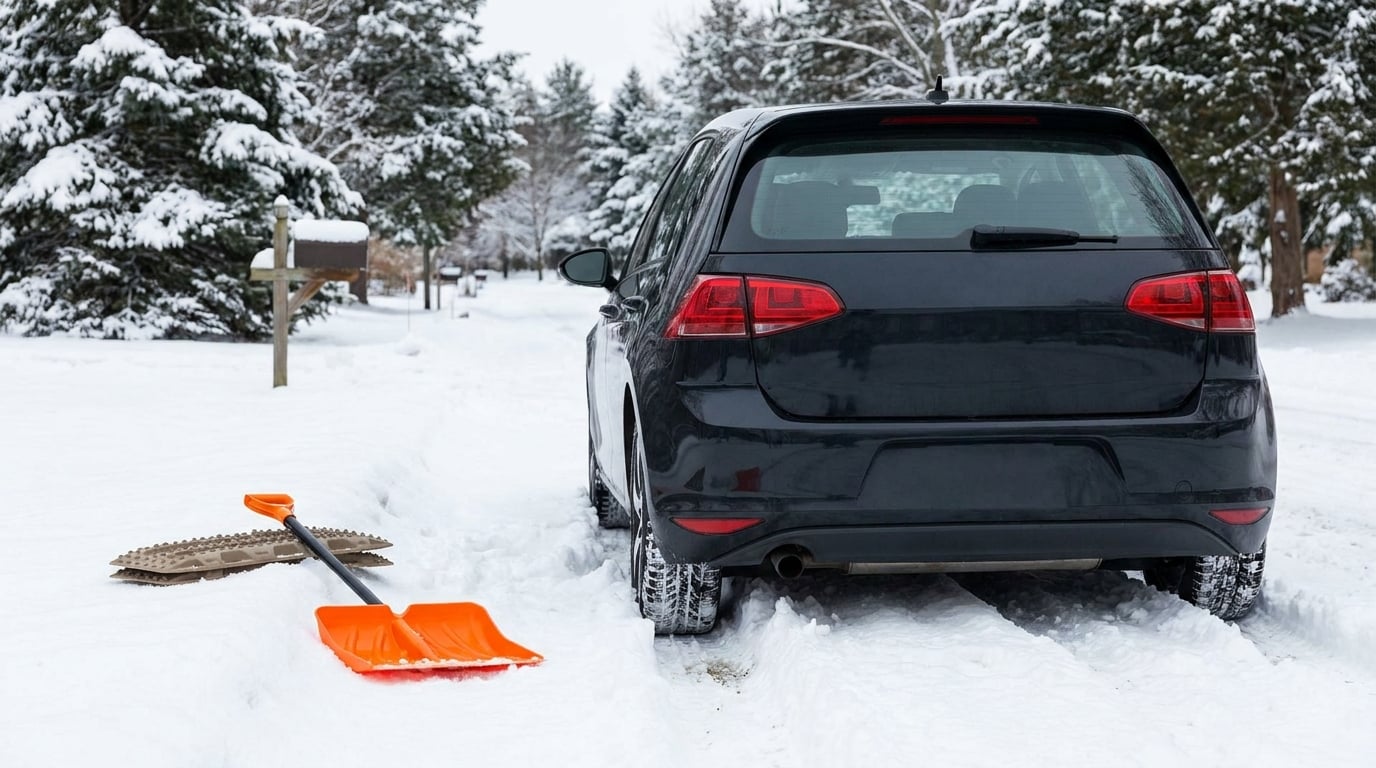
To get unstuck from snow, clear packed snow from around and under all four tires, dig a clean path several feet ahead of the car, put high-friction material under the drive wheels, then use slow, steady throttle in first gear and reverse to build momentum. Digging is the part that works. Spinning the wheels is the part that traps you.
Nobody enjoys getting bogged down, and a lot of drivers assume it means they drove badly. It usually means soft fresh snow, a short driveway, and one spin of the tires. A few careful minutes fixes most of it.
This guide was checked for 2026 and follows your owner’s manual where it matters. Rules, lighting kits, and recovery ratings vary by vehicle, so check yours before you rely on any control mentioned here.
Table of Contents
What You Need
Before you touch the throttle, take stock of the vehicle, the tools you have, and the road under it. Five minutes here saves a wrecked transmission.
Know which wheels drive the car. Front-wheel drive puts power to the front tires, rear-wheel drive to the rear, and AWD or 4WD to all four. Digging traction material under the wrong axle is the most common wasted effort in a driveway.
Check the tires, not just the tread depth. Cold pressure drops in winter, and a hard tire floats over packed snow. Sidewall cuts and bulges from earlier impacts matter too. If you want to understand how tread design bites into snow, what tire siping does for snow and ice grip is worth a read before winter.
Do not count on AWD to rescue you. AWD sends torque to all four wheels, so if two of them spin in the air, the other two get very little. Owners on r/subaru keep pointing out that ground clearance and tire choice decide more failures than drivetrain badges do.
Have on hand:
- A plastic-edge snow shovel, a stiff snow brush, and an ice scraper or plastic scraper
- Traction material: coarse sand, gravel, non-clumping cat litter, or traction boards
- Gloves, a blanket, a phone charger, water, and a warm layer
- A rated tow strap with a working rating, plus roadside assistance details
Check the conditions outside. Road forecasts, plowing status, and the time of day tell you whether a help call will be answered quickly. Tell somebody your location and plan before you start digging, and store the kit indoors where it stays usable. If your garage is where you keep it, keeping a garage from freezing in winter covers the other half of that problem.
Step-by-Step: How to Get Unstuck from Snow
Work in order. Each step removes one reason the tires cannot grip, and skipping ahead just buries the car deeper. You will know a step worked when the wheel stops spinning and the car actually moves.
1. Confirm the car is safe and assess the snow
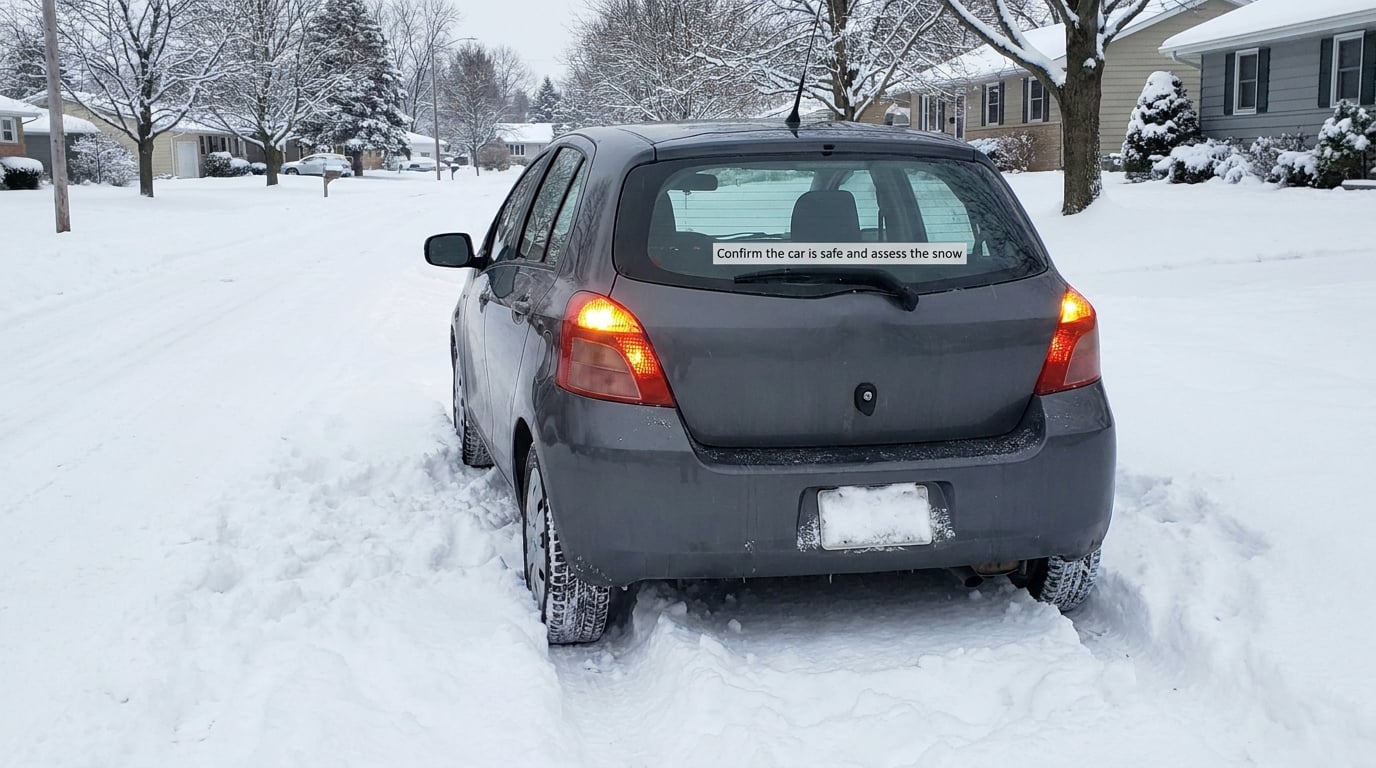
Turn on your hazards so other drivers see you, and check traffic in both directions before you open a door. Look at the slope: on a hill, the danger is not being stuck but rolling back into traffic or into water.
Then look at the snow itself. Fresh powder 6 to 10 inches deep is usually forgiving. Gray, gritty, compacted snow that breaks apart in blocks behaves more like concrete, and that is where most failed attempts end. Feel under the snow for a hard layer: if there is ice on the road surface, you are dealing with grip, not depth.
Check where the weight sits. A car buried to the axle, sitting nose-up on a drift, or high-centered in a rut will not free itself no matter how much you dig. Look for visible damage too, particularly a hanging bumper, a cracked lamp housing, or a wheel that sits crooked.
Before you start the engine, clear the tailpipe completely. A snow-blocked exhaust can push carbon monoxide into the cabin. Take two minutes to dig the pipe and the area around it clear, every time, even if you think the car idled outside yesterday.
2. Clear the wheels and create traction
Dig out around each tire, especially the wheel well, and clear everything from under the car between the wheels. Packed snow packed into a wheel well can hold a tire off the ground even when the rest of the car is free.
Then dig an exit path straight ahead of the car, at least 10 to 15 feet long and wider than the vehicle. A short path means you clear it again halfway out, with the wheels at an angle where they dig in hardest.
Put traction material under the drive wheels, about 2 feet long per wheel, and keep the engine off while you place it. A few owners on r/self swear by cutting an old carpet mat or trunk liner into 2-by-2-foot squares and shoving those under the tire. It is free, it stays in your garage, and it works surprisingly often.
Two cautions. Do not dig a bowl under the tire; you are building a trap. And keep a full shovel-width of clearance in front of each wheel so the car can pull straight rather than at an angle.
3. Use the correct gear and gentle momentum
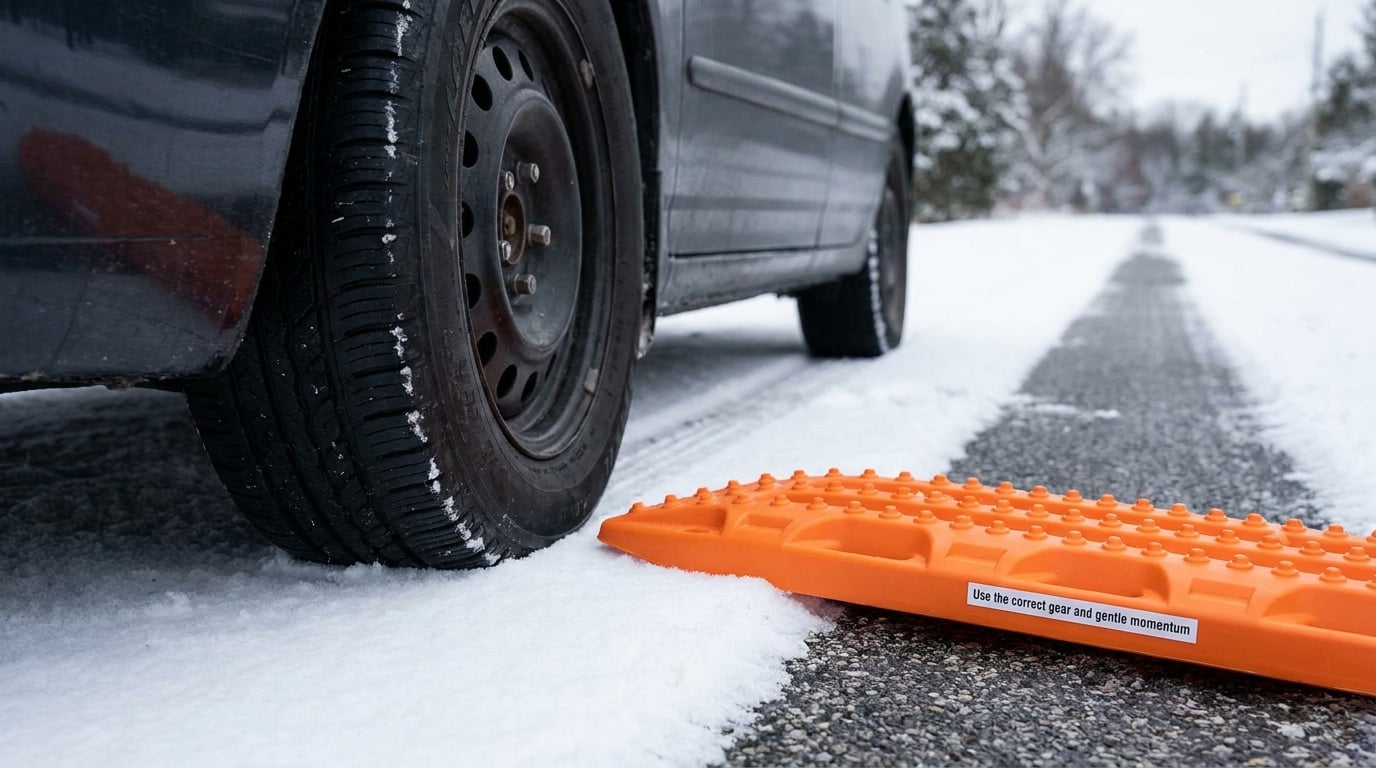
Wheel position first. For a straight path out, wheels straight ahead, not turned. Turning them locks the vehicle in a shallow arc and adds resistance; only turn them lock-to-lock when you are genuinely aiming out sideways.
On an automatic, your foot stays on the brake and the shifter alternates between D and R. On a manual, clutch in, first gear forward or reverse, feather the throttle, and let the clutch feed in gently. Either way, the throttle is a light, steady press, never a floorboard stomp.
Watch the tire, not the mirror. A few rotations with the wheels gripping means the car is climbing out. Continuous roaring with no movement means the tire is spinning and cutting a new rut, so back off immediately.
Leave traction control on in most cases. The system cuts torque when it detects wheel spin and redirects it to a wheel with grip, which is exactly what you want on a mixed surface. Turn it off only if the light comes on, power drops to nothing instantly, and every attempt fails the same way. Truck owners, and the r/4Runner crowd, converge on the same answer for a serious stuck: low range, diff lock engaged, traction control on.
4. Free the vehicle from a shallow rut or drift
Alternating forward and reverse is the standard move, and moderation is the whole technique. Drive forward a few feet with light throttle, select reverse, back up a few feet, repeat. Keep your hazards on and each pass under about 20 mph.
Take a breath between direction changes so the transmission stops fighting itself. Hammering the shifter every half second is what damages transmissions, not the number of overall attempts.
Stop after five or six cycles if nothing changes. If the car has not moved at all, more of the same will not help. Re-dig the tires and the path, add fresh traction material, or change methods.
5. Recover the vehicle from a deep rut or steep slope
A deeper entrapment calls for different tools. With a second vehicle of similar size, attach a tow strap that has a working load rating well above your car’s weight, to rated recovery points on both vehicles, not to a plastic tow cover or a bumper bolt.
Move the strap so the pull comes from the axle, take the strain slowly, and keep everyone else far away from the taut line. Strap snatch is violent and unforgiving.
On a truck or SUV with a transfer case, low range multiplies torque and slows the wheels for exactly this. A differential lock forces both wheels on an axle to turn together so a spinning wheel cannot eat all the power. Check your owner’s manual for how and when to engage either.
Stop and call for a tow when the car is high-centered, on a bank near water, in a rut deeper than the tire diameter, when the tow strap has no rating, or when a recovery line runs anywhere near bystanders. A tow bill is cheaper than a bent subframe or a car in a creek.
6. Check the car before driving again
Walk around the vehicle before you pull away. Look for cuts or bulges in the sidewalls, chunks of snow or ice packed into the wheel wells, and a slow or flat tire. Rock the vehicle gently to check for loose parts.
Check the underbody for scraping marks, and look underneath for fluid spots. Then confirm the lights work, since packed snow blocks them easily. Brake gently and see how the pedal feels. Brake lines damaged on a hidden ice ridge do not fail gradually.
When you do pull away, keep the first 100 feet slow. Easy throttle, gentle steering, and a long following distance until the tires and brakes warm up and stop throwing slush. Wash road salt off the undercarriage and body once you are home, not before you get there.
Common Mistakes
Almost every stuck car gets stuck twice: once by the snow, once by the driver. Here is what damages a car, and what to do instead.
Standing on the throttle. A spinning tire digs a rut and lowers the car further. The fix is pressure you can feel at the tread, held long enough for the car to move.
Rocking hard and fast. Violent back-and-forth through all gears wears the transmission. The fix is slow cycles with a pause between each direction.
Steering while the wheels dig. Turning the wheel during a stuck attempt makes the tire plow sideways into packed snow. Set the wheel once, then go.
Digging a bowl under the tire. It feels productive and guarantees you sit lower than when you started. Flatten the ground, then dig away from the car.
Hooking a tow strap to a bumper bolt or tow cover. Those are not recovery points, and they can pull the bumper off. Use rated recovery points, and if you cannot identify them, call a tow.
Pouring hot water on frozen ground or the car. It cracks concrete, shatters glass, and melts into a new ice sheet in minutes. Warm water and a scraper work; boiling water does not.
Running the engine with the tailpipe blocked. This is the one that can hurt people. Clear the pipe first, every time.
Standing near spinning wheels. Ice, gravel, and compacted snow come off a spinning tire at highway speed. Keep bystanders behind the car, out of the wheel line, and give them a job well clear of the action.
Frequently Asked Questions
Should I turn off traction control if I’m stuck in snow?
Usually no. Traction control cuts torque when a wheel spins and sends it to a wheel that has grip, which is what you want in mixed snow. Turn it off only if the light comes on, power drops to nothing the instant you touch the throttle, and every attempt fails identically. On a truck, low range plus diff lock with traction control still on is the combination most owners land on.
What to put under tires to get unstuck in snow?
Coarse sand, gravel, non-clumping cat litter, or traction boards all work, and the choice matters less than using them. Put about 2 feet of material under each drive wheel, dig a straight path 10 to 15 feet long first, and keep the engine off while you place it. Carpet offcuts or an old trunk mat cut into squares are a free improvised pad that works surprisingly well.
Does cat litter help with traction in snow?
Yes, but buy non-clumping. Clumping litter bakes into a solid mass under a tire and gives you nothing but extra weight. Rough, non-clumping litter bites into packed snow and ice far better than smooth sand. Many owners keep a jug permanently in the trunk, and for a rear-wheel drive car, litter in the trunk also adds weight over the rear axle.
How do I get my 4WD unstuck?
4WD does not help when two wheels spin. Clear the tires, dig a straight path, add traction under the gripping wheels, then select low range if your transfer case has it. Engage the differential lock so both wheels on an axle turn together, leave traction control on, and feather the throttle. Rock between first gear and reverse slowly, and stop after five or six cycles if nothing moves.
Is it safe to run the engine while stuck in snow?
It is safe only after you clear the tailpipe completely. A blocked exhaust can push carbon monoxide into the cabin through the vents, and the danger is highest in a garage or against a wall. Dig the pipe and the snow around it clear first, leave the vehicle outdoors, keep the tailpipe pointing away from people, and shut the engine off the moment you are not actively working on the car.
When should I call a tow truck instead of digging out?
Call when the car is high-centered on a drift crown, sitting in a rut deeper than the tire diameter, near water or a steep drop, or wedged against a curb or guardrail. Also call if you have no rated recovery points for a strap, if the drive wheels are off the ground, or if a snowbank is packed hard enough that a shovel will not move it. Roadside assistance and many insurance policies cover this, so check before paying cash.
Conclusion
Make the scene safe, clear the tailpipe, then dig. Snow and ice out from around the tires and from under the wheel wells, a straight path 10 to 15 feet long, and traction material under the drive wheels solve most cases in under ten minutes.
After that, it is control, not force. Wheels straight, light throttle, slow cycles between drive and reverse, and traction control left on. If five or six cycles produce no movement, stop digging and call for a tow. Keeping your transmission, differentials, and your wallet intact is a better outcome than another ten minutes of spinning.